


close
Choose Your Site
Global
Social Media
Views: 220 Author: Shengda Publish Time: 2026-08-02 Origin: Site


Content Menu
● What Makes HPMC Grades Different?
>> Medium-Viscosity HPMC Grades
● HPMC Applications by Industry
>> Pharmaceutical Formulations
● How to Choose the Right HPMC Grade
>> Step 1: Identify the main performance target
>> Step 2: Match the viscosity range
>> Step 3: Test under actual production conditions
>> Step 4: Adjust dosage if needed
● Practical Selection Guide for Common Uses
● Common Problems and Solutions
● Why Grade Consistency Matters
● HPMC in Modern Formulation Development
● FAQ
>> What are the main differences between HPMC grades?
>> Which HPMC grade is best for tile adhesive?
>> Why is HPMC used in wall putty?
>> Can one HPMC grade be used in both construction and personal care?
>> What should buyers check before choosing an HPMC supplier?
Hydroxypropyl Methyl Cellulose is a water-soluble, non-ionic polymer derived from cellulose. It is widely used because it can modify viscosity, improve water retention, support film formation, and enhance the overall handling of many different formulations.
Although HPMC is often discussed as a single ingredient, it is actually a family of grades with different physical and performance characteristics. These differences matter in real applications. A grade that works well in tile adhesive may not be suitable for tablet coating or shampoo formulation. For that reason, understanding the relationship between HPMC grades and their applications is a practical necessity for formulators, distributors, and manufacturers.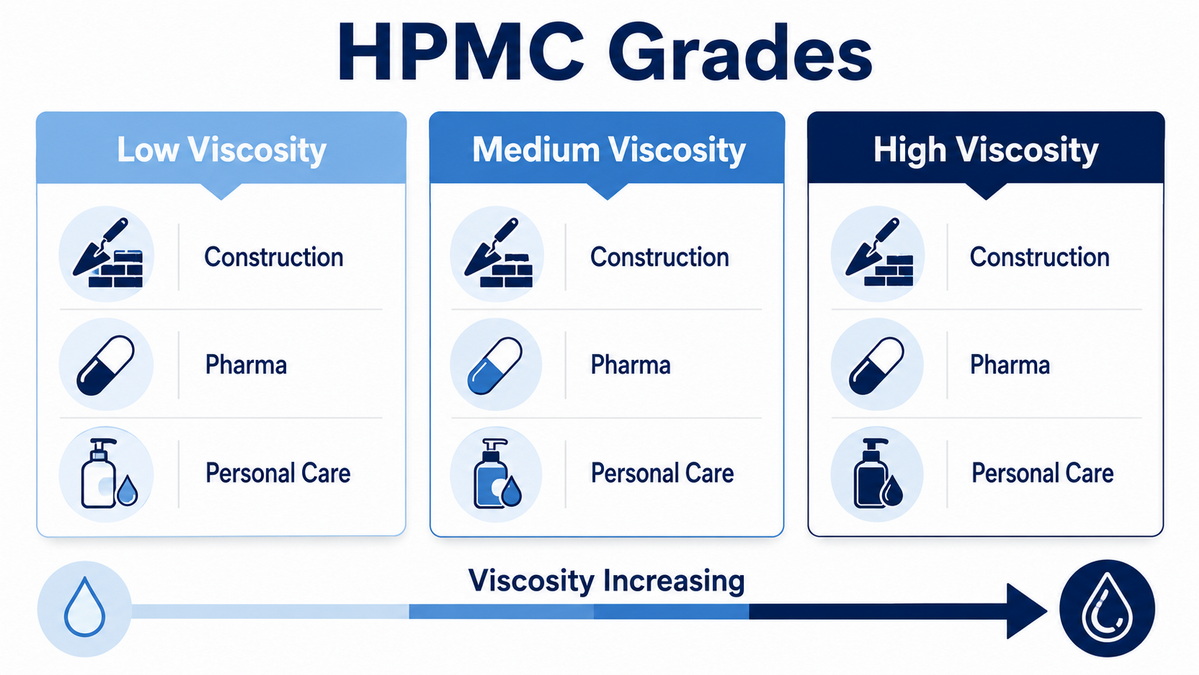
HPMC grades are mainly differentiated by several technical factors:
- Viscosity
- Degree of substitution
- Particle size
- Dissolution behavior
- Surface treatment
- Application-specific performance
Among these, viscosity is usually the first parameter used to classify HPMC. In general, lower-viscosity grades are easier to dissolve and process, while higher-viscosity grades provide stronger thickening and water retention effects.
The correct grade must be chosen according to the final formulation goal. In other words, the best HPMC is not simply the one with the highest viscosity, but the one that performs best in the intended system.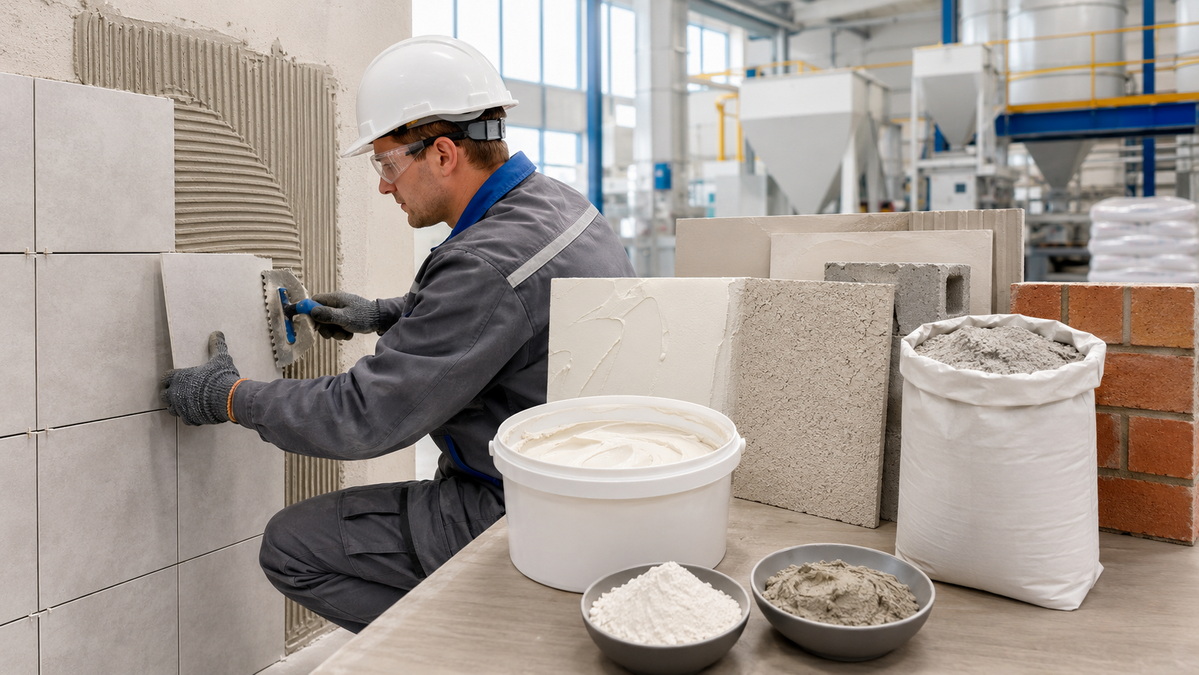
Low-viscosity HPMC grades are used when fast dispersion, light thickening, and smooth processing are required. They are especially useful in systems where the formulation must remain fluid while still gaining stability or film-forming ability.
Typical applications include:
- Tablet coating
- Film-forming systems
- Liquid and semi-liquid formulations
- Stabilizing systems
- Some personal care products
These grades are often chosen when the manufacturer needs a balance between processability and functional performance. They are particularly valuable in formulations that require quick hydration and uniform mixing.
Medium-viscosity HPMC grades offer a balanced performance profile. They are widely used when the formulation needs enough body and stability without becoming too thick or difficult to process.
Typical applications include:
- General-purpose adhesives
- Wall putty
- Skim coat
- Emulsion stabilization
- Building materials with moderate rheology requirements
- Personal care products that need moderate texture control
These grades are often preferred in systems where application feel, spreadability, and product consistency are equally important.
High-viscosity grades are designed for formulations that require stronger water retention, improved sag resistance, enhanced workability, and longer open time. They are particularly important in dry-mix construction materials.
Typical applications include:
- Tile adhesive
- Cement mortar
- Gypsum plaster
- Wall putty
- Self-leveling compounds
- EIFS systems
- Controlled-release formulations
In construction systems, these grades help improve the performance of the final material under real-world application conditions. They are especially useful when a formulation must remain workable for a longer period while maintaining stability after application.
HPMC is one of the most important additives in construction chemistry. It improves the behavior of cement-based and gypsum-based products by helping with water retention, adhesion, open time, and workability.
Common construction applications include:
- Tile adhesive
- Wall putty
- Skim coat
- Gypsum plaster
- Cement mortar
- Self-leveling compounds
- Exterior insulation and finish systems
In these systems, HPMC helps prevent premature water loss, improves spreadability, reduces cracking risk, and supports more stable application. For tile adhesive, for example, the right grade helps the material stay workable long enough for installation while also providing sufficient anti-slip performance.
In pharmaceutical use, HPMC plays a different but equally important role. It is commonly used as a binder, film former, suspending agent, and controlled-release matrix former.
Common pharmaceutical applications include:
- Tablet coating
- Controlled-release tablets
- Capsule-related systems
- Suspensions
- Oral solid dosage forms
Here, the choice of grade depends on the desired release profile, coating behavior, and processing requirements. Lower-viscosity grades are often used in coating systems, while higher-viscosity grades are used where sustained release or stronger matrix formation is needed.
HPMC is also widely used in personal care formulations because it can improve texture, stability, and sensory feel. It is valued for being non-ionic and compatible with many ingredient systems.
Common personal care applications include:
- Shampoo
- Facial cleanser
- Lotion
- Cream
- Gel
- Toothpaste
In these products, HPMC helps create a smooth texture, improve product consistency, and support suspension of ingredients without making the formula overly sticky or unstable.
Choosing the right grade begins with understanding the end-use requirement. A manufacturer should first define what the formulation must achieve, then match the HPMC grade to that objective.
Ask what the formulation needs most:
- Water retention
- Thickening
- Film formation
- Suspension stability
- Workability
- Adhesion
- Controlled release
- Low viscosity for easier flow, faster dissolution, and light thickening
- Medium viscosity for balanced performance
- High viscosity for stronger body, water retention, and sag resistance
Laboratory performance is important, but real production and application conditions often reveal additional requirements. Temperature, mixing speed, solids content, substrate type, and storage conditions can all affect final performance.
Even the correct grade may require dosage optimization. A small change in concentration can significantly influence viscosity, open time, and workability.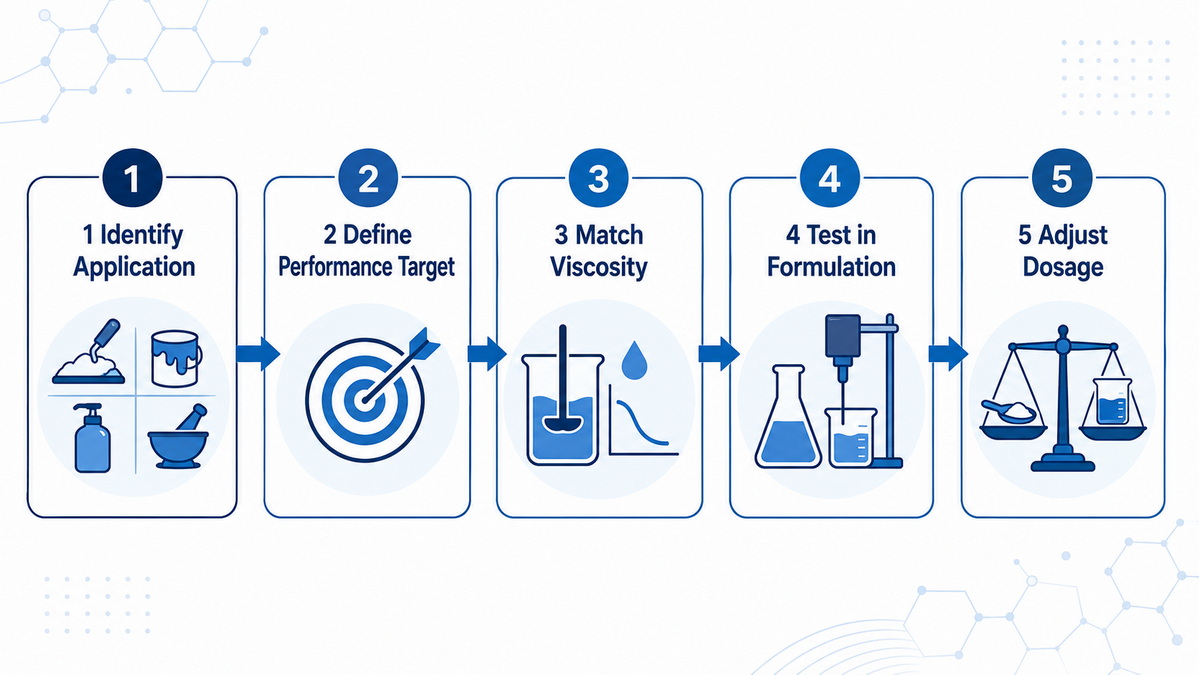
| Application | Main Requirement | Recommended HPMC Grade Type |
|---|---|---|
| Tile adhesive | Open time, adhesion, anti-slip | Medium to high viscosity |
| Wall putty | Smooth application, water retention | Medium to high viscosity |
| Gypsum plaster | Workability, sag resistance | High viscosity |
| Self-leveling compound | Flow control, stability | Low to medium viscosity |
| Tablet coating | Smooth film formation | Low viscosity |
| Controlled-release tablets | Matrix performance | Medium to high viscosity |
| Shampoo and lotion | Texture and stability | Low to medium viscosity |
This table provides a simple starting point, but final selection should always be based on formulation testing and end-use performance.
If a formulation dries too quickly or loses workability too early, the grade may be too low in viscosity or not optimized for water retention.
If tiles slide during application, the formula may need stronger body and better rheology control.
If coating quality is inconsistent, the HPMC grade may not be suitable for the required film properties.
If the product is difficult to mix or disperses poorly, the particle size or dissolution behavior may need to be adjusted.
These issues often come from grade mismatch rather than from the raw material itself. In many cases, better selection solves the problem more effectively than increasing dosage.
For global buyers, consistency is one of the most important concerns. Even when a grade name stays the same, the final performance can change if particle size, moisture content, viscosity range, or manufacturing process varies.
That is why manufacturers and buyers should pay attention not only to the label, but also to:
- Batch-to-batch stability
- Application support
- Technical communication
- Packaging quality
- Storage conditions
- Documentation and testing
A reliable supplier is not only providing a product. It is providing a stable formulation ingredient that supports the final brand experience.
As industries continue to demand better performance and more efficient production, HPMC remains an important functional material in many markets. Construction customers want better water retention and easier application. Pharmaceutical customers want more controlled performance. Personal care customers want improved texture and product feel.
This is why HPMC grades continue to evolve. Suppliers are expected to offer not only standard viscosity options, but also customized solutions designed for specific formulations and operating conditions.
Different HPMC grades have different roles, and the correct choice can significantly influence product quality, processing efficiency, and end-user satisfaction. Whether the application is construction, pharmaceutical, or personal care, the key is to match the technical profile of the grade with the real requirements of the formulation.
For manufacturers, formulators, and distributors, a clear understanding of HPMC grades is the foundation for better product development and more stable performance.
If you are evaluating HPMC for a new formulation or improving an existing one, careful grade selection and technical testing are always worth the effort.
The main differences are viscosity, degree of substitution, particle size, and dissolution behavior. These factors determine how the material performs in different applications.
Medium to high viscosity grades are usually preferred because they improve water retention, open time, and anti-slip performance.
HPMC helps wall putty retain water, improve spreadability, and reduce drying-related issues during application.
Sometimes the same base chemistry may be used in different industries, but the required grade is usually selected according to the final application and performance needs.
Buyers should review product consistency, technical support, documentation, customization capability, and overall supply reliability.
1. LANDU China. "The Ultimate HPMC Grades Breakdown."
[https://landu-china.com/en/different-hpmc-grades-and-their-corresponding-applications/]
2. LANDU China. "Different HPMC Grades and Their Corresponding Applications."
[https://landu-china.com/en/different-hpmc-grades-and-their-corresponding-applications/]
3. PubMed Central. "Hydroxypropyl Methylcellulose—A Key Excipient in Pharmaceutical Applications."
[https://pmc.ncbi.nlm.nih.gov/]
4. PubMed Central. "Updates on applications of low-viscosity grade HPMC."


