


close
Choose Your Site
Global
Social Media
Views: 238 Author: Shengda Publish Time: 2026-09-07 Origin: Site


Content Menu
● Why Viscosity and Pourability Must Be Balanced
● What Is Detergent Grade HEMC?
>> Key Benefits of Detergent Grade HEMC
>> Important HEMC Processing Considerations
>> How Xanthan Gum Changes Detergent Flow
>> Key Benefits of Xanthan Gum
>> Important Xanthan Gum Processing Considerations
● Detergent Grade HEMC vs Xanthan Gum: Key Differences
● Which Thickener Is Better for Different Detergent Products?
>> General-Purpose Surface Cleaner
>> Abrasive and Particle-Containing Cleaners
● Viscosity Is Not the Only Performance Target
● A Practical Evaluation Method for HEMC and Xanthan Gum
>> Step 1: Define the Product Target
>> Step 2: Create a Side-by-Side Trial Matrix
>> Step 3: Test Consumer-Relevant Properties
>> Step 4: Validate Manufacturing Performance
● How Shandong Shengda Supports Detergent Formulation Development
● FAQ
>> What is detergent grade HEMC?
>> Is HEMC better than xanthan gum for liquid detergent?
>> Can xanthan gum make liquid detergent stringy?
>> Can HEMC be used in anionic surfactant systems?
>> How should HEMC be added to a liquid detergent batch?
>> Which thickener is better for a toilet bowl gel?
>> How can detergent manufacturers test pourability?
>> Does high viscosity always mean better detergent quality?
Detergent grade Hydroxyethyl Methyl Cellulose (HEMC) and xanthan gum can both increase the viscosity of liquid detergents, but they produce very different flow behaviors. This article compares their rheology, pourability, suspension performance, processing requirements, and best-fit applications to help detergent manufacturers select the most suitable thickener for stable, consumer-friendly home-care products.
In liquid detergent development, a thickener does much more than make a formula look richer. It affects how the product pours, pumps, spreads, clings to surfaces, suspends ingredients, and performs during filling and storage. The comparison between detergent grade HEMC vs xanthan gum is therefore not simply about which material creates the highest viscosity.
It is about selecting the right rheology modifier for the intended product experience.
A hand dishwashing liquid should feel substantial but still pour easily from a squeeze bottle. A toilet cleaner may need to cling to vertical surfaces. A laundry detergent may need stable viscosity while carrying enzymes, fragrance, optical brighteners, and surfactants. These products can require completely different rheological profiles.
Detergent grade HEMC is a non-ionic cellulose ether that can build smooth, adjustable viscosity in many liquid cleaning systems. Xanthan gum is a fermentation-derived polysaccharide known for strong low-shear viscosity and pronounced shear-thinning behavior.
Both materials can be valuable. The best choice depends on the formula, packaging, production process, target consumer experience, and desired product position.
Viscosity is one of the first attributes consumers notice in a liquid detergent. A product that is too thin may look diluted, weak, or low value. A product that is too thick may be difficult to pour, hard to pump, slow to dispense, or difficult to remove from the bottle.
However, a viscosity number alone does not tell the full story.
Two liquid detergents may show similar viscosity readings in the laboratory but behave differently during consumer use. One may pour in a smooth, controlled stream. The other may stretch, string, cling to the cap, or resist flow until the bottle is squeezed forcefully.
This difference comes from rheology, which describes how a material responds to force, movement, and time.
A well-designed detergent should achieve several goals at once:
- Enough body to communicate quality and concentration
- Smooth pourability from bottles, caps, pumps, or refill packs
- Stable appearance during storage and transport
- Reliable pumping and filling during production
- Good ingredient suspension when pigments, pearls, particles, or capsules are included
- Consistent performance across temperature changes
- Compatibility with surfactants, salts, preservatives, fragrances, solvents, and functional additives
For this reason, a formulator should consider not only apparent viscosity but also yield value, shear-thinning behavior, bottle-emptying performance, and product appearance after storage.
The goal is not to create the thickest detergent. The goal is to create the most functional and consumer-friendly flow behavior.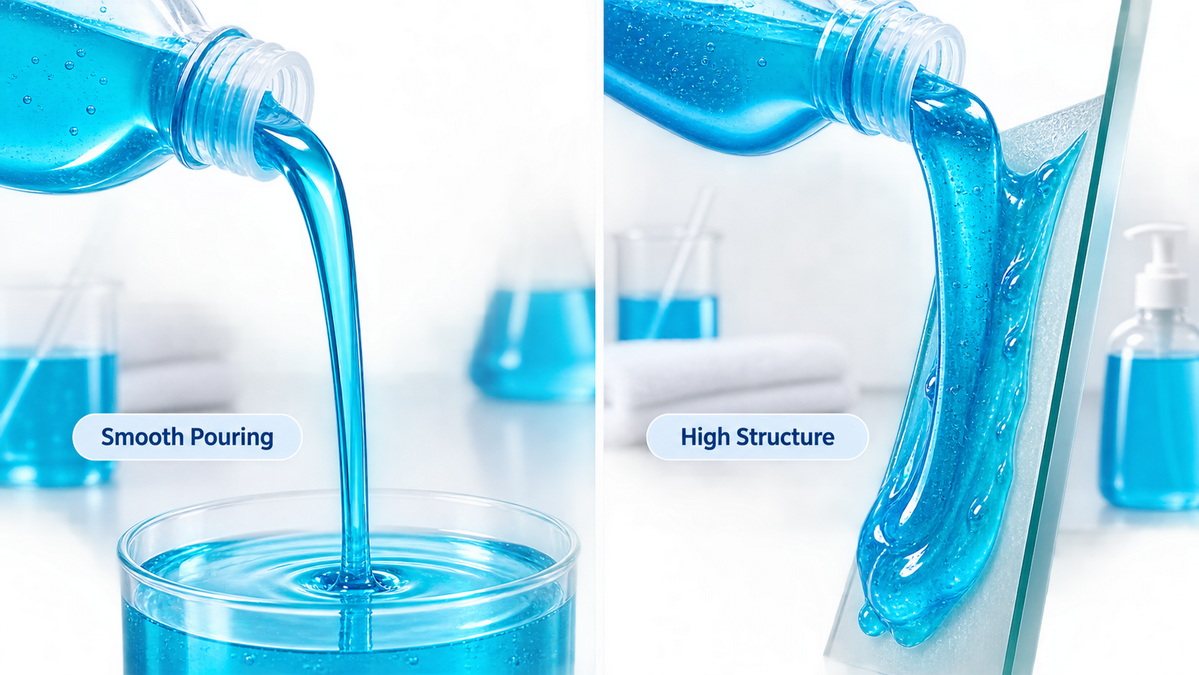
Hydroxyethyl Methyl Cellulose, commonly called HEMC or MHEC, is a water-soluble cellulose ether. It is produced by modifying cellulose with methyl and hydroxyethyl groups, which provide controlled solubility, hydration, and thickening performance.
Detergent grade HEMC is developed for liquid home-care and daily chemical formulations where manufacturers need stable viscosity, a smooth texture, and manageable processing behavior.
As a non-ionic polymer, HEMC can be a practical option for many surfactant-based formulas. Its performance still depends on the total formulation, but its chemistry can provide useful flexibility in mixed surfactant systems.
When HEMC is properly dispersed and hydrated in water, the polymer chains swell and form a network throughout the liquid phase. This network increases resistance to flow and gives the detergent more body.
The final viscosity will depend on several important variables:
- HEMC viscosity grade
- Addition level
- Water temperature
- Mixing speed and mixing time
- Hydration sequence
- Surfactant composition
- Electrolyte concentration
- pH level
- Fragrance and solvent package
- Storage temperature
A low-viscosity HEMC grade may be suitable for products that need easy pumping and a lighter flow. A higher-viscosity grade may support a denser, more luxurious detergent appearance. The correct choice should always be confirmed through formulation trials.
Smooth and controlled flow: HEMC can help create a refined pouring profile without excessive elasticity.
Flexible viscosity design: Different grades can support different detergent formats, from pourable liquids to more structured cleaning products.
Non-ionic character: HEMC may work well in many mixed surfactant systems, subject to full compatibility testing.
Improved product body: It can help thin detergent bases achieve a richer and more premium visual impression.
Useful processing control: With a suitable addition method, HEMC can support repeatable manufacturing and filling performance.
Cellulose-based formulation option: HEMC is derived from cellulose, which can support formulation strategies that prioritize renewable raw-material origins.
HEMC must be added carefully. If powder is introduced too quickly into water, the outer surface can hydrate before the inside is fully wetted. This may form clumps or partially hydrated particles that are difficult to dissolve.
A controlled addition process is important. Manufacturers should determine the most suitable mixing method based on their equipment, batch size, water temperature, and formula sequence.
A practical HEMC processing approach may include:
1. Prepare the water phase with suitable agitation.
2. Add HEMC gradually to avoid rapid surface hydration and powder clumping.
3. Allow adequate time for complete wetting and hydration.
4. Add surfactants and other ingredients according to the validated production sequence.
5. Adjust final viscosity only after the system reaches equilibrium.
6. Test the finished product in its final package.
Xanthan gum is a high-molecular-weight polysaccharide produced through fermentation. It is widely used as a thickener, stabilizer, and suspending agent in food, personal care, industrial, and cleaning formulations.
In detergent systems, xanthan gum is especially recognized for creating high viscosity at low use levels and for developing strong shear-thinning behavior.
Shear-thinning means that the product becomes less viscous when force is applied. For example, a xanthan-thickened cleaner may become easier to pump, brush, spread, or squeeze under movement while remaining thick and stable at rest.
At rest, xanthan gum can create a highly structured network. This can improve the suspension of solids and help the formula remain stable during storage.
When the product is shaken, pumped, poured, brushed, or squeezed, the internal structure can temporarily align and flow more easily. Once the force stops, the structure can rebuild.
This behavior may be especially valuable for products that require cling, suspension, or high stationary viscosity.
Examples include:
- Toilet bowl cleaning gels
- Vertical-surface cleaners
- Abrasive cream cleaners
- Particle-containing formulations
- Thick specialty cleaning gels
- Products designed to remain on a surface before rinsing
High low-shear viscosity: Xanthan gum can create strong body even at relatively low concentrations.
Excellent suspension support: It can help keep insoluble particles, pigments, abrasives, and decorative beads evenly distributed.
Strong shear-thinning: It may flow more easily under pumping or spreading while maintaining a structured appearance at rest.
Useful surface cling: Its rheological behavior can support products that need to remain on vertical surfaces.
Broad application experience: Xanthan gum is used in a wide range of industries and has long been recognized as an effective rheology modifier.
Xanthan gum requires careful dispersion. It can hydrate quickly, and once viscosity begins to rise, it may become harder to disperse remaining powder uniformly.
Poor addition can lead to:
- Powder clumps
- Uneven viscosity
- Long mixing times
- Incomplete hydration
- Air entrapment
- Batch inconsistency
In some liquid detergent formulas, excessive xanthan gum structure can create a texture that feels too elastic, stringy, or gel-like. This may not be suitable for products designed for smooth hand pouring.
| Performance Factor | Detergent Grade HEMC | Xanthan Gum |
|---|---|---|
| Raw material category | Non-ionic cellulose ether | Fermentation-derived polysaccharide |
| Primary thickening style | Smooth and adjustable viscosity | High structure and strong shear-thinning |
| Typical pouring behavior | Controlled, smooth, and less elastic | Can become stringy or ropy at high levels |
| Consumer texture | Refined liquid body | More gel-like or elastic feel |
| Low-shear viscosity | Adjustable through grade and dosage | Often high even at low use levels |
| High-shear flow | Can remain smooth and manageable | Often thins significantly during movement |
| Suspension ability | Moderate to good depending on formulation | Often excellent for suspended solids |
| Surface cling | Suitable for selected structured products | Often highly suitable for cling applications |
| Dispersion requirements | Requires gradual addition and full hydration | Requires controlled addition to prevent rapid thickening |
| Best-fit applications | Pourable detergents, hand washes, smooth liquid cleaners | Toilet gels, abrasive cleaners, cling products, suspensions |
The most important difference is the type of flow behavior each material can create.
HEMC often supports smooth, consumer-friendly pourability.
Xanthan gum often supports stronger stationary structure and surface cling.
Neither material is universally superior. Each one solves a different formulation challenge.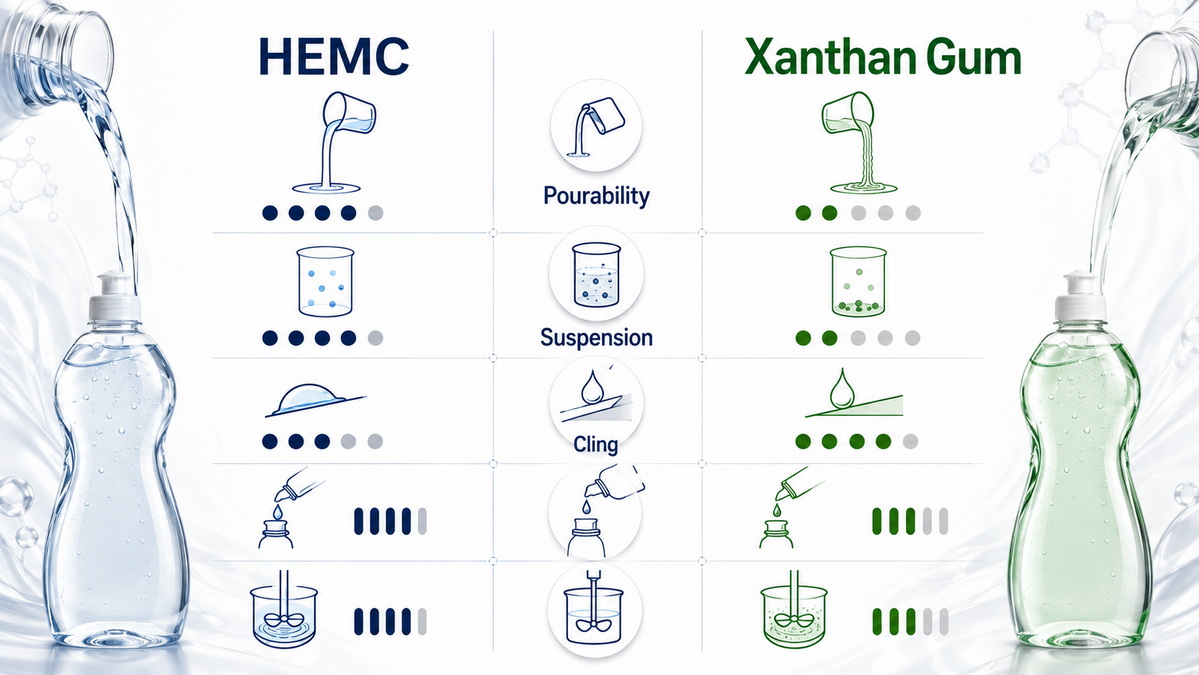
Hand dishwashing liquid should generally have a premium body while remaining easy to squeeze, pour, and rinse from the bottle cap.
For this application, detergent grade HEMC may be a strong option when smooth flow and controlled viscosity are the priority. It can help create a liquid that feels rich without becoming overly elastic.
Xanthan gum may also be evaluated, but a highly structured xanthan system can sometimes create an undesirable stringy flow from the bottle opening.
Laundry detergents often contain complex ingredient systems. These may include surfactants, enzymes, optical brighteners, fragrance, polymers, salts, preservatives, and colorants.
The thickener must be tested in the full formula rather than in water alone.
HEMC may be useful where the desired result is a stable and refined pourable liquid. Xanthan gum may be valuable where suspension performance is critical, especially if the formula contains visible particles or requires high structure during storage.
Toilet bowl cleaners often need to cling to vertical surfaces long enough for cleaning ingredients to work effectively.
Xanthan gum may be well suited to this application because its high yield value can help the formula stay in place. Its shear-thinning behavior can also make it easier to dispense from a squeeze bottle.
For products where a smoother, less elastic flow is preferred, HEMC may still be tested as part of a broader rheology design.
For pourable all-purpose cleaners, the product should be easy to dose and should not feel excessively thick. A very high viscosity can make the product inconvenient, particularly when consumers use trigger sprayers, refill bottles, or dilution systems.
HEMC can offer useful viscosity control for these applications. The right grade and dosage can improve body while preserving practical pouring behavior.
When a cleaner contains abrasive particles, decorative beads, pigments, or other suspended materials, xanthan gum can be especially useful because of its strong suspension capacity.
The formulator should still test whether the product remains easy to dispense and whether the final texture aligns with the intended market position.
A common development mistake is to focus only on achieving a high viscosity reading. This can lead to a formula that looks impressive in a laboratory beaker but performs poorly in a consumer package.
For example, a thickened detergent may show a high viscosity value but still create problems such as:
- Difficult bottle squeezing
- Poor pump output
- Excessive stringing
- Slow filling speed
- Air entrapment during mixing
- Poor bottle emptying
- Unstable viscosity after temperature cycling
- Reduced product clarity
- Inconsistent consumer dosing
The more meaningful goal is functional rheology.
Functional rheology means the detergent has the correct flow behavior during every stage of its life cycle:
- During powder addition
- During mixing
- During transfer to holding tanks
- During filtration
- During filling
- During transport
- During storage
- During consumer dispensing
- During product application
- During final bottle emptying
A formula should be assessed in the package that consumers will actually use. A laboratory jar cannot fully predict the behavior of a pump, flip-top cap, squeeze bottle, refill pouch, or dosing chamber.
A structured comparison can help product developers avoid costly reformulation later.
Before selecting a thickener, clarify the intended consumer experience.
Consider the following questions:
1. Should the detergent pour freely or cling strongly?
2. Will the product be sold in a squeeze bottle, pump bottle, refill pouch, or trigger spray format?
3. Does the formula contain particles, capsules, pigments, or abrasives?
4. Is high clarity required?
5. Does the product need to remain stable at high or low temperatures?
6. Is smooth pouring more important than maximum stationary viscosity?
7. Does the product need to feel like a liquid, gel, or cream?
Prepare comparable prototypes using the same detergent base.
A useful screening plan can include:
- One low-viscosity HEMC grade
- One medium-viscosity HEMC grade
- One high-viscosity HEMC grade
- One xanthan gum sample
- Several addition levels for each material
- A fixed surfactant package
- The same fragrance and preservative system
- Identical storage conditions
This approach helps reveal how each thickener performs in the actual formula rather than in theory.
Do not rely on a single viscosity test. Evaluate multiple properties that reflect real product use.
Key tests may include:
- Low-shear viscosity
- High-shear viscosity
- Yield stress
- Pour time
- Pump output
- Bottle squeeze force
- Stringiness
- Surface cling
- Foam performance
- Product clarity
- Particle suspension
- Temperature stability
- Freeze-thaw stability
- Long-term storage behavior
A detergent formula must be practical to produce at commercial scale.
The production team should review:
- Powder addition speed
- Mixing equipment capability
- Hydration time
- Foam control during mixing
- Batch consistency
- Transfer pump performance
- Filling speed
- Equipment cleaning requirements
- Raw material handling conditions
A thickener that performs well in a laboratory but creates long mixing times or poor filling efficiency may increase total production cost.
Shandong Shengda New Material Co., Ltd. focuses on the research, development, production, and supply of cellulose ether products, including Hydroxyethyl Methyl Cellulose for daily chemical and building material applications.
For liquid detergent manufacturers, selecting a suitable HEMC grade should begin with the full product requirement rather than a generic viscosity target.
Important project information includes:
- Target detergent type
- Required viscosity range
- Desired pouring behavior
- Surfactant system
- Salt concentration
- pH range
- Packaging format
- Storage temperature
- Transparency target
- Manufacturing process
- Target market positioning
A detergent grade HEMC is not simply a thickening powder. It is a rheology-control tool that can influence processing, stability, appearance, consumer dosing, and overall product perception.
Shandong Shengda can support customers in evaluating cellulose ether grades for specific detergent systems. Through focused sample testing and formulation comparison, manufacturers can identify an HEMC solution that better matches their performance and production requirements.
The comparison of detergent grade HEMC vs xanthan gum should begin with the final consumer experience, not with the highest viscosity number.
Detergent grade HEMC can be a valuable solution for brands seeking smooth viscosity, controlled pourability, flexible grade selection, and a refined liquid texture. It is particularly relevant for pourable dishwashing liquids, hand washes, laundry detergents, and general liquid cleaners where elegant flow behavior matters.
Xanthan gum can be highly effective when the formula requires strong stationary structure, particle suspension, pronounced shear-thinning, or vertical surface cling. It may be especially suitable for toilet gels, abrasive cleaners, and specialty products with suspended ingredients.
The right choice depends on the total formula, the package, the production method, and the expected user experience. A carefully designed side-by-side evaluation can reveal whether HEMC, xanthan gum, or a broader rheology strategy provides the most practical and commercially successful result.
If you are developing a new liquid detergent or improving an existing formula, work with a supplier that understands both cellulose ether performance and real manufacturing conditions. Request detergent grade HEMC samples, compare them with your current thickener system, and evaluate the final formula in the intended package before moving into full-scale production.
Detergent grade HEMC is Hydroxyethyl Methyl Cellulose developed for use in liquid cleaning and home-care products. It is a non-ionic cellulose ether that can help modify viscosity, improve product body, and support smooth dispensing behavior.
Neither is automatically better. HEMC is often selected for smooth viscosity and controlled pourability. Xanthan gum is often selected for stronger suspension, higher yield value, and surface-cling performance. The better option depends on the complete formula and intended product format.
Yes. When xanthan gum creates too much structure, the detergent may become stringy, elastic, or rope-like during pouring. This can affect consumer perception, bottle-emptying efficiency, and dosing convenience.
HEMC is non-ionic and may be suitable for many formulas containing anionic surfactants. However, compatibility should always be confirmed through testing because pH, salt level, surfactant type, fragrance, solvents, and other ingredients can affect final performance.
HEMC should be added gradually under suitable agitation. The objective is to wet and disperse the powder evenly before full hydration occurs. The ideal addition sequence depends on the HEMC grade, equipment, water temperature, and detergent formula.
Xanthan gum is often useful for toilet bowl gels because it can provide strong low-shear viscosity and cling to vertical surfaces. HEMC may also be considered when a smoother flow profile or different processing behavior is needed. Full formulation trials are recommended.
Manufacturers can test pourability by measuring pour time, bottle squeeze force, pump output, stream consistency, stringiness, and residual product left in the package. Testing should be conducted in the final bottle, pouch, cap, or pump design.
No. Excessive viscosity can create difficult dispensing, poor bottle emptying, slower filling, and an unpleasant consumer experience. The best product achieves a balance between body, stability, flow, and ease of use.
1. [American Chemical Society — Improving Detergent Performance in Surfactant Products with Xanthan Gum]
2. [Lotte Fine Chemical — Hydroxyethyl Methyl Cellulose (HEMC/MHEC) Overview]
3. [Silverson — How to Disperse Xanthan Gum]
4. [Google Patents — Acidic Cleaning Compositions Containing Xanthan Gum]
5. [ScienceDirect Topics — Cellulose Ether Overview]
6. [Kima Chemical — HEMC for Detergent]
7. [Celotech — Cellulose Ether for Home Care and Detergent Thickening]
8. [MarketsandMarkets — North America Cellulose Ether and Derivatives Market]


