


close
Choose Your Site
Global
Social Media
Views: 222 Author: Shengda Publish Time: 2026-05-24 Origin: Site


Construction HPMC and HEMC both significantly improve vertical slip resistance for large granite tiles, but they do it with slightly different strengths in water retention, rheology, and climate adaptability. By understanding these differences, you can fine‑tune tile adhesive formulations to keep heavy large‑format granite perfectly aligned on walls, even under challenging jobsite conditions. [hnxbntech]
When installing 600×600 mm or larger granite tiles on vertical walls, vertical slip resistance is the ability of the adhesive to hold the tile in place without sagging during and after positioning. Large granite pieces create high dead load, so the tile adhesive must provide enough initial grab and thixotropy to resist gravity before full cement hydration is complete. [kimacellulose]
Key performance risks without optimized cellulose ether:
- Tile "creeping" or sliding a few millimeters after alignment
- Formation of uneven joints and lippage
- Delamination or hollowing due to disturbed adhesive ribs
- Extra need for mechanical support (wedges, spacers, support bars)
For global construction projects, improving slip resistance is not just about passing EN 12004 slip tests; it is a practical productivity and quality issue on every façade, bathroom wall, or commercial lobby with large‑format granite. [celotech]
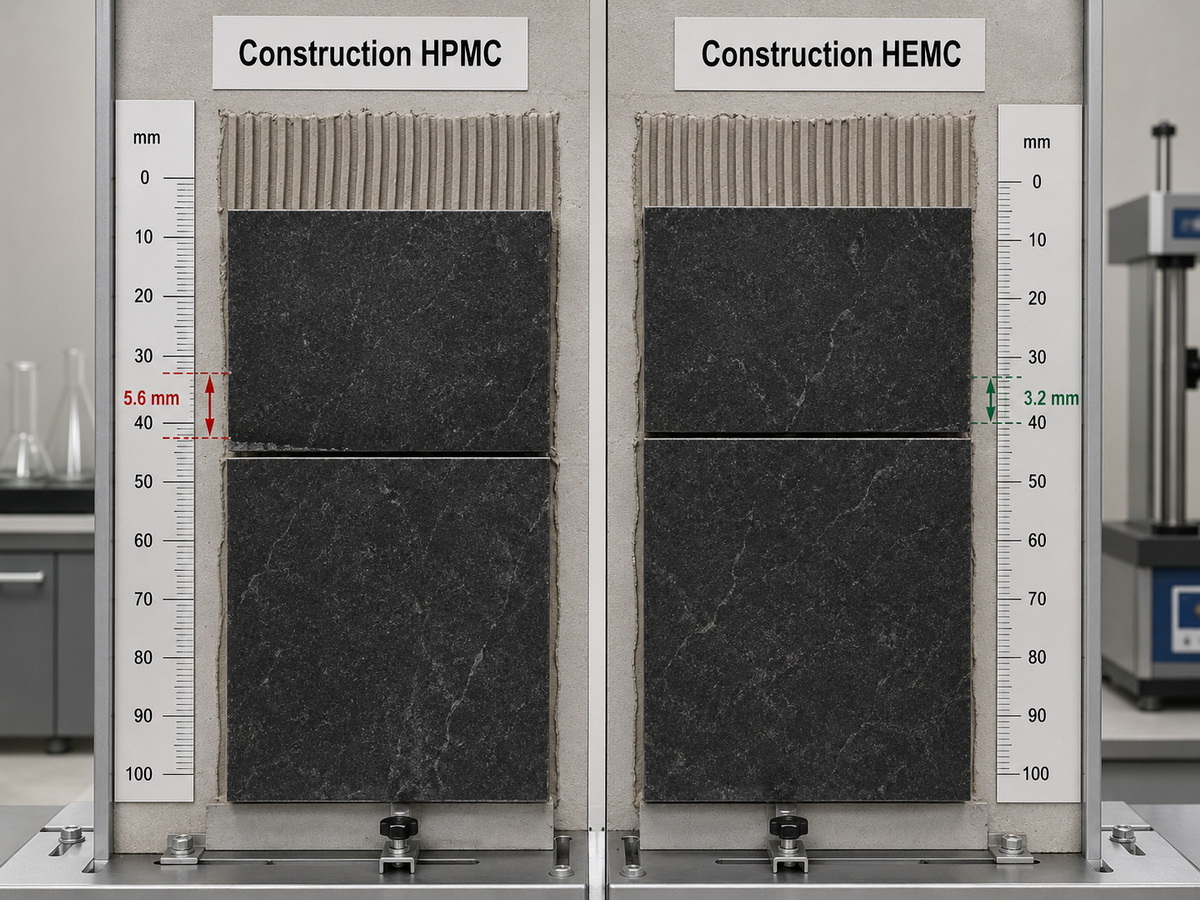
Hydroxypropyl Methyl Cellulose (HPMC) is a non‑ionic cellulose ether used widely in tile adhesive as a high‑performance rheology and water‑retention modifier. In cementitious tile mortars, construction‑grade HPMC provides: [tenessy]
- Strong water retention, keeping the adhesive wet for full cement hydration
- Film formation that bridges between granite and substrate
- Thixotropic behavior: fluid under shear, stiff again at rest [kimacellulose]
From a practical jobsite perspective, the installer experiences HPMC‑modified adhesive as:
- Smoother troweling with stable ridges
- High initial grab when the tile is pressed onto the wall
- Minimal down‑slip after positioning, especially for heavy tiles [celotech]
For large granite tiles, higher‑viscosity HPMC grades or slightly increased dosage are often chosen to maximize sag resistance and vertical stability. However, if viscosity is too high, workability and wetting of low‑porosity granite may suffer, so balancing is critical. [tenessy]
Hydroxyethyl Methyl Cellulose (HEMC, sometimes MHEC) is another non‑ionic cellulose ether widely used in construction mortars, especially where improved workability and climate‑adapted open time are needed. Compared with HPMC at similar viscosity, HEMC often offers: [linkedin]
- Very strong water retention across a wide temperature range
- Excellent open time, supporting large‑format tile adjustment
- Good slip resistance with a slightly "creamier" feel in many formulations [hnxbntech]
Industry discussions and technical articles note that in some construction systems, HEMC can show stronger applicability in harsh climates and can better support vertical stability and workability when humidity and temperature fluctuate. For installers, this means more forgiving mortar in hot, windy, or very humid environments, with consistent performance across seasons. [shengdahpmc]
From a formulation standpoint, both HPMC and HEMC can deliver excellent anti‑slip properties—but they do so with slightly different rheology profiles and climate responses. [linkedin]
Both cellulose ethers improve slip resistance mainly by:
- Increasing viscosity to support tile weight
- Providing thixotropy, so mortar stiffens quickly after tile placement
- Enhancing water retention, which stabilizes the adhesive structure until cement sets [tenessy]
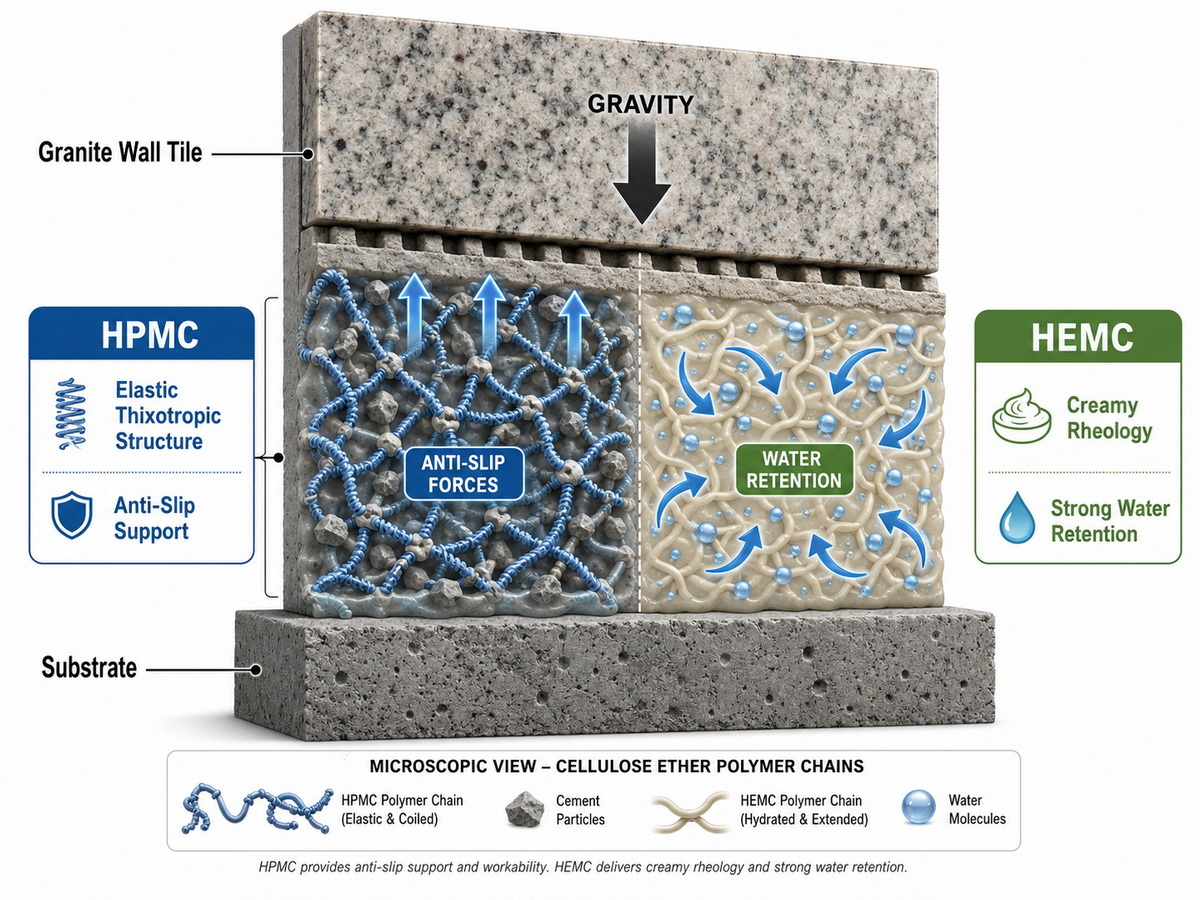
| Aspect | Construction HPMC | Construction HEMC |
|---|---|---|
| Slip resistance potential | Very strong when using high‑viscosity grades; widely proven in tile adhesive. (kimacellulose) | Strong, especially in formulations optimized for hot or humid climates. (hnxbntech) |
| Thixotropy feel | More "elastic" body, fast rebuilding of viscosity at rest. (kimacellulose) | Often creamier, with slightly softer, more lubricated feel. (hnxbntech) |
| Open time | Extended, but extreme heat may shorten it if not well optimized. (kimacellulose) | Often better retained open time under hot or windy conditions. (hnxbntech) |
| Climate adaptability | Very robust; widely used worldwide with adjusted dosage. (kimacellulose) | Particularly favored under challenging climates (high temperature, high humidity, or direct sunlight). (linkedin) |
| Typical use | Standard and high‑performance C1/C2 tile adhesives, including large‑format tiles. (kimacellulose) | Systems requiring climate‑robust open time and smooth workability, including large‑format applications. (hnxbntech) |
In many real‑world projects, blends of HPMC + HEMC are used to fine‑tune slip resistance, open time, and troweling behavior for large granite tiles. [shengdahpmc]
From an expert formulator's perspective, viscosity grade and dosage are the two most powerful levers for vertical slip resistance in large‑format granite tile adhesive. [tenessy]
1. Viscosity grade selection
- Higher viscosity HPMC or HEMC grades increase yield stress and reduce sag.
- Too high a viscosity can reduce wetting on very dense granite and increase mixing difficulty. [kimacellulose]
2. Dosage optimization
- Studies on HPMC show that properly optimized dosage can raise 28‑day tensile bond strength to 1.2–1.5 MPa, a 30–50% increase versus cellulose‑free control, while also improving anti‑slip. [tenessy]
- Excessive dosage, however, can trap air and slightly reduce ultimate strength, so balance is crucial. [celotech]
3. Rheology profile tuning
- For vertical granite applications, you want high yield stress and rapid rebuild after shear to prevent tile creep.
- Combining construction‑grade HPMC and HEMC allows you to fine‑tune this rheology more precisely for different climates and substrates. [shengdahpmc]
This is why working with a cellulose ether partner that offers multiple grades and technical support is essential for engineering reliable anti‑slip performance.
In practice, choosing between HPMC and HEMC is rarely a pure "either/or" decision. For large granite wall tiles, the jobsite environment strongly influences which cellulose ether system is more suitable. [linkedin]
- Hot, dry, or direct‑sun façades
- HEMC often maintains open time and water retention better, supporting easier adjustment of heavy granite panels while preventing premature skinning. [linkedin]
- A blend with HPMC can increase vertical anti‑slip while keeping the climate robustness of HEMC. [shengdahpmc]
- Temperate indoor applications (shopping malls, lobbies)
- HPMC‑based systems already deliver excellent slip resistance and workability, with a long global track record and broad standard compliance. [kimacellulose]
- Very dense substrates (fair‑faced concrete, precast panels)
- Both HPMC and HEMC help maintain moisture at the interface, improving bond and reducing slippage by stabilizing the adhesive layer. [tenessy]
From a specification perspective, describing the climate, substrate, tile size, and expected workability can help the supplier recommend the best HPMC/HEMC grade or blend.
Several industry case reports and technical articles highlight that tile adhesives modified with optimized cellulose ether can significantly reduce slip and rework on vertical installations of heavy tiles. Consider a typical scenario: [tenessy]
- 800×800 mm polished granite tiles on a south‑facing façade
- Summer wall temperatures up to 40–50 °C under direct sunlight
- Cement‑based C2TE adhesive with polymer and cellulose ether
In such conditions:
- A standard HPMC‑only system may lose some open time and become harder to adjust as surface water evaporates quickly. [celotech]
- A formulation that includes HEMC or HEMC‑rich blends maintains more stable open time and workability, while additional HPMC ensures strong anti‑slip rheology. [linkedin]
- Optimized dosage leads to both high initial grab and high final tensile bond strength, reducing callbacks and tile slippage complaints. [tenessy]
This type of climate‑adapted formulation strategy is exactly where expert suppliers add long‑term value for façade contractors.
From both a lab and site perspective, here are practical steps to improve vertical slip resistance with HPMC and HEMC in granite tile adhesives:
1. Define application conditions clearly
- Tile size, weight, and water absorption
- Substrate type and porosity
- Climate profile (temperature, humidity, wind, direct sun)
2. Select cellulose ether system
- Start with a construction‑grade HPMC for baseline slip resistance and rheology. [kimacellulose]
- Introduce HEMC or a blend for projects in harsh climates requiring longer open time and smoother workability. [hnxbntech]
3. Optimize viscosity and dosage
- Choose viscosity levels that provide strong anti‑slip without over‑thickening.
- Adjust dosage stepwise and evaluate vertical slip, open time, and tensile bond strength according to EN 12004 or similar standards. [celotech]
4. Verify performance on mock‑ups
- Conduct vertical slip tests with real granite tiles and typical joint widths.
- Check slip after 20–30 minutes and again after 2–3 hours to simulate real adjustment windows.
5. Document technical parameters
- Record viscosity, substitution type, water retention rate, and set times so that the formulation can be replicated or adapted for other markets.
Shandong Shengda New Material Co., Ltd. is a specialized Chinese manufacturer focused on non‑ionic cellulose ethers, including construction‑grade HPMC and HEMC, with independent R&D and large‑scale production capacity. The company has accumulated expertise in building materials‑grade cellulose ethers, supporting global customers with tailored solutions for tile adhesives, renders, and other dry‑mix mortars. [sdshengda.en.made-in-china]
For large granite tile applications, this means Shengda can:
- Provide multiple viscosity grades of HPMC and HEMC designed specifically for high anti‑slip and stable rheology
- Offer application‑oriented technical support, including recommendations on blends, dosage, and test methods
- Help optimize formulations for both construction‑grade and daily‑chemical grade cellulose ether portfolios, enhancing cost–performance ratios for mortar producers [shengdahpmc]
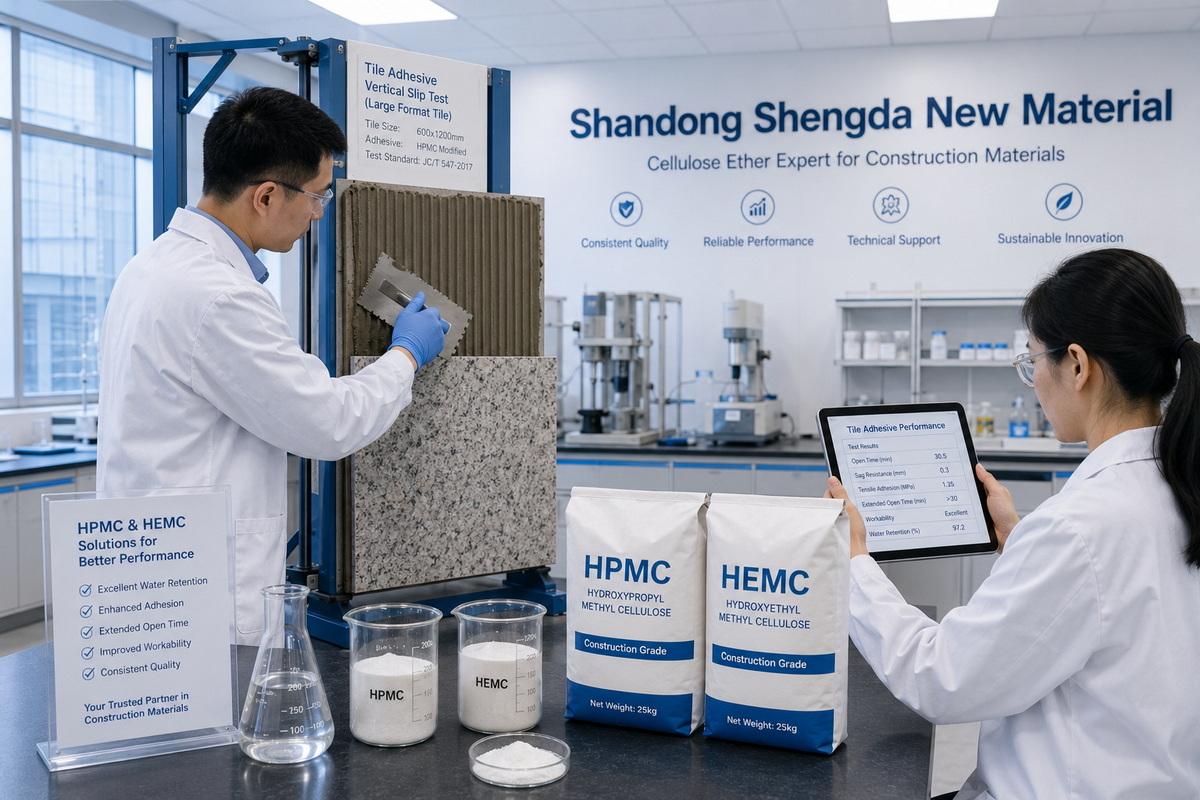
For large granite tiles, choosing between HPMC, HEMC, or blended systems is not only a raw‑material decision—it is a design choice that determines vertical slip resistance, installation speed, and long‑term durability. To develop a stable, high‑performance tile adhesive portfolio for demanding global markets, you can collaborate with a dedicated cellulose ether manufacturer like Shandong Shengda New Material Co., Ltd., who understands both formulation and real jobsite conditions. [linkedin]
If you are formulating or upgrading a granite tile adhesive line, consider sharing your tile size, climate profile, and current mortar composition with Shengda's technical team to receive a tailored HPMC/HEMC recommendation and trial samples.
Yes, construction‑grade HPMC with suitable viscosity and dosage can deliver strong slip resistance and initial grab, and it is already widely used in high‑performance granite tile adhesives. [kimacellulose]
HEMC can be advantageous in hot or highly variable climates where extended open time and consistent workability are critical, while still maintaining good vertical stability. [hnxbntech]
Not always, but blends are often used to fine‑tune rheology, slip resistance, and open time to meet specific regional standards and climatic conditions. [shengdahpmc]
Run standardized slip tests (such as those linked to EN 12004) with real granite tiles, measuring downward movement under defined conditions and times; adjust cellulose ether grade and dosage accordingly. [tenessy]
Share tile size, substrate type, climate conditions, existing formulation, and target standards so the supplier can recommend the most appropriate HPMC/HEMC grade and dosage for your application. [sdshengda.en.made-in-china]
1. Tenessy. "How to Match the Optimal HPMC Based on Tile Types and Construction Environment." [https://tenessy.com/how-to-match-the-optimal-hpmc-based-on-tile-types-and-construction-environment/] [tenessy]
2. VIGANER (HNXBN Tech). "HPMC & HEMC Construction Additives." [https://hnxbntech.com/products/hpmc-hemc] [hnxbntech]
3. Kima Chemical. "HPMC in Building Materials and Tile Adhesives." [https://www.kimacellulose.com/hpmc-in-building-materials-and-tile-adhesives.html] [kimacellulose]
4. Celotech. "Construction Grade HPMC: Benefits in Tile Adhesives & Dry‑Mix Mortars." [https://www.celotech.com/news/advantages-of-hpmc-in-building-materials-and-tile-adhesives/] [celotech]
5. Tenessy. "Mechanism of Action of HPMC in Tile Adhesives and Its Effect on Bonding Performance Enhancement." [https://tenessy.com/mechanism-of-action-of-hpmc-in-tile-adhesives-and-its-effect-on-bonding-performance-enhancement/] [tenessy]
6. Tenessy. "The Impact of HPMC Dosage on the Bonding Strength of Tile Adhesive." [https://tenessy.com/the-impact-of-hpmc-dosage-on-the-bonding-strength-of-tile-adhesive-the-key-role-of-scientific-proportioning/] [tenessy]
7. Shandong Shengda New Material Co., Ltd. Company Profile. Made‑in‑China. [https://sdshengda.en.made-in-china.com] [sdshengda.en.made-in-china]
8. Shandong Shengda New Material Co., Ltd. LinkedIn Profile. [https://www.linkedin.com/company/shandongshengda] [linkedin]
9. Dongyuan Shengda / related group websites on cellulose ether and RDP for construction chemicals. [https://www.dysdfactory.com] [dysdfactory]
10. Shengdahpmc technical article. "The Survival Guide for Tile Adhesives: HEMC Vs. HPMC Performance Comparison Under Direct Sunlight and …" [https://www.shengdahpmc.com] [shengdahpmc]
11. Shengdahpmc product and technical resources page. [https://www.shengdahpmc.com/products.html] [shengdahpmc]
12. LinkedIn article. "HPMC vs HEMC: Which is Better for Your Project?" [https://www.linkedin.com/pulse/hpmc-vs-hemc-which-better-your-project-judy-liu-w7aoc] [linkedin]


