


close
Choose Your Site
Global
Social Media
Views: 259 Author: Shengda Publish Time: 2026-07-06 Origin: Site


Cellulose ethers are among the most versatile functional polymers used in modern industry, and HPMC (Hydroxypropyl Methyl Cellulose) is one of the most important members of this family. For construction, personal care, and pharmaceutical-related formulations, the right cellulose ether can directly improve workability, stability, water retention, film formation, and final product performance. [sciencedirect]

As a manufacturer working with cellulose ether research, development, production, and global supply, we see the same pattern across industries: formulators do not buy cellulose ethers for chemistry alone, but for predictable function. In other words, the real value of cellulose ethers lies in how they control viscosity, water behavior, texture, open time, adhesion, suspension, and product consistency. [sciencedirect]
Among all cellulose ethers, HPMC stands out because it combines thickening, water retention, film-forming, binding, suspending, and protective-colloid properties in one material. That is why it is widely used in construction materials, detergents, coatings, cosmetics, food-related systems, and controlled-release applications. [sciencedirect]
Cellulose ethers are chemically modified derivatives of cellulose, where some hydroxyl groups are replaced by ether substituents. This modification changes the way the polymer interacts with water and other ingredients, making it useful as a functional additive rather than a structural raw material. [sciencedirect]
Different cellulose ethers behave differently, but they all share one important trait: they help formulators improve processability and product performance. In practical terms, they are often selected to solve problems such as poor water retention, weak consistency, fast slump, instability, uneven dispersion, or inadequate film formation. [sciencedirect]
The main functions of cellulose ethers can be grouped into several practical categories:
- Thickening and viscosity control. They increase the internal body of a formula and help it hold shape. [sciencedirect]
- Water retention. They slow water loss, which is especially important in cement-based and mortar systems. [sciencedirect]
- Suspension and stabilization. They help keep solid particles evenly distributed and reduce phase separation. [sciencedirect]
- Film formation. They create smooth, flexible films that improve surface quality and functional performance. [sciencedirect]
- Binding and adhesion. They support cohesion in powder systems and improve interaction between ingredients. [sciencedirect]
- Emulsifying and protective-colloid effects. They support stable dispersions and more uniform product texture. [sciencedirect]
These functions are not abstract. They are the reason cellulose ethers are used in tile adhesives, wall putties, detergents, lotions, tablets, paints, and coatings.
HPMC is a non-ionic cellulose ether with broad industrial use because it balances performance and process flexibility. It is known for water solubility, film-forming ability, viscosity control, and a broad range of grades that allow formulators to tailor performance to specific applications. [sciencedirect]
From a formulation perspective, HPMC is valued because it can help improve:
- open time,
- sag resistance,
- water retention,
- smoothness,
- application feel,
- powder cohesion,
- and surface finish. [sciencedirect]
In construction and daily chemical formulations, this makes HPMC more than just an additive. It becomes a performance manager that influences how the whole system behaves during mixing, application, and drying.
Many readers search for "cellulose ethers" and "HPMC" as if they were competing terms. In reality, the relationship is simpler: HPMC is a type of cellulose ether. [sciencedirect]
The table below clarifies the difference:
| Item | Cellulose Ethers | HPMC |
|---|---|---|
| Definition | A family of modified cellulose derivatives | A specific cellulose ether grade family |
| Scope | Broad category | One of the most widely used members |
| Main function | Thickening, water retention, stabilization, film formation | Same functions, with strong versatility and broad industrial use |
| Typical applications | Construction, personal care, food, pharma, coatings | Especially strong in construction, detergents, coatings, and related systems |
| User decision | Choose by function and application | Choose when balanced viscosity, retention, and film-forming performance are needed |
The key SEO and editorial opportunity here is to explain that users are often not choosing between the two. They are choosing which cellulose ether type best fits their formulation, and HPMC is frequently the starting point.
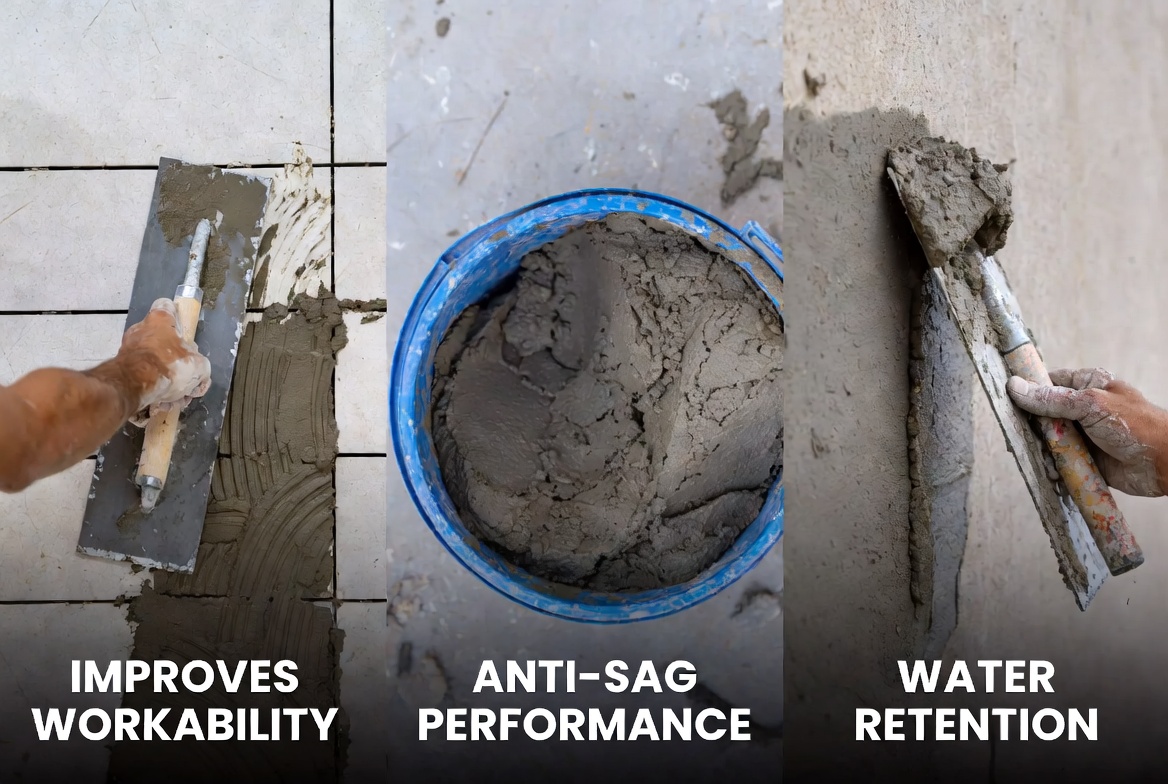
Construction grade HPMC is one of the most commercially important cellulose ethers because it helps cementitious systems perform more reliably. In dry-mix mortar, tile adhesive, skim coat, plaster, and wall putty, water retention and workability are critical. [sciencedirect]
HPMC helps by:
- keeping water available longer for hydration,
- improving application time,
- reducing cracking caused by rapid water loss,
- improving consistency during troweling,
- supporting better bond performance,
- and enhancing anti-sag behavior on vertical surfaces.
For builders and manufacturers, these benefits translate into easier application, fewer defects, and more stable results across changing jobsite conditions.
In daily chemical products, cellulose ethers are used to improve feel, structure, and stability. HPMC can help lotions, creams, gels, shampoos, and cleaning formulations achieve a more uniform texture and more controlled flow. [sciencedirect]
Its function in this segment is often less visible to end users but highly important to formulators:
- it improves product body,
- supports suspension of solids or pearls,
- helps stabilize the formula,
- and contributes to a smoother sensory profile.
For brands, that means better consumer experience and more consistent product quality. For manufacturers, it means easier scaling and less batch variation.
Choosing the right cellulose ether is not only about viscosity. It is about the interaction between raw materials, processing conditions, application method, and final performance target. In our experience, formulators usually evaluate cellulose ethers using four practical questions:
1. What problem must the additive solve?
2. What is the required viscosity range?
3. How will the product be applied or processed?
4. What final performance matters most: water retention, film formation, suspension, or texture?
A high-quality HPMC should deliver consistent performance batch after batch. That consistency is often more valuable than chasing a single headline specification.
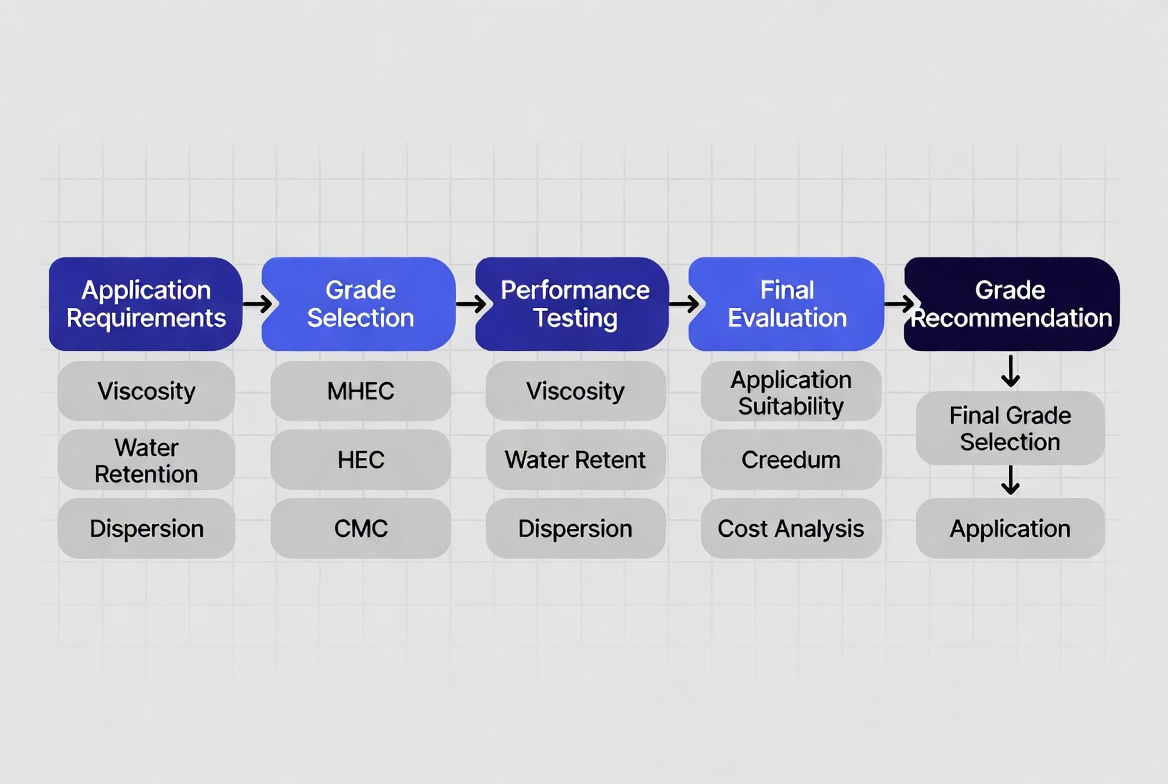
One useful way to evaluate HPMC is to separate functional performance from lab data. Lab data may show viscosity, substitution pattern, or particle behavior, but the actual market decision is usually based on application outcome.
When reviewing HPMC, formulators should ask:
- Does it improve open time enough?
- Does it keep the formula stable under heat or storage?
- Does it disperse quickly?
- Does it work in the real pH and mixing environment?
- Does it maintain performance at scale?
This approach is more useful than comparing numbers alone, because the same viscosity grade can behave differently depending on the system.
The market is increasingly focused on sustainable formulation and reduced waste. Cellulose ethers fit this trend well because they are derived from cellulose and are used in small dosages to create meaningful functional impact. [sciencedirect]
Across industries, formulators are seeking:
- lower material waste,
- improved application efficiency,
- longer product shelf stability,
- and better balance between performance and environmental expectations.
For manufacturers, this means cellulose ether products are no longer just performance additives. They are part of a broader strategy for efficient, responsible, and scalable formulation.
Before choosing a cellulose ether or HPMC grade, use this checklist:
- Define the application first.
- Identify the main functional target.
- Match viscosity to process requirements.
- Confirm water retention and film-forming needs.
- Test in the final formula, not only in a lab standard.
- Compare consistency across batches.
- Review technical support and supply stability.
This simple process reduces trial-and-error and improves the chance of a successful formula launch.
If you want to improve formulation stability, water retention, or application performance, the next step is to evaluate the right HPMC grade for your specific system. A technical consultation and sample-based test can save time, reduce cost, and improve final product quality.
Cellulose ethers are used as thickeners, stabilizers, water-retention agents, binders, suspension aids, and film-forming materials in construction, personal care, coatings, and other industries. [sciencedirect]
Yes. HPMC is a specific type of cellulose ether with broad industrial use and strong performance in viscosity control, water retention, and film formation. [sciencedirect]
It helps improve water retention, workability, open time, anti-sag behavior, and overall application consistency in mortar, tile adhesive, and wall putty systems. [sciencedirect]
Start with your application target, then test viscosity, water retention, dispersion, and final performance in the actual formula rather than relying on a single specification.
Yes. They are widely used in personal care and cleaning formulations to improve texture, stability, flow, and sensory performance. [sciencedirect]
1. Google Search Central. [Creating Helpful, Reliable, People-First Content].
2. PMC Article. [Hydroxypropyl Methylcellulose—A Key Excipient in Pharmaceutical ...].
3. ScienceDirect Topics. [Hydroxypropyl Methylcellulose - an overview].
4. ScienceDirect Article Snippet. [Updates on applications of low-viscosity grade ...].
5. Google Search Central. [Creating Helpful, Reliable, People-First Content].


