


close
Choose Your Site
Global
Social Media
Views: 246 Author: Shengda Publish Time: 2026-09-08 Origin: Site


Content Menu
● What Is Hydroxypropyl Methylcellulose?
● Why HPMC Supplier Selection Matters
>> HPMC Is Not Defined by Viscosity Alone
● Top HPMC Suppliers and Cellulose Ether Brands
>> Shandong Shengda New Material Co., Ltd.
>> Dow and METHOCEL™ Cellulose Ethers
>> Shin-Etsu Chemical and Specialty Cellulose Materials
>> LOTTE Fine Chemical and MECELLOSE™
>> JRS PHARMA and Pharmaceutical HPMC Applications
● How to Choose the Right HPMC Supplier
>> Define Your Application Requirements First
>> Review Technical Specifications Carefully
>> Test HPMC in Your Actual Formula
● Construction-Grade HPMC for Dry-Mix Mortar
>> Water Retention and Cement Hydration
>> Workability and Application Experience
● Daily Chemical HPMC for Detergent and Cleaning Products
>> Key Tests for Detergent-Grade HPMC
● Common Mistakes When Buying HPMC
>> Comparing Only Nominal Viscosity
>> Ignoring Local Raw Materials
>> Using the Wrong Product Grade
● A Practical HPMC Qualification Process
>> What is HPMC mainly used for?
>> Is higher HPMC viscosity always better?
>> How can I compare HPMC suppliers fairly?
>> Can construction-grade HPMC be used in detergent products?
>> What documents should I request from an HPMC manufacturer?
>> Why is water retention important in tile adhesive?
>> What should detergent manufacturers test when using HPMC?
Hydroxypropyl Methylcellulose (HPMC) is a performance-critical cellulose ether used in dry-mix mortar, tile adhesive, wall putty, gypsum products, detergents, and personal-care formulations. This article introduces leading global HPMC suppliers, explains the factors that matter when comparing HPMC grades, and provides a practical supplier-selection framework for manufacturers seeking stable quality, technical compatibility, and dependable long-term supply.
Choosing among the top HPMC suppliers in the world is not only a matter of comparing quotations. For manufacturers of tile adhesive, wall putty, cement mortar, gypsum plaster, liquid detergent, hand wash, and other formulated products, the right Hydroxypropyl Methylcellulose supplier can influence product consistency, water retention, viscosity, workability, production efficiency, and customer satisfaction.
Hydroxypropyl Methylcellulose, commonly known as HPMC or hypromellose, is not a simple interchangeable raw material. Two HPMC products with a similar viscosity label may deliver different results in actual production. Differences in raw materials, manufacturing process, substitution level, particle size, dissolution behavior, moisture content, water retention, and batch consistency can all affect the final application.
For this reason, professional buyers should evaluate an HPMC supplier based on technical capability, product stability, communication efficiency, documentation, testing support, and cost in use—not only on price per ton.
Hydroxypropyl Methylcellulose is a non-ionic cellulose ether derived from natural cellulose. It is widely used as a thickener, water-retention agent, binder, film former, stabilizer, suspending agent, and rheology modifier.
Because HPMC can interact with water and influence formulation rheology, it is valuable in many industrial and consumer-product applications. Its performance depends on the selected grade and the complete formulation system.
HPMC can help improve:
- Water retention in cement-based and gypsum-based dry-mix products
- Open time in tile adhesive and other cementitious mortars
- Workability and smoother spreading in wall putty and skim coat
- Sag resistance in vertical mortar applications
- Viscosity control in detergents and liquid cleaning products
- Suspension stability in liquid formulations
- Film-forming performance in selected industrial and personal-care products
- Batch consistency in finished products
In food-related and regulated applications, Hydroxypropyl Methylcellulose is commonly associated with the designation E 464 or INS 464. However, product suitability should always be confirmed according to the specific grade, intended use, local regulations, documentation requirements, and destination-market standards.
HPMC plays an important role in product performance, especially in systems where water control, rheology, stability, and ease of application are essential.
For example, tile adhesive manufacturers need a balanced HPMC grade that can help maintain workable consistency, support water retention, extend open time, and reduce tile slip. A wall putty producer may require smooth trowelability, good leveling behavior, and stable viscosity. A detergent manufacturer may focus on fast dissolution, clear appearance, viscosity stability, and compatibility with surfactants.
These applications require different performance profiles.
A supplier that understands only viscosity may not be able to provide the right solution. A supplier that understands the full application system can help customers choose an HPMC grade that fits their formulation, raw materials, climate conditions, production equipment, and market requirements.
Many buyers begin their search by requesting a specific viscosity, such as 40,000 cps, 75,000 cps, 100,000 cps, or 200,000 cps. Viscosity is important, but it should not be the only selection criterion.
Two HPMC grades with the same nominal viscosity may differ in:
- Water-retention ability
- Thickening efficiency
- Particle-size distribution
- Surface treatment
- Dissolution speed
- Gel temperature
- Moisture level
- Ash content
- Solution clarity
- Compatibility with other materials
- Stability during storage
- Performance under hot or humid conditions
A well-selected grade can reduce formulation risk, improve finished-product consistency, and lower the overall cost of production.
The international HPMC market includes established multinational companies, specialty cellulose ether producers, pharmaceutical excipient suppliers, and specialized Chinese manufacturers. Each company may have different strengths in construction chemicals, personal care, pharmaceuticals, food, coatings, or industrial applications.
The following companies are commonly recognized in the global cellulose ether industry.
| Supplier / Brand | Main Cellulose Ether Brand or Product Portfolio | Common Application Areas | Buyer Evaluation Focus |
|---|---|---|---|
| Dow | METHOCEL™ cellulose ethers | Construction, coatings, food, pharmaceuticals, personal care, industrial applications | Grade availability, technical support, formulation compatibility |
| Shin-Etsu Chemical | Cellulose-based pharmaceutical and specialty materials | Pharmaceuticals, food, specialty industrial applications | Regulatory documentation, controlled-release performance, consistency |
| LOTTE Fine Chemical | MECELLOSE™ cellulose ethers | Construction, food, cosmetics, pharmaceuticals, industrial products | Construction-grade selection, local technical service, supply reliability |
| Ashland | BENECEL™ methylcellulose and HPMC | Personal care, home care, pharmaceutical, food, specialty formulations | Rheology profile, clarity, sensory properties, compatibility |
| JRS PHARMA | Pharmaceutical excipient portfolio | Tablets, capsules, controlled-release dosage forms | Pharmacopeial compliance, application documentation, dosage-form performance |
| Shandong Shengda New Material Co., Ltd. | Construction-grade and daily-chemical-grade cellulose ether solutions | Tile adhesive, wall putty, mortar, gypsum products, detergent, hand wash, cleaning products | Customized grade selection, sample testing, export support, cost-to-performance balance |
Shandong Shengda New Material Co., Ltd. is a China-based manufacturer specializing in the research, development, production, and sales of cellulose ether products, including Hydroxypropyl Methylcellulose and related non-ionic cellulose ethers.
The company provides construction-grade and daily-chemical-grade cellulose ether solutions for global customers. Its core application areas include tile adhesive, wall putty, skim coat, cement mortar, gypsum-based products, detergent, hand wash, liquid cleaning products, and other formulations requiring viscosity control or water-retention performance.
For international buyers, a specialized manufacturer can offer practical benefits, including:
- Application-oriented product recommendations
- Customized viscosity and performance ranges
- Sample support for laboratory evaluation
- Technical communication for formula adjustment
- Export-oriented packaging and shipment coordination
- Flexible support for construction and daily-chemical applications
- Competitive cost-to-performance solutions for qualified buyers
The most valuable supplier relationship is based on transparent specifications, repeatable quality, and shared testing. Shandong Shengda works with customers to identify suitable HPMC grades according to specific formulation needs rather than relying on a one-size-fits-all approach.
Dow is one of the best-known names in the cellulose ether industry. Its METHOCEL™ product family includes methylcellulose and Hydroxypropyl Methylcellulose products used across a wide range of applications.
These products are associated with functions such as thickening, water retention, film formation, binding, suspension, and rheology control. Dow products are often considered in high-performance construction materials, specialty coatings, food, pharmaceutical, and personal-care applications.
For buyers, the important point is to identify the exact product grade rather than selecting based only on brand recognition. A specific HPMC grade must match the required technical performance in the finished formula.
Shin-Etsu Chemical is widely recognized for cellulose derivatives used in pharmaceutical, food, and specialty applications. The company has a strong presence in technically demanding markets that require consistent quality systems and application-specific material performance.
For pharmaceutical and controlled-release applications, buyers often evaluate factors such as compendial compliance, particle size, release profile, binding performance, and documentation.
Shin-Etsu is especially relevant for buyers that require advanced excipient performance and detailed quality documentation. However, product suitability should always be validated according to the specific dosage form, regulatory market, and manufacturing process.
LOTTE Fine Chemical is associated with the MECELLOSE™ brand of cellulose ethers. Its products are used in construction materials, food, cosmetics, pharmaceuticals, coatings, and industrial formulations.
In construction chemicals, HPMC is widely used to support water retention and improve application behavior. MECELLOSE™ products are often considered for tile adhesive, cement render, skim coat, gypsum plaster, and wall putty applications.
For construction material producers, it is important to test HPMC performance with the actual cement, filler, sand, redispersible polymer powder, and mixing conditions used in production.
Ashland offers BENECEL™ methylcellulose and Hydroxypropyl Methylcellulose products for personal care, home care, pharmaceutical, food, and specialty applications.
In daily chemical and personal-care formulations, HPMC may be used to influence viscosity, texture, suspension, appearance, and product feel. It can be used in selected liquid soaps, body washes, shower gels, facial cleansers, and related products.
For formulators, the key considerations include solution clarity, dissolution behavior, viscosity development, surfactant compatibility, salt sensitivity, and stability during storage.
JRS PHARMA is known for pharmaceutical excipient solutions. In pharmaceutical applications, HPMC can function as a binder, matrix-forming polymer, film former, and controlled-release material.
Pharmaceutical buyers should pay close attention to regulatory documentation, product traceability, pharmacopeial requirements, microbiological standards, and application-specific testing.
Construction-grade or daily-chemical-grade HPMC should never be assumed suitable for pharmaceutical use. Product grade, quality system, documentation, and market-specific regulatory requirements must be evaluated separately.
The best HPMC supplier is not necessarily the largest company or the lowest-cost provider. The right supplier is the one that can repeatedly meet the technical and commercial requirements of your product.
A professional supplier evaluation should include product qualification, application testing, communication assessment, and supply-chain review.
Before requesting samples or quotations, prepare a clear application brief.
Include the following information:
- Finished product type
- Current HPMC grade and dosage
- Target viscosity range
- Required water retention or thickening performance
- Required open time or workability
- Main raw materials used in the formula
- Production process and mixing equipment
- Target market and climate conditions
- Monthly or annual purchasing volume
- Packaging and documentation requirements
For example, a tile adhesive producer should specify whether the product is intended for standard ceramic tile adhesive, large-format tile installation, high-slip-resistance mortar, fast-setting adhesive, or a more flexible polymer-modified system.
A detergent producer should specify the surfactant system, desired viscosity, appearance requirements, pH range, salt content, fragrance load, and storage expectations.
The clearer the product brief, the more accurate the supplier's grade recommendation can be.
A Certificate of Analysis is important, but it should not be the only document reviewed.
Ask for detailed product information covering:
- Nominal viscosity and test method
- Moisture content
- Ash content
- pH value
- Particle-size information
- Surface-treatment information
- Dissolution method
- Water-retention data, where relevant
- Packaging type and net weight
- Shelf life
- Storage recommendations
- Batch traceability
- Safety documentation
- Application guidance
For construction-grade HPMC, water retention, workability, thickening behavior, and open time are often more meaningful than viscosity alone.
For daily-chemical-grade HPMC, buyers should pay particular attention to dissolution speed, clarity, viscosity stability, surfactant compatibility, and storage performance.
Laboratory testing should compare the proposed grade with the existing material under controlled conditions.
Use the same formula, water ratio, mixing sequence, raw materials, and testing temperature whenever possible.
| Test Area | Why It Matters | Recommended Evaluation |
|---|---|---|
| Water retention | Supports mortar performance and hydration conditions | Compare under the same mortar formula |
| Workability | Affects spreading, troweling, and application efficiency | Assess immediately after mixing and after resting |
| Open time | Influences installation time and practical site performance | Test at expected ambient conditions |
| Anti-sag performance | Important for vertical tile adhesive applications | Measure slip or sag under controlled conditions |
| Viscosity stability | Important for liquid detergent and personal-care products | Test after storage intervals |
| Dissolution speed | Influences production efficiency and product appearance | Observe dispersion and hydration behavior |
| Dosage efficiency | Determines true formulation cost | Compare dosage required to reach the target result |
| Batch consistency | Protects long-term product quality | Review several sample or production batches |
A side-by-side test can reveal whether a supplier's HPMC provides equivalent or improved performance at the same dosage, lower dosage, or a different formulation balance.
Construction-grade HPMC is widely used in dry-mix mortar formulations because it can help manage water movement and rheological behavior.
Common applications include:
- Tile adhesive
- Cement-based wall putty
- Skim coat
- Cement render
- Gypsum plaster
- EIFS mortar
- Masonry mortar
- Crack filler
- Self-leveling compounds
- Repair mortar
In cement-based systems, water retention is one of the most important functions of HPMC. Mortar can lose water quickly when applied to porous substrates or exposed to hot, dry, or windy conditions.
A suitable HPMC grade can help retain water in the mortar for a longer period. This can support more consistent cement hydration and improve the practical application window.
However, stronger water retention should not be evaluated in isolation. Excessive thickening or poor workability can make a mortar difficult to mix or apply. The goal is balance.
A high-performing mortar should feel smooth during mixing and application. It should spread evenly, hold its consistency, and remain workable for an appropriate amount of time.
The final application experience depends on multiple materials working together, including:
- Cement type
- Calcium carbonate grade
- Silica sand particle size
- Redispersible polymer powder
- Starch ether
- Defoamer
- Hydrophobic additives
- Water-to-powder ratio
- Mixing process
- Temperature and humidity
For this reason, HPMC should be selected as part of the complete formulation system.
In detergent and daily chemical formulations, HPMC can be used to provide rheology control, thickening, suspension support, and viscosity stability.
Typical applications may include:
- Liquid detergent
- Hand wash
- Dishwashing liquid
- Laundry liquid
- Household cleaners
- Gel cleaning products
- Selected personal-care cleansing products
The correct HPMC grade should disperse effectively, develop controlled viscosity, and remain stable within the formulation.
Detergent and cleaning-product manufacturers should test more than initial viscosity.
Important evaluation items include:
1. Cold-water dispersion and dissolution time
2. Viscosity immediately after mixing
3. Viscosity after 24 hours
4. Viscosity after 7 days or longer storage periods
5. Compatibility with surfactants
6. Salt tolerance where relevant
7. Stability after fragrance and preservative addition
8. Appearance and clarity
9. Foam-system compatibility
10. Pourability and consumer-use feel
A customer review published on Shandong Shengda's company website describes a detergent manufacturer that tested its detergent-grade HPMC after working with multiple factories and later continued cooperation. This reflects an individual customer experience. Every detergent manufacturer should still conduct its own formula-specific validation before making a purchasing decision.
Many sourcing problems can be avoided by using a more structured qualification process.
The lowest price per ton may not produce the lowest total manufacturing cost. If a lower-priced HPMC requires a higher dosage, reduces workability, creates production instability, or increases customer complaints, its real cost may be higher.
The more useful comparison is cost in use.
Viscosity is only one product parameter. Buyers should also compare water retention, dissolution, particle size, moisture, solution behavior, batch consistency, and application performance.
A single sample may not represent long-term supply consistency. Where possible, buyers should evaluate multiple batches before approving a supplier for large-scale production.
HPMC performance can change depending on the cement source, filler quality, sand grading, surfactant system, mixing equipment, and local climate. A grade that works well in one formulation may require adjustment in another.
Construction-grade, daily-chemical-grade, food-grade, and pharmaceutical-grade HPMC have different performance and documentation requirements. Buyers should clearly state the intended application before requesting a recommendation.
A structured qualification process helps reduce purchasing risk and supports more stable long-term production.
1. Prepare a product brief
Define your application, performance target, current formula, dosage, market, and projected demand.
2. Request technical information
Review technical data sheets, Certificates of Analysis, safety documentation, packaging details, and product-grade information.
3. Receive representative samples
Confirm the product grade, batch number, packaging condition, and test method before beginning evaluation.
4. Run laboratory comparisons
Compare the proposed HPMC with your current material using the same formula and controlled testing conditions.
5. Conduct a pilot-scale trial
Evaluate mixing behavior, process stability, output consistency, and finished-product performance under real production conditions.
6. Confirm acceptance criteria
Agree on important quality parameters, test methods, tolerance ranges, and handling procedures for non-conforming material.
7. Place a controlled first order
Track delivery performance, product condition, batch consistency, and final customer feedback.
8. Review supplier performance regularly
Measure technical response time, delivery reliability, documentation quality, product consistency, and total cost in use.
The global HPMC market offers buyers many options, from multinational specialty-material companies to dedicated cellulose ether manufacturers in China. Dow, Shin-Etsu Chemical, LOTTE Fine Chemical, Ashland, JRS PHARMA, and Shandong Shengda New Material Co., Ltd. each serve different markets and application needs.
The right choice depends on more than a supplier's name or quoted price. Buyers should focus on the exact HPMC grade, formulation compatibility, application performance, quality consistency, technical support, documentation, and supply reliability.
For construction chemical manufacturers, the priority may be water retention, workability, open time, and anti-sag performance. For detergent and daily chemical manufacturers, the focus may be dissolution, viscosity stability, appearance, surfactant compatibility, and storage behavior.
Shandong Shengda New Material Co., Ltd. provides HPMC and cellulose ether solutions for construction and daily chemical applications. By sharing your formulation requirements, target performance, and purchasing needs, you can identify a suitable HPMC grade for laboratory testing, pilot production, and long-term supply evaluation.
Discuss your HPMC application requirements with Shandong Shengda New Material Co., Ltd. to obtain an appropriate product recommendation, technical information, and representative samples for evaluation.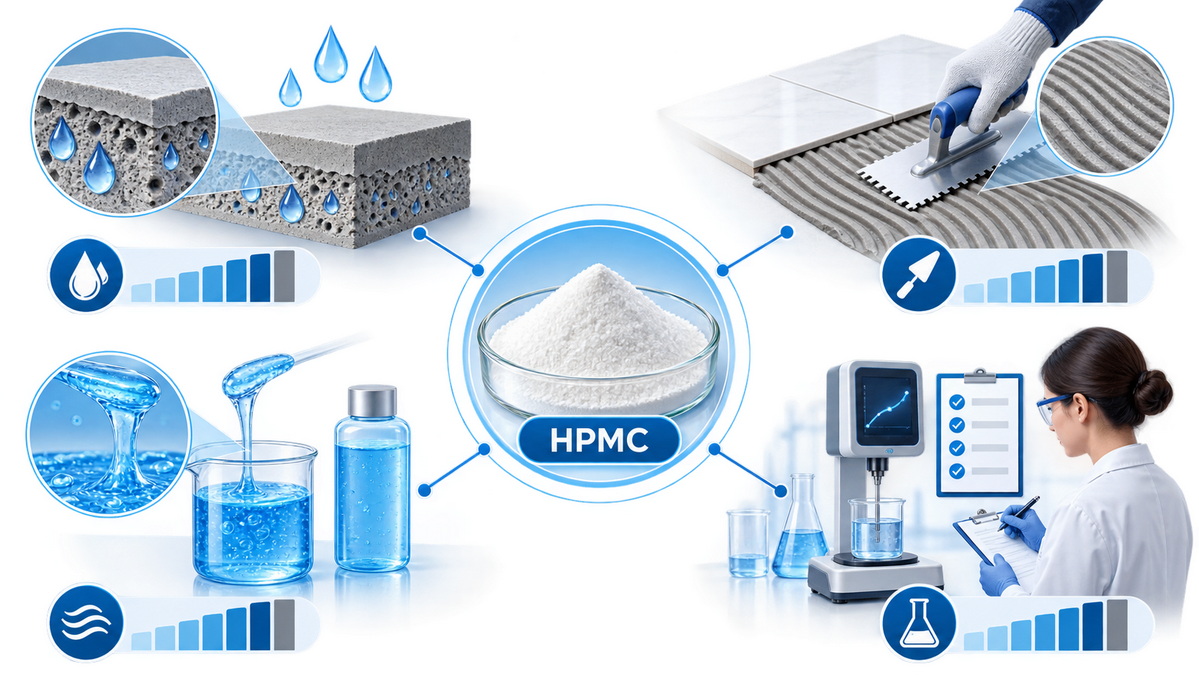
HPMC is used as a thickener, water-retention agent, rheology modifier, binder, film former, stabilizer, and suspending agent. Common applications include tile adhesive, wall putty, cement mortar, gypsum plaster, detergent, hand wash, food products, pharmaceutical formulations, and personal-care products.
No. A higher-viscosity grade may improve certain properties, but it may also affect mixing behavior, workability, dosage, and application feel. The best HPMC grade is the one that delivers the required overall balance in your specific formulation.
Use the same formula, raw materials, water ratio, mixing process, test temperature, and evaluation method. Compare water retention, workability, viscosity stability, dissolution, dosage efficiency, open time, and total cost in use.
Not automatically. Construction-grade and detergent-grade HPMC may have different technical requirements, quality controls, and performance targets. Always request an application-specific recommendation and test the material in your own formulation.
You should request a technical data sheet, Certificate of Analysis, Safety Data Sheet, product specification, packaging information, shelf-life information, storage recommendations, batch traceability details, and any required application or regulatory documentation.
Water retention helps reduce rapid water loss from the mortar after application. This can support cement hydration, improve workability, and help maintain an appropriate installation window. The correct balance is important because excessive thickening may negatively affect application performance.
Detergent manufacturers should test dissolution speed, initial viscosity, viscosity after storage, surfactant compatibility, salt tolerance, appearance, clarity, fragrance compatibility, foam behavior, pourability, and long-term stability.
1. KIMA CHEMICAL CO., LTD. "Top 6 HPMC Suppliers in the World." Available at: [https://www.kimacellulose.com/top-6-hpmc-suppliers-in-the-world.html]
2. Ashland. "BENECEL™ Methylcellulose and Hydroxypropyl Methylcellulose." Available at: [https://www.ashland.com/industries/personal-and-home-care/skin-and-sun-care/benecel-methylcellulose-and-hydroxypropyl-methylcellulose]
3. World Health Organization / Joint FAO/WHO Expert Committee on Food Additives. "Hydroxypropylmethyl Cellulose." Available at: [https://apps.who.int/food-additives-contaminants-jecfa-database/chemical.aspx?chemID=2510]
4. European Food Safety Authority. "Safety and Efficacy of Hydroxypropyl Methyl Cellulose for All Animal Species." Available at: [https://pmc.ncbi.nlm.nih.gov/articles/PMC7395937/]
5. Shandong Shengda / Dongyuan Shengda. "Hydroxypropyl Methyl Cellulose Manufacturer." Available at: [https://www.shengdahpmc.com/]
6. Shandong Shengda New Material Co., Ltd. "Company Profile and Product Range." Available at: [https://sdshengda.en.made-in-china.com/]


