


close
Choose Your Site
Global
Social Media
Views: 279 Author: Shengda Publish Time: 2026-09-11 Origin: Site


Content Menu
● 2026 Updated: A Practical Selection Guide for Industrial Buyers
● Vietnam's Growing Demand for Cellulose HEC
● How to Select a Reliable Cellulose HEC Supplier
>> Key Supplier Evaluation Criteria
● What Makes Cellulose HEC Technically Different?
>> Important Technical Properties
● Top Cellulose HEC Manufacturers and Suppliers Serving Vietnam
● 1. Shandong Shengda New Material Co., Ltd.
>> Recommended Qualification Questions
● 2. Dow
● 4. Shin-Etsu Chemical Co., Ltd.
● 7. Sidley Chemical Co., Ltd.
● Comparison of Major HEC Supply Options
● Capacity, MOQ, and Certification Considerations
>> What to Ask About Certification
● Common Problems When Buying Cellulose HEC
>> Buying the Lowest-Priced Product Without Formula Testing
>> Approving a Sample Without Checking Batch Consistency
>> Confusing Nominal Viscosity With Real Formulation Performance
>> Ignoring Packaging and Humidity Risks
>> Purchasing From a Trading Company Without Knowing the Factory
● Buyer's Guide for HEC Procurement in Vietnam
>>Step 1: Prepare a Clear Technical Requirement
>>Step 2: Request Documents Before Samples
>> Step 3: Test the Material in Three Stages
>>> Laboratory Formulation Testing
● Step 4: Establish a Commercial Quality Agreement
● Logistics Planning for Vietnam Imports
>> Important Logistics Questions
>> 1. How can I verify whether an HEC supplier's ISO certificate is still valid?
>> 2. Can I replace one HEC supplier with another if both products have the same viscosity?
>> 3. What MOQ should I expect when importing HEC into Vietnam?
>> 4. What is the best way to compare HEC prices from different suppliers?
>> 5. How can I ensure that commercial HEC matches the approved sample?
Vietnam is becoming an increasingly important market for cellulose ether consumption, especially in water-based paints, construction chemicals, dry-mix mortar, detergents, household cleaners, and personal-care products. However, Vietnam is primarily a growing application and distribution market for Hydroxyethyl Cellulose rather than a major global production center for HEC.
For this reason, professional buyers in Vietnam often source Cellulose HEC through a combination of local distributors, regional trading partners, and export-oriented manufacturers from China, Japan, Europe, and other established cellulose ether production regions.
Choosing a reliable supplier requires more than comparing quotations. Buyers need to assess whether the supplier can provide stable viscosity, consistent batch quality, appropriate documentation, technical support, flexible packaging, dependable lead times, and an HEC grade that works in the buyer's actual formulation.
This guide introduces leading Cellulose HEC manufacturers and suppliers relevant to the Vietnamese market. It also explains how to compare suppliers, avoid common procurement risks, verify product quality, and build a more stable long-term supply chain.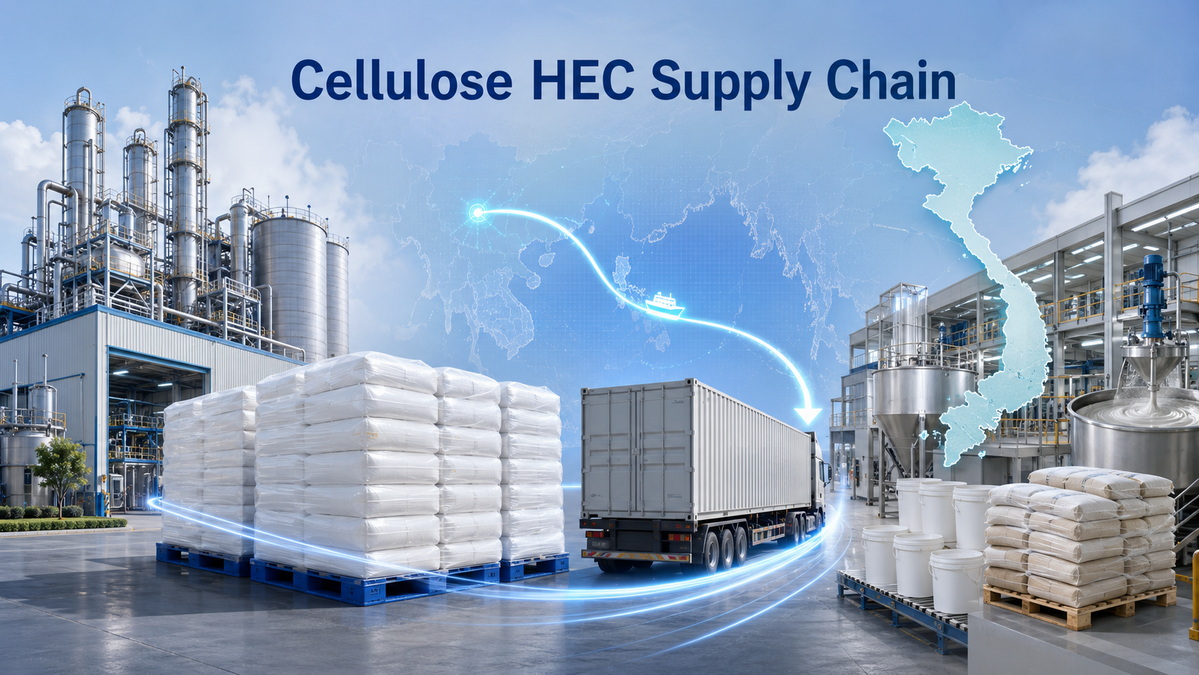
Hydroxyethyl Cellulose, commonly called HEC, is a non-ionic, water-soluble cellulose ether. It is widely used as a thickener, rheology modifier, stabilizer, protective colloid, binder, and water-retention additive.
In Vietnam, demand for HEC is closely connected to the expansion of local manufacturing in several downstream industries:
- Architectural paints and decorative coatings
- Water-based industrial coatings
- Wall putty and skim-coat products
- Dry-mix mortar and construction chemicals
- Household cleaning products
- Liquid detergents and laundry-care formulations
- Hand wash, shampoo, shower gel, and other daily chemicals
- Adhesives, pigment dispersions, and latex systems
- Oilfield, water-treatment, and industrial-processing applications
Vietnam's paint, coatings, construction, and consumer-product sectors have become more sophisticated in recent years. Manufacturers are increasingly focused on viscosity stability, appearance, storage performance, flow control, and end-user application quality.
This creates demand not only for standard HEC powder, but also for application-specific HEC grades with controlled viscosity, good dissolution behavior, reliable moisture levels, and strong compatibility with water-based formulations.
For many Vietnamese buyers, China remains one of the most practical sourcing locations because of its manufacturing scale, export infrastructure, product variety, and ability to support different price and performance levels. At the same time, multinational suppliers remain important for premium coatings, personal-care formulations, and highly controlled industrial applications.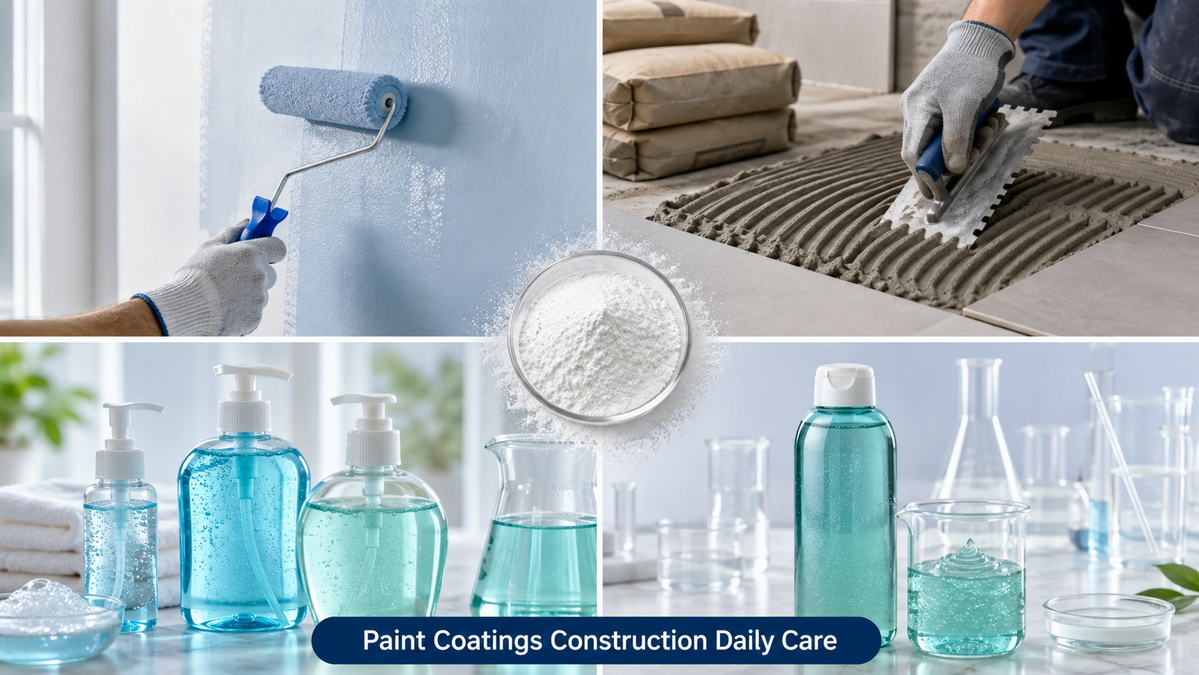
A reliable HEC supplier should be evaluated as a long-term production partner rather than simply a source of low-cost powder.
The strongest suppliers are usually able to explain how their products are manufactured, tested, packed, shipped, and supported after delivery. They should also understand that HEC performance can vary significantly depending on the buyer's formulation system.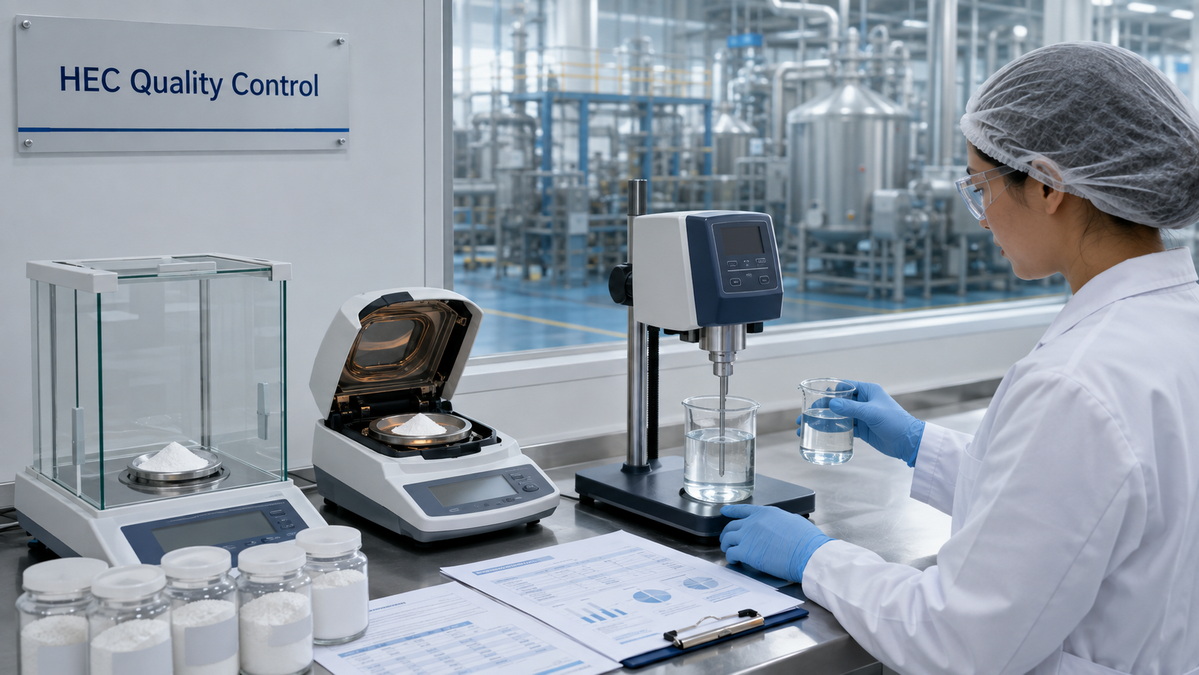
| Evaluation Area | What Buyers Should Check | Why It Matters |
|---|---|---|
| Factory identity | Whether the company owns and operates its own production facility | Direct manufacturers normally offer better control over quality, production planning, and traceability |
| Product range | Availability of HEC, HPMC, HEMC, and other relevant cellulose ethers | Helpful for buyers who need to consolidate multiple additives from one supplier |
| Quality-control process | Raw material testing, in-process control, final inspection, COA release, and retained samples | Reduces the risk of inconsistent batches |
| Application support | Ability to recommend grades for paints, detergents, personal care, or construction chemicals | HEC is not a one-grade-fits-all material |
| Production capacity | Actual HEC output, not only total cellulose ether capacity | Ensures supply continuity during demand increases |
| Documentation | TDS, SDS, COA, ISO certificates, regulatory declarations, packaging details | Supports import clearance, quality approval, and customer audits |
| Delivery reliability | Lead time, export history, container-loading capability, and shipping options | Helps avoid production interruptions |
| Customization | Private-label packaging, customized viscosity, grade adjustment, and OEM support | Important for distributors and developing brands |
| Communication efficiency | Speed and accuracy of technical and commercial responses | Critical when handling sample trials or production issues |
A supplier that cannot explain its test methods, product specifications, or batch-control process should be approached carefully, even if its pricing appears attractive.
HEC is produced by chemically modifying cellulose. The degree of modification, molecular weight, particle size, moisture level, and processing method can affect how the material performs in water-based systems.
Two HEC products may carry the same nominal viscosity label but still behave differently during mixing and in the final product.
For example, one grade may disperse quickly in a paint formulation but create excessive viscosity drift during storage. Another may thicken a detergent efficiently but produce haze or poor clarity in a transparent hand-wash formulation.
| Property | Importance in Formulation | Buyer Verification Question |
|---|---|---|
| Viscosity | Determines thickening power and rheological behavior | What concentration, spindle, speed, and temperature are used for testing? |
| Particle size | Influences dispersion, hydration time, and risk of lumps | Is the grade designed for easy dispersion or delayed hydration? |
| Moisture content | Affects storage stability and effective active content | What is the maximum moisture specification? |
| pH value | Influences compatibility with surfactants, pigments, and preservatives | What is the standard pH range and test procedure? |
| Dissolution behavior | Determines mixing time and production efficiency | What dispersion procedure is recommended? |
| Substitution degree | Affects solubility, viscosity development, and compatibility | Can the supplier provide technical guidance on this parameter? |
| Batch consistency | Protects long-term product stability | Can the supplier provide several recent COAs for comparison? |
| Storage stability | Important in humid Southeast Asian conditions | What packaging and warehouse conditions are recommended? |
A professional purchaser should always compare materials using the same internal test method. Supplier viscosity values are useful, but they should not be treated as directly interchangeable unless the test conditions are identical.
The following companies represent different sourcing options for buyers in Vietnam. Some are direct cellulose ether manufacturers, while others are globally established specialty-materials suppliers. Each company should be evaluated based on the buyer's application, commercial volume, documentation requirements, and technical expectations.
Shandong Shengda New Material Co., Ltd. is a China-based cellulose ether manufacturer specializing in the research, development, production, and sales of Hydroxyethyl Cellulose, Hydroxypropyl Methyl Cellulose, and Hydroxyethyl Methyl Cellulose.
Established in 2006, the company has developed a broad product portfolio serving construction materials, paints and coatings, wall putty, gypsum and plaster systems, tile adhesive, and daily-chemical applications. Its stated total cellulose ether production capacity is 60,000 metric tons per year across two manufacturing facilities.
- Hydroxyethyl Cellulose (HEC)
- Hydroxypropyl Methyl Cellulose (HPMC)
- Hydroxyethyl Methyl Cellulose (HEMC)
- Construction-grade cellulose ethers
- Paint- and coating-grade cellulose ethers
- Daily-chemical-grade cellulose ethers
- Customized cellulose ether solutions
- Long-term focus on cellulose ether production since 2006
- Broad portfolio covering HEC, HPMC, and HEMC
- Stated 60,000-ton annual cellulose ether capacity
- Suitable for coatings, construction chemicals, wall putty, tile adhesive, gypsum systems, detergents, and daily chemicals
- Practical support for small and medium-sized brands as well as distributors
- Flexible communication for technical specifications, sample evaluation, packaging, and product customization
- Ability to support OEM and private-label projects
- Suitable for buyers seeking a balance between cost control, production capability, and technical service
Shandong Shengda is particularly relevant for:
- Vietnam-based paint manufacturers
- Wall putty and skim-coat producers
- Dry-mix mortar manufacturers
- Construction-chemical distributors
- Detergent and household-cleaning brands
- Daily-chemical manufacturers
- Importers developing private-label additive businesses
- Buyers requiring HEC, HPMC, and HEMC from one supply partner
For customers that require flexible order arrangements, prompt technical communication, and customized packaging or viscosity ranges, Shandong Shengda can be a practical manufacturer-led option.
Before placing a commercial order, buyers should request:
- Product-specific Technical Data Sheet
- Safety Data Sheet
- Recent Certificate of Analysis
- HEC viscosity test method
- Moisture specification
- pH specification
- Recommended dosage range
- Recommended dispersion procedure
- Packaging and pallet-loading information
- Batch traceability process
- Standard production lead time
- Export experience to Southeast Asia
- OEM label and packaging requirements
Dow is a globally recognized materials-science company with a long history in functional polymers, specialty chemicals, and cellulose ether technologies.
For industrial buyers, Dow is often considered when technical consistency, global supply-chain support, and formulation expertise are more important than the lowest initial purchase price.
- Water-based paints and coatings
- Rheology control
- Industrial formulations
- High-performance waterborne systems
- Specialty additives
- Strong international technical reputation
- Broad experience in coating and formulation chemistry
- Suitable for high-specification applications
- Often preferred by multinational paint producers
- Strong technical-documentation capabilities
- Relevant for customers with formal supplier-qualification systems
Dow may be more suitable for large manufacturers, multinational businesses, and applications where technical performance needs to be highly consistent across multiple locations.
Smaller businesses should confirm local availability, distributor channels, sample policies, and commercial minimums before starting a qualification project.
Ashland is a specialty-materials company known for functional ingredients used in personal care, coatings, pharmaceuticals, and industrial formulations.
Its cellulose ether technologies are particularly relevant for buyers that require more than basic thickening performance. In personal-care and premium coating applications, the behavior of HEC can influence texture, clarity, stability, flow, sensory feel, and long-term product appearance.
- Personal care and cosmetics
- Shampoo and shower gel
- Hand wash and liquid soap
- Water-based coatings
- Specialty rheology modification
- High-value consumer formulations
- Strong formulation expertise
- Suitable for premium personal-care systems
- Experience with high-value functional ingredients
- Relevant for customers focused on sensory quality and appearance
- Good fit for complex water-based formulations
Ashland products may be better suited to customers that place a high value on advanced formulation support, premium-grade performance, and established technical documentation.
For standard industrial paints or cost-sensitive detergent applications, buyers should compare total formulation cost rather than assuming that a specialty grade is automatically necessary.
Shin-Etsu Chemical is a major Japanese chemical manufacturer with international experience in cellulose derivatives and specialty materials.
The company is often evaluated by customers that require controlled quality systems, detailed technical documentation, and dependable performance in demanding product categories.
- Specialty cellulose derivatives
- Personal-care formulations
- Pharmaceutical and technical applications
- Controlled industrial formulations
- High-value functional materials
- Strong reputation for quality consistency
- Suitable for stringent product-qualification processes
- Deep technical capability in functional polymer materials
- Appropriate for high-specification applications
- Relevant for buyers that prioritize traceability and documentation
Shin-Etsu may be most suitable for buyers with formal technical-approval procedures and applications that require a high level of process control.
Buyers should confirm whether the required HEC grade is available through Vietnam or ASEAN distribution channels and whether the product meets the intended formulation requirements.
Nouryon is an international specialty-chemicals supplier with experience in rheology modifiers, coatings additives, and cellulose ether-related technologies.
For coating and construction-material buyers, its products can be relevant when rheological control is a critical part of finished-product performance.
- Water-based paints
- Industrial coatings
- Rheology modification
- Construction-chemical formulations
- Specialty additive systems
- Experience in specialty coatings chemistry
- Suitable for demanding water-based systems
- Relevant for viscosity and flow control
- Good fit for companies with internal formulation laboratories
- Established technical positioning in performance additives
Buyers should carefully confirm whether a product is standard HEC, ethyl hydroxyethyl cellulose, or another cellulose ether derivative. These materials may have different behavior and should not be treated as direct substitutes.
A coating producer should test any alternative material in its actual formula, including pigments, fillers, emulsions, dispersants, defoamers, and coalescents.
Kima Chemical is an export-oriented cellulose ether supplier offering products such as HEC, HPMC, MHEC, and CMC.
Its product range may be useful for distributors and manufacturers that source more than one cellulose ether category. This is especially relevant for buyers who require HEC for paint or detergent applications and HPMC or MHEC for dry-mix mortar, skim coat, or tile adhesive.
- Hydroxyethyl Cellulose
- Hydroxypropyl Methyl Cellulose
- Methyl Hydroxyethyl Cellulose
- Carboxymethyl Cellulose
- Construction-grade cellulose ether
- Paint- and coating-grade cellulose ether
- Broad product portfolio
- Suitable for multi-product procurement
- Relevant for distributors and building-material suppliers
- Potentially useful for mixed-container orders
- Appropriate for buyers comparing standard industrial-grade options
Before approval, buyers should verify:
- Actual manufacturing location
- Production capacity by product category
- Recent COA consistency
- HEC viscosity test method
- Quality-control process
- Export packing quality
- Application-specific recommendation capability
A broad product catalog is useful, but it should not replace sample testing in the final formulation.
Sidley Chemical is associated with a broad range of cellulose ether and related functional-polymer products, including HEC, HPMC, CMC, ethyl cellulose, and PAC.
This type of supplier can be relevant for distributors serving several industries, especially when customers require different cellulose ether products for construction, paint, detergent, oilfield, or industrial applications.
- Hydroxyethyl Cellulose
- Hydroxypropyl Methyl Cellulose
- Carboxymethyl Cellulose
- Ethyl Cellulose
- Polyanionic Cellulose
- Construction and industrial cellulose derivatives
- Broad portfolio for multiple industrial segments
- Suitable for general chemical distributors
- Useful for buyers requiring more than one cellulose derivative
- Potential option for standard industrial applications
- Relevant for mixed product procurement
As with any supplier offering many product categories, buyers should confirm which specific factory produces the selected HEC grade. They should also review the product's batch-control process and conduct formulation testing before approving commercial supply.
| Supplier | Supply Model | Key Product Focus | Typical Buyer Type | MOQ Flexibility | Main Consideration |
|---|---|---|---|---|---|
| Shandong Shengda New Material Co., Ltd. | Direct manufacturer | HEC, HPMC, HEMC for coatings, construction, and daily chemicals | Distributors, paint producers, construction-chemical manufacturers, private-label brands | Often more flexible depending on grade and packaging | Strong option for customized support and mid-sized buyers |
| Dow | Global specialty supplier | High-performance coatings and rheology systems | Multinational and high-specification manufacturers | Usually program- or distributor-based | Premium technical positioning |
| Ashland | Global specialty supplier | Personal care, coatings, specialty formulations | Personal-care and premium formulation companies | Depends on regional supply channel | Strong formulation and sensory-performance support |
| Shin-Etsu | Global specialty manufacturer | Controlled specialty cellulose derivatives | High-specification and regulated applications | Often structured around formal qualification | Strong quality and documentation reputation |
| Nouryon | Global specialty-additives supplier | Coatings, rheology, industrial systems | Coating and construction-chemical formulators | Depends on region and grade | Confirm exact cellulose ether chemistry |
| Kima Chemical | Export-oriented manufacturer | HEC, HPMC, MHEC, CMC | Importers, distributors, building-material manufacturers | Often order-volume dependent | Verify product-specific consistency |
| Sidley Chemical | Broad cellulose ether supplier | HEC, HPMC, CMC, EC, PAC | General distributors and industrial buyers | Depends on product and shipment size | Confirm factory source and test method |
Production capacity, MOQ, and certification status are important procurement factors, but they should be interpreted carefully.
A large total cellulose ether capacity does not automatically mean that the supplier has sufficient available HEC capacity for a specific grade. Some factories may focus primarily on HPMC, while HEC production may represent a smaller share of their output.
Similarly, a supplier may advertise flexible MOQ terms but be unable to maintain the same grade quality once the buyer moves from sample quantities to container-scale orders.
- What is the annual capacity specifically for HEC?
- What percentage of production is allocated to paint-grade HEC?
- What percentage is allocated to daily-chemical-grade HEC?
- Is the requested grade produced regularly or only on demand?
- What is the average monthly output of the selected grade?
- Is there available inventory for urgent orders?
- How long is the normal production lead time?
- Can the supplier reserve production capacity under an annual agreement?
- What is the MOQ for samples?
- What is the MOQ for standard 25 kg bags?
- What is the MOQ for customized viscosity ranges?
- What is the MOQ for private-label packaging?
- What is the MOQ for a full-container order?
- Can the supplier support pallet-level trial orders?
- Are different HEC grades allowed in one shipment?
- Is the ISO certificate valid and current?
- Does the certificate cover the actual production factory?
- What is the certificate scope?
- Which organization issued the certificate?
- Is the certification body accredited?
- Can the supplier provide product-specific documentation?
- Are there application-specific declarations available for the target market?
A low unit price may appear attractive, but the actual formulation cost can be higher if the product requires a larger dosage or creates production problems.
For example, an HEC product may be cheaper per kilogram but require 10% to 20% more dosage to achieve the same paint viscosity. It may also cause longer mixing time, reduced flow, poor leveling, weaker storage stability, or higher rejection rates.
The correct comparison is not simply price per kilogram. It is cost per unit of effective performance.
A good sample does not guarantee that future production material will perform the same way.
A buyer should request COAs from several recent production batches and compare:
- Viscosity
- Moisture content
- pH value
- Appearance
- Dissolution behavior
- Particle-size information, if available
- Batch number format
- Production date
- Retention-sample policy
The first commercial delivery should be treated as a controlled qualification step, not as a fully unrestricted purchase.
A nominal HEC viscosity number can be misleading if the supplier does not provide a complete test method.
For example, a viscosity value can change depending on:
- Sample concentration
- Water temperature
- Water quality
- Hydration time
- Test pH
- Brookfield spindle
- Rotational speed
- Test temperature
- Moisture condition of the sample
One supplier may state "100,000 cps," while another states the same number using completely different test conditions.
Never ask only:
> What is the viscosity of your HEC?
Ask instead:
> Please provide the full viscosity test method, including sample concentration, mixing procedure, hydration time, water temperature, pH condition, Brookfield spindle, rotational speed, and final test temperature.
This question can quickly reveal whether the supplier understands technical quality control or is relying only on broad marketing specifications.
Vietnam's tropical climate makes moisture protection especially important. HEC should be packed in moisture-resistant bags and stored in a dry warehouse.
Poor packaging can lead to:
- Caking
- Reduced flowability
- Difficult feeding into mixing equipment
- Increased moisture content
- Handling losses
- Product-performance variation
Buyers should clearly define packaging, pallet protection, container loading, and storage conditions in the purchase order.
Trading companies can be useful, especially when they provide local stock, credit terms, mixed-container loading, or technical service. However, buyers should understand whether the company is a manufacturer, an authorized distributor, or an independent trader.
A credible supplier should be able to provide clear information about:
- Legal company name
- Factory address
- Production-site photos or virtual inspection access
- Business registration details
- Batch traceability
- COA format
- Factory audit information
- Export history
- Product-origin confirmation
Before contacting suppliers, prepare a concise product requirement sheet.
Include:
- Application type
- Current formulation system
- Target viscosity
- Target dosage range
- Required particle behavior
- Current supplier or reference grade
- Monthly consumption volume
- Annual purchasing forecast
- Packaging preference
- Delivery location in Vietnam
- Required quality documents
- Required lead time
This will help suppliers recommend the correct HEC grade and avoid sending unsuitable samples.
A supplier should be able to provide technical documents before sending a sample.
Request:
- Technical Data Sheet
- Safety Data Sheet
- Certificate of Analysis
- Product specification
- Packaging specification
- Shelf-life information
- Storage recommendations
- Batch-code explanation
- Quality-management certificate
- Product-origin statement
- Recommended application guide
For coating-grade HEC, request a dispersion procedure. For detergent- and personal-care-grade HEC, request guidance on hydration, surfactant compatibility, salt addition, and preservative compatibility.
Check:
- Appearance
- Odor
- Moisture content
- pH value
- Viscosity
- Dissolution time
- Sieve residue, where relevant
- Packaging condition
Test the HEC in the real product formulation.
For coatings, evaluate:
- Viscosity development
- Flow and leveling
- Sag resistance
- Pigment suspension
- Spatter resistance
- Storage stability
- Compatibility with dispersants and defoamers
For detergents and personal care, evaluate:
- Clarity
- Viscosity response
- Salt tolerance
- Fragrance compatibility
- Preservative compatibility
- Long-term stability
- Sensory feel
- Stringiness
- Foam behavior
Before approving full-scale supply, conduct a pilot batch at production-relevant scale.
This stage can reveal issues that may not appear in laboratory testing, including:
- Powder feeding difficulty
- Lumping
- Excess foam
- Slow hydration
- Pumping problems
- Filtration issues
- Filling instability
- Viscosity drift after storage
A purchase order or quality agreement should clearly state:
- Exact product grade
- Internal buyer product code
- Viscosity range
- Test method
- Moisture limit
- pH specification
- Appearance requirement
- Packaging type
- Net weight
- Allowed weight tolerance
- Production date requirement
- Shelf-life requirement
- Batch-code requirement
- COA requirement for each shipment
- Storage and transportation conditions
- Nonconformance claim procedure
- Requirement that commercial material match the approved sample
This document helps protect both the buyer and the supplier by reducing ambiguity.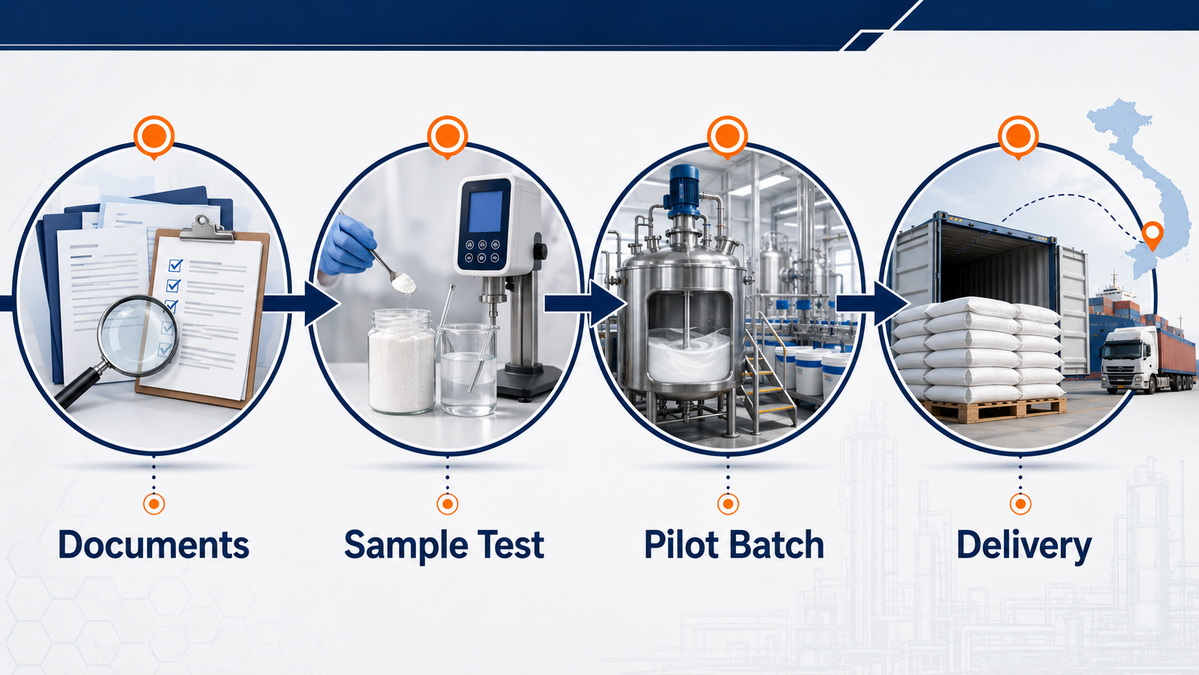
HEC is usually transported by sea freight in palletized bags or bulk container quantities. Buyers should plan their inventory based on actual lead time rather than only factory production time.
A complete lead time may include:
- Sample approval
- Production scheduling
- Quality inspection
- Export documentation
- Container booking
- Inland delivery to port
- Sea transit
- Customs clearance
- Warehouse delivery
- Internal quality release
- Is the order LCL or FCL?
- How many 25 kg bags fit in one pallet?
- How many pallets fit in a 20-foot or 40-foot container?
- Is the packaging suitable for humid sea freight?
- Are desiccants required?
- Does the supplier use inner PE bags and outer moisture-resistant bags?
- Is the container loading process documented?
- Can the supplier provide packing photos before shipment?
- What are the port options for Hai Phong, Cat Lai, or other Vietnam destinations?
- What documents are required by the importer and customs broker?
A practical buyer should maintain safety stock, especially for HEC used in high-volume paint, construction, and detergent production.
Vietnam offers strong demand potential for Cellulose HEC across paints, coatings, construction chemicals, detergents, and daily-chemical products. The most reliable purchasing strategy is to select suppliers based on technical suitability, batch consistency, production transparency, documentation quality, logistics reliability, and long-term service capability.
For many buyers, the most suitable supplier will not necessarily be the lowest-priced company. It will be the supplier that understands the target application, provides clear quality documentation, supports formulation trials, communicates efficiently, and delivers consistent commercial batches.
Shandong Shengda New Material Co., Ltd. is a relevant manufacturer for buyers seeking HEC, HPMC, and HEMC solutions with a practical balance of production scale, flexible cooperation, customized support, and responsiveness to small and medium-sized brands. Its product range is suitable for customers in coatings, construction materials, detergents, and daily-chemical applications.
The strongest supply relationship begins with clear technical requirements, structured sample testing, documented specifications, and a shared commitment to long-term quality consistency.
Request the complete certificate and check the legal company name, factory address, certificate number, scope, issue date, expiry date, and issuing certification body. Confirm that the certificate covers the actual manufacturing site rather than only a sales office. For higher-value supply projects, verify the certificate directly through the issuing certification body.
Not automatically. The same nominal viscosity does not guarantee the same performance. Differences in molecular structure, substitution degree, particle size, moisture content, hydration behavior, and surface treatment can affect the final formulation. Always conduct a laboratory trial and pilot-batch test before changing suppliers.
MOQ depends on the supplier, product grade, packaging, customization level, and shipment method. Standard industrial grades may allow pallet-level trial orders, while customized viscosity, private-label bags, or special documentation can require higher minimum quantities. Buyers should request separate pricing for samples, pallet quantities, LCL shipments, and full-container orders.
Compare cost-in-use rather than price per kilogram. Consider the actual dosage required, mixing time, production efficiency, viscosity stability, rejection rate, storage performance, logistics cost, payment terms, and technical support. A slightly higher-priced HEC may reduce total production cost if it performs more efficiently.
Include the approved sample code, detailed technical specification, viscosity test method, and acceptance limits in the purchase order. Require a batch-specific COA before shipment, keep retained samples from every delivery, and use a documented claim procedure. For large orders, consider third-party pre-shipment inspection or periodic factory audits.
1. Shandong Shengda New Material Co., Ltd. — [About Us]
2. MarketsandMarkets — [North America Cellulose Ether & Derivatives Market]
3. 24ChemicalResearch — [Southeast Asia Cellulose Ether and Its Derivatives Market Research Report 2025]
4. IndexBox — [Coating Grade Cellulose Ether Market in Asia-Pacific]
5. Drymix.info — [Industry Directory: HEC Manufacturers and Suppliers]
6. Kima Chemical — [Top Hydroxyethyl Cellulose Manufacturers in the World]


