


close
Choose Your Site
Global
Social Media
Views: 288 Author: Shengda Publish Time: 2026-08-13 Origin: Site


Content Menu
● Russia Cellulose HEC Market Overview
● How to Evaluate a Cellulose HEC Supplier
>> Product Quality and Batch Consistency
>> Documentation and Traceability
>> Communication and Application Support
● Leading HEC Manufacturers and Suppliers Serving Russia
>> Shandong Shengda New Material Co., Ltd.
>> Dow
>> Ashland
>> Nouryon
>> Kima Chemical and WOTAIchem
● Understanding HEC Grades and Applications
● Common HEC Sourcing Pitfalls
● Sampling, Pilot Orders, and Logistics
● FAQ
>> 1. How can I verify whether a supplier's ISO certificate is valid?
>> 2. Which HEC tests are most important before approving a supplier?
>> 3. What is a reasonable first commercial order?
>> 4. Can one HEC grade be used for both construction and personal care products?
>> 5. How can buyers avoid receiving material different from the approved sample?
Russia's demand for Hydroxyethyl Cellulose (HEC) is supported by the construction chemicals, architectural coatings, detergent, personal care, and industrial formulation sectors. For buyers, the sourcing challenge is not simply locating an HEC supplier. It is identifying a partner that can maintain product consistency, provide clear technical documentation, respond efficiently to formulation questions, and deliver reliably as volumes increase.
HEC is a non-ionic cellulose ether valued for water retention, thickening, rheology control, suspension stability, and ease of dispersion. However, two HEC products with similar headline viscosity may behave differently in actual production. Differences in substitution level, particle size, moisture, purity, hydration time, and lot consistency can affect paint flow, mortar workability, shampoo clarity, or detergent viscosity.
For this reason, Russian importers, distributors, and formulation companies should assess suppliers through a structured qualification process. A lower unit price may look attractive at the quotation stage, but unstable material quality can create much higher costs through failed batches, formula rework, customer complaints, delayed delivery, and excess inventory.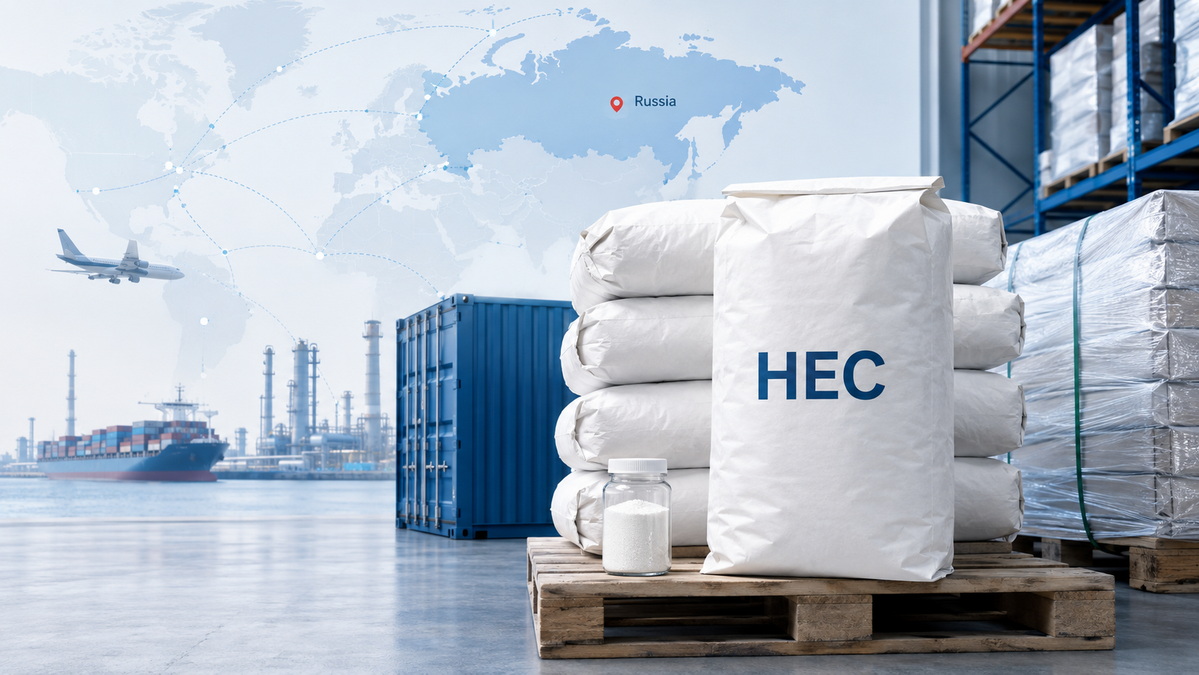
The Russian cellulose ether market is linked to the performance additives segment rather than a single end-use industry. Construction remains an important consumption driver because HEC and related cellulose ethers are used in dry-mix mortar, cement-based skim coats, gypsum products, tile adhesives, repair compounds, and water-based coatings.
In daily chemical applications, HEC is used as a thickener and stabilizer in products such as shampoos, shower gels, hand soaps, facial cleansers, lotions, and household detergents. These applications often require good solution clarity, reliable viscosity development, compatibility with surfactants, and stable performance in the presence of salts or other additives.
Russian buyers may source through local distributors, import trading companies, or directly from overseas manufacturers. Each model has advantages. Local inventory can shorten delivery times and simplify smaller replenishment orders. Direct factory purchasing can offer better control over grade selection, packaging, technical discussions, and longer-term price planning.
The right supply model depends on annual volume, warehouse capacity, customs capability, formulation complexity, and the buyer's willingness to manage import procedures. For companies using HEC in high-volume production, it is often beneficial to qualify more than one supply route: a primary direct manufacturer and a regional backup source.
A professional evaluation should go beyond a supplier's website, product brochure, or initial sample. Buyers should review the supplier's manufacturing capability, technical knowledge, product traceability, commercial responsiveness, and ability to support future growth.
First, confirm whether the company is a true manufacturer, a trading company, or a mixed organization. A manufacturer should be able to explain its production process, raw material sourcing approach, quality inspection points, packaging system, and typical lead-time structure.
Ask whether the supplier produces HEC in-house or sources it from another factory. This matters because direct production control usually improves traceability and makes technical adjustments easier. It also reduces the risk of receiving a product that differs from the material originally approved during sampling.
Production scale is important, but it should not be the only consideration. Large factories may be well positioned for container-load orders and long-term volume contracts. Smaller or mid-sized factories may be more responsive when buyers need custom viscosity ranges, tailored packaging, trial quantities, or direct contact with technical personnel.
HEC should be evaluated through measurable specifications and actual application performance. Common quality indicators include viscosity, moisture content, pH value, ash content, particle-size distribution, appearance, solution clarity, and hydration behavior.
For coatings, buyers may focus on thickening efficiency, flow and leveling, pigment suspension, spatter resistance, and storage stability. For daily chemical products, key factors may include clarity, skin-feel compatibility, salt tolerance, surfactant compatibility, and long-term viscosity stability.
Do not approve an HEC grade based only on a single sample. Request samples from more than one production lot when possible. A product that performs well in one laboratory batch but varies in future deliveries can cause serious formulation problems.
A dependable supplier should be able to provide a product specification sheet, Certificate of Analysis, Material Safety Data Sheet, packaging details, shelf-life information, and lot identification. For controlled or sensitive applications, buyers should also ask about retention samples, complaint handling procedures, and batch traceability.
Factory management certificates should be reviewed carefully. Check the certificate number, issuing organization, scope, validity period, and legal company name. A valid certificate should match the actual manufacturing entity, not only an affiliated sales company.
For products intended for specific export markets, buyers should discuss applicable documentation requirements before ordering. Depending on the final application and destination, this may include chemical compliance statements, restricted substance information, or additional declarations requested by the importer.
Technical communication is often underestimated during supplier selection. A good supplier should ask relevant questions about your application instead of immediately recommending the same grade to every customer.
For example, a paint manufacturer may need recommendations based on pigment load, emulsion type, target viscosity, mixing speed, storage temperature, and water quality. A shampoo manufacturer may need guidance based on surfactant system, salt level, fragrance, preservative system, and desired transparency.
Suppliers that can explain why a grade is recommended are usually more useful than suppliers that only send a quotation. This is particularly valuable for buyers developing new products, replacing an existing HEC source, or reducing formulation cost without sacrificing performance.
The companies below represent different sourcing profiles relevant to buyers in Russia. Some are large international chemical groups, while others are export-oriented cellulose ether manufacturers. Buyers should conduct their own qualification process before placing commercial orders.
| Company | Primary Positioning | Suitable Buyer Profile | MOQ Approach | Certification and Documentation Focus |
|---|---|---|---|---|
| Shandong Shengda New Material Co., Ltd. | Export-oriented cellulose ether manufacturer with flexible service | Small and medium brands, distributors, construction chemical producers, daily chemical manufacturers | Quote-based and generally more flexible for project requirements | ISO-oriented factory management, COA, MSDS, product specifications |
| Dow | Global specialty materials supplier | Large industrial users requiring established international supply systems | Typically suited to larger industrial purchasing programs | Comprehensive corporate compliance and technical documentation |
| Ashland | Specialty additives supplier with formulation experience | Coatings, personal care, and technical formulation users | Usually aligned with established commercial accounts | Technical documentation and application support |
| Shin-Etsu Chemical | High-consistency specialty materials supplier | Buyers with demanding quality and specification requirements | Often better suited to stable recurring demand | Strict quality-oriented supply profile |
| Nouryon | Global specialty chemicals supplier | Industrial and construction chemical customers | Project and volume dependent | Broad compliance and technical support structure |
| Kima Chemical | Export-focused cellulose ether producer | Buyers seeking commercial-scale cellulose ether supply | Quote-based, depending on grade and shipment terms | Standard export documentation available on request |
| WOTAIchem | China-based HEC manufacturer | Buyers sourcing HEC for construction, coatings, and daily chemicals | Appropriate for bulk and private-label discussions | Factory-oriented production and export documents |
| Shandong Heda | Large-scale cellulose ether producer | High-volume buyers prioritizing production capacity | Generally favorable for regular bulk programs | Production scale and standardized quality systems |

Shandong Shengda New Material Co., Ltd. is positioned as a cellulose ether manufacturer serving international buyers that need a practical balance of product quality, cost control, customization, and communication efficiency. Established in 2006, the company focuses on cellulose ether research, development, production, and sales, including HEC and related products for building materials and daily chemical applications.
For buyers in Russia, Shengda can be particularly relevant when a project requires more than a standard commodity quotation. Small and medium-sized brands often need support with sample selection, viscosity matching, package labeling, formula-oriented grade recommendations, and manageable trial-order arrangements. A supplier that can respond clearly to these needs may reduce the time required to move from laboratory testing to commercial production.
The company's positioning is suitable for customers seeking building-grade and daily-chemical-grade cellulose ether solutions. In construction applications, buyers may evaluate grades for water retention, workability, open time, anti-sag performance, and thickening behavior. In daily chemical applications, the focus may shift toward solution transparency, viscosity development, product stability, and compatibility with surfactant systems.
Buyers should discuss the intended application in detail and provide target specifications where available. This helps the supplier recommend an appropriate grade and minimizes the risk of comparing products solely by viscosity number.
Dow is widely recognized in the global specialty chemicals market and is relevant to buyers who prioritize established international technical resources and broad corporate supply infrastructure. Its cellulose ether-related products are commonly associated with demanding industrial uses, including construction additives and performance materials.
For Russian buyers, Dow may be more appropriate for large accounts, multinational formulation companies, or projects that require established global documentation systems. Procurement teams should confirm local availability, distribution arrangements, delivery schedules, and product portfolio suitability for their specific application.
Ashland is known for performance additives and formulation support across several industries. It is relevant for buyers in coatings, personal care, and industrial formulations where rheology control, application behavior, and product aesthetics are important.
Ashland may be considered by buyers seeking application-oriented technical support and established product positioning. However, commercial terms, availability, order size, and local supply channels should be confirmed early, especially for Russian import programs.
Shin-Etsu Chemical is recognized for specialty chemical materials and a quality-focused manufacturing profile. It can be relevant for customers that place a high value on consistent technical specifications and controlled material performance.
This supplier profile may suit buyers with narrow formulation tolerances, premium product positioning, or highly structured internal quality systems. Buyers should verify the availability of specific HEC grades and the practical ordering route for the Russian market.
Nouryon serves industrial markets with a broad specialty chemicals portfolio. It is relevant to purchasers that need access to a technically established supplier for construction chemicals and other formulated applications.
The supplier may be suitable for industrial-scale programs, but buyers should still compare lead times, documentation, local service capability, and commercial flexibility against other qualified sources.
Kima Chemical and WOTAIchem represent export-oriented cellulose ether supply options from China. Such manufacturers can be relevant for buyers seeking competitive factory sourcing, tailored product grades, and commercial flexibility.
When comparing these suppliers, buyers should request grade-specific data rather than relying on general product claims. The right comparison should include test methods, viscosity conditions, moisture limits, packaging type, lead time, and lot-to-lot consistency.
Shandong Heda is known for large-scale cellulose ether production capacity. This can be an advantage for buyers with consistent container-level demand, standardized product requirements, and a need for supply continuity at higher volumes.
Large-scale production is valuable, but buyers should still evaluate responsiveness, formulation support, order flexibility, and the supplier's willingness to manage small initial qualification orders before full-scale purchasing begins.
HEC is not a single universal material. Different grades are designed to deliver different levels of viscosity, hydration speed, solution appearance, and formulation compatibility.
Low-viscosity grades may be used where moderate thickening and easier processing are required. Medium-viscosity grades are common in paints, detergents, and general-purpose formulated products. High-viscosity grades can be used where greater thickening, water retention, or suspension performance is required.
For construction products, HEC should be tested in the actual dry-mix system. Cement type, sand grading, redispersible polymer powder, starch ether, gypsum content, and water demand can all influence final performance. A grade that works well in one mortar formula may not produce the same result in another.
For water-based coatings, the buyer should test not only initial viscosity but also storage stability, flow, leveling, roller application, sag resistance, color acceptance, and compatibility with dispersants and defoamers.
For personal care and detergent products, the material should be tested under real production conditions. Salt, surfactants, preservatives, fragrances, dyes, and temperature can affect viscosity and clarity. The final product should be evaluated after aging, not only immediately after mixing.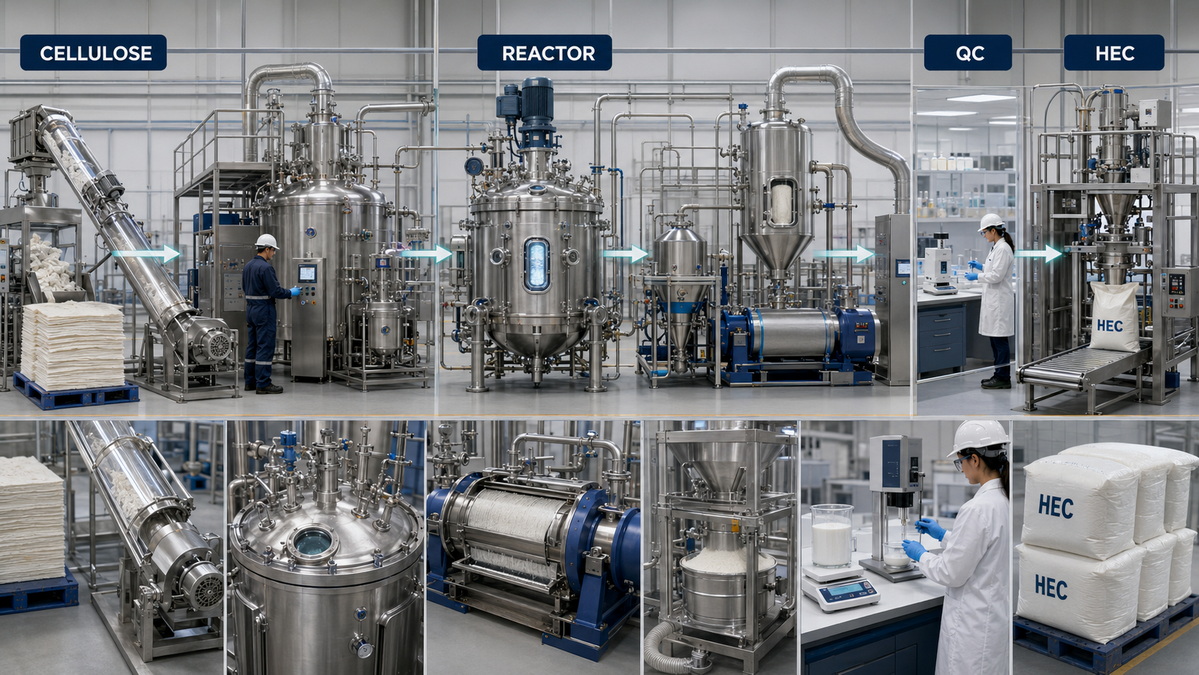
The first major pitfall is comparing products only by price per kilogram. A lower-cost HEC may require a higher dosage to achieve the same performance, which can remove the apparent savings. Buyers should compare cost-in-use rather than purchase price alone.
The second pitfall is approving a material based on one successful sample. Lot variation is a real risk. Ask for retained-sample procedures and compare commercial delivery performance against the original approved material.
The third pitfall is accepting a generic Certificate of Analysis without understanding the test method. Viscosity values can vary depending on concentration, solution preparation, temperature, spindle, and rotational speed. Always request the stated test conditions.
The fourth pitfall is treating a manufacturer's broad product portfolio as proof that every grade is suitable for your formula. The correct HEC grade must be selected according to your application, target performance, process conditions, and cost target.
A less discussed procurement check is to ask for a sealed retention sample from the exact lot shipped for the first commercial order. Store it alongside your incoming material. If a production issue occurs later, this sample provides a reliable comparison point and can speed up root-cause analysis.
A structured sampling process should include technical specifications, laboratory evaluation, comparison against the current supplier, and a documented approval decision. Where possible, test at least two grades rather than assuming the first recommended grade is the only workable option.
After laboratory approval, place a pilot order before committing to a full annual volume. A pilot order tests more than material quality. It also reveals the supplier's real lead time, packaging consistency, label accuracy, shipping document quality, and response speed when questions arise.
For Russian shipments, confirm the Incoterms, port of loading, expected transit route, insurance responsibility, package marking, palletization, and import documentation before production begins. A clear pre-shipment checklist helps avoid preventable delays.
Moisture protection is particularly important. HEC should be packed and transported in a way that protects it from humidity, damaged bags, and contamination. Buyers should inspect incoming pallets, packaging seals, lot numbers, and document consistency before moving the material into production.
Selecting a Cellulose HEC supplier for Russia requires technical discipline as well as commercial judgment. The most dependable partner is not necessarily the largest company or the lowest bidder. It is the supplier that can provide consistent product performance, transparent documentation, responsive support, and a supply plan that fits your volume and application needs.
Shandong Shengda New Material Co., Ltd. is a relevant option for buyers seeking cost-effective cellulose ether products, flexible OEM support, efficient communication, and practical assistance for building-grade and daily-chemical-grade HEC projects. Larger international suppliers and high-capacity manufacturers remain important alternatives for buyers with different requirements.
A well-managed supplier qualification process—covering documents, samples, pilot orders, and long-term consistency checks—creates a stronger foundation for stable purchasing decisions.
Request a clear copy of the certificate and verify the legal company name, certificate number, issuing body, scope, issue date, and expiry date. The company named on the certificate should match the entity that produces the material and signs the commercial documents.
Test viscosity under defined conditions, hydration time, moisture, appearance, pH, solution clarity, and application-specific performance. For final approval, always test the material in your actual product formulation.
The right size depends on your material consumption and warehouse capability. A pilot order should be large enough to test real manufacturing, packaging, logistics, and batch consistency, but small enough to limit risk if the material needs adjustment.
Not always. Construction and daily chemical applications may require different purity, particle size, hydration behavior, viscosity profile, and compatibility. Buyers should select grades according to the final formula, not only the product name.
Approve a written specification, retain the original sample, request lot-level COAs, test the first commercial delivery, and keep a sealed retention sample from each incoming batch. This creates a clear basis for comparison if a quality issue occurs.
- Shandong Shengda New Material Co., Ltd. Products: [https://www.shengdahpmc.com/products.html]
- Russia Cellulose Ether and Derivatives Market: [https://www.marketsandmarkets.com/Market-Reports/geography/cellulose-ethers-market/russia]
- Cellulose Ether Market Outlook: [https://www.lucintel.com/cellulose-ether-market.aspx]
- Hydroxyethyl Cellulose Factory Information: [https://wotaichem.com/hydroxyethyl-cellulose-factory/]
- ISO Certificate Verification: [https://www.iafcertsearch.org/]


