


close
Choose Your Site
Global
Social Media
Views: 259 Author: Shengda Publish Time: 2026-10-22 Origin: Site


Content Menu
● Malaysia's Position in the Cellulose HEC Supply Chain
>> Chemical Clusters and Their Procurement Advantages
>> What Recent Industry Data Actually Shows
● Selection Criteria: How to Evaluate a Reliable HEC Supplier
● Five Cellulose HEC Manufacturers and Suppliers to Consider for Malaysia
>> 1. Shandong Shengda New Material Co., Ltd.
>>> Company Background and Supply Model
>>> Core Strengths and Buyer Fit
>>> OEM and Customization Scope
>>> What to Verify Before Ordering
>>> Company Background and Main Market
>>> Core Strengths
>>> OEM and Technical-Service Scope
>>> What to Verify Before Ordering
>>> Company Background and Main Market
>>> Core Strengths
>>> OEM and Technical-Service Scope
>>> What to Verify Before Ordering
>> 4. Personal Formula Resources (M) Sdn Bhd
>>> Company Background and Main Market
>>> Core Strengths
>>> OEM and Technical-Service Scope
>>> What to Verify Before Ordering
>>> Company Background and Main Market
>>> Core Strengths
>>> OEM and Technical-Service Scope
>>> What to Verify Before Ordering
● Supplier Comparison: Capacity, MOQ, and Certification Transparency
● Technical Buyer's Guide: Specify HEC Correctly
>> Distinguish Application Grades
>> Standardize the Viscosity Test
>> Understand Surface-Treated Grades
>> Treat Certifications According to Their Actual Scope
● Common Procurement Traps and How to Avoid Them
>> Trap 1: The Sample and Shipment Have Different Origins
>> Trap 2: A Higher Viscosity Number Looks Like Better Value
>> Trap 3: Packaging Is Mistaken for Manufacturing Identity
>> The Less-Discussed Trap: Successful Fresh Tests Can Hide Later Viscosity Loss
● A Practical Qualification and Logistics Workflow
>> Step 1: Send a Complete Technical Enquiry
>> Step 2: Qualify a Traceable Sample
>> Step 3: Confirm Commercial-Scale Consistency
>> Step 4: Audit the Relevant Operation
>> Step 5: Define Logistics Responsibilities
● FAQ
>> 1. How Can I Verify Whether a Supplier's ISO Certificate Has Expired?
>> 2. How Can Two HEC Grades Have Similar Viscosity but Behave Differently in My Product?
>> 3. Can Industrial HEC Be Used in a Personal-Care Product?
>> 4. What Should an OEM Agreement for HEC Actually Specify?
>> 5. What Should We Investigate if a Delivered Batch Passes the Certificate but Fails Our Formula?
Malaysia offers practical sourcing options for buyers of Hydroxyethyl Cellulose, commonly called HEC. Its chemical distribution network supports paint manufacturers, construction-material producers, household-product companies, and personal-care formulators.
However, finding a dependable Cellulose HEC supplier requires more than comparing prices or accepting a viscosity figure on a quotation. Procurement teams need to establish who manufactures the material, how each grade is tested, whether production batches remain consistent, and what happens when delivery or formulation problems occur.
This guide evaluates five sourcing options available to Malaysian buyers, including four Malaysia-based suppliers and one Chinese manufacturing alternative: Shandong Shengda New Material Co., Ltd.
The central selection principle is traceability: buyers should be able to connect the quoted grade, sample, production batch, certificate of analysis, and manufacturing source.

Malaysia's established chemical ecosystem makes it relevant to regional HEC procurement. However, the companies reviewed here primarily demonstrate local distribution and ingredient supply rather than verified domestic HEC synthesis.
That distinction matters. A Malaysian supplier can provide valuable local purchasing support without owning the reactor system that produces the cellulose ether.
Malaysia's chemical infrastructure includes:
- Kertih in Terengganu, an established integrated petrochemical hub.
- Gebeng in Pahang, which hosts major international chemical businesses.
- Pasir Gudang–Tanjung Langsat in Johor, an industrial area supported by port access.
These clusters strengthen Malaysia's wider chemical-manufacturing and logistics environment. They should not, however, be described as dedicated HEC production clusters without plant-specific evidence.
For HEC buyers, the practical attraction is access to chemical distributors, industrial customers, and established logistics services—not proof that the material was manufactured locally.
Malaysia's official first-half 2025 investment announcement reported RM15.5 billion in approved investments for chemicals and chemical products. Manufacturing as a whole attracted RM68.4 billion during the same period. These figures indicate broader chemical-sector investment activity; they are not HEC production or consumption statistics.
MATRADE's February 2025 trade report recorded RM5.64 billion in exports of chemicals and chemical products, representing 4.8% of total exports that month. Again, this category covers considerably more than cellulose ethers.
No verified Malaysia-specific HEC market-size figure is used in this guide. Broad chemical statistics should not be repackaged as evidence of domestic HEC capacity.
A serious supplier assessment should cover six areas.
| Assessment area | Evidence to request | Why it matters |
|---|---|---|
| Manufacturing identity | Legal entity, production-site address, producer declaration, audit access | Separates manufacturers from distributors and repackers |
| Product consistency | Grade-specific specification and recent batch certificates | Reveals whether the proposed material has a controlled quality range |
| Technical capability | Application recommendations, laboratory methods, troubleshooting process | Helps distinguish genuine grade matching from simple price matching |
| Quality management | Verifiable certificates, scope, site coverage, expiry status | Prevents reliance on unrelated or outdated documents |
| Supply reliability | Available inventory, production allocation, lead-time basis, contingency arrangements | Reduces interruption risk |
| Commercial suitability | MOQ, packaging, payment terms, complaint procedure, customization scope | Establishes whether the supplier fits the buyer's operating model |
ISO certification should be checked against the exact legal entity and relevant site. IAF CertSearch supports verification of accredited management-system certificates, including their current status. A certificate image alone is insufficient.
For a distributor, qualification should also establish whether the original producer can change between orders. For a manufacturer, it should identify which plant and production line will supply the approved grade.
Founded in 2006, Shandong Shengda New Material Co., Ltd. is a Chinese cellulose ether manufacturer whose published portfolio includes HEC, HPMC, and HEMC.
Its company page describes a dual-factory production model with a combined annual capacity of 60,000 tonnes. This is a company-reported total across its cellulose ether operations, not a separately verified HEC-only capacity figure.
Its stated market orientation is domestic and international supply. The reviewed page does not provide a country-by-country sales breakdown.
Shengda is relevant to Malaysian buyers considering direct manufacturing procurement rather than relying exclusively on local distribution.
Its published positioning combines cellulose ether production, customized solutions, and pre-sales and after-sales technical support. This makes it a candidate for buyers who want to discuss application requirements directly with the manufacturing organization.
For small and medium-sized brands, the appropriate evaluation is not whether Shengda promises the lowest price. It is whether the company can deliver a workable combination of:
- Application-appropriate grade selection.
- Responsive technical communication.
- Consistent production material.
- Commercially viable trial quantities.
- Clearly documented customization.
Direct communication may simplify technical discussions, but response speed and coordination quality should be tested during the sampling stage rather than assumed.
Shengda states that it offers customized solutions. Buyers can therefore use the qualification process to discuss viscosity targets, hydration behavior, packaging requirements, and application testing. However, private-label availability, customized bag printing, minimum production runs, and specific OEM arrangements require written confirmation.
For HEC raw materials, "OEM" should mean a clearly defined supply arrangement. It should not imply finished detergent or cosmetic development unless that service is separately confirmed.
Request HEC-specific production allocation, the exact grade specification, relevant certification details, and a sample linked to the proposed commercial source.
Shengda is a reasonable factory-direct candidate for cost-conscious buyers seeking customization support. Its actual cost advantage must be demonstrated through an equivalent-grade landed-cost comparison.

Duro Kimia traces its business history to September 1982, when it began operating in Subang Jaya. Duro Kimia Sdn Bhd was incorporated in 2000 and subsequently operated from Petaling Jaya, Selangor. Its business focuses on chemical distribution for industrial applications.
The company explicitly lists Hydroxyethyl Cellulose and states that it supplies the material in 25 kg bags. Its product page describes multiple viscosity grades and applications across coatings, construction, household products, and personal care.
Duro Kimia is relevant to buyers seeking an established Malaysia-based industrial chemical distributor with an identifiable HEC offering.
Its public product information provides a starting point for technical discussions, including a 1% solution viscosity basis and indicative physical specifications. These should be replaced by a signed, grade-specific specification before purchasing.
The reviewed information establishes chemical distribution, not HEC manufacturing or confirmed private-label production.
Ask whether Duro Kimia can arrange:
- Producer-supported grade selection.
- Samples of the intended commercial grade.
- Consistent supply from a named manufacturer.
- Application troubleshooting.
- Alternative grades with disclosed differences.
A 25 kg bag size does not establish a 25 kg MOQ. Confirm the order minimum, available inventory, producer identity, and whether subsequent orders will retain the same origin.
ChemTrade Malaysia publishes a dedicated HEC product page for Malaysian enquiries. The reviewed HEC information does not establish a founding year or identify an owned HEC manufacturing facility.
Its offering is presented around matching grades to viscosity targets, hydration behavior, and intended applications. Availability, packaging, documentation, delivery route, and timing are confirmed through quotation.
ChemTrade's published enquiry requirements are technically useful. It asks buyers to provide the required viscosity, complete test basis, application, quantity, and delivery location. It also distinguishes conventional viscosity grades from surface-treated grades with delayed hydration.
This approach is relevant when a buyer needs specification-led sourcing rather than an unidentified "high-viscosity HEC."
Grade sourcing is the publicly visible service. Bespoke manufacturing, private labeling, and finished-formulation development are not established by the reviewed page.
Buyers requesting customized material should ask whether ChemTrade will coordinate directly with the producer and whether the requested changes are manufacturing adjustments or simply selection from existing grades.
Confirm the legal contracting entity, manufacturing origin, stock location, technical documents, and commercial sample source.
A well-structured enquiry process is helpful, but it does not replace producer qualification.
Personal Formula Resources states that it has served Malaysian cosmetic-ingredient customers since 2005, including individual formulators, home-based businesses, and professional manufacturers.
Its HEC listing offers 100 g, 500 g, and 1 kg pack sizes. The listed application information includes water dispersion and a suggested dosage range of 0.1–1%, which should be treated as preliminary guidance rather than a universal formulation rule.
This supplier is particularly relevant to laboratory development and small-scale personal-care projects.
Small packs let formulators investigate texture, incorporation behavior, and compatibility without first committing to an industrial shipment.
The reviewed evidence supports ingredient supply. It does not establish custom HEC synthesis, industrial private-label production, or a complete finished-product development service.
Its strongest documented fit is therefore early-stage formulation work, not assumed bulk manufacturing supply.
Before scaling a successful trial, request the original grade designation, producer details, batch documentation, and confirmation that the same material is available in larger quantities.
A small laboratory pack and a later bulk shipment must not be treated as equivalent merely because both are labeled HEC.
DChemie Malaysia presents itself as a source of chemical raw materials and fragrance solutions. Its reviewed company information does not specify a founding year.
The company lists Hydroxyethyl Cellulose as a thickening ingredient for cosmetic and personal-care applications and states that an SDS is available on request.
DChemie provides another Malaysia-based enquiry route for personal-care formulators evaluating HEC alongside other chemical ingredients.
Its relevance is strongest where buyers need application-specific raw-material information and local commercial communication.
The public information reviewed does not demonstrate owned HEC production, customized polymer manufacturing, or confirmed private-label services.
Any formulation assistance, repacking, bespoke sourcing, or OEM arrangement should be defined in a written proposal.
Request the commercial grade name, original producer, viscosity method, packing options, MOQ, and the documentation needed for the intended product category.
An SDS supports hazard communication; it does not prove cosmetic-grade suitability or application performance.
The table distinguishes published information from items requiring confirmation. "Not established" does not mean a capability or certificate is absent; it means the reviewed evidence does not substantiate it.
| Assessment area | Evidence to request | Why it matters |
|---|---|---|
| Manufacturing identity | Legal entity, production-site address, producer declaration, audit access | Separates manufacturers from distributors and repackers |
| Product consistency | Grade-specific specification and recent batch certificates | Reveals whether the proposed material has a controlled quality range |
| Technical capability | Application recommendations, laboratory methods, troubleshooting process | Helps distinguish genuine grade matching from simple price matching |
| Quality management | Verifiable certificates, scope, site coverage, expiry status | Prevents reliance on unrelated or outdated documents |
| Supply reliability | Available inventory, production allocation, lead-time basis, contingency arrangements | Reduces interruption risk |
| Commercial suitability | MOQ, packaging, payment terms, complaint procedure, customization scope | Establishes whether the supplier fits the buyer's operating model |
Capacity and packaging entries reflect the companies' published information. None of these entries establishes available stock, guaranteed delivery, or an independently audited production volume.
HEC is a nonionic, water-soluble cellulose ether used for thickening and rheology control. Commercial grades differ in viscosity, hydration characteristics, and other performance attributes.
A useful enquiry separates the intended application:
| Application | Priority evaluation points |
|---|---|
| Water-based architectural paint | Thickening efficiency, application feel, sag control, storage stability |
| Construction-related aqueous formulations | Water retention, compatibility, processing behavior |
| Household cleaning products | Surfactant compatibility, appearance, viscosity stability |
| Personal-care products | Sensory properties, clarity requirements, appropriate purity and documentation |
Do not select HEC solely because another cellulose ether works in a related application. Qualification should use the actual formulation and production process.
"100,000 cP" is not a complete specification.
A meaningful viscosity requirement includes:
1. Polymer concentration and whether it is expressed by mass or volume.
2. Water quality.
3. Dissolution and conditioning procedure.
4. Test temperature.
5. Instrument, spindle, and rotational speed.
6. Acceptance range.
Published producer documentation illustrates why the method matters: viscosity figures can be tied to specific concentrations, temperatures, and measurement procedures. Comparing nominal numbers without these conditions can produce a false grade match.
Some HEC grades receive a surface treatment that delays hydration, allowing particles to disperse before significant thickening begins. Ashland's Natrosol R grades are a documented example.
The practical consequence is important: slower initial viscosity development does not automatically indicate weak material. Conversely, rapid thickening does not prove superior quality.
Use the producer's recommended incorporation procedure, and record water temperature, pH, mixing conditions, and time.
CE marking is not a generic HEC quality certificate. It applies only where relevant European product legislation requires it; it must not be applied indiscriminately.
RoHS concerns restricted substances in electrical and electronic equipment. A customer may request related substance testing for a particular supply chain, but a RoHS statement does not establish HEC performance, cosmetic suitability, or environmental sustainability.
For Malaysia, evaluate applicable chemical classification and hazard-communication duties. DOSH guidance explains that hazardous workplace chemicals can trigger requirements covering classification, packaging, labeling, and SDS preparation. It also states that DOSH does not approve or certify SDS documents. Where required, Malaysia-compliant SDS documentation must address the relevant language requirements.
Environmental claims should likewise be specific. Plant-derived feedstock alone does not substantiate a finished grade's biodegradability, manufacturing footprint, or responsible-sourcing claim.
A distributor may offer an acceptable development sample but later source commercial material elsewhere.
Prevent this through an approved manufacturer, named grade, agreed specification, and written change-notification requirement. Retain sealed samples from both qualification material and incoming shipments.
A high nominal viscosity can distract buyers from dosage, hydration, formulation compatibility, and final-product stability.
Compare the cost of achieving the required finished-product performance—not simply the price per kilogram of powder.
A locally labeled bag does not establish local production.
Ask who synthesized the polymer, who repacked it, and which entity issued the batch certificate. These can be different organizations.
Experienced coatings formulators distinguish initial thickening from resistance to later degradation.
Ashland specifically offers enzyme-resistant HEC grades for applications where cellulase associated with microbial activity can damage the polymer and reduce viscosity. This demonstrates that apparently comparable HEC grades can differ in storage-related performance.
The purchasing lesson is to include aged-formulation testing where storage stability matters. Investigate the formulation's preservation system and polymer resistance separately. An enzyme-resistant grade is not a substitute for an appropriate preservation program.
Provide the application, existing grade if available, viscosity method, required quantity, destination, and critical performance targets.
For customized supply, distinguish mandatory requirements from preferences.
Request a sample identified by grade and batch, together with its specification, certificate of analysis, and SDS.
Test it using both an agreed laboratory method and the actual formulation. Compare incorporation behavior, required dosage, and relevant stability outcomes.
Where practical, assess more than one production batch before a major supply commitment.
The objective is to understand normal variation, not merely approve the supplier's most favorable sample.
For a manufacturer, review production control, testing, batch release, retained samples, and complaint handling.
For a distributor, review producer authorization where applicable, incoming verification, storage, repacking controls, and change management.
For imported HEC, agree on:
- Incoterms and the named delivery point.
- Export and import documentation responsibilities.
- Moisture-protective packaging.
- Pallet and container requirements.
- Shipment identification and traceability.
- Inspection and complaint deadlines.
- Responsibility for delayed or damaged cargo.
Confirm customs classification, origin treatment, duties, and transport status using the actual product documentation and qualified local advice. Do not infer these solely from the term "cellulose ether."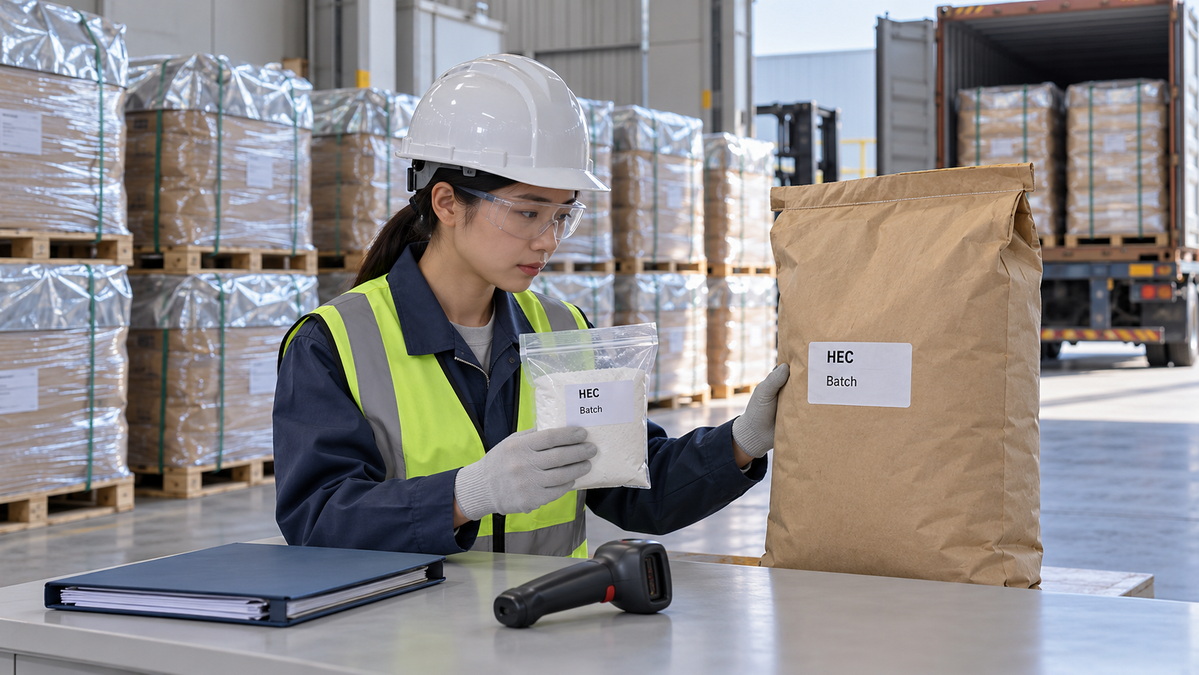
Malaysia offers useful HEC sourcing channels, but buyers should distinguish local ingredient supply from original polymer manufacturing.
Duro Kimia provides an established industrial distribution route. ChemTrade Malaysia offers a specification-oriented enquiry process. Personal Formula Resources supports small-pack formulation work, while DChemie provides another personal-care raw-material sourcing option.
Shandong Shengda offers a China-based factory-direct alternative for buyers seeking cellulose ether manufacturing access and customization discussions. Its suitability should be established through application trials, verified documentation, and clearly agreed commercial terms.
For your next HEC enquiry, prepare a concise technical brief covering application, viscosity test method, sample quantity, packaging, expected annual demand, and delivery location. Share it with Shandong Shengda and qualified Malaysian suppliers, then compare their responses on the same technical and commercial basis.
Search the exact legal entity or certificate number in IAF CertSearch where applicable. Check certificate status, standard, covered sites, scope, and issuing certification body.
If the certificate cannot be verified there, contact the certification body using independently obtained contact details. An absent search result warrants further investigation; a PDF alone does not resolve the question.
The reported figures may use different test methods. Even when the methods match, grades can differ in hydration behavior, surface treatment, and resistance to degradation.
Require both standardized solution testing and application testing. A nominal viscosity match is only the beginning of substitution work.
An industrial designation alone does not establish suitability. Request documentation for the intended use, including the supplier's grade recommendation and relevant purity, impurity, and microbiological information.
Assess the complete formulation and target-market requirements before approval. Published personal-care HEC offerings show that application-specific grade selection matters; they do not make all HEC grades interchangeable.
Define the producer, manufacturing site where relevant, grade, specification, test methods, packaging artwork, batch coding, and permitted changes.
Also specify whether customization means selecting an existing grade, modifying a production specification, or supplying privately labeled packaging. Require sample approval and written authorization before changes to an approved supply arrangement.
First, reconcile test methods and sample preparation. Then compare retained qualification material with the delivered batch under identical conditions.
Check grade identity, batch origin, hydration conditions, formulation inputs, and storage history. If initial viscosity passes but later performance deteriorates, investigate microbial control and enzyme-related degradation as separate possibilities rather than assuming the supplier's viscosity result was false.
- Shandong Shengda New Material Co., Ltd. Company background, product portfolio, reported combined capacity, and customized support. [shengdahpmc]
- Malaysian Investment Development Authority. First-half 2025 approved investment announcement, including chemical-sector figures. [investmalaysia.gov]
- Malaysia External Trade Development Corporation. Malaysia's Trade Performance, February 2025. [matrade.gov]
- Malaysian Investment Development Authority. Malaysia's Petrochemical Industry: Poised for Growth, including industrial-cluster information. [mida.gov]
- Duro Kimia. Company history and incorporation background. [durokimia]
- Duro Kimia. Hydroxyethyl Cellulose product information and packaging. [durokimia]
- ChemTrade Malaysia. HEC grade-enquiry and supply information. [chemtrademalaysia]
- Personal Formula Resources. Company background and HEC product information. [personalformularesources]
- DChemie Malaysia. Company background and HEC product listing. [dchemie.com]
- Ashland. Natrosol surface-treated HEC, viscosity-method documentation, enzyme-resistant grades, and personal-care applications. [ashland]
- Department of Occupational Safety and Health, Malaysia. Frequently Asked Questions for CLASS Regulations. [dosh.gov]
- European Union. CE-marking requirements and product scope. [europa]
- European Commission. RoHS Directive and electrical/electronic equipment scope. [environment.ec.europa]
- International Accreditation Forum. IAF CertSearch and certificate-verification guidance. [iafcertsearch]


