


close
Choose Your Site
Global
Social Media
Views: 210 Author: Shengda Publish Time: 2026-07-17 Origin: Site


Content Menu
● Introduction: Why Germany Matters In HEC Sourcing
● How To Evaluate A High‑Quality HEC Supplier
● Technical Background: What Matters In HEC Grades
● Selection Criteria For "Top HEC Manufacturers And Suppliers In Germany"
● Top Cellulose HEC Manufacturers And Suppliers In Germany (2026)
>> Shandong Shengda New Material Co., Ltd. (China – Serving German And EU Buyers)
>> German And EU‑Linked HEC / Cellulose Ether Suppliers Serving Germany
● Comparative Overview Of Key Suppliers
● Buyer's Guide: Practical Steps For Sourcing HEC For Germany
● Industry Pain Points And Internal "Avoid‑Pit" Guide
● FAQs
Germany has built a strong reputation in specialty chemicals and advanced polymers, including cellulose ethers such as Hydroxyethyl Cellulose (HEC) for construction and daily‑chemical applications. For global procurement managers looking for long‑term partners, German suppliers offer consistent quality, robust compliance, and integration into broader EU supply chains, while also collaborating closely with high‑value producers in Asia such as Shandong Shengda New Material Co., Ltd. for cost‑effective capacity. [shengdahpmc]
In practical B2B sourcing, buyers rarely rely on one country alone; instead, they combine German technical leadership with Chinese scale and flexibility to balance cost, performance, and risk. This guide focuses on top HEC manufacturers and suppliers active in the German market and shows how to evaluate them from an industrial buyer's perspective, with special attention to quality systems, certifications, and OEM/ODM support. [landu-china]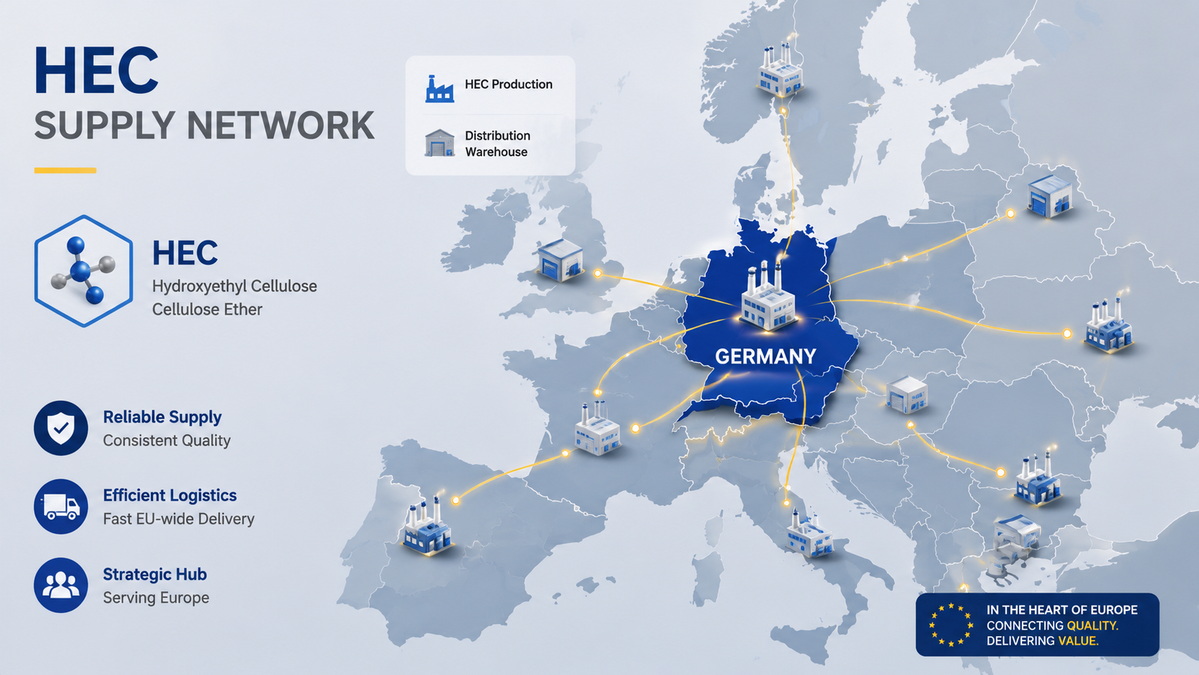
Before shortlisting any HEC partner in Germany or abroad, experienced buyers systematically assess four dimensions: factory certifications, R&D capability, quality control, and delivery stability. [hpmc]
- Factory certifications and compliance. Look for ISO 9001/14001/45001, and relevant EU‑focused approvals such as REACH registration, CE for construction products where applicable, and adherence to RoHS for formulations entering electronics‑related supply chains. [sciencedirect]
- R&D and application support. Strong HEC suppliers maintain in‑house laboratories for rheology, application testing in paints, coatings, detergents, and construction mortars, and can propose grade adjustments (e.g., viscosity, substitution level) tailored to your formulations. [sdhead]
- Quality control (QC) and traceability. Mature plants run batch‑based QC (viscosity, purity, moisture, particle size, substitution degree), use SAP/ERP traceability, and provide COAs and MSDS with every shipment. [pdf.dfcfw]
- Delivery stability and logistics. For Germany‑linked supply, this includes buffer warehouses in the EU, reliable lead times (typically 2–6 weeks for repeat orders), and multi‑route shipping strategies to avoid single‑port disruption. [facebook]
From experience, procurement managers who integrate technical audits, small‑lot pilot orders, and ongoing performance reviews achieve far lower supply risk than those who choose solely based on price or brand name. [actabiotechnology]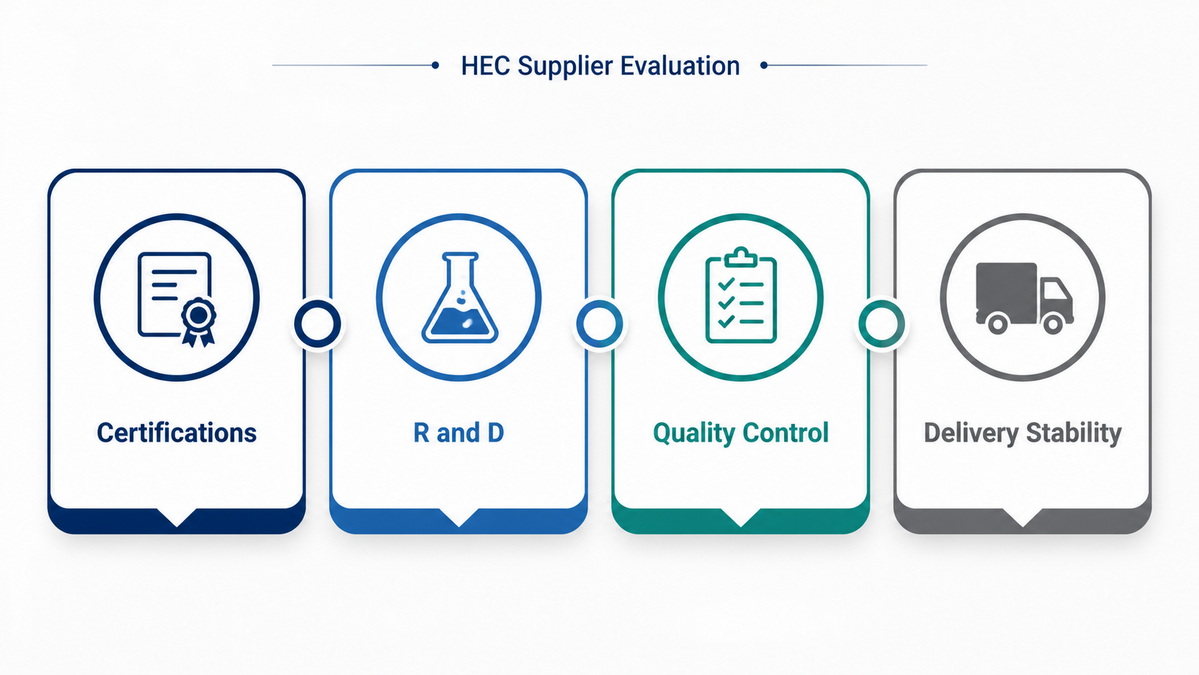
Hydroxyethyl Cellulose (HEC) is a non‑ionic, water‑soluble cellulose ether derived from natural cellulose and widely used as a thickener, rheology modifier, film‑former, and stabilizer in coatings, construction mortars, detergents, and personal care products. [chembk]
When assessing HEC grades from German‑related suppliers, buyers should pay attention to: [celotech]
- Viscosity ranges. Typical HEC products are classified by solution viscosity (e.g., 5,000–80,000 mPa·s), which directly impacts brushability, sag resistance, and water retention. [gemaisi.com]
- Degree of substitution and molecular structure. This drives salt tolerance, pH stability, and compatibility with surfactants and pigments in coatings and detergents. [chembk]
- Purity and by‑products. Low levels of organic impurities and salts are essential for sensitive applications (e.g., high‑end paints, personal care), and reputable suppliers disclose detailed impurity specs. [static.cninfo.com]
- Environmental and safety certifications. Many German and EU‑oriented producers emphasize compliance with REACH, VOC limits, and sustainable sourcing of cellulose raw materials. [sdhead]
In building materials, HEC often complements or substitutes HPMC/HEMC to adjust open time, water retention, and workability in specific formulations, making technical collaboration between supplier and buyer crucial. [gemaisi.com]
The companies highlighted below have been selected based on transparent criteria that reflect real B2B sourcing priorities. [thebusinessresearchcompany]
Key selection criteria:
- Documented HEC or cellulose ether portfolio with clear grade information and industrial references. [celotech]
- Demonstrated exports or supply footprint linked to Germany or the broader EU market, including distribution partnerships or local warehousing. [hpmc]
- Verified certifications (ISO, REACH, CE where applicable) and traceable quality systems. [static.cninfo.com]
- Sustainable or scalable production capacity for HEC and related cellulose ethers. [pdf.dfcfw]
- Ability to support OEM/ODM services for private‑label or customized formulations aimed at EU requirements. [shengdahpmc]
Within this framework, we also include Shandong Shengda New Material Co., Ltd. as an example of a Chinese cellulose ether manufacturer that works with German and European partners on cost‑effective, R&D‑driven OEM projects, illustrating the hybrid sourcing models many procurement teams now adopt. [shengdahpmc]
Although based in Shandong, China, Shandong Shengda New Material Co., Ltd. is increasingly relevant for German procurement teams seeking stable HEC and cellulose ether supply with competitive cost structures. Founded in 2006, the company specializes in research, development, production, and sales of cellulose ethers, including HEC, HPMC, and HEMC, with a strong focus on construction‑grade and daily‑chemical‑grade solutions. [sdhead]
Shengda's core advantages for German buyers include: [shengdahpmc]
- Balanced pricing and quality, suitable for small and mid‑size brands that need industrial‑grade consistency without the overhead of very large multinationals.
- Flexible OEM/ODM support, with responsive technical communication and readiness to fine‑tune viscosity, particle size, and packaging for private labels targeting the German and EU markets.
- Growing expertise in export logistics, including experience with EU regulatory documentation and coordinated shipments via coastal Chinese ports to European hubs.
Because of its R&D orientation and willingness to support iterative formulation work, Shengda often acts as a cost‑efficient extension to German or EU‑based supply chains, especially for buyers who combine local technical centers with overseas manufacturing capacity. [pdf.dfcfw]
Below are representative companies and supply structures relevant to HEC and cellulose ether sourcing for Germany, including domestic producers, EU‑based chemical groups, and specialized distributors. [thebusinessresearchcompany]
1. MATECEL – Cellulose Ether Supplier (EU‑linked, Germany supported)
MATECEL, a cellulose ether supplier with strong China–EU integration, provides HPMC, HEC, and related ethers and actively serves customers across Europe, including Germany. Its strengths lie in high‑quality non‑ionic cellulose ethers for construction mortars, paints, and detergents, supported by ISO quality systems and a network of distributors. [drymix]
2. Zhejiang Yisheng New Material Co., Ltd. (Supplying Germany via exports)
While headquartered in China, Yisheng supplies cellulose ethers including HEC to multiple international markets and positions itself as a professional wholesale cellulose ether manufacturer with a portfolio covering construction and daily‑chemical applications. German buyers typically engage through traders or direct export agreements, benefiting from Yisheng's scale in non‑ionic cellulose ether production. [hecmanufacturer]
3. Shandong Head Group – Cellulose Ether Division (EU‑export oriented)
Shandong Head is an international cellulose ether producer with multiple production bases and a portfolio including HEC, HPMC, HEMC, and EC, serving global markets such as Europe. For German procurement, Head offers high‑volume capacity, comprehensive certification, and strong application experience in construction, daily‑chemical, and energy sectors. [static.cninfo.com]
4. Landu New Material – HEC Specialist (China to EU, including Germany)
Landu promotes itself as a trusted HEC manufacturer, emphasizing eco‑friendly cellulose ether production and detailed technical support for paints, coatings, and daily‑chemical products. German buyers often use Landu as a specialized HEC source when they need tailored viscosity and eco‑compliant formulations aligned with EU expectations. [landu-china]
5. Regional Distributors And Chemical Traders In Germany
In addition to producers, Germany hosts several distribution companies that import HEC and other cellulose ethers, stock them locally, and provide B2B services including technical advice and smaller‑lot deliveries. These entities rarely manufacture HEC themselves but are crucial for buyers who prefer EU‑based contractual frameworks, German‑language support, and short‑lead‑time replenishment. [europages.co]
In practice, many German procurement managers combine one or two core producers (e.g., Shandong‑origin HEC plants) with local distributors that handle smaller orders, safety stocks, and emergency deliveries. [europages.co]
| Supplier / Channel | Year founded / maturity | Main products (HEC / cellulose ethers) | Typical MOQ (industrial) | Key certifications / compliance focus |
|---|---|---|---|---|
| Shandong Shengda New Material Co., Ltd. | 2006 (shengdahpmc) | HEC, HPMC, HEMC for construction & daily‑chemicals (shengdahpmc) | Flexible, often 1–5 tons per grade for OEM (shengdahpmc) | ISO‑based QC, export documentation for EU, focus on R&D and OEM (shengdahpmc) |
| MATECEL (EU‑linked supplier) | Established chemical group (hpmc) | HEC, HPMC, HEC derivatives for drymix and coatings (hpmc) | Typically full‑container or pallet‑based (hpmc) | ISO, EU‑compliant supply, technical support in Europe (hpmc) |
| Zhejiang Yisheng New Material | Modern cellulose ether plant (hecmanufacturer) | HEC, HPMC, HEMC, EC with broad portfolio (hecmanufacturer) | Industrial MOQ, full‑container loads (hecmanufacturer) | ISO and export certifications, focused on volume and stability (hecmanufacturer) |
| Shandong Head Group | Listed group, multi‑base (sdhead) | HEC, HPMC, HEMC, EC, specialty ethers (sdhead) | Larger MOQ, suited for high‑volume buyers (static.cninfo.com) | ISO, environmental management, REACH and global compliance (static.cninfo.com) |
| Landu New Material | Specialized HEC maker (landu-china) | HEC, HPMC and eco‑focused cellulose ethers (landu-china) | Moderate MOQ, project‑oriented (landu-china) | Focus on eco‑friendly processes, EU‑aligned technical docs (landu-china) |
| German chemical distributors | Various dates (europages.co) | Stocked HEC and cellulose ethers from Asia and EU (europages.co) | Very flexible MOQ, from few hundred kg (europages.co) | EU trade compliance, REACH registration, local QC checks (europages.co) |
This kind of structured comparison helps procurement managers quickly match supplier profiles to their own sourcing strategy—whether they prioritize volume, OEM flexibility, local support, or eco‑compliance. [actabiotechnology]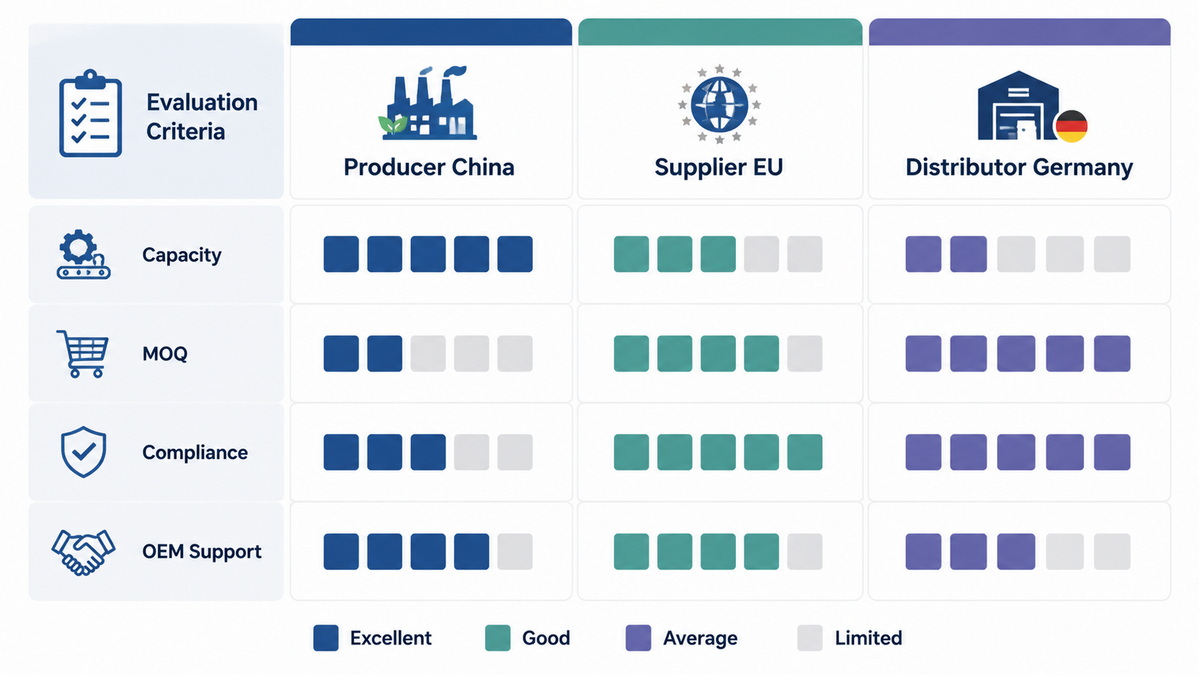
Experienced industrial buyers follow a multi‑stage process to minimize risk when sourcing HEC for German operations. [actabiotechnology]
1. Pre‑qualification and document audit.
Request ISO certificates, REACH registration status, CE/RoHS documentation where relevant, and detailed product data sheets including viscosity, substitution degree, and impurity limits. [sciencedirect]
2. Small‑lot sampling and application testing.
Order pilot quantities (e.g., 50–500 kg) to run internal tests in real formulations: paints, tile adhesives, detergents, or personal care products. Measure rheology, stability, and end‑use performance rather than relying only on lab viscosity data. [gemaisi.com]
3. Factory visit or remote audit.
For key suppliers, conduct on‑site audits or at least remote video audits focusing on raw‑material handling, reactor systems, QC labs, and packaging lines. Confirm that batch numbering and traceability are consistently applied. [sdhead]
4. Contract and logistics planning.
Define clear lead times, Incoterms, stock strategies, and safety inventories in Germany. Work with local distributors or 3PLs to manage customs, warehousing, and short‑notice replenishment. [facebook]
5. Ongoing performance review.
Track quality incidents, on‑time delivery rate, price stability, and technical responsiveness across at least 12 months. Suppliers like Shandong Shengda that show high responsiveness and flexible OEM adaptation often become strategic partners for mid‑sized brands. [pdf.dfcfw]
The HEC procurement community shares several pain points that rarely appear in public marketing materials, but are well known among experienced buyers. [pdf.dfcfw]
- Material substitution without clear notice. Some suppliers quietly shift between HEC and other cellulose ethers (e.g., HPMC or HEMC blends) to manage cost, which can alter rheology and end‑use performance. Serious buyers insist on grade‑locked contracts and COA cross‑checking per batch. [gemaisi.com]
- Viscosity drift over time. Inconsistent process control can cause viscosity variations beyond tolerance; this may not be obvious from a single reference sample. Regular incoming QC and comparison against long‑term viscosimetry data are essential. [sciencedirect]
- Over‑promised eco‑claims. "Green" or "eco‑friendly" labels are sometimes used loosely; buyers should review actual VOC data, REACH dossiers, and cellulose sourcing policies rather than relying on slogans. [landu-china]
A widely known but rarely written rule among senior buyers is: never approve a cellulose ether supplier based only on one excellent lab sample and an attractive price sheet. Instead, insist on two to three production batches over several months, monitored for viscosity, impurity levels, and delivery performance, before final vendor qualification. This internal "avoid‑pit" guideline dramatically reduces the risk of hidden quality fluctuations that only emerge in real‑world production. [static.cninfo.com]
Germany occupies a central role in European specialty chemicals and advanced materials, making it a key hub for high‑quality HEC usage and distribution, even when core manufacturing is shared with trusted partners abroad. For procurement managers, the most resilient strategy is to combine technically credible HEC producers—such as Shandong Shengda New Material Co., Ltd. and other cellulose ether manufacturers—with German or EU‑based distributors that secure compliance, stock, and local service. [hpmc]
If you are planning or revising your HEC sourcing strategy for the German market, consider shortlisting two to three producers and at least one local distributor, then running structured trials and audits as outlined above. You can contact Shandong Shengda's technical and sales team with your current HEC specifications and application details to explore cost‑efficient, OEM‑friendly options that integrate smoothly with your German operations. [pdf.dfcfw]
Q1: How can I verify whether a supplier's ISO certificate has expired or been suspended?
Ask for scanned certificates with registrar details, then cross‑check directly on the registrar's official website or via email; many registrars maintain public databases where you can confirm validity and scope. [sdhead]
Q2: How do I ensure that the HEC shipped to Germany matches the grade used in my lab trials?
Specify grade codes, viscosity ranges, and key parameters explicitly in the contract, require batch‑level COAs, and implement incoming QC that measures viscosity and moisture for each delivery. Reject batches that deviate beyond agreed tolerances. [sciencedirect]
Q3: What is the best way to compare offers from European distributors and direct Asian manufacturers?
Normalize total landed cost (product + freight + duties), compare lead time and flexibility, and evaluate technical support in German or English. Many buyers choose a hybrid model: direct imports for core volume and local distributors for urgent or small‑lot needs. [europages.co]
Q4: How do I avoid issues with REACH and other EU regulations when importing HEC?
Ensure that either the manufacturer or an EU‑based Only Representative has filed the necessary REACH registrations, verify tonnage bands, and confirm that your specific HEC grades are within the registered scope. Consult specialized regulatory advisors for high volumes. [thebusinessresearchcompany]
Q5: What should I look for in OEM/ODM agreements for private‑label HEC‑based products in Germany?
Specify formulation IP ownership, grade lock, change‑control procedures, packaging specs, and performance metrics, and include technical service clauses for formulation optimization and troubleshooting. Suppliers like Shandong Shengda that actively support OEM development tend to deliver smoother product launches. [actabiotechnology]
1. The Business Research Company – "Hydroxyethyl Cellulose Market Report 2026." [thebusinessresearchcompany]
2. Shandong Shengda New Material Co., Ltd. – "About Us – Dongyuan Shengda HPMC Manufacturer." [shengdahpmc]
3. Shandong Head Group – "Cellulose Ether Division." [static.cninfo.com]
4. Landu New Material – "Hydroxyethyl Cellulose | Trusted HEC Manufacturer in China." [landu-china]
5. MATECEL – "About us | Cellulose Ether Supplier." [hpmc]
6. Statista – Specialty Chemicals and Cellulose Ether Market Data 2025/2026 (industry overview). [thebusinessresearchcompany]
7. Suzhou Celotech – "Cellulose Ether Product Introduction." [celotech]
8. ScienceDirect – "Hydroxyethyl Cellulose and Cellulose Ether Overview." [sciencedirect]
9. ChemBK – "HEC Properties and Data." [chembk]
10. Drymix.info – "Cellulose Ethers Industry Directory." [drymix]


