


close
Choose Your Site
Global
Social Media
Views: 298 Author: Shengda Publish Time: 2026-11-09 Origin: Site


Content Menu
● Why Source Hydroxypropyl Methyl Cellulose From China?
>> What Does Recent Market Research Indicate?
● Selection Criteria: How These Manufacturers Were Assessed
● Manufacturer Comparison: Capacity, MOQ, and Certification Evidence
● The Top 10 Hydroxypropyl Methyl Cellulose Manufacturers in China
>> 1. Shandong Shengda New Material Co., Ltd.
>> 2. Shandong Head Group Co., Ltd.
>> 3. Shandong ETON New Materials Co., Ltd.
>> 4. LANDU
>> 5. Kingmax Cellulose Co., Ltd.
>> 6. Sidley Chemical Co., Ltd.
>> 7. Shijiazhuang Henggu Matecel Cellulose Co., Ltd.
>> 9. Tai'an Ruitai New Materials Co., Ltd.
● Technical Buyer's Guide: How to Compare HPMC Correctly
>> Match the Grade to the Application
>> Standardize the Viscosity Test Before Comparing Prices
>> Separate Quality Certification From Product Compliance
● Common Procurement Pitfalls and How to Avoid Them
>> Pitfall 1: Approving a Premium Sample Without Controlling Commercial Supply
>> Pitfall 2: Confusing Modified Grades With Undisclosed Substitution
>> Pitfall 3: Buying the Lowest Price per Tonne Instead of the Lowest Formulation Cost
>> An Underdiscussed Insider Check: Control the Grade, Not Just the Grade Name
● Factory Verification, Sampling, and Logistics
>> Stage 1: Verify the Manufacturing Chain
>> Stage 2: Qualify Samples in Your Own Formulation
>> Stage 3: Separate Stock Orders From Customized Orders
>> Stage 4: Define Shipping and Receiving Controls
● Conclusion: Select a Manufacturing Partner Through Evidence
● FAQ
>> 1. How can I verify whether a manufacturer's ISO certificate has expired or been suspended?
>> 2. Why can two HPMC grades with the same nominal viscosity perform differently?
>> 3. How can a buyer investigate possible adulteration or an undisclosed formulation change?
>> 4. How can I establish whether a supplier has enough capacity for a yearly contract?
>> 5. Can a construction-grade HPMC supplier also supply household-care products?
China offers professional buyers a broad range of Hydroxypropyl Methyl Cellulose manufacturers, from established cellulose ether groups to application-focused factories serving construction chemical distributors and private-label brands. The challenge is not finding suppliers. It is identifying a manufacturer whose production consistency, technical support, and documentation match your long-term purchasing requirements.
A credible assessment starts with factory identity, current certifications, research capabilities, quality-control procedures, and delivery reliability—not simply a quoted viscosity or a low price per tonne.
This guide reviews ten Chinese manufacturers and explains how to compare their capabilities. Shandong Shengda New Material Co., Ltd. appears first as the publishing company and a relevant option for buyers seeking application support and customized supply. The list is an editorial sourcing shortlist, not an independently audited ranking by market share, product quality, or production scale.
Throughout the comparison, traceability is the central purchasing principle: every important claim should connect to an identifiable factory, an approved product grade, and verifiable supporting records.
China has a substantial export base for cellulose ethers. World Bank WITS data, drawing on UN Comtrade, records Chinese exports under HS 391239 at approximately 180,190 tonnes and US$510.1 million in 2024. Major destinations included India, Russia, Brazil, Turkey, and Thailand. Importantly, this customs category covers "other cellulose ethers" and should not be presented as HPMC-only export data.
The supplier locations in this guide illustrate two important sourcing clusters:
- Shandong, including Zibo, Feicheng, Jinan, and Linyi, offers a concentration of cellulose ether manufacturers and construction-additive businesses.
- Hebei, particularly the Jinzhou–Shijiazhuang–Xinji area, provides another established base for construction-grade cellulose ether production.
These clusters give buyers access to different manufacturing scales, related additives, and application-support capabilities. However, proximity does not make factories interchangeable: equipment, grade portfolios, quality systems, and export arrangements still require individual evaluation.
MarketsandMarkets' 2026–2031 China cellulose ether and derivatives market overview estimates a market value of US$372.6 million in 2026, rising to US$483.0 million by 2031. These are commercial research estimates for the report's defined market, not government production statistics or HPMC-only figures. They should not be directly compared with customs export values, which use different product boundaries and valuation methods.
For procurement teams, the useful conclusion is practical: assess the exact grade and manufacturing site rather than assuming that broad market growth guarantees available capacity or consistent quality.
The shortlist uses publicly available manufacturer information, selected industry directories, trade-event profiles, and official trade and compliance sources.
No factory audits, certificate authentication exercises, or comparative laboratory trials were conducted for this article. Manufacturer-reported claims are identified accordingly.
| Assessment area | What buyers should examine | Why it matters |
|---|---|---|
| Manufacturing identity | Legal entity, production address, invoicing entity, and actual production activities | Distinguishes the approved factory from an unrelated trading or contracting entity |
| Grade suitability | Construction, household-care, coating, food, or pharmaceutical applications | A matching chemical name does not establish suitability |
| Research and application support | Laboratory capabilities, formulation testing, and technical response quality | Helps connect powder specifications with finished-product performance |
| Quality control | Test methods, batch records, retained samples, and change-control procedures | Supports repeatability between samples and commercial shipments |
| Capacity and delivery | Operating output, grade allocation, maintenance schedule, and order backlog | Converts a headline capacity figure into realistic supply availability |
| Compliance documentation | Relevant certificates, safety information, and destination-market declarations | Reduces qualification and import risks |
| Customization | Grade adjustment, packaging, labeling, and technical-development scope | Determines whether the supplier can support private-label growth |
A company can be suitable for bulk commodity procurement yet poorly matched to a smaller brand requiring frequent formulation adjustments. Conversely, a responsive supplier is not automatically qualified for regulated applications.
The figures below are public supplier claims, not independently verified operating output. They may cover multiple cellulose ethers or broader product portfolios.
"RFQ required" means that a dependable, generally applicable commercial MOQ was not established from the reviewed sources. Sample quantities, standard-grade orders, and customized production runs should be quoted separately.
| Manufacturer | Publicly reported annual capacity | Commercial MOQ | Certification or compliance evidence reviewed |
|---|---|---|---|
| Shandong Shengda New Material | 60,000 tonnes across two factories; company-wide claim | RFQ required | Qualification section exists; current certificate numbers, scope, and validity require direct verification |
| Shandong Head Group | Public pages contain different capacity figures, including 47,000 and 75,000 tonnes; confirm current site and grade allocation | RFQ required | Obtain current certificates for the proposed manufacturing site |
| Shandong ETON New Materials | 50,000 tonnes design capacity | RFQ required | Trade-event profile reports ISO 9001 and REACH-related claims; verify documents and applicability |
| LANDU | 75,000 tonnes across three factories; portfolio scope requires clarification | RFQ required | Obtain certificates matching the contracted legal entity and factory |
| Kingmax Cellulose | 30,000 tonnes industrial-grade cellulose ethers on one company website | RFQ required | Website lists ISO 9001, ISO 14001, "ISO18001," and REACH; clarify exact standards and current status |
| Sidley Chemical | 50,000 tonnes overall capacity; not identified as HPMC-only | RFQ required | Request plant-specific certificates and manufacturing scope |
| Shijiazhuang Henggu Matecel | Capacity not established; historical exports must not be treated as capacity | RFQ required | Company states ISO 9001 certification; authenticate current certificate |
| Kima Chemical | Historical profile cites 20,000 tonnes and a separate 27,000-tonne project; do not add them without confirmation | RFQ required | General quality-system claims require current documentary support |
| Tai'an Ruitai New Materials | Current capacity not established from the reviewed primary page | RFQ required | Request current site-specific qualification package |
| Tianpu Chemicals | Historical company profile cites 18,000 tonnes; current corporate and plant scope require confirmation | RFQ required | Request current certificates and clarification of manufacturing entity |
Sources for comparison: company profiles and public product pages.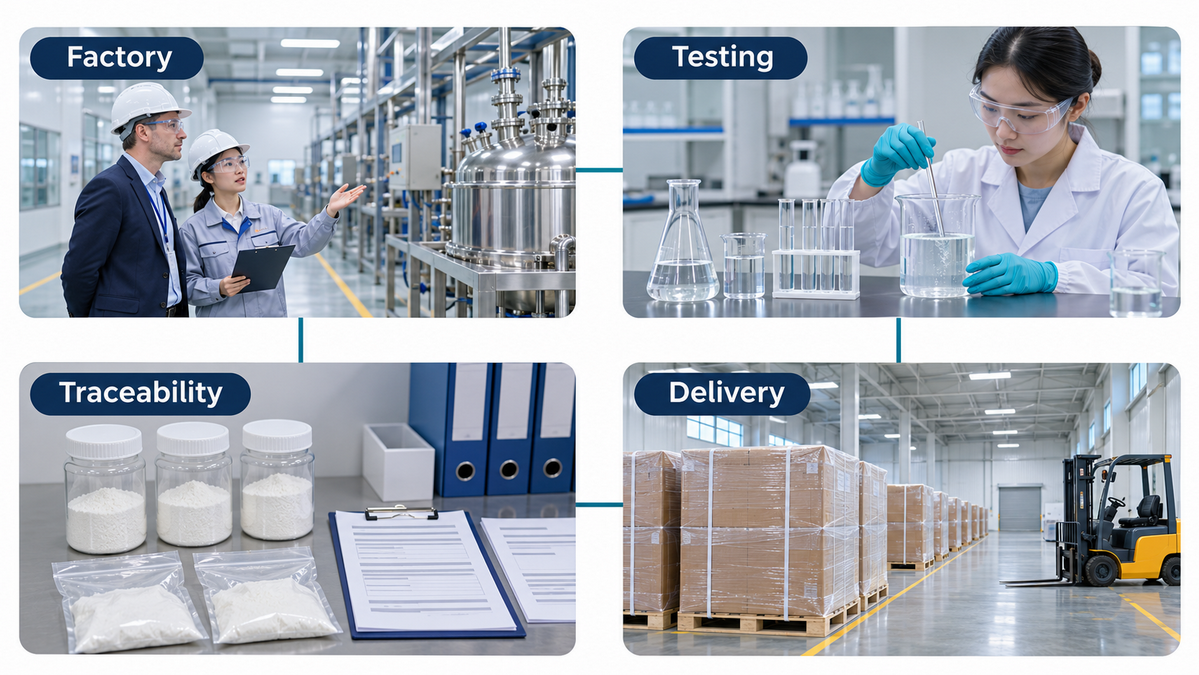
Founded: 2006
Location: Shandong, China
Core portfolio: HPMC, HEMC, and HEC
Market orientation: Domestic and international cellulose ether customers; regional sales proportions are not publicly specified.
Shandong Shengda describes a dual-factory manufacturing model with a combined annual capacity of 60,000 tonnes. Its public profile emphasizes research, production, customized solutions, and pre-sales and after-sales technical support. This gives procurement teams a basis for evaluating both supply scale and application assistance.
For small and medium-sized construction chemical or household-care brands, Shengda is worth evaluating as a potential value-focused partner rather than solely as a bulk powder supplier.
The relevant customization discussion should cover:
- Grade selection against the buyer's existing formulation.
- Agreed viscosity and dissolution characteristics.
- Private-label packaging and documentation.
- Trial-order arrangements and scale-up support.
- A named technical contact and clear response expectations.
Its stated customer-specific support provides a starting point for these discussions, but exact OEM terms, minimum production runs, response times, and pricing advantages require a written quotation. The public profile does not establish that Shengda is cheaper or more flexible than every competing manufacturer.
Buyer qualification priority: request three recent batch COAs, current factory certificates, the proposed production-site address, and a sample-development plan. Evaluate communication efficiency through the completeness and speed of its actual technical response.
Founded: 1992
Location: Zibo, Shandong
Core portfolio: Nonionic cellulose ethers, including HPMC, HEMC, EC, and HEC
Disclosed export markets: The Americas, Europe, Africa, Australia, and other regions.
Shandong Head offers a broad cellulose ether portfolio and downstream HPMC capsule activities. Its website describes nearly 100 cellulose ether varieties, making it relevant to buyers sourcing multiple grades or managing broader industrial portfolios.
Its principal sourcing appeal is product breadth and established international activity. However, different public pages contain different capacity figures, so procurement teams should obtain a current statement distinguishing group capacity, operating site capacity, and available output for the approved grade.
OEM/ODM discussion: prioritize technical-grade selection, customer-specific specification agreements, packaging options, and supply contracts. Do not assume private-label production or bespoke polymer development is available without confirmation.
Buyer qualification priority: identify the responsible business division and confirm that the technical documentation, invoice, and manufacturing site refer to the intended supply chain.
Founded: 2004, according to its trade-event and industry profiles
Location: Feicheng, Shandong
Core portfolio: HPMC, HEMC, and starch ethers
Market orientation: Chinese and overseas customers across building materials and other application sectors.
ETON publicly reports a design capacity of 50,000 tonnes. Its website also identifies participation in drafting GB/T 34263-2017 for industrial HPMC and JC/T 2190-2013 for cellulose ether used in dry-mixed mortar. These disclosures make standards-based technical discussions particularly relevant when evaluating the company.
A CHINACOAT exhibitor profile reports ISO 9001 and REACH-related credentials. Buyers should obtain the underlying documents rather than interpreting an exhibition listing as current certificate verification.
OEM/ODM discussion: application-grade selection and coordinated cellulose ether–starch ether trials are appropriate topics. Private-label scope, exclusivity, and customized production requirements should be negotiated separately.
Buyer qualification priority: ask which published standards apply to the quoted grade and how each shipment's COA demonstrates conformity.
Founded: 2008 as a trading company, according to its corporate history
Location: Jinan, Shandong
Core portfolio: HPMC, HEMC, HEC, and related construction additives
Market orientation: Construction-material and industrial customers; regional revenue shares are not disclosed in the reviewed sources.
LANDU's history distinguishes its trading origins from its current manufacturing position. That distinction matters because buyers should verify the production entity supplying their order rather than assuming the brand's founding date represents uninterrupted operation of a particular factory.
Its HPMC page reports three factories and 75,000 tonnes of annual capacity. The same portfolio includes several additives, so buyers should clarify the product and site coverage of that figure.
OEM/ODM discussion: explore application testing, complementary additive selection, brand-specific packaging, and specification development. Confirm which services occur in-house and which involve affiliated or external facilities.
Buyer qualification priority: obtain the actual manufacturing address and confirm that samples and commercial shipments originate from the same approved source.
Reported establishment: 2003 in a recent company-focused industry release; verify against the business license
Location: Jinzhou, Hebei
Core portfolio: HPMC, MHEC, HEC, and related additives
Market orientation: Construction and other industrial applications, including international supply.
Kingmax's public materials emphasize industrial cellulose ethers. One company website reports 30,000 tonnes of production capacity, while a recent release discusses additional project figures. These numbers should not be combined without checking whether they describe separate plants, projects, or overlapping capacity.
Its associated website lists several certification claims, including "ISO18001." Buyers should request the actual certificate because that wording does not clearly identify a current occupational health and safety management standard.
OEM/ODM discussion: application-grade matching, customized specifications, and packaging arrangements warrant discussion, but the factory should document which changes it can control during production.
Buyer qualification priority: reconcile the legal entity, website contact, certificate holder, production address, and quoted capacity before approval.
Founded: 2005
Location: Linyi, Shandong
Core portfolio: Cellulose ethers, construction additives, concrete admixtures, and other specialty chemicals
Public market activity: China and international markets, with disclosed engagement in the Middle East, Africa, Central Asia, and Pakistan.
Sidley's sourcing appeal lies in its broad construction-additive offering and application-oriented positioning. Its company page reports 50,000 tonnes of overall annual capacity, but does not establish that this is dedicated HPMC capacity.
This makes it relevant for buyers seeking coordinated additive sourcing rather than an isolated HPMC purchase.
OEM/ODM discussion: formulation-support projects, additive compatibility trials, packaging, and customer-specific documentation. Clarify whether a proposed product is manufactured directly by the contracting entity or supplied through another approved plant.
Buyer qualification priority: establish manufacturing responsibility for every quoted product and require traceable COAs for each shipment.
Founded: 2006
Location: Hebei, with disclosed production development in Jinzhou and Xinji
Core portfolio: Construction-focused HPMC and related cellulose ether products
Disclosed export markets: Asia, Africa, Europe, and Latin America, including Russia, Indonesia, Egypt, and Brazil.
Matecel's history describes a second factory established in Xinji in 2011. Its website also states ISO 9001 certification and historical annual cellulose ether exports exceeding 25,000 tonnes. Export volume is not the same as manufacturing capacity and should not be used as a substitute.
The company is a relevant candidate for buyers focused on construction-grade cellulose ether and established export handling.
OEM/ODM discussion: grade matching, order-specific packaging, and distributor documentation. Obtain written confirmation of private-label terms and minimum customized production quantities.
Buyer qualification priority: reconcile the Matecel and Henggu naming used across public pages with the exact legal entity on the business license, contract, and certificates.
Founded: Not reliably established from the reviewed primary profile
Location: Public contact address in Zibo, Shandong; a historical profile also discusses a Bohai New District project
Core portfolio: HPMC, MHEC, HEC, CMC, EC, and related additives
Market orientation: Construction and other industrial applications, with additional food, pharmaceutical, cosmetic, and detergent uses described by the company.
Kima's broad portfolio may suit importers consolidating several cellulose ether requirements. Its historical profile cites 20,000 tonnes of capacity and separately describes a 27,000-tonne plant project. Neither figure should be treated as verified current HPMC availability.
OEM/ODM discussion: viscosity matching, application testing, specification adjustment, and private-label arrangements. Confirm the exact plant and production process behind the proposed grade.
Buyer qualification priority: request the legal establishment date, current operating capacity, product-specific compliance documents, and a clear explanation of the relationship between the listed locations.
Current entity founded: 2018
Heritage positioning: The company website also displays "Since 1993"
Location: Tai'an, Shandong
Core portfolio: HPMC, MC, EC, and MCC
Disclosed market coverage: More than 30 countries, serving construction, pharmaceutical, food, and household-care sectors.
Ruitai illustrates an important procurement distinction: the history of a brand or production operation can predate the current legal entity.
Its website presents cellulose-derivative specialization and research and export activities. Buyers should distinguish manufacturing heritage from present ownership, contracting responsibility, and certification scope.
OEM/ODM discussion: application-specific grade matching, specification agreements, and packaging. Do not assume that suitability in one regulated sector transfers automatically to another.
Buyer qualification priority: obtain a documented explanation connecting the current entity, manufacturing assets, historical business, and proposed certificates.
Manufacturing milestone: A kilotonne-scale methyl cellulose ether site was established in Luzhou in 1999
Disclosed production locations: Luzhou, Sichuan, and Zhangjiagang, Jiangsu
Core positioning: Methyl cellulose ether manufacturing and HEMC process development
Market orientation: Industrial cellulose ether customers; current regional sales distribution is not established from the reviewed profile.
Tianpu's historical profile describes a second production site established in 2002 and cooperation with Hercules in 2007 on HEMC production. It also refers to cellulose-business integration beginning in 2019.
This makes the business relevant as an established cellulose ether manufacturing candidate, but its historical profile is not enough to confirm the present HPMC product range, corporate structure, or operating capacity.
OEM/ODM discussion: begin with current grade availability and technical-equivalence testing before discussing customer-specific packaging or development services.
Buyer qualification priority: confirm the current contracting entity, HPMC production status, available grades, and responsibility for technical support.
Hydroxypropyl Methyl Cellulose is a nonionic cellulose ether whose performance depends on more than nominal viscosity. Polymer characteristics, concentration, temperature, and shear conditions all influence measured solution behavior.
For construction applications, establish acceptance criteria for:
- Water retention in the actual formulation.
- Workability and trowel feel.
- Open-time behavior.
- Slip or sag resistance.
- Setting and strength development.
- Dissolution and mixing consistency.
For household-care applications, extend qualification to solution clarity, hydration behavior, compatibility with the actual surfactant system, and storage stability.
These are proposed purchasing checks, not interchangeable guarantees attached to a particular viscosity grade.
A construction-grade product should not be approved for a sensitive household-care, food, or pharmaceutical use simply because the supplier also sells grades into those sectors.
A specification such as "100,000 mPa·s" is incomplete without a test method.
Agree on:
1. Solution concentration and whether it uses a dry-product basis.
2. Preparation and hydration procedure.
3. Measurement temperature.
4. Instrument type.
5. Spindle and rotational speed where applicable.
6. Reading time and acceptance range.
HPMC solution viscosity changes with concentration, temperature, and shear conditions. Consequently, results from different instruments or preparation methods cannot automatically be compared directly.
For purchasing purposes, use one mutually agreed method to compare the incumbent material, candidate samples, and incoming commercial batches.
ISO 9001 concerns a quality-management system. Certificate verification should establish the holder, standard, active status, scope, manufacturing locations, and accredited issuing body. It does not replace grade-specific testing.
CE marking and RoHS should not be treated as universal environmental certificates for bulk HPMC:
- CE marking applies only where relevant harmonized EU product legislation requires it.
- RoHS regulates restricted substances in electrical and electronic equipment.
- A RoHS-style laboratory report is not a substitute for chemical-market compliance or application suitability.
For European supply, request a product-specific regulatory assessment and appropriate safety documentation. REACH places obligations on companies handling chemicals; a generic "REACH compliant" logo does not explain the legal basis relevant to a particular substance and supply arrangement.
For sustainability claims, ask for measurable evidence covering energy use, wastewater management, emissions, packaging, or a clearly defined product footprint. Treat broad environmental statements as qualification questions, not verified outcomes.
A well-performing sample does not establish how future shipments will be manufactured.
A practical prevention plan is to:
- Record the sample batch number and manufacturing site.
- Obtain samples from three separately produced batches.
- Retain sealed reference samples.
- Define incoming inspection tests.
- Require written notice before changes to the approved grade or production site.
Make these requirements part of the purchase specification rather than relying on informal assurances.
A formulated or modified cellulose ether is not inherently inferior. The problem is an undisclosed composition change that alters performance or contradicts the purchase specification.
Ask whether the product is an unmodified polymer grade or a formulated product. Where composition is commercially confidential, agree on functional limits, analytical checks, and change-notification obligations.
Avoid using whiteness, hand feel, or a single viscosity result as the sole acceptance criterion.
Compare the cost of achieving the required finished-product performance:
HPMC cost per tonne of finished product=HPMC price per tonne×HPMC dosage fra
Then include rejected batches, extra mixing time, laboratory effort, and complaint handling in the commercial assessment.
A lower powder price can lose its advantage if the formulation requires a higher dosage or more corrective work.
A rarely emphasized procurement safeguard is to make the approval site-specific and change-controlled.
For example, the purchase agreement can require approval before changes to:
- Manufacturing location.
- Polymer grade or formulation.
- Surface treatment.
- Agreed analytical method.
- Contracted performance limits.
The point is not to assume wrongdoing. It is to prevent a familiar grade code from becoming an insufficient substitute for a controlled specification.
For long-term contracts, request both routine COA results and periodic application-test results. This creates a stronger control system than repeatedly checking nominal viscosity alone.
Request the business license, factory address, certificate package, production-flow description, and a live factory walkthrough or independent audit.
If a trader or export company participates, identify it openly. The important issue is whether the manufacturing source and responsibility for quality are clear.
Use a staged process:
1. Laboratory screening against the incumbent product.
2. Repeat testing using separate production batches.
3. Pilot-scale production.
4. A controlled commercial trial.
5. Approval of the final specification and reference sample.
For household-care products, include the actual fragrance, preservative, surfactants, and processing conditions rather than testing only a simple aqueous solution.
Request three distinct quotations:
- Available standard grade.
- Private-label packaging of an existing grade.
- A customized grade or new development project.
Each should identify MOQ, manufacturing lead time, packaging lead time, testing requirements, and additional charges.
Agree in writing on:
- Moisture-resistant packaging and liner specifications.
- Batch identification on bags and pallets.
- Clean, dry container inspection.
- Pallet and shipment-weight requirements.
- Documentation responsibilities under the agreed Incoterm.
- Shelf-life and storage instructions.
- Destination-country customs classification and import requirements.
Ask the freight forwarder and customs broker to confirm current requirements before shipment rather than copying the tariff treatment from an earlier order.
The strongest HPMC supplier for a particular buyer is the one that can repeatedly meet the approved application specification, explain its test methods, document its production source, and support predictable commercial deliveries.
Shandong Shengda New Material Co., Ltd. provides a relevant starting point for buyers evaluating a China-based partner with a stated dual-factory production model and customer-specific technical support. Its suitability for an individual program should be established through samples, documents, and a written service scope—not through ranking position alone.
To begin qualification, send Shengda your application, target market, current formulation challenges, viscosity test method, estimated annual demand, and packaging requirements. Request a matched sample proposal, recent batch COAs, current certificates, and separate quotations for standard and customized supply.
Search the certificate number or company name in IAF CertSearch. Check the status, standard, scope, issuing body, and listed locations—not merely the expiry date printed on a PDF. The database distinguishes active, suspended, withdrawn, and expired certificates.
If the record cannot be located or the entity details do not match, contact the issuing certification body directly. Treat an unresolved discrepancy as a qualification gap rather than automatically declaring the certificate fraudulent.
Measured viscosity depends on the polymer and the test conditions, including concentration, temperature, instrument, and shear rate. Matching the printed number therefore does not establish technical equivalence.
Compare both materials using one agreed analytical method and then test them in the intended formulation. Approve the performance window rather than the grade name alone.
Start with a defined product specification and retained reference sample. Have a competent laboratory select appropriate identity, moisture, ash, substitution, or other analytical tests for the suspected issue.
Use the results alongside application testing and batch history. No single visual check or viscosity result can resolve every possible composition question. For modified products, require an agreed declaration and change-control process rather than demanding an inappropriate "pure polymer" specification.
Ask for the operating capacity and available monthly allocation of the approved grade at the approved site.
Then request a delivery plan covering maintenance, peak demand, raw-material interruptions, and inventory. Public figures in this guide vary in scope: some represent design capacity, others broader product portfolios or historical projects. They are not interchangeable measures of available HPMC supply.
Potentially, but approval should be grade-specific. Several manufacturers describe both construction and daily-chemical applications, including Shengda, ETON, and Kima. That portfolio breadth does not establish that a particular construction grade is suitable for a particular household-care formulation.
Request the proposed household-care grade's documentation and test it in the final formulation for hydration, appearance, compatibility, storage behavior, and the relevant safety and impurity requirements.
1. World Bank WITS / UN Comtrade — "China Other cellulose ethers, in primary forms, nes exports by country, 2024." Official trade data for HS 391239; not HPMC-only. [wits.worldbank]
2. MarketsandMarkets — "China Cellulose Ether & Derivatives Market, 2026–2031." Commercial market estimates with a scope distinct from customs statistics. [marketsandmarkets]
3. Shandong Shengda New Material — "About Us." Company history, dual-factory model, product portfolio, reported capacity, and technical-support positioning. [shengdahpmc]
4. Shandong Head Group — Corporate website and company profile; SD Head USA — "Who We Are." Product portfolio, corporate history, capacity disclosures, and export coverage. [sdhead]
5. Shandong ETON — Corporate website; CHINACOAT exhibitor profile; PharmaSources company introduction. Capacity, standards participation, history, applications, and reported credentials. [sdeton]
6. LANDU — "LANDU History" and HPMC product page. Trading origins, product scope, and reported factory capacity. [landu-china]
7. Kingmax Cellulose — Corporate websites and recent company-focused industry release. Product scope, reported capacity, establishment claim, and certification statements. [kaimaoxingfactory]
8. Sidley Chemical — "About Us." Company history, product portfolio, research positioning, and overall capacity. [sidleychem]
9. Henggu Matecel — "About Us" and supplier profile. Company history, factory development, reported certification, and export coverage. [hpmc]
10. Kima Chemical — "Who Is Kima Chemical?" Historical capacity statements, product scope, locations, and application support. [kimachemical]
11. Tai'an Ruitai New Materials — Corporate website. Current entity establishment, heritage positioning, products, and export coverage. [ruitai]
12. Tianpu Chemicals — "Company Profile." Manufacturing milestones, historical capacity, and corporate integration references. [m.en.tianpuchemical]
13. IAF CertSearch — "Verify Certificates Instantly" and certificate-verification guidance. Certificate status, scope, and issuer verification. [iafcertsearch]
14. European Union — "CE Marking"; European Commission — "RoHS Directive"; ECHA — "Understanding REACH." Official explanations of the respective regulatory frameworks. [europa]
15. Celotech — "Viscosity Properties of Hydroxypropyl Methylcellulose." Technical discussion of concentration, temperature, shear, and measurement effects. [celotech]


