


close
Choose Your Site
Global
Social Media
Views: 258 Author: Shengda Publish Time: 2026-10-01 Origin: Site


Content Menu
● What Is Hydroxypropyl Methylcellulose?
● Key Functional Properties of HPMC
>> Thickening and Viscosity Control
● Why HPMC Grade Selection Is Important
>> Main Factors to Consider When Selecting HPMC
● HPMC in Construction Materials
>> HPMC for Wall Putty and Skim Coat
>> HPMC for Exterior Insulation Systems
>> HPMC for Self-Leveling Compounds
● HPMC in Daily Chemical Products
>> HPMC for Shampoo and Body Wash
>> HPMC for Facial Cleansers and Hand Soaps
>> HPMC for Creams and Lotions
>> Practical HPMC Hydration Steps for Daily Chemical Formulations
● HPMC in Pharmaceutical Formulations
● HPMC in Ceramics, Adhesives, and Coatings
>> HPMC for Ceramic Processing
>> HPMC for Adhesives and Sealants
● How to Select a Reliable HPMC Supplier
>> Important Supplier Evaluation Points
>> What is HPMC mainly used for?
>> What does HPMC do in tile adhesive?
>> Is higher-viscosity HPMC always better?
>> Can construction-grade HPMC be used in shampoo or cosmetic gel?
>> What is the difference between HPMC and hypromellose?
>> How can HPMC lumps be prevented during mixing?
Hydroxypropyl Methylcellulose (HPMC), also called hypromellose, is a versatile cellulose ether used to improve water retention, viscosity, workability, stability, film formation, and texture. This guide explains how HPMC performs in construction materials, daily chemical products, pharmaceuticals, food, ceramics, coatings, and other industrial systems, while helping formulators choose the most suitable grade for reliable production results.
Hydroxypropyl Methylcellulose (HPMC) is one of the most widely used cellulose ethers in modern industrial formulations. It is valued for its ability to control water retention, viscosity, consistency, suspension stability, film formation, and application performance.
For manufacturers, HPMC is more than a simple thickener. The right grade can help a tile adhesive maintain open time, allow wall putty to spread smoothly, improve the texture of a detergent, stabilize a personal care gel, or support controlled release in pharmaceutical formulations.
Shandong Shengda New Material Co., Ltd. focuses on the research, development, production, and supply of cellulose ethers for global customers. Our construction-grade and daily chemical-grade HPMC products are designed to support formulation performance, manufacturing efficiency, and stable product quality across different industrial applications.
This article explores the main industrial uses of HPMC, explains how it works in different systems, and provides practical guidance for selecting a suitable HPMC grade.
Hydroxypropyl Methylcellulose is a non-ionic cellulose ether derived from natural cellulose. It is produced by chemically modifying cellulose to introduce methoxy and hydroxypropoxy groups into the molecular structure.
These modifications give HPMC several important functional properties. When properly dispersed and hydrated in water, HPMC can form a polymer network that helps thicken liquids, retain water, stabilize suspended particles, improve workability, and form films after drying.
In pharmaceutical applications, HPMC is commonly called hypromellose. Although the terminology may vary by industry, both names generally refer to the same cellulose ether family.
The performance of HPMC depends on several factors, including viscosity grade, methoxy content, hydroxypropoxy content, particle size, moisture level, dissolution behavior, and compatibility with other materials in the formulation.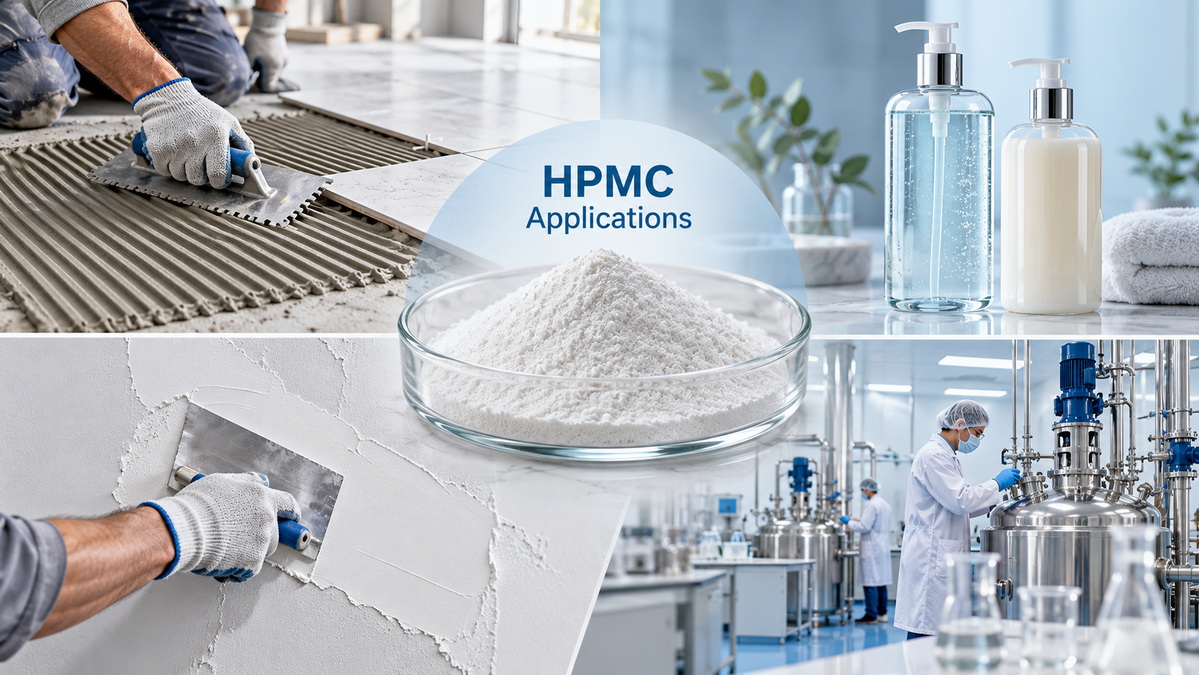
HPMC is widely used because one ingredient can provide several performance benefits at the same time.
Water retention is especially important in cement-based and gypsum-based building materials. HPMC helps keep water in the mixture for a longer period, allowing cement or gypsum to hydrate more effectively.
Better water retention can improve workability, reduce premature drying, support bonding strength, and help produce a smoother surface.
HPMC can increase the viscosity of water-based formulations. This makes it useful in tile adhesive, wall putty, shampoo, detergent, cream, gel, coating, and adhesive systems.
The degree of thickening depends on the HPMC grade, dosage, temperature, mixing conditions, and other ingredients in the formula.
Rheology describes how a material flows, spreads, levels, or resists sagging. HPMC helps formulators manage these properties.
For example, a tile adhesive needs enough body to prevent tiles from slipping on vertical surfaces. A self-leveling compound needs controlled flow without excessive separation. A shampoo needs a smooth texture that can be poured easily but does not feel overly thin.
Some HPMC grades can form a continuous film after drying. This makes the material useful in coatings, pharmaceutical tablet films, personal care products, paper coatings, and specialty industrial formulations.
HPMC can help bind powders, particles, or active ingredients together. This benefit is important in ceramic processing, tablets, dry-mix building materials, coatings, and some adhesive systems.
In liquid formulations, HPMC can help reduce settling or separation. It can support the suspension of pigments, mineral particles, exfoliating beads, active ingredients, and other insoluble components.
Many buyers choose HPMC by checking viscosity only. While viscosity is important, it should not be the only selection criterion.
Two HPMC products with a similar nominal viscosity may behave differently in a finished formulation. Differences in substitution level, particle size, hydration speed, surface treatment, manufacturing consistency, and compatibility may lead to different results.
For example, an HPMC grade suitable for cement-based tile adhesive may not be appropriate for shampoo or cosmetic gel. A fast-dispersing daily chemical grade may not provide the water retention required for a dry-mix mortar system.
| Selection Factor | Why It Matters | Typical Impact |
|---|---|---|
| Viscosity grade | Controls thickening and formulation body | Affects mortar consistency, gel texture, and liquid stability |
| Water retention | Helps maintain moisture in mineral systems | Supports cement hydration, open time, and adhesion |
| Dissolution behavior | Influences mixing efficiency and hydration speed | Helps prevent lumps and incomplete dispersion |
| Particle size | Affects dispersibility and processing time | Influences batch consistency and production efficiency |
| Substitution level | Influences solubility and rheology | Helps optimize performance in different applications |
| Compatibility | Determines interaction with other ingredients | Reduces separation, instability, and unexpected viscosity changes |
| Intended use | Determines technical and documentation requirements | Important for construction, daily chemical, food, and pharmaceutical products |
The most reliable approach is to test HPMC in the complete formulation rather than evaluating it only in water.
Construction is one of the largest application areas for Hydroxypropyl Methylcellulose. Construction-grade HPMC is commonly used in dry-mix mortar products because it can improve water retention, workability, consistency, and application efficiency.
Cement-based materials can lose water quickly because of evaporation, substrate absorption, wind, high temperature, or rapid cement hydration. When water is lost too early, the material may become difficult to apply, develop weak adhesion, crack, or show surface defects.
HPMC helps manage this process by holding water in the system for a longer time.
Tile adhesive requires a carefully balanced formula. It must spread smoothly, hold tiles in position, provide sufficient open time, and develop reliable bonding performance after curing.
In cement-based tile adhesive, HPMC can help improve:
- Water retention
- Open time
- Troweling performance
- Wet adhesion
- Anti-slip performance
- Consistency during application
- Cement hydration support
A properly selected HPMC grade can help installers apply adhesive more evenly and place tiles with greater flexibility. This is especially valuable in warm, dry, or highly absorbent construction environments.
However, excessive HPMC dosage may create an overly sticky formulation or reduce flow. The best result comes from balancing HPMC with cement, fillers, redispersible polymer powder, starch ether, defoamer, and other additives.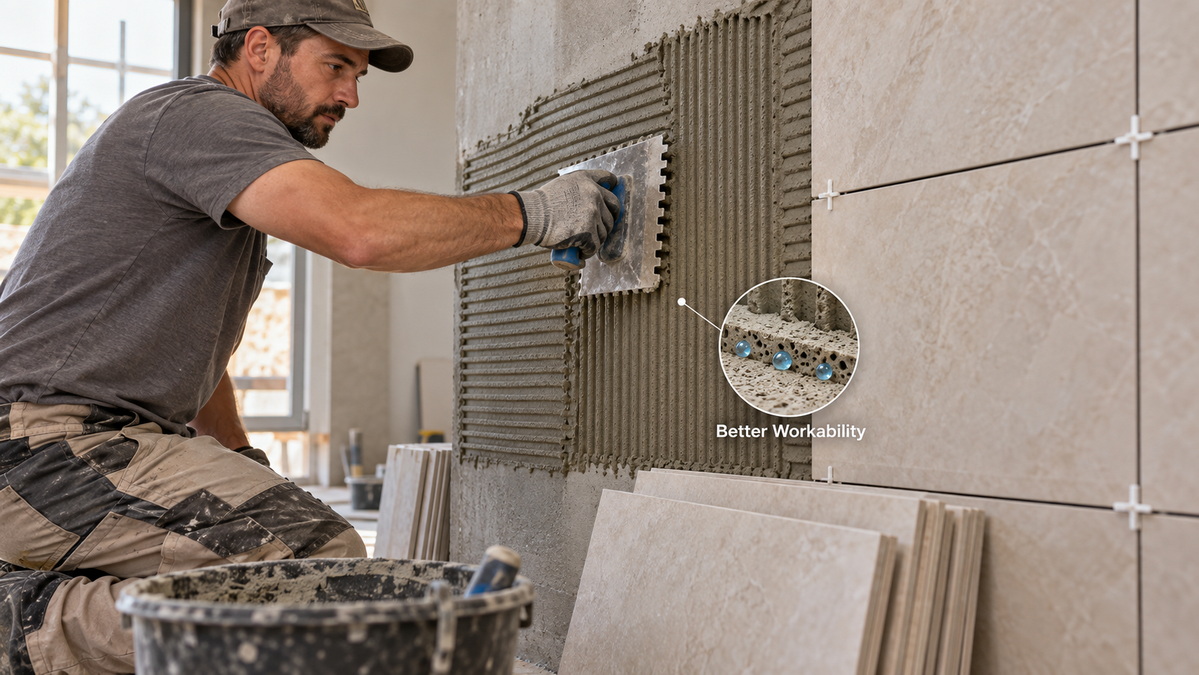
Wall putty and skim coat products need smooth application, strong adhesion, controlled drying, and a clean final surface. HPMC helps the material retain moisture and remain workable during application.
A suitable HPMC grade can improve:
- Smooth troweling performance
- Leveling ability
- Water retention
- Open time
- Surface finish
- Reduced cracking tendency
- Improved adhesion to the substrate
- More consistent workability between batches
When developing wall putty, manufacturers should avoid simply increasing HPMC dosage to solve every problem. Excessive dosage may increase stickiness, reduce sanding performance, or raise formulation cost without delivering proportional benefits.
Testing should include water retention, application feel, leveling, drying behavior, sanding, adhesion, cracking resistance, and surface smoothness.
Gypsum plaster requires good workability and controlled water management. HPMC can support smooth mixing, improve application consistency, and help maintain workable time.
In gypsum-based systems, HPMC may help reduce rapid water loss and improve the ability of the plaster to spread across walls and ceilings. It can also contribute to a more uniform surface appearance after application.
The final performance depends on the gypsum quality, retarder system, filler composition, lightweight aggregate, air entrainment, and local environmental conditions.
Exterior insulation and finish systems require stable basecoat and finish formulations. These materials need good workability, strong adhesion, controlled sag resistance, and reliable performance under changing outdoor conditions.
HPMC can support rheology control and application consistency in these systems. It may also help maintain workable time during installation.
Manufacturers should evaluate compatibility with polymer modifiers, mineral fillers, fibers, pigments, and other additives before finalizing the formulation.
Self-leveling compounds require a different balance from tile adhesive or wall putty. They need to flow easily, spread across the floor, and create a smooth surface without excessive settling or bleeding.
HPMC may help manage water and improve stability, but too much thickening can reduce flow. The formulation should maintain enough fluidity to level properly while avoiding separation of cement, sand, fillers, and other ingredients.
Important performance tests include:
1. Flowability after mixing.
2. Flow retention over time.
3. Surface leveling quality.
4. Segregation resistance.
5. Bleeding control.
6. Setting time.
7. Compressive strength.
8. Surface hardness and finish.
Daily chemical-grade HPMC is used in a wide range of personal care and household products. Common applications include shampoo, body wash, facial cleanser, liquid hand soap, shower gel, lotion, cream, toothpaste, styling gel, and other water-based formulations.
HPMC can help increase viscosity, improve stability, enhance texture, support suspension, and create a more pleasant consumer experience.
Shampoo and body wash products need a stable texture, good appearance, smooth pouring performance, and acceptable viscosity throughout their shelf life.
HPMC can help improve the body and consistency of surfactant-based formulations. It may also support the suspension of selected ingredients and improve the overall sensory profile.
When formulating shampoo or body wash with HPMC, manufacturers should consider:
- Surfactant type and concentration.
- Electrolyte or salt level.
- pH range.
- Fragrance compatibility.
- Preservative system.
- Colorant stability.
- Temperature resistance.
- Freeze-thaw stability.
- Long-term viscosity stability.
A product that looks stable immediately after production may still separate, lose viscosity, or become cloudy after storage. Stability testing is therefore essential before commercial production.
Facial cleansers and hand soaps often require a balance between cleansing performance and a soft, smooth texture. HPMC can help create a more refined rheology profile and reduce the perception of excessive thinness.
It can also help support formula stability when products contain moisturizing ingredients, botanical extracts, beads, pigments, or other suspended materials.
The final result depends on the interaction between HPMC and the surfactant system. Small changes in salt concentration, pH, or active ingredient content may significantly affect viscosity.
In creams and lotions, HPMC can contribute to viscosity, body, spreadability, and product texture. It may also help improve the uniformity of some emulsion systems.
A well-designed HPMC-containing cream should feel smooth, spread easily, remain stable during storage, and maintain a consistent appearance. The material should be evaluated with oils, emulsifiers, humectants, preservatives, fragrances, actives, and other polymers in the final formula.
For emulsions, formulators should test for:
- Viscosity stability.
- Separation resistance.
- Appearance.
- pH stability.
- Centrifuge stability.
- High-temperature storage stability.
- Low-temperature storage stability.
- Freeze-thaw stability.
- Consumer sensory performance.
HPMC can be used in clear or translucent gel systems, depending on the formulation and ingredient compatibility. It can help create a smooth, stable gel structure with controlled flow.
Clear gel production requires careful attention to mixing order and hydration conditions. Incorrect processing may create lumps, fish-eyes, incomplete hydration, or uneven viscosity.
The correct method depends on the selected grade, but the following process can help reduce dispersion problems:
1. Confirm the recommended hydration method for the selected HPMC grade.
2. Prepare the water phase with controlled agitation.
3. Add HPMC gradually into the moving liquid.
4. Avoid adding HPMC directly into stagnant water.
5. Allow sufficient time for full dispersion and hydration.
6. Add surfactants, salts, fragrances, preservatives, and actives according to the intended sequence.
7. Check viscosity, pH, appearance, and stability before approving the batch.
The addition sequence should always be optimized through laboratory trials because each formula behaves differently.
In pharmaceutical applications, HPMC is often known as hypromellose. It is used in tablets, capsules, film coatings, ophthalmic preparations, oral liquids, and controlled-release dosage forms.
One important application is the hydrophilic matrix tablet. When the tablet comes into contact with fluid, HPMC hydrates and forms a gel layer around the tablet. This gel layer can help regulate water penetration and influence the release of active ingredients.
The performance of HPMC in pharmaceutical products depends on several factors:
- Polymer grade.
- Viscosity.
- Particle size.
- Drug solubility.
- Tablet hardness.
- Tablet shape.
- Compression force.
- Other excipients.
- Coating composition.
- Dissolution conditions.
Pharmaceutical-grade HPMC requires strict quality control, traceability, specification management, and application-specific evaluation. General industrial HPMC should not be used as a substitute for pharmaceutical-grade material.
HPMC is also used in selected food applications where it can support texture, thickening, film formation, moisture management, and stability.
Food-grade HPMC may be considered for applications such as:
- Gluten-free bakery products.
- Batter and coating systems.
- Thickened foods.
- Reduced-fat formulations.
- Emulsified food systems.
- Texture-modified foods.
- Film-forming applications.
- Stabilized beverage and dessert systems.
In gluten-free bakery products, HPMC can help improve dough handling and support structure development during baking. In some reduced-fat applications, it may contribute to mouthfeel and texture.
Food applications require careful evaluation of destination-market regulations, purity criteria, permitted usage conditions, labeling requirements, and customer specifications.
HPMC also supports performance in several specialty industrial applications.
In ceramic processing, HPMC may be used as a binder, thickener, and rheology modifier. It can help improve green strength, shaping consistency, and suspension stability.
Ceramic manufacturers may use HPMC in extrusion, casting, glazing, and other forming processes. The selected grade should be tested for compatibility with clay, minerals, pigments, and firing conditions.
In water-based adhesive and sealant systems, HPMC can help improve viscosity, cohesion, and application consistency.
The best grade depends on the type of polymer, filler loading, substrate, drying speed, and required bonding performance. Laboratory testing should include viscosity stability, bonding strength, open time, and drying behavior.
HPMC can be used in textile printing pastes to control viscosity and improve print performance. It may help maintain paste consistency and improve pattern definition.
The final formulation should be evaluated for screen performance, color behavior, print sharpness, bleeding control, and compatibility with dyes or pigments.
HPMC may be used in selected coating systems where thickening, water retention, film formation, or rheology control is required.
Potential applications include water-based coatings, paper coatings, specialty coatings, and certain industrial surface treatments. The material should be selected according to the specific coating chemistry and application method.
Selecting an HPMC supplier involves more than comparing price and viscosity values. Consistent raw material quality is essential for reducing production risks and maintaining stable formulation performance.
A reliable supplier should understand the intended application and provide clear technical information for each grade.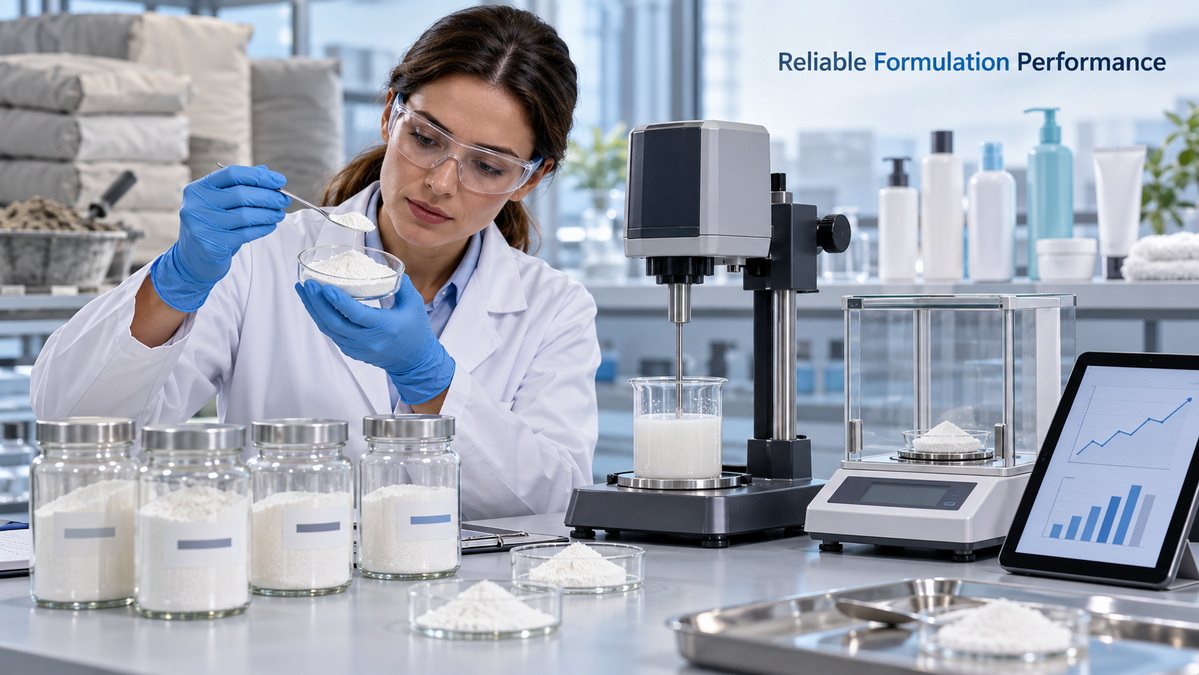
- Detailed technical data sheets.
- Clear viscosity testing conditions.
- Batch-specific certificates of analysis.
- Stable quality control procedures.
- Moisture and ash information.
- Particle size information where relevant.
- Water-retention information for construction-grade products.
- Application guidance for mortar or daily chemical systems.
- Sample support for laboratory testing.
- Batch traceability.
- Consistent packaging and storage recommendations.
- Clear shelf-life information.
- Technical communication during formulation development.
The best supplier relationship is based on application understanding. When buyers share their formulation system, target performance, climate conditions, production equipment, and common problems, the supplier can provide more accurate grade recommendations.
Hydroxypropyl Methylcellulose is a high-value cellulose ether with broad industrial applications. It can improve water retention, viscosity, stability, workability, film formation, binding, and suspension performance in a wide range of systems.
In construction materials, HPMC supports tile adhesive, wall putty, skim coat, gypsum plaster, exterior insulation systems, and self-leveling compounds. In daily chemical products, it can improve the texture, stability, and usability of shampoo, body wash, facial cleanser, lotion, cream, gel, and liquid soap.
HPMC also plays an important role in pharmaceutical formulations, food products, ceramics, adhesives, textile printing, and specialty coatings.
The most effective HPMC solution depends on the complete formulation, not on viscosity alone. Testing the material under real production conditions is essential for achieving stable quality, efficient processing, and reliable end-product performance.
For construction-grade and daily chemical-grade HPMC solutions, Shandong Shengda New Material Co., Ltd. can support product selection, technical discussion, sample evaluation, and formulation development based on your application requirements.
HPMC is mainly used as a water-retention agent, thickener, binder, film former, and rheology modifier. It is widely used in tile adhesive, dry-mix mortar, wall putty, gypsum plaster, shampoo, body wash, creams, gels, pharmaceuticals, food products, ceramics, coatings, and adhesives.
HPMC helps tile adhesive retain water, improve workability, extend open time, support cement hydration, improve wet adhesion, and reduce tile slip on vertical surfaces.
No. Higher viscosity may improve thickening and water retention in some systems, but it may also create excessive stickiness, reduce flow, slow mixing, or negatively affect application performance. The right grade depends on the complete formulation.
Construction-grade HPMC should not automatically be used in shampoo, gel, lotion, or other personal care products. Daily chemical applications require grades selected for the intended formulation, quality expectations, and market requirements.
HPMC and hypromellose refer to the same cellulose ether family. "Hypromellose" is commonly used in pharmaceutical contexts, while "HPMC" is widely used in industrial, construction, personal care, and commercial applications.
Lumps can be reduced by using the correct hydration method, adding HPMC gradually under controlled agitation, avoiding direct addition into stagnant water, allowing enough hydration time, and following the correct ingredient addition sequence.
HPMC should be stored in a cool, dry, and clean environment. The material should remain protected from moisture, direct sunlight, damaged packaging, and contamination. Bags should be sealed properly after opening to maintain consistent powder quality.
1. Kima Chemical. "[What Are the Industrial Uses of Hydroxypropyl Methylcellulose?]"
Original reference article reviewed for topic coverage and content expansion.
2. United States Pharmacopeia. "[Hypromellose—USP–NF Monograph]"
Reference for the definition and composition of hypromellose as a mixed methyl and hydroxypropyl ether of cellulose.
3. Li, C. L., Martini, L. G., Ford, J. L., and Roberts, M. "[The Use of Hypromellose in Oral Drug Delivery]." *Journal of Pharmacy and Pharmacology*, 2005.
Reference for HPMC applications in oral drug delivery and controlled-release matrix systems.
4. Mašková, E., Kubová, K., Raimi-Abraham, B. T., Vllasaliu, D., Vohlídalová, E., and Turánek, J. "[Hypromellose—A Traditional Pharmaceutical Excipient with Modern Applications in Oral and Oromucosal Drug Delivery]." *Journal of Controlled Release*, 2020.
Reference for modern pharmaceutical applications of hypromellose.
5. World Health Organization / FAO Joint Expert Committee on Food Additives. "[Hydroxypropylmethyl Cellulose: JECFA Database Entry]."
Reference for hydroxypropyl methylcellulose, CAS No. 9004-65-3, and INS 464.
6. European Commission. "[Food and Feed Information Portal: Hydroxypropyl Methyl Cellulose]."
Reference for the E464 designation of hydroxypropyl methylcellulose in food-related contexts.
7. European Commission. "[CosIng Cosmetic Ingredient Database]."
Reference database for cosmetic ingredient information and relevant regulatory references.


