


close
Choose Your Site
Global
Social Media
Views: 222 Author: Shengda Publish Time: 2026-04-14 Origin: Site


As a formulation consultant working with global food brands, I have seen hydroxypropyl methylcellulose (HPMC) quietly become one of the most important "invisible" ingredients behind successful gluten-free, low‑fat and plant‑based launches. When used correctly, HPMC not only stabilizes formulations and improves texture, but also supports safer, more consistent products that meet strict regulatory and consumer expectations. [fda]
Hydroxypropyl methylcellulose is a semi‑synthetic cellulose ether produced by modifying plant‑derived cellulose with methyl and hydroxypropyl groups, which makes it water‑soluble and highly functional in food systems. It is odorless, tasteless, and non‑ionic, so it is compatible with many food ingredients and maintains stable viscosity over a wide pH range. [sciencedirect]
From an applications perspective, HPMC behaves like a multifunctional tool: thickener, stabilizer, emulsifier, film‑former, water‑binder, and gluten replacer, depending on grade and dosage. Because it has minimal impact on flavor, formulators can significantly upgrade mouthfeel, stability, and shelf life without changing the product's core sensory identity. [gushwork]

In day‑to‑day formulation work, HPMC is used because it solves multiple technical problems at once. [fda]
- Thickener and gelling agent: Provides viscosity in liquids and semi‑solids, and can form heat‑induced gels in some systems, improving body and stability in sauces, gravies, desserts, and beverages. [gushwork]
- Water retention: Binds and retains moisture in doughs, batters, and processed meats, helping keep bread soft, cakes moist, and cooked products juicy for longer. [fda]
- Film‑forming and coating: Forms transparent, flexible films on confectionery and tablets, improving gloss, reducing stickiness, and protecting sensitive cores from moisture and oxygen. [gushwork]
- Stabilizer and emulsifier: Helps prevent oil–water separation in dressings and mayonnaise and reduces sedimentation in beverages by increasing continuous‑phase viscosity and forming protective hydrated layers around dispersed droplets. [fda]
- Texture and mouthfeel modifier: Enhances creaminess in low‑fat dressings and sauces and contributes elasticity and chewiness in noodles, bakery, and plant‑based meats. [gushwork]
- Fat replacer: In reduced‑fat formulations, it partially mimics the lubricity and body of fat while lowering overall fat content. [fda]
- Gluten replacer: In gluten‑free doughs, it helps hold gas, stabilize crumb structure, and delay staling, compensating for the absence of gluten. [gushwork]
For manufacturers, this combination of roles often means one well‑selected HPMC grade can replace multiple individual stabilizers, simplifying recipes and technical risk. [fda]
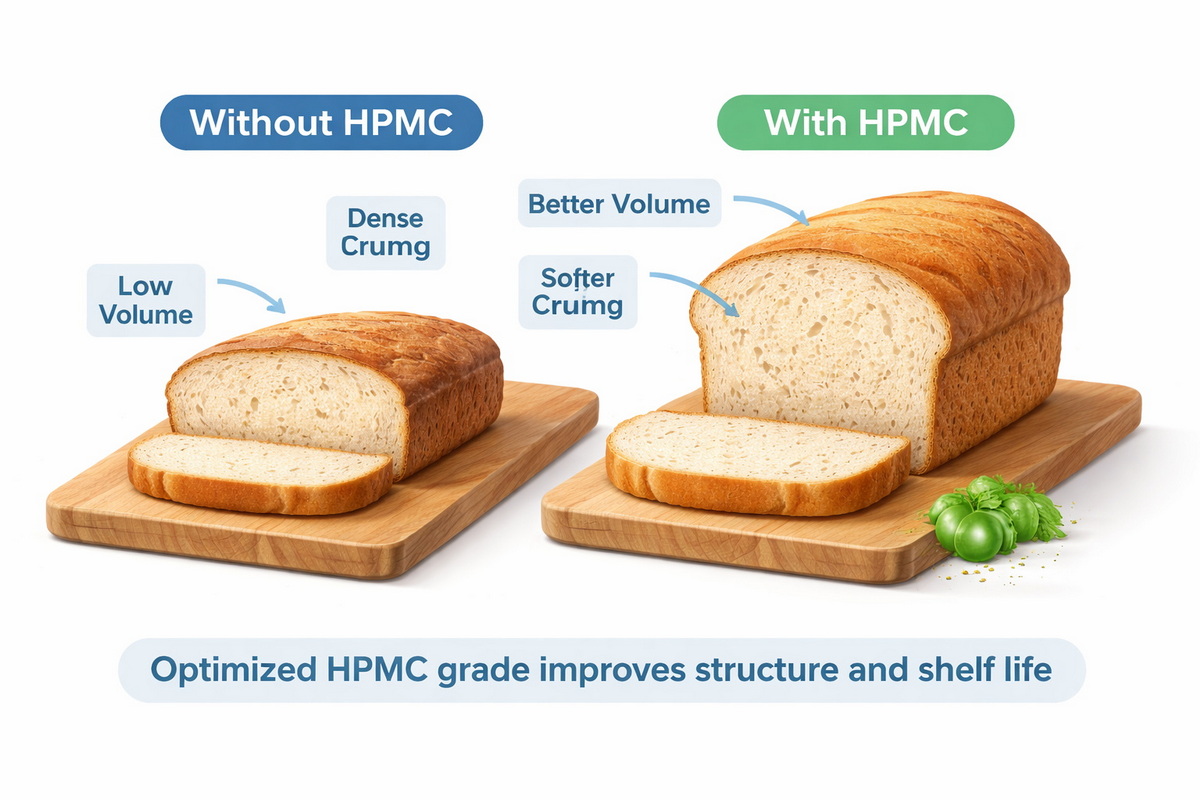
In bread, cakes, biscuits, and pastries, HPMC is primarily used for structure, moisture management, and shelf life. [gushwork]
- In wheat breads, it enhances loaf volume, improves crumb fineness, and reduces cracking and breakage during slicing and handling. [gushwork]
- In gluten‑free breads and high‑fiber bakery, it provides viscosity and gas‑holding capacity, resulting in higher volume and softer crumb over time. [fda]
- In cakes and muffins, it reduces baking weight loss and keeps the crumb moist and resilient throughout shelf life. [gushwork]
From pilot tests I have supported, moving from a simple starch‑only gluten‑free recipe to one that includes an optimized HPMC grade typically delivers visibly better volume and reduced day‑2 hardness, even without major process changes. [gushwork]
In dairy desserts, flavored milks, protein drinks, and plant‑based beverages, HPMC serves as a viscosity builder and physical stabilizer. [gushwork]
- Improves creaminess and "coating" sensation in the mouth, especially where fat levels are low or proteins are high. [gushwork]
- Reduces phase separation and sedimentation of cocoa, protein, or flavor particles, keeping the drink visually uniform and pleasant to consume. [gushwork]
- Helps stabilize proteins during shelf life, particularly in high‑protein ready‑to‑drink formats. [gushwork]
In plant‑based milks, carefully selected low‑viscosity grades can provide the subtle body consumers expect from dairy while keeping labels plant‑derived and familiar. [gushwork]
Sauces and dressings must combine processability (pumping, filling, heat processing) with long‑term stability and sensory appeal. [fda]
- HPMC allows formulators to tune smooth, spoonable or pourable textures that are heat‑stable and freeze–thaw tolerant in many systems. [gushwork]
- It supports reduced‑oil recipes by compensating for the lost viscosity and mouthfeel traditionally provided by fat. [mavrk]
- It helps dressings withstand chilled storage without phase separation or syneresis. [gushwork]
Compared with some starches, HPMC tends to produce cleaner, less pasty mouthfeel in delicate sauces, especially when reheated. [gushwork]
In confectionery, the film‑forming ability of HPMC is central. [fda]
- Provides glossy, protective coatings for candies, chewing gum centers, and nutraceutical tablets. [gushwork]
- Reduces stickiness and moisture pickup in high‑sugar or acid products during storage and transport. [gushwork]
- Protects flavors, colors, and active ingredients, extending shelf life and maintaining appearance. [gushwork]
This is especially valuable in export markets where products must endure long, humid logistics chains.
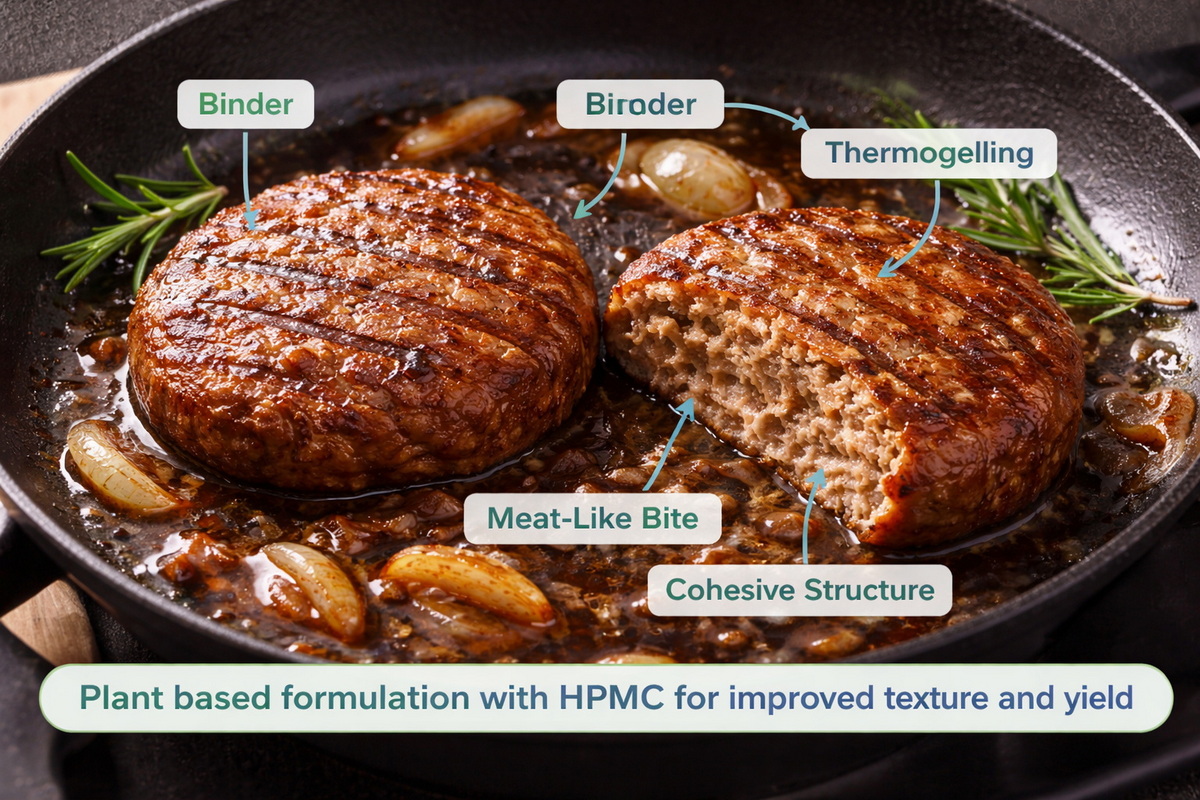
In sausages, patties, hams, and plant‑based analogues, HPMC is prized for water management and texture. [gushwork]
- In meat products, it enhances elasticity, sliceability, juiciness, and yield by retaining water and stabilizing fat–water distribution. [gushwork]
- In plant‑based burgers, sausages, and nuggets, it functions as a key binder and thermogelling agent, helping build meat‑like bite and cohesive structure when combined with proteins and fibers. [gushwork]
For plant‑based R&D teams, the ability of HPMC to set during heating and then relax during cooling is often crucial to achieving convincing "bite" without animal ingredients. [gushwork]
HPMC has been evaluated by authorities such as the FDA, EU bodies, and JECFA as a permitted food additive. Toxicological data show low toxicity, no significant genotoxicity, and limited gastrointestinal absorption, so it behaves largely like a non‑digestible fiber. [sciencedirect]
- In the United States, HPMC is an approved direct and indirect food additive under specific CFR provisions. [sciencedirect]
- In the EU, it is authorized as a food additive under defined purity and use conditions. [sciencedirect]
- JECFA evaluations have supported its use across food, pharma, and supplement applications. [sciencedirect]
When used within established good manufacturing practice (GMP) and applicable maximum levels, regulators consider HPMC safe for repeated consumption in everyday foods. [sciencedirect]
Some consumers are cautious about any "E‑number" or modified ingredient, and critics may view HPMC as a marker of "ultra‑processed" foods. Typical concerns include: [sciencedirect]
- Perception that cellulose ethers are overly synthetic
- Fears of allergies or digestive issues in sensitive individuals
Current evidence suggests HPMC has low allergenic potential and is generally well tolerated, but brands should still communicate transparently, emphasize plant origin, and keep usage tied to a clear functional purpose. Positioning HPMC alongside more familiar terms such as "plant‑based stabilizer" in educational content can improve understanding without being misleading. [sciencedirect]
From a technical buyer's perspective, understanding how HPMC compares with HEMC and HEC helps optimize performance and cost. [gushwork]
Cellulose ethers in food applications
| Aspect | HPMC | HEMC | HEC |
|---|---|---|---|
| Main substitution | Methoxy + hydroxypropyl groups gushwork | Methoxy + hydroxyethyl groups gushwork | Hydroxyethyl groups only gushwork |
| Typical food roles | Thickener, stabilizer, emulsifier, film‑former, gluten replacer gushwork | Mainly thickener/stabilizer; food use still limited in many markets gushwork | Thickener and rheology modifier, especially in beverages and sauces gushwork |
| Thermal behavior | Shows thermal gelation, key for bakery and meat analogues gushwork | Also thermogelling but with different gel temperatures gushwork | Primarily viscous, weak or no gel network gushwork |
| Core industries | Food, pharma, personal care, construction gushwork | Construction, detergents, some food gushwork | Beverages, sauces, personal care, paints gushwork |
For most bakery and plant‑based meat projects, HPMC remains the first choice due to its thermogelling properties and broader regulatory acceptance. HEC and certain HEMC grades are more suitable where a purely viscous liquid thickener is required without gel strength. [sciencedirect]
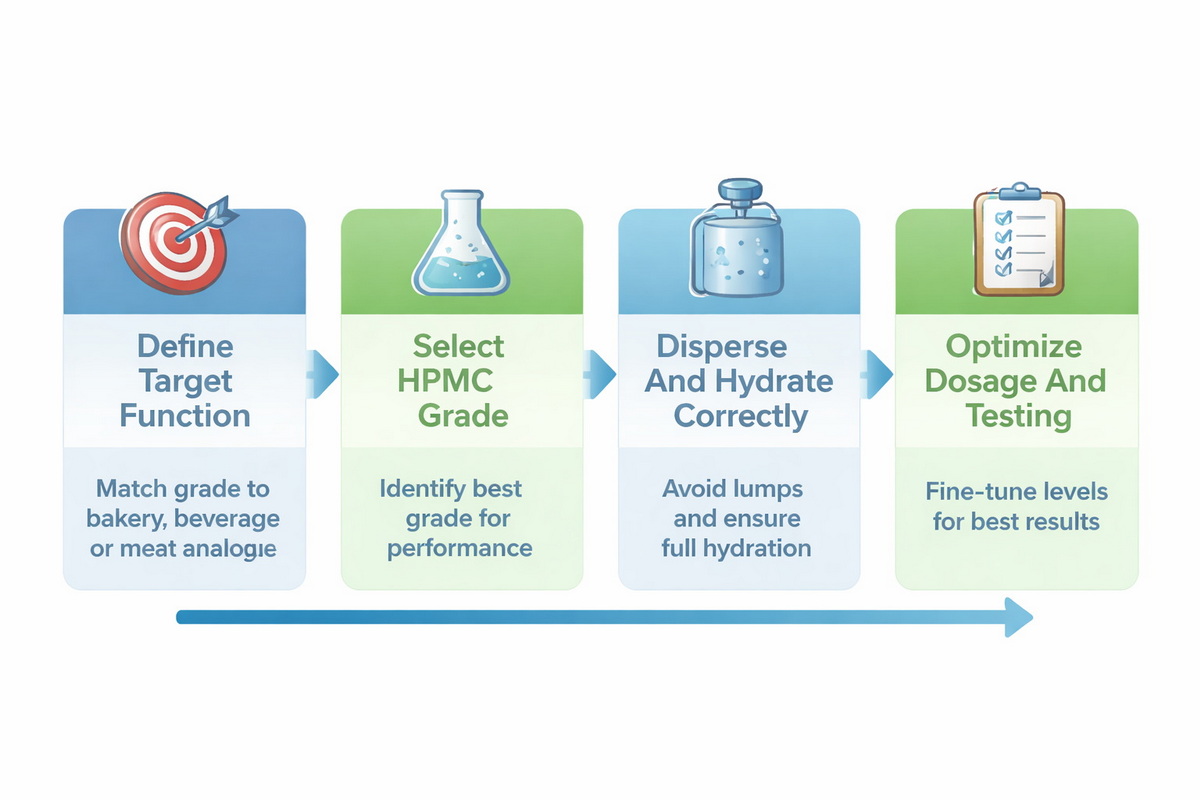
Based on typical development workflows, a structured approach prevents common pitfalls such as poor dispersion or over‑thickening. [fda]
Clarify what you need HPMC to do:
- Thickening and body (sauce, beverage)
- Gluten replacement (bread, cake)
- Film/coating (confectionery, tablets)
- Water retention and yield (meat, plant‑based meat)
This drives grade selection and dosage from the start. [gushwork]
- Use lower‑viscosity grades for beverages and easily pumpable sauces.
- Use medium‑to‑high viscosity grades for bakery, fillings, processed meats, and plant‑based analogues where structure and gel strength matter. [cyhuagong]
- Check the substitution pattern and gelation temperature in relation to your heating and cooling profile (baking, extrusion, retorting). [gushwork]
Working with a specialist manufacturer like Shandong Shengda New Material Co., Ltd. ensures access to multiple food‑grade viscosities and technical support tailored to your process. [shengdahpmc]
To avoid lumps and incomplete hydration:
1. Premix HPMC powder with other dry ingredients such as sugar, flour, or starch to dilute local concentration. [gushwork]
2. Add the dry blend slowly into cold or ambient water under vigorous agitation. [gushwork]
3. Allow sufficient time for hydration before heating, especially in systems that will cross the HPMC gelation temperature. [gushwork]
This simple protocol is one of the biggest differences between lab success and plant‑scale problems.
- Start with the lower end of recommended ranges for each application and increase in small steps while observing viscosity, processability, and sensory impact. [fda]
- Adjust other hydrocolloids and starches so you are not over‑structuring the system or inflating cost‑in‑use. [gushwork]
- Test under real conditions: mixing, heating, cooling, freezing, storage, and distribution. [gushwork]
Careful sensory and shelf‑life evaluation at pilot scale is essential before full rollout.
HPMC use is growing fastest in applications where plant‑based, gluten‑free, and "better‑for‑you" claims intersect with high expectations for texture and stability. [mavrk]
- Gluten‑free bakery: Better volume, softness, and delayed staling at acceptable cost and process complexity. [gushwork]
- High‑protein and functional beverages: Stabilizing proteins, managing viscosity, and preventing sedimentation while enabling higher protein loads. [sciencedirect]
- Plant‑based meat and dairy: Building convincing bite and creaminess without animal ingredients. [shengdahpmc]
At the same time, regulatory and scientific communities continue to refine risk‑management frameworks for additives in general, ensuring their use remains safe and aligned with evolving consumer expectations. [sciencedirect]
For food manufacturers, ingredient performance is only as reliable as the supply partner behind it. When evaluating HPMC suppliers, consider: [shengdahpmc]
- Dedicated food‑grade production lines and consistent quality control
- A broad portfolio of HPMC, HEMC, and HEC grades covering bakery, beverages, sauces, and meat/analogue applications [cyhuagong]
- Application labs that can support formulation trials, troubleshooting, and scale‑up [shengdahpmc]
- Documentation support for regulatory, halal, kosher, and sustainability requirements [fda]
Shandong Shengda New Material Co., Ltd., as a specialized cellulose‑ether manufacturer, focuses on delivering stable quality and technical guidance for both construction‑grade and food/household‑care‑grade cellulose products, supporting global brands in building high‑performance, compliant formulations. [shengdahpmc]
If you are developing gluten‑free bakery, high‑protein beverages, or plant‑based meat and dairy alternatives, HPMC should be on your shortlist of strategic ingredients. By partnering with a specialized cellulose‑ether manufacturer like Shandong Shengda New Material Co., Ltd., you can tap into application expertise, multiple tailored grades, and global supply capabilities to shorten development time and reduce formulation risk. [shengdahpmc]
You can contact our technical team to discuss your specific formulations, request tailored HPMC samples for bakery, beverage, or plant‑based projects, and obtain detailed application guides and regulatory support for your target markets. [shengdahpmc]
Yes. Regulatory and scientific evaluations indicate that HPMC has low toxicity, is not significantly absorbed in the gut, and is considered safe when used within food‑additive regulations and good manufacturing practice. [sciencedirect]
HPMC is essentially tasteless and odorless, so its primary impact is on texture, viscosity, and stability rather than flavor; in most products, consumers do not notice it directly. [fda]
Gluten‑free doughs lack the viscoelastic gluten network, so HPMC provides viscosity, gas‑holding capacity, and crumb stability, supporting higher loaf volume and slower staling. [fda]
Yes. It is widely used as a binder and texture builder in plant‑based burgers, sausages, and nuggets, where its thermogelling properties help create a cohesive, meat‑like bite and juiciness. [shengdahpmc]
HPMC is a plant‑derived cellulose ether with strong functional benefits, but some markets still view it as a processed additive; brands should assess local expectations, dosage levels, and communication strategy when targeting strict clean‑label claims. [sciencedirect]
1. Kimachemical. "Why is hydroxypropyl methylcellulose in food?" (Jan 15, 2024).
https://www.kimachemical.com/news/why-is-hydroxypropyl-methylcellulose-in-food/ [fda]
2. Shandong Shengda New Material. "Hydroxypropyl Methylcellulose in Food: Uses, Benefits, Safety and Practical Formulation Guide." (Feb 13, 2026).
https://www.shengdahpmc.com/hydroxypropyl-methylcellulose-in-food-uses-benefits-safety-and-practical-formulation-guide.html [gushwork]
3. U.S. Food and Drug Administration. "Understanding How the FDA Regulates Food Additives and GRAS Ingredients." (2024).
https://www.fda.gov/food/food-additives-and-gras-ingredients-information-consumers/understanding-how-fda-regulates-food-additive [fda]
4. Rowe, R. C. et al. "Safety assessment of hydroxypropyl methylcellulose as a food ingredient." Food and Chemical Toxicology (2007).
https://www.sciencedirect.com/science/article/abs/pii/S027869150700261X [sciencedirect]
5. Wikipedia. "Hypromellose."
https://en.wikipedia.org/wiki/Hypromellose [gushwork]
6. Gushwork. "Food Manufacturer SEO Strategies to Increase Leads." (2026).
https://www.gushwork.ai/blog/seo-for-food-manufacturing-companies [gushwork]
7. MAVRK Studio. "Top 8 SEO Tips for Food and Beverage Brands." (2025).
https://mavrk.studio/seo-for-food-and-beverage/ [mavrk]
8. Cyhuagong.
http://www.cyhuagong.com/content/?229.html [cyhuagong]
9. ScienceDirect Topics. "Hydroxypropyl methylcellulose – Overview."
https://www.sciencedirect.com/topics/chemistry/hydroxypropyl-methylcellulose [gushwork]
10. ScienceDirect. "Progress and Challenge in the Risk Management of Food Additives." (2025).
https://www.sciencedirect.com/science/article/pii/S0362028X25001590 [sciencedirect]


