


close
Choose Your Site
Global
Social Media
Views: 222 Author: Shengda Publish Time: 2026-05-27 Origin: Site


Decorative plaster color floating is one of those frustrating defects that can quietly ruin an otherwise attractive wall finish. In most formulations, HEMC and HPMC both help control water retention, rheology, and workability, but they do not always perform the same when pigment stability and surface uniformity matter most. [efful]

Decorative plaster is judged not only by strength and adhesion, but also by visual consistency. When color floating occurs, pigments migrate unevenly during drying or application, creating blotches, streaks, or a washed-out surface. In high-value architectural finishes, that defect can mean rework, product complaints, and loss of trust. [efful]
From a formulation perspective, the main job of a cellulose ether is to help the mortar hold water, stabilize viscosity, and keep the mix workable long enough for proper finishing. That is why the HEMC vs. HPMC decision becomes important: both influence open time and rheology, but the best choice depends on how the plaster sets, how the pigment is dispersed, and the environmental conditions during application. [linkedin]
Color floating happens when the colored components in a decorative plaster separate or move toward the surface at different rates than the rest of the mix. It is often linked to excess water, poor dispersion, unstable rheology, or uneven drying. Once the surface starts skinning over while moisture is still moving inside, pigments can shift and create a non-uniform appearance. [linkedin]
In practical terms, color floating is not just a "color problem." It is a structure and moisture-management problem. If the additive package cannot keep water distributed evenly and keep the mix stable during finishing, the visual result suffers even when the plaster technically hardens correctly. [linkedin]
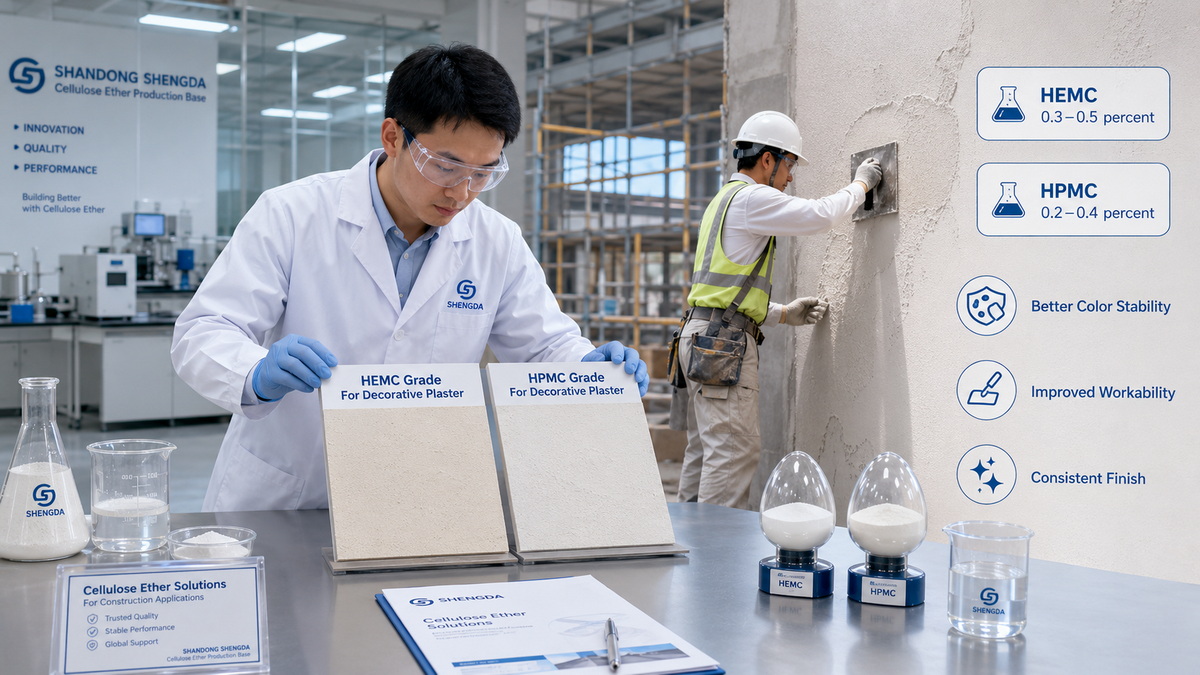
HEMC and HPMC are both non-ionic cellulose ethers widely used in construction materials, including mortars, plasters, tile adhesives, and putties. They improve water retention, thickening, adhesion, and workability, which are all critical in decorative plaster systems. [hnxbntech]
Their chemical difference lies in the side groups attached to the cellulose backbone. That difference affects solubility, gel behavior, thickening profile, and heat sensitivity, which in turn influences how the plaster behaves during spreading, setting, and surface finishing. [efful]
The most important distinction for decorative plaster is not simply "which is stronger," but which creates a more stable finish window. HEMC is often valued for strong water retention and excellent sag resistance, while HPMC is widely preferred for balanced performance, broad compatibility, and smoother application. [tenessy]
HEMC is often a strong candidate when a formula needs high water retention, stable rheology, and excellent vertical anti-sag performance. In high-temperature or fast-drying conditions, that stability can help reduce surface defects caused by premature moisture loss. [tenessy]
From a color-finish standpoint, HEMC can help because it supports a more controlled drying process and a more uniform wet film. That said, if the formula traps too much air or is not well dispersed, color floating can still happen. So HEMC is helpful, but it is not a cure-all. [linkedin]
HPMC is often favored in decorative plaster because it delivers a very balanced combination of water retention, open time, smooth application, and compatibility with other additives. In many practical formulations, this balance makes it easier to achieve a uniform finish with fewer application-related defects. [chinayidahpmc]
For color floating specifically, HPMC can perform very well when the goal is consistent surface leveling and stable pigment distribution. Its broad use in construction mortars comes from exactly that kind of practical reliability. [celixhpmc]
For most decorative plaster systems, HPMC is usually the safer default choice for minimizing color floating, especially when the finish depends on even pigment distribution, predictable workability, and broad formulation compatibility. [chinayidahpmc]
However, HEMC can outperform HPMC in hot, dry, or high-sag environments where rapid moisture loss or poor vertical stability would otherwise increase color defects. In other words, HPMC is often better for overall finish consistency, while HEMC is often better when environmental stress is the main enemy. [tenessy]
- Choose HPMC when you want a balanced decorative plaster with smoother application and strong general resistance to uneven finish.
- Choose HEMC when you need stronger stability under heat, dryness, or vertical application stress.
- If color floating is your top issue, the final answer depends on the whole formula, not just the cellulose ether type. [efful]
Color floating is rarely caused by one ingredient alone. Pigment type, filler size distribution, mixing energy, water ratio, redispersible polymer powder, defoamer selection, and drying conditions all play a role. Cellulose ether is a major lever, but it works best as part of a system-level formulation strategy. [linkedin]
This is especially important in decorative plasters, where pigments are part of the aesthetic value. A formula that looks acceptable in lab trials can still fail on site if the substrate is too absorbent, the temperature is too high, or the applicator adds extra water during finishing. [linkedin]
Based on industrial practice, here are the most useful rules when trying to prevent color floating in decorative plaster:
1. Keep the water demand as low as possible while preserving workability.
2. Choose a cellulose ether that supports stable rheology, not just high viscosity.
3. Match the product to climate conditions, especially temperature and humidity.
4. Avoid over-air-entrainment, because excessive microbubbles can affect surface appearance.
5. Test pigment compatibility in the exact dry-mix system, not in isolation. [linkedin]
In our experience as a cellulose ether manufacturer, the best results come when formulators evaluate open time, anti-sag behavior, and pigment uniformity together. A plaster that is easy to apply but visually unstable is still a failed product in the market. [sdshengda.en.made-in-china]
| Property | HEMC | HPMC | Relevance to Color Floating |
|---|---|---|---|
| Water retention | Very strong efful | Very strong tenessy | Helps reduce uneven drying |
| Anti-sag performance | Excellent efful | Good to excellent tenessy | Stabilizes vertical surfaces |
| Workability | Stable and smooth hnxbntech | Very balanced chinayidahpmc | Improves finish control |
| Heat resistance | Strong efful | Strong efful | Important in hot climates |
| Pigment uniformity support | Strong under stress efful | Strong in balanced systems chinayidahpmc | Directly affects appearance |
| Best use case | Hot, dry, demanding jobs tenessy | General decorative plaster systems chinayidahpmc | Depends on project conditions |
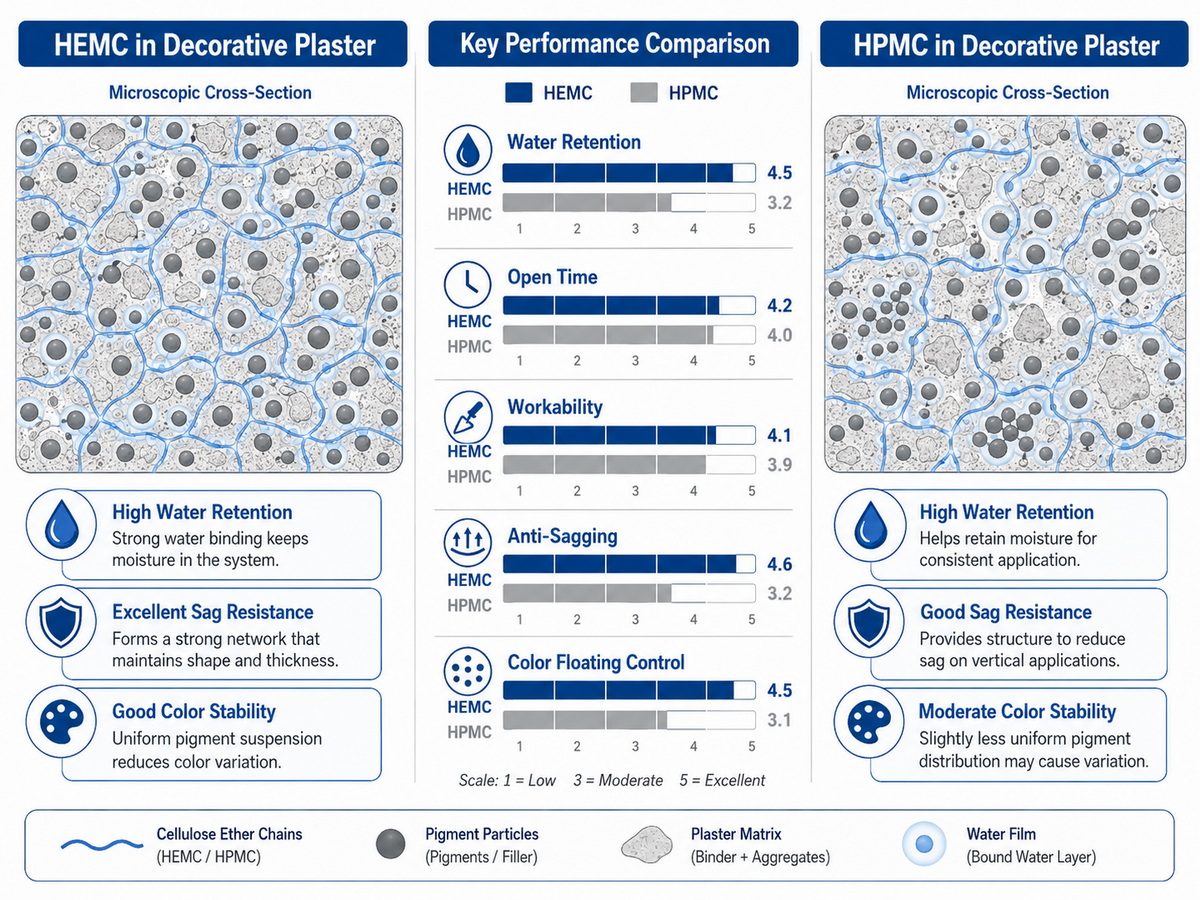
If your decorative plaster is used in a standard indoor environment, HPMC is often the first formulation choice because it offers a reliable balance of workability and finish quality. If the product is designed for high-temperature construction, exterior walls, or highly absorbent substrates, HEMC may provide better stability and reduce visual defects. [chinayidahpmc]
For premium decorative plasters, many manufacturers also test small formulation adjustments such as:
- Slight viscosity tuning.
- Filler grading optimization.
- Pigment dispersion improvement.
- Defoamer balancing.
- Open-time control under real climate conditions. [linkedin]
As a manufacturer focused on HEMC and HPMC research, development, production, and sales, Shandong Shengda New Material Co., Ltd. is well positioned to support customers who need more than a generic material spec. The right cellulose ether selection should be based on the actual plaster system, climate, substrate, and visual target—not only on viscosity grade. [sdshengda.en.made-in-china]
That is the core advantage of working with a technical supplier: you get formulation guidance, not just a product. For global decorative plaster producers, that can shorten trial cycles and improve launch success. [sdshengda.en.made-in-china]
If your decorative plaster is struggling with color floating, poor surface uniformity, or inconsistent finish quality, start by evaluating the cellulose ether system first. Request a tailored HEMC/HPMC recommendation from the technical team and test it against your exact pigment, filler, and climate conditions. [sdshengda.en.made-in-china]
No. HEMC is often better in hot or difficult environments, but HPMC is usually stronger as an all-around solution for finish consistency and broad compatibility. [tenessy]
No. Higher viscosity can help stability, but color floating also depends on water ratio, pigment dispersion, drying speed, and the rest of the formulation. [linkedin]
Yes. Pigment particle size, density, and dispersion quality all influence whether the color stays uniform during drying and finishing. [linkedin]
HEMC often performs very well in hot weather because it supports strong water retention and stable rheology under thermal stress. [efful]
No. Cellulose ether is important, but it works best with proper filler grading, water control, pigment selection, and mixing procedure. [linkedin]
1. https://efful.com/newsinfo/8555291.html
2. [TENESSY — HPMC vs HEMC: Which is Better for Your Project?]
3. [Shandong Shengda New Material Co., Ltd. on LinkedIn]
4. [Shandong Shengda New Material Co., Ltd. on Made-in-China]


