


close
Choose Your Site
Global
Social Media
Views: 222 Author: Shengda Publish Time: 2026-04-15 Origin: Site


Hydroxypropyl methylcellulose (HPMC) is a water‑soluble, nonionic cellulose ether derived from natural cellulose and modified through alkalization and etherification. [wotaichem]
Because it combines plant origin with engineered performance, it has become a core functional additive in construction materials and daily chemical products worldwide. [kimachemical]
In practice, I see HPMC as the "invisible engineer" in formulations: it controls water, viscosity, and workability, while helping manufacturers hit consistent quality standards batch after batch. [hpmc]

In both building materials and personal care products, HPMC is primarily used as: [kemoxcellulose]
- Thickener and rheology modifier for precise viscosity control. [hpmc]
- Water‑retention agent to keep moisture in cementitious or aqueous systems. [wotaichem]
- Binder and film‑former, improving adhesion and surface properties. [celotech]
- Stabilizer to prevent segregation, sedimentation, or phase separation. [kemoxcellulose]
For formulators, this translates into more predictable performance, easier production control, and fewer complaints from end users. [celotech]
In construction‑grade (building‑grade) applications, properly selected HPMC can: [wotaichem]
- Improve workability and cohesion of mortars and tile adhesives. [hpmc]
- Increase water retention, extending open time and curing quality. [wotaichem]
- Enhance adhesion and bonding strength between mortars, tiles, and substrates. [celotech]
- Reduce sagging on vertical surfaces through better thixotropy and sag resistance. [hpmc]
- Boost crack resistance by increasing flexibility and tensile strength. [celotech]
From the job‑site perspective, contractors experience easier troweling, fewer tile slips, and more stable curing—directly affecting project efficiency and defect rates. [wotaichem]
As a formulation consultant, I've seen that the biggest ROI from HPMC in construction comes from a few high‑impact applications. [kemoxcellulose]
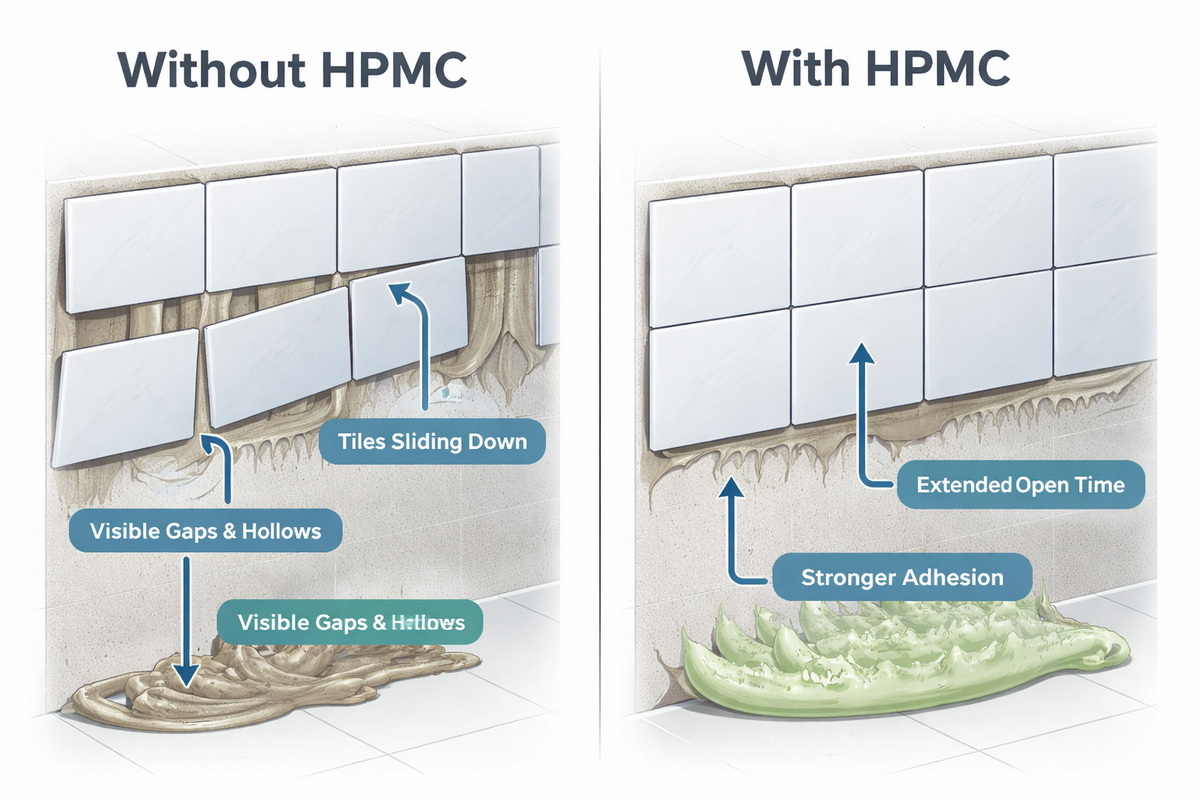
In cement tile adhesives, HPMC is now considered a standard additive rather than an option. [hpmcfactory]
Main benefits: [hpmcfactory]
- Extended open time: HPMC forms a thin film that reduces water evaporation so tilers have more time to adjust tiles. [hpmcfactory]
- Increased tensile adhesion strength due to sufficient water for cement hydration. [hpmcfactory]
- Better workability and spreadability, improving application speed and surface coverage. [hpmcfactory]
- Superior sag resistance, especially on vertical walls and large‑format tiles. [wotaichem]
From a user‑experience viewpoint, this directly reduces tile hollowing, sliding, and rework, which are among the most common site complaints. [hpmcfactory]
In dry‑mix systems (plaster, skim coat, repair mortar), construction‑grade HPMC: [kemoxcellulose]
- Improves cohesion, preventing segregation and bleeding of the mix. [hpmc]
- Ensures smooth trowel feel and uniform layer thickness. [celotech]
- Maintains water in the system, enabling proper cement hydration and strength development. [hpmc]
Result: more durable and aesthetically uniform surfaces with fewer cracks and surface defects. [celotech]
In self‑leveling compounds, grouts, and specialty mortars, suitable HPMC grades help: [kemoxcellulose]
- Balance flow and leveling with anti‑segregation stability. [kemoxcellulose]
- Optimize set time and early strength development through controlled water retention. [wotaichem]
- Improve long‑term durability and resistance to environmental stress. [wotaichem]
Here, minor adjustments in HPMC viscosity and dosage can dramatically change floor flatness and curing behavior—something professionals quickly notice on site. [kemoxcellulose]
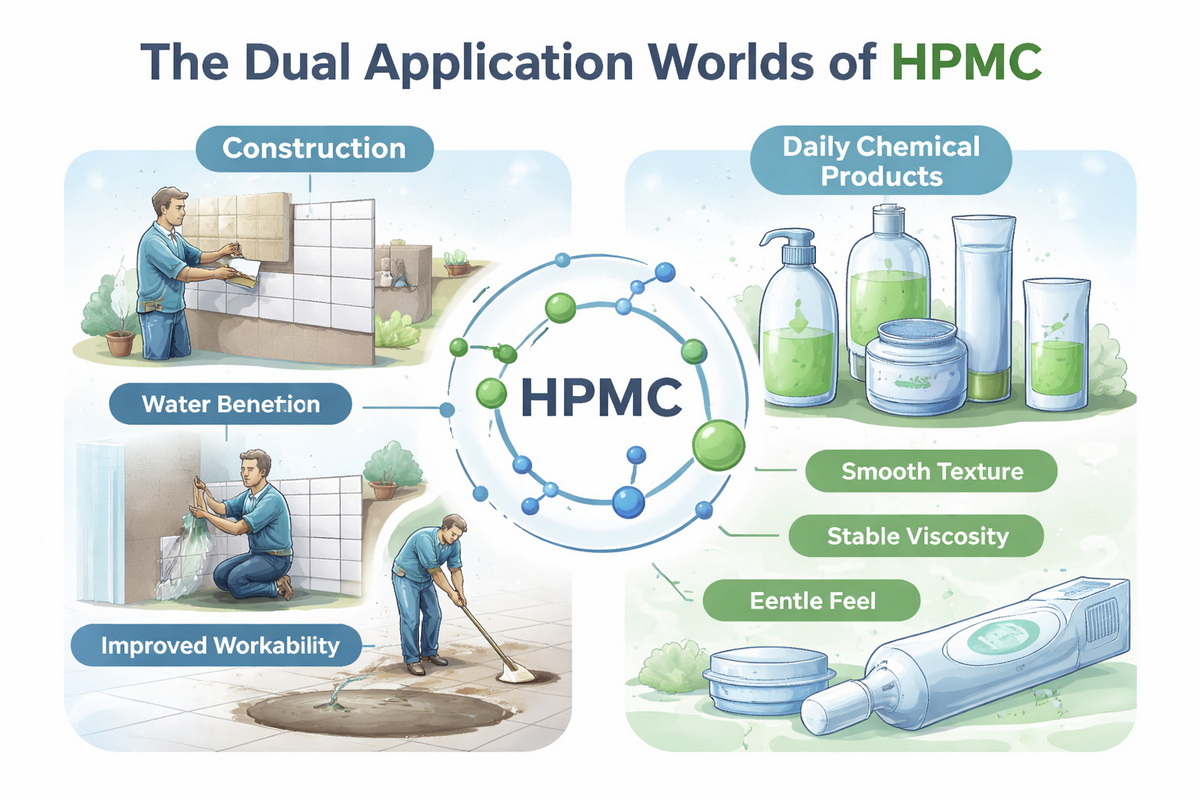
While construction applications are highly visible, cosmetic and household formulators also rely on HPMC for stability and sensory control. [kimachemical]
Daily‑chemical grade HPMC is used as a thickener, film‑former, and stabilizer in: [kemoxcellulose]
- Shampoos and body washes for viscosity and foam stability. [kemoxcellulose]
- Lotions, creams, and gels for texture and spreadability. [kemoxcellulose]
- Toothpastes and oral‑care products as a binder and thickener. [kemoxcellulose]
- Decorative cosmetics (foundations, mascaras) for suspension and film formation. [kemoxcellulose]
Its nonionic nature and plant origin make it a gentle choice that fits clean‑label and "green" positioning in many brands. [kimachemical]
Compared with many synthetic thickeners, HPMC often offers: [kemoxcellulose]
- Smooth, non‑sticky skin feel with customizable viscosity profiles. [kemoxcellulose]
- Good compatibility across a wide pH range and with common surfactants. [kemoxcellulose]
- Stable performance under typical storage and transport conditions. [kemoxcellulose]
For formulators, this simplifies scale‑up and reduces instability issues like phase separation or viscosity drift during shelf life. [kemoxcellulose]
Even though HPMC comes from cellulose, the manufacturing route is a precise chemical process that strongly affects performance. [wyatt]
Typical industrial HPMC production involves: [wotaichem]
- Alkalization: natural cellulose reacts with an alkaline solution, activating hydroxyl groups. [wotaichem]
- Etherification: the activated cellulose reacts with etherifying agents (such as methyl chloride and propylene oxide) to introduce methyl and hydroxypropyl groups. [wotaichem]
- Neutralization: the reaction is stopped and the product is stabilized. [wotaichem]
- Purification: washing and filtration remove residual chemicals and by‑products. [wotaichem]
Each stage influences viscosity, substitution pattern, and final functional performance, so experienced manufacturers guard their process control closely. [wyatt]
Construction‑grade HPMC is typically available in viscosity ranges from a few hundred to over 200,000 mPa·s, each suited to different systems. [kemoxcellulose]
Higher viscosity grades generally provide stronger water retention and thickening, while lower viscosity grades favor flow and leveling. [kemoxcellulose]
Matching viscosity, substitution level, and particle size to a customer's exact formulation is where expertise and application testing become essential. [hpmc]
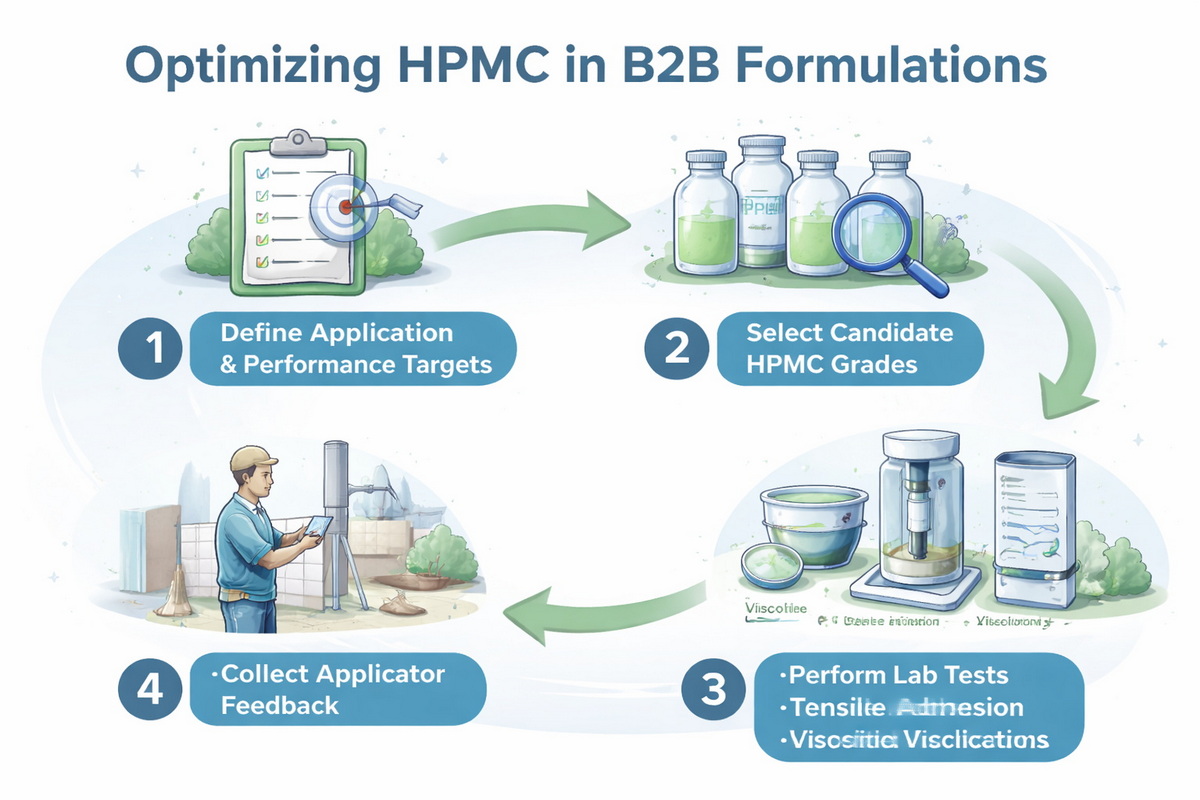
Based on field projects and lab work with global customers, a structured selection process works best. [hpmcfactory]
Start with three fundamental questions: [hpmc]
1. What is the application? (tile adhesive, skim coat, self‑leveling, shampoo, lotion, etc.) [hpmcfactory]
2. Which properties are critical? (open time, sag resistance, pumpability, skin feel, clarity, etc.) [wotaichem]
3. What processing conditions apply? (mixing equipment, water temperature, climate at job site or market region). [hpmc]
With these clarified, an experienced supplier can recommend a shortlist of grades for lab and pilot‑scale evaluation. [hpmc]
Typical steps during trials: [hpmcfactory]
- Start within recommended dosage ranges from technical data sheets for similar systems. [wotaichem]
- Adjust water content and mixing protocol to prevent lumping and ensure full dissolution. [hpmcfactory]
- Run standardized tests (open time, sag, tensile adhesion, viscosity curves) and record data across HPMC grades. [wotaichem]
This test‑and‑refine loop usually leads to a narrow dosage window where performance and cost are optimized. [wotaichem]
You can use a simple checklist when benchmarking HPMC grades in tile adhesive: [hpmcfactory]
- Mixing time until lump‑free slurry
- Pot life and open time
- Vertical slip/sag measurement
- Tensile adhesion after standard curing
- Workability feedback from applicators
Putting applicator feedback and lab data side by side gives the most realistic picture of field performance. [hpmcfactory]
HPMC sits at the intersection of performance, safety, and sustainability, and recent trends are raising the bar for suppliers. [hpmc]
Because HPMC is derived from renewable plant‑based cellulose and is non‑toxic, it aligns well with green‑building and clean‑beauty narratives. [hpmc]
At the same time, customers increasingly expect consistent quality, low impurities, and transparent documentation for compliance and eco‑labeling. [wyatt]
Beyond supplying powder, leading HPMC producers now provide: [wotaichem]
- Application‑oriented R&D and joint formulation development. [wotaichem]
- Guidance on regional standards and test methods for mortars and adhesives. [celotech]
- On‑site or remote troubleshooting when formulations are scaled to new markets. [wotaichem]
From an industry perspective, this technical partnership has become a decisive factor in supplier selection for large construction and daily‑chemical brands. [celotech]
| Aspect | Construction‑Grade HPMC | Daily‑Chemical‑Grade HPMC |
|---|---|---|
| Main role | Water retention, thickening, adhesion, sag control hpmc | Thickening, film formation, stabilization kemoxcellulose |
| Typical products | Tile adhesive, dry‑mix mortar, self‑leveling, grouts hpmc | Shampoo, lotion, toothpaste, cosmetics kemoxcellulose |
| Key performance targets | Open time, workability, crack resistance, durability hpmc | Viscosity, skin feel, texture, shelf stability kemoxcellulose |
| Viscosity range (mPa·s) | ~400–200,000 depending on system kemoxcellulose | Broad range; often medium viscosity for feel kemoxcellulose |
| End‑user experience | Easier troweling, less sag, stronger bonding hpmcfactory | Pleasant feel, consistent texture, no phase separation kemoxcellulose |
From the perspective of experience and trust (E‑E‑A‑T), choosing a specialized HPMC partner matters as much as choosing the right grade. [wellows]
A dedicated cellulose‑ether producer with focused R&D and application labs can: [hpmc]
- Tailor construction‑grade and daily‑chemical‑grade HPMC to your exact formulation. [hpmc]
- Support multi‑market compliance and provide stable quality over long‑term supply. [wyatt]
- Co‑develop new products that meet emerging standards in performance and sustainability. [celotech]
For global customers, this combination of material science, process control, and application expertise is what ultimately secures consistent, scalable performance in the field. [rocketagency.com]
If you are optimizing tile adhesive, upgrading dry‑mix mortars, or developing new daily‑chemical formulations, now is the right time to review your HPMC strategy. [celotech]
Share your current formulation, target properties, and regional standards with a specialized HPMC manufacturer, and request tailored grade recommendations plus lab‑scale evaluation support. [hpmc]
By combining high‑quality HPMC with expert technical guidance, you can deliver more reliable products, reduce complaint rates, and strengthen your position in demanding global markets. [celotech]
Yes, HPMC is considered non‑toxic and is widely used in construction, food, pharmaceuticals, and cosmetics when produced and applied according to relevant standards. [kimachemical]
You should consider your application type, desired workability or sensory profile, and process conditions, then conduct lab trials with several viscosity grades recommended by your supplier. [wotaichem]
HPMC mainly influences water retention and workability, and while it can indirectly impact setting behavior, final setting time is usually managed through cement type and set modifiers. [celotech]
Not always; many brands use HPMC in combination with other polymers or gums to balance clarity, feel, and cost, so complete replacement should be validated through stability and consumer tests. [kemoxcellulose]
Exact dosage depends on formulation and grade, but manufacturers usually provide recommended ranges and test methods that help you identify the optimal addition level. [hpmcfactory]
1. WOTAIchem – "What is Cellulose Ether? Ultimate Guide to Its Properties and Manufacturing Process." https://wotaichem.com/what-is-cellulose-ether/ [wotaichem]
2. Kima Chemical – "Why Use Hydroxypropyl Methylcellulose?" https://www.kimachemical.com/news/why-use-hydroxypropyl-methylcellulose/ [kimachemical]
3. HPMC.com – "Construction Grade HPMC Hydroxypropyl Methylcellulose Advantages." https://www.hpmc.com/company-news/construction-grade-hpmc-hydroxypropyl.html [hpmc]
4. HPMC Factory – "HPMC for Tile Adhesive CAS9004‑65‑3." https://www.hpmcfactory.com/product-for-tile-adhesive.html [hpmcfactory]
5. WOTAIchem – "HPMC for Tile Adhesive | Superior Bonding for Construction." https://wotaichem.com/hpmc-for-tile-adhesive/ [wotaichem]
6. Celotech – "Construction Grade HPMC: Benefits in Tile Adhesives & Dry‑Mix Mortars." https://www.celotech.com/news/advantages-of-hpmc-in-building-materials-and-tile-adhesives/ [celotech]
7. Kemox Cellulose – "Understanding the Different HPMC Grades and Their Applications." https://www.kemoxcellulose.com/hpmc-grades-and-their-applications/ [kemoxcellulose]
8. Rocket Agency – "E‑E‑A‑T & SEO Content Best Practices in 2026." https://rocketagency.com.au/blog/eeat-and-content-best-practices [rocketagency.com]
9. Wellows – "E‑E‑A‑T Checklist for SEO." https://wellows.com/blog/e-e-a-t-checklist/ [wellows]
10. OHO – "Top SEO Strategies for Authoritative Content." https://www.oho.com/blog/seo-strategy-healthcare-content-marketers [oho]


