


close
Choose Your Site
Global
Social Media
Views: 265 Author: Shengda Publish Time: 2026-11-04 Origin: Site


Content Menu
● HPMC vs HEMC: What Their Chemical Differences Mean
>> Why Matching Viscosity Is Not Enough
● How HPMC and HEMC Influence Air Entrainment
>> 1. Mixing Introduces Air into the Mortar
>> 2. Interfacial Activity Helps Stabilize Bubbles
>> 3. Rheology Slows Bubble Movement and Drainage
● HPMC vs HEMC Air Entrainment: A Practical Comparison
>> An Important Evidence Limitation: HEC Is Not HEMC
● Why Air Content Changes Mortar Performance
>> Workability and Fresh Density
>> Surface Finish and Durability
● What Published Data Reveal About HEMC and Air Control
● A More Reliable HPMC vs HEMC Testing Protocol
>> Step 1: Define Application-Specific Acceptance Criteria
>> Step 2: Standardize Materials and Mixing
>> Step 3: Run Two Different Comparisons
>> Step 4: Track Air Over Time
>> Step 5: Validate Hardened Performance
● Troubleshooting Excessive Air Without Losing Water Retention
>> Use Defoamers as Part of the Formulation
● Selecting Cellulose Ethers with Shandong Shengda
>> Does HPMC Always Entrain More Air Than HEMC?
>> Can Higher Viscosity Increase Air Retention?
>> Does Higher Air Content Always Reduce Adhesion?
>> Can I Replace HPMC with HEMC at the Same Dosage?
>> What Air Content Should My Mortar Have?
HPMC vs HEMC is more than a comparison of water retention and viscosity. In cement-based mortars, both Hydroxypropyl Methyl Cellulose (HPMC) and Hydroxyethyl Methyl Cellulose (HEMC) influence how air enters during mixing, how bubbles survive, and how the resulting voids affect performance.
The practical answer is straightforward: neither cellulose ether universally entrains more air. The outcome depends on the specific grade, substitution chemistry, dosage, dissolution behavior, and complete mortar formulation.
From a manufacturer's perspective, the objective should be balance: enough water retention and workability for reliable application, without excessive air compromising strength or surface quality.
At Shandong Shengda New Material Co., Ltd., our focus on HPMC, HEMC, and related cellulose ethers makes this relationship particularly relevant to construction-grade product selection. This article explains the mechanisms, compares the two materials, and presents a practical framework for evaluating them.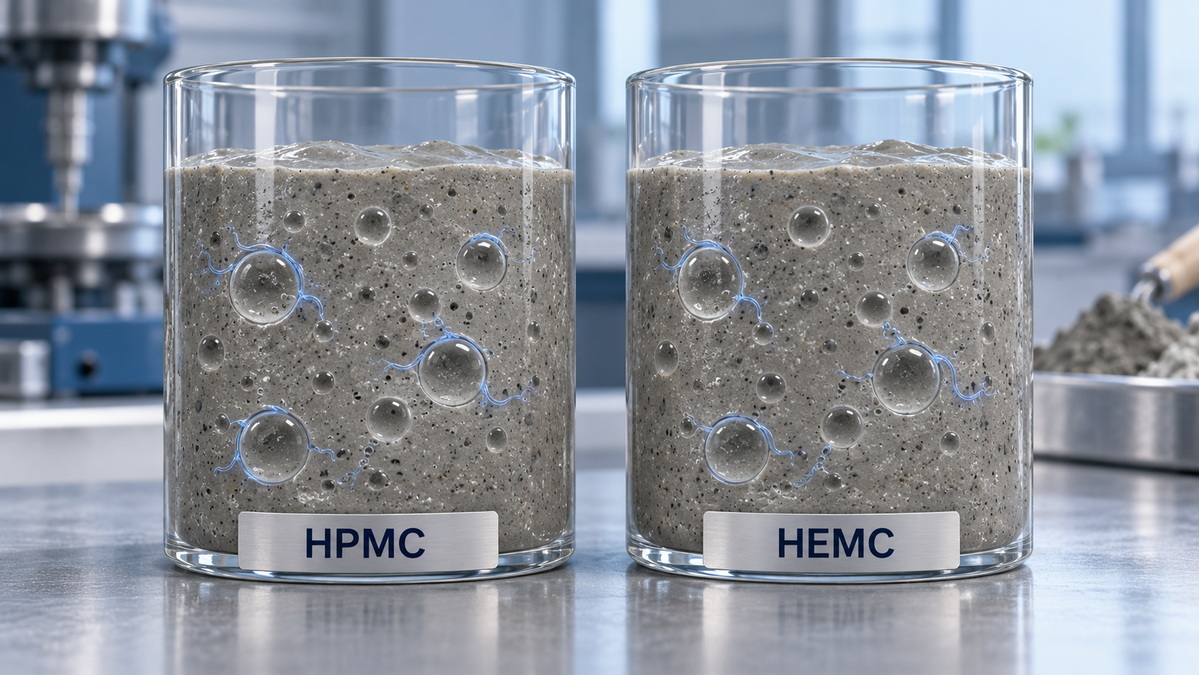
HPMC and HEMC are nonionic cellulose ethers derived from chemically modified cellulose. Both dissolve in water to form solutions that modify viscosity and water retention.
Their main structural difference lies in their hydroxyalkyl substituents:
- HPMC contains methyl and hydroxypropyl groups.
- HEMC contains methyl and hydroxyethyl groups.
HEMC is also commonly called methyl hydroxyethyl cellulose, or MHEC.
These substituents influence interactions with water, dissolved ions, mineral particles, and air–water interfaces. However, the family name does not completely describe a commercial product.
Molecular weight, substitution levels, substitution distribution, and additional modifications can produce substantial differences between grades within the same family.
Two products can have similar viscosity in a laboratory solution yet behave differently in mortar.
A viscosity result depends on solution concentration, temperature, instrument, and measurement conditions. It does not directly measure interfacial activity, bubble stabilization, or compatibility with other additives.
For an informative HPMC vs HEMC comparison, request the viscosity test method and evaluate the products in the intended formulation—not just in clean water.
Cellulose ethers do not normally generate gas through a chemical reaction in cement mortar. Instead, they influence the incorporation and persistence of air introduced mechanically during mixing.
The mechanism involves three connected processes.
Rotating paddles fold air into the wet mixture. Mixing speed, paddle geometry, batch volume, and mixing duration affect the initial bubble population.
Without sufficient stabilization, bubbles can rise, merge, or escape. Some mechanically trapped air remains even in mortar without cellulose ether.
This distinction matters: the measured air content reflects both how much air enters and how much survives until testing.
Cellulose ethers contain water-compatible and comparatively less water-compatible structural regions. Their surface-active behavior can promote enrichment at the air–water interface.
This can alter surface tension and form polymer-rich interfacial layers around bubbles.
Microscopic investigations have observed cellulose-ether enrichment along air-void boundaries. These findings support the explanation that interfacial films help mechanically introduced bubbles persist.
However, interfacial stabilization does not mean every bubble remains unchanged. Coalescence and bubble-size evolution can continue after mixing.
Cellulose ethers also change the surrounding liquid phase and mortar rheology.
A more viscous environment can slow liquid drainage around bubbles and reduce their upward movement. Mortar yield stress can further limit bubble mobility.
Consequently, bubble persistence depends on both interfacial behavior and the mechanical resistance of the surrounding material.
This explains why solution surface tension alone cannot reliably predict mortar air content.
| Comparison factor | HPMC | HEMC | Practical implication |
|---|---|---|---|
| Main substituents | Methyl and hydroxypropyl | Methyl and hydroxyethyl | Chemistry affects hydration and interfacial behavior |
| Water retention | Strong performance is possible with suitable grades | Strong performance is possible with suitable grades | Compare at the required application conditions |
| Bubble stabilization | Can stabilize mechanically introduced bubbles | Can also stabilize mechanically introduced bubbles | Neither family is inherently air-free |
| Thickening behavior | Depends on molecular characteristics and formulation | Depends on molecular characteristics and formulation | Similar solution viscosity does not ensure similar mortar behavior |
| Air-content response | Grade-, dosage-, and process-dependent | Grade-, dosage-, and process-dependent | Measure rather than assume a ranking |
| Selection priority | Required application performance | Required application performance | Choose the grade that satisfies the complete specification |
Some published investigations compare HPMC with hydroxyethyl cellulose, or HEC, and report stronger bubble stabilization for the tested HPMC grades.
That finding must not be presented as proof that HPMC always entrains more air than HEMC.
HEC and HEMC are different cellulose ethers. HEMC also contains methyl substitution, which changes its molecular characteristics.
For responsible product selection, findings from HPMC–HEC experiments should explain possible mechanisms, not establish an unsupported HPMC–HEMC performance hierarchy.
Air is not automatically beneficial or harmful. Its effects depend on total volume, bubble size, distribution, stability, and the intended application.
Air incorporation can lower fresh mortar density and change the handling experience. In renders and plastering mortars, controlled air may contribute to easier spreading and greater volumetric yield.
Nevertheless, a lighter, creamier mortar is not necessarily a better-performing mortar.
Application feel should be assessed alongside water retention, sag resistance, substrate wetting, and hardened properties.
Excessive voids can reduce the effective load-bearing area and compromise mechanical performance.
Adhesion requires a more nuanced assessment. Cellulose ethers can improve water retention and application conditions while their associated air increases porosity.
The final bond strength reflects these competing effects. It should not be predicted from air content alone.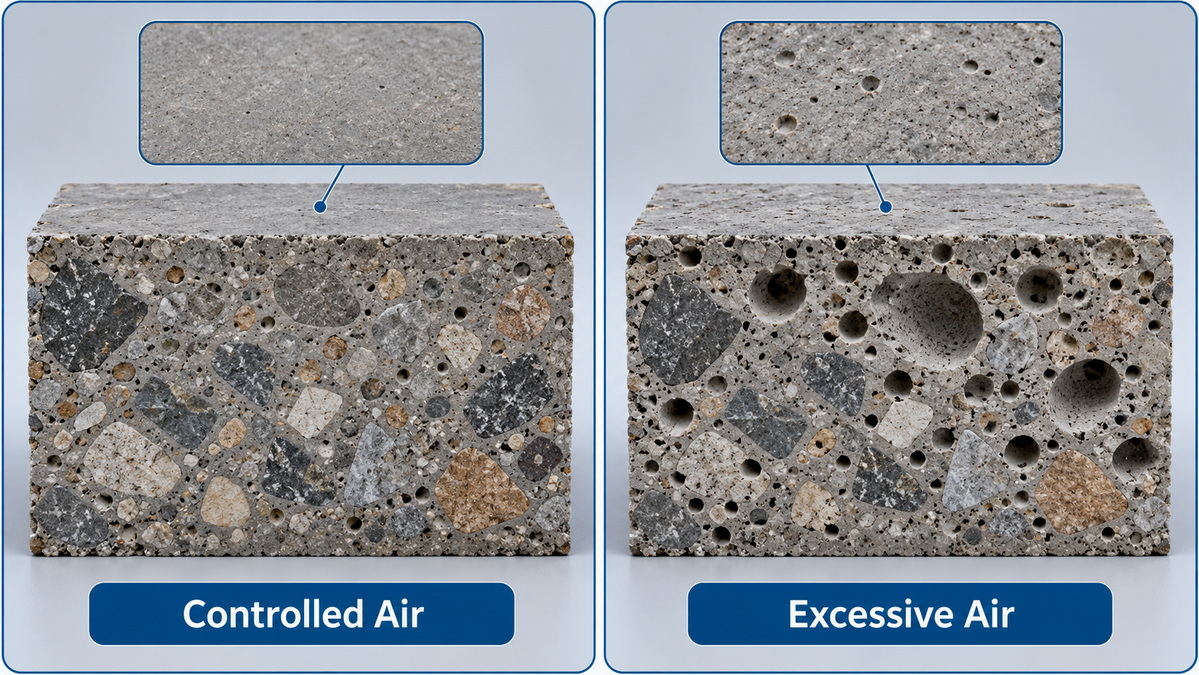
Persistent bubbles may contribute to pinholes, craters, or visible voids, particularly where a smooth finish is required.
Similarly, cellulose-ether-induced air should not automatically be credited with freeze–thaw protection. That performance requires an appropriate hardened air-void system and relevant testing.
A 2022 mortar study used a commercial MHEC grade at approximately 0.056–0.22% of the dry cement-and-sand mass.
The reference mortar contained 5.5% air. At the highest cellulose ether dosage, the researchers reported approximately four times the reference air content.
Fresh density fell from 1,860 to 1,540 kg/m³. Meanwhile, water retention measured after 30 minutes increased from 71.1% in the reference mortar to 99.2% at the highest dosage.
These results illustrate an important trade-off: increasing dosage can improve water retention while also substantially increasing air.
They are not universal targets. The investigation used a particular MHEC grade, mortar composition, and relatively high water-to-cement ratio of 1.33.
A separate 2022 HEMC investigation found that controlling air content substantially alleviated compressive-strength losses and improved aspects of the pore structure.
The formulation lesson is not simply "use less cellulose ether." It is to manage water retention, rheology, and air together.
For development teams, a structured comparison is more useful than a general claim that one chemistry is superior.
The following is a proposed screening framework, not a published universal test specification.
Set requirements before evaluating samples.
For a tile adhesive, these may include:
- Water retention and application consistency.
- Open time and tensile adhesion.
- Slip resistance.
- Fresh air content and density.
For a self-leveling compound, flow, leveling, surface defects, and strength may require greater emphasis.
Use the same cement, aggregate grading, water quality, batch size, and other additives.
Fix the mixer, paddle, mixing sequence, mixing time, and resting period. Record material and room temperatures.
Otherwise, process variation may be mistaken for a difference between HPMC and HEMC.
First, compare products at equal dosage and fixed water content. This reveals their direct effects within a controlled recipe.
Second, optimize each product to comparable application consistency and required water retention.
These comparisons answer different questions. Equal dosage tests material response; performance-matched testing helps identify the commercially useful formulation.
Measure air content and fresh density immediately after mixing and at defined later intervals, such as 15 and 30 minutes.
Use a consistent, documented remixing procedure where applicable.
Time-dependent measurements help distinguish initial air incorporation from bubble persistence during the working period.
Confirm the shortlisted formulations through relevant adhesion, strength, shrinkage, and surface-quality testing.
Use appropriate test methods, such as EN 1015-7 for fresh mortar air content and EN 1015-6 for fresh bulk density, where applicable.
Repeat the trials sufficiently to distinguish genuine formulation effects from normal test variation.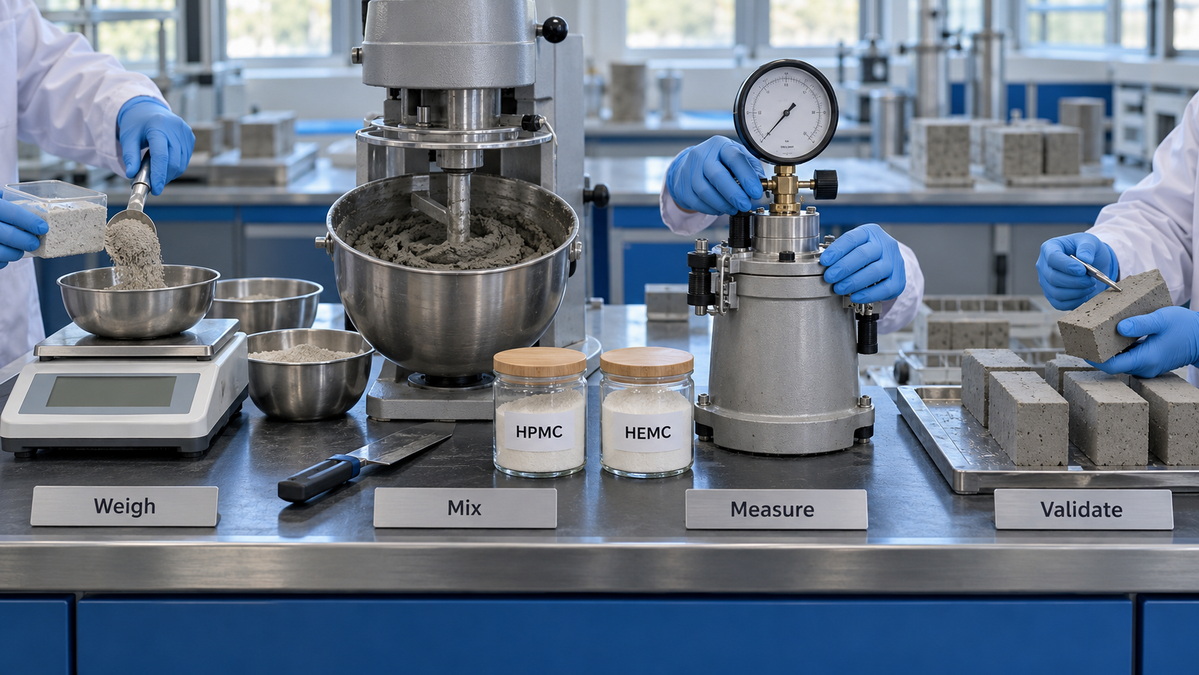
When a formulation becomes too aerated, changing cellulose ether family immediately may obscure the real cause.
| Observed problem | Variables to investigate | Recommended trial |
|---|---|---|
| Air increases after longer mixing | Mixing duration and energy | Repeat with a controlled mixing cycle |
| Good handling but weak hardened mortar | Air, water demand, hydration, curing | Measure air and strength together |
| Pinholes in a flowing compound | Bubble persistence and additive compatibility | Screen a compatible defoamer and reassess flow |
| Air changes between batches | Dispersion, temperature, raw materials | Standardize preparation and compare repeat batches |
| Reducing dosage harms water retention | Grade efficiency and formulation balance | Compare alternative grades at matched performance |
A defoamer may help control unwanted air, but its performance depends on compatibility, dosage, dispersion, and the surrounding additive package.
Evaluate the complete recipe after adding it. Confirm that lower air content does not come with unacceptable changes in workability or other required properties.
The objective is a controlled air window, not automatically the lowest measurable air content.
For global construction-material producers, a useful supplier discussion begins with the application—not simply a requested viscosity number.
Shandong Shengda New Material Co., Ltd. develops, produces, and supplies HPMC, HEMC, and related cellulose ether solutions for construction and daily chemical applications.
For construction-grade selection, prepare the following information:
- Application and target performance.
- Binder system and aggregate composition.
- Current cellulose ether grade and dosage.
- Water addition and mixing procedure.
- Measured air content, density, and observed defects.
This makes sample evaluation more focused and helps avoid unsuitable one-for-one substitutions.
A sustainability-oriented decision should also consider service performance, material efficiency, and avoidable rework. Renewable cellulose feedstock alone does not establish the environmental footprint of a finished product.
Contact Shandong Shengda with your formulation requirements and request suitable HPMC and HEMC samples for side-by-side evaluation. Use the resulting performance data to guide grade selection.
No. There is no defensible universal ranking across all commercial grades. Substitution chemistry, molecular characteristics, dosage, mixing, and the full formulation determine the result.
Yes. HEMC and MHEC commonly refer to hydroxyethyl methyl cellulose. HEC, however, is hydroxyethyl cellulose and should not be treated as the same material.
It can slow bubble movement and liquid drainage. However, viscosity alone cannot predict retained air because interfacial activity and mortar rheology also matter.
No. Improved water retention may benefit adhesion while increased porosity works against mechanical performance. Measure bond strength in the actual formulation.
Equal dosage is a useful starting point for screening, not proof of equivalence. Recheck water retention, consistency, air content, working time, and hardened performance.
There is no single optimum for every mortar. Establish an application-specific range that satisfies handling, density, finish, strength, and durability requirements.
1. He, M., Lin, Y., Huang, Y., Fang, Y., and Xiong, X. (2025). [Research Progress of the Preparation of Cellulose Ethers and Their Applications: A Short Review]. *Molecules*, 30(7), 1610. DOI: 10.3390/molecules30071610. Supports the discussion of cellulose ether chemistry and structure–performance relationships. [pmc.ncbi.nlm.nih]
2. Spychał, E., and Stępień, P. (2022). [Effect of Cellulose Ether and Starch Ether on Hydration of Cement Processes and Fresh-State Properties of Cement Mortars]. *Materials*, 15(24), 8764. DOI: 10.3390/ma15248764. Source of the MHEC dosage, air-content, density, water-retention data, and fresh-mortar test-method discussion. [pmc.ncbi.nlm.nih]
3. Wang, S., Zhang, G., Wang, Z., Huang, T., and Wang, P. (2022). [Evolutions in the Properties and Microstructure of Cement Mortars Containing Hydroxyethyl Methyl Cellulose After Controlling the Air Content]. *Cement and Concrete Composites*. Supports the discussion of air control, strength, adhesion, and pore structure in HEMC-modified mortar. [sciencedirect]
4. [Impact of Cellulose Ethers on the Cement Paste Microstructure]. Research paper available through the HAL open research archive. Supports the discussion of interfacial polymer films, bubble stabilization, and the distinction between HPMC–HEC findings and HPMC–HEMC comparisons. [hal]
5. [Analysis of Air Voids Evolution in Cement Pastes Admixed with Cellulose Ethers] (2018). *Journal of Wuhan University of Technology–Materials Science Edition*. DOI: 10.1007/s11595-018-1913-x. Supports the explanation of surface tension, viscosity, liquid-film behavior, and bubble evolution. [link.springer]


