


close
Choose Your Site
Global
Social Media
Views: 274 Author: Shengda Publish Time: 2026-11-03 Origin: Site


Content Menu
● HPMC vs HEMC: The Essential Differences
● What Molar Substitution Means in HPMC and HEMC
>> Molar Substitution Measures Hydroxyalkyl Incorporation
>> Degree of Substitution Is a Separate Parameter
● Understanding Cellulose Ether Water Retention Curves
● How Molar Substitution Affects Water Retention: Published Evidence
>> Controlled HEMC Comparisons Show a Modest MS Effect
>> HPMC Also Showed Lower Retention as MS Increased
>> Molecular Weight Had the Stronger Overall Influence
● Why "More Hydrophilic" Does Not Always Mean Better Retention
● HPMC vs HEMC Water Retention at Elevated Temperatures
>> Thermal Gelation Changes the Comparison
>> Room-Temperature MS Trends Do Not Predict Every Hot-Weather Result
● A Practical Protocol for Comparing HPMC and HEMC
>> Step 1: Define the Application
>> Step 2: Establish Comparable Grade Information
>> Step 3: Hold Formulation Variables Constant
>> Step 4: Build More Than One Curve
>> Step 5: Measure Application Performance Separately
● How to Interpret Small Differences Without Overclaiming
● Choosing the Right Grade with Shandong Shengda
>> Does Higher Molar Substitution Always Improve Water Retention?
>> Is HEMC Always Better Than HPMC in Hot Weather?
>> Can Two Grades with the Same Viscosity Have Different Retention?
>> What Is the Difference Between MS and DS?
>> Does Better Water Retention Guarantee Longer Open Time?
>> Can Construction Results Guide Household Product Selection?
HPMC vs HEMC comparisons often begin with viscosity. However, understanding how molar substitution affects water retention curves requires a closer look at polymer chemistry, temperature, and mortar formulation. Hydroxypropyl methyl cellulose (HPMC) and hydroxyethyl methyl cellulose (HEMC) both help construction mortars retain mixing water, but their performance cannot be predicted from their names or substitution levels alone.
For buyers and formulators, the central principle is context: molar substitution influences performance, but molecular weight, methyl substitution, dosage, and testing conditions can outweigh its effect.
At Shandong Shengda New Material Co., Ltd., our focus on cellulose ether research, development, production, and supply supports a formulation-led approach. Rather than treating HPMC and HEMC as interchangeable powders, we recommend comparing how specific grades perform under the conditions customers actually face.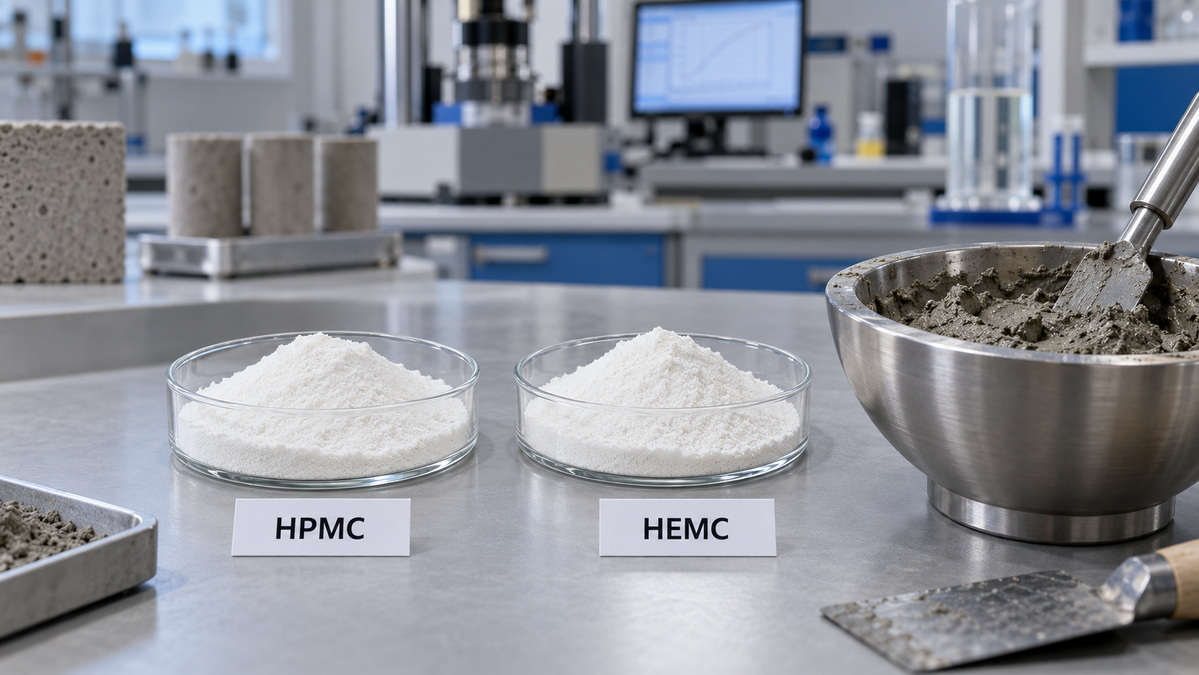
Both products are nonionic cellulose ethers manufactured by chemically modifying cellulose. Their distinguishing feature is the hydroxyalkyl group attached to the cellulose structure.
| Comparison point | HPMC | HEMC |
|---|---|---|
| Full name | Hydroxypropyl methyl cellulose | Hydroxyethyl methyl cellulose |
| Hydroxyalkyl substituent | Hydroxypropyl | Hydroxyethyl |
| Shared substituent | Methyl | Methyl |
| Main construction functions | Water retention, thickening, workability control | Water retention, thickening, workability control |
| Thermal behavior | Grade-dependent thermal gelation | Grade-dependent thermal gelation; often higher than comparable HPMC grades |
| Selection priority | Verified performance in the target formulation | Verified performance in the target formulation |
HEMC is also commonly called methyl hydroxyethyl cellulose, or MHEC.
Neither family automatically delivers better water retention. A well-matched HPMC grade can outperform an unsuitable HEMC grade, particularly when molecular weight, dissolution behavior, or dosage differs.
Molar substitution, abbreviated MS, describes the average number of hydroxyalkyl units incorporated per anhydroglucose unit of cellulose.
For HPMC, MS relates to hydroxypropyl incorporation. For HEMC, it relates to hydroxyethyl incorporation.
Hydroxyalkyl side chains can undergo further reaction, so MS is not simply a count of the original hydroxyl positions occupied.
Importantly, equal MS values do not make HPMC and HEMC chemically equivalent. Hydroxypropyl and hydroxyethyl groups have different structures, so the same numerical value represents different molecular environments.
Degree of substitution, or DS, describes substitution at the original hydroxyl positions of the cellulose repeat unit. In construction-grade HPMC and HEMC discussions, methyl DS is particularly relevant.
Each anhydroglucose unit has three original hydroxyl positions. However, hydroxyalkyl chain extension means MS and DS should not be used interchangeably.
When reviewing supplier documents, confirm whether a reported figure represents:
- Methyl DS.
- Hydroxyalkyl MS.
- Methoxyl content by mass.
- Hydroxypropoxyl or hydroxyethoxyl content by mass.
A mass percentage is not an MS value. Comparing these figures without understanding their basis can lead to incorrect grade selection.
A water retention percentage is meaningful only when its test conditions are known. Likewise, a "water retention curve" can describe several different relationships.
| Curve type | Horizontal axis | Practical purpose |
|---|---|---|
| Retention versus MS | Hydroxyalkyl substitution | Investigate chemical-structure effects |
| Retention versus dosage | Cellulose ether addition | Identify diminishing returns |
| Retention versus temperature | Mortar or test temperature | Assess temperature sensitivity |
| Retention versus elapsed time | Time after mixing or exposure | Evaluate changing performance during use |
These curves are not interchangeable.
For example, a grade with slightly higher retention at room temperature may not maintain that advantage under warmer conditions. Similarly, a strong laboratory retention result does not directly establish tile adhesive open time.
Water retention concerns resistance to water removal. Open time concerns the period during which an applied adhesive can still form an acceptable bond. The properties are connected, but they require separate evaluation.
A controlled study of cellulose ethers in cement-based mortars examined HEMC groups with approximately constant molecular weight and methyl DS.
For HEMC with molecular weights around 350–400 kDa and DS of 1.8, lower MS produced slightly better water retention under the study's conditions.
Across two investigated groups, increasing MS corresponded to retention reductions of approximately 1.0–1.2 percentage points.
This is useful evidence against a common oversimplification: adding more hydroxyethyl groups does not necessarily produce higher measured mortar water retention.
However, the result belongs to those polymers, formulations, and test conditions. It should not become a universal purchasing rule.
The same study investigated HPMC grades with molecular weight around 250 kDa and DS of approximately 1.8.
As MS increased from 0.13 to 0.48, the researchers reported a reduction in water retention of about three percentage points.
The comparison suggests that MS can influence the retention curve even when other major structural parameters remain broadly similar.
It does not prove that HPMC is inherently more sensitive to MS than HEMC. The two investigated families had different molecular-weight ranges and were not a universal, matched comparison of every commercial grade.
The researchers identified molecular weight as a more influential parameter than MS in their experimental program.
In one HPMC series, increasing molecular weight from 225 to 910 kDa increased water retention from 96.8% to 98.9%.
For practical selection, this means an MS specification should never be evaluated alone. Polymer chain length and the resulting solution behavior can materially affect the outcome.
Hydroxyalkyl substitution changes how cellulose ethers interact with water. Nevertheless, mortar water retention is not simply the amount of water attracted to individual chemical groups.
Water must move through a concentrated mixture of binder, aggregates, fillers, dissolved substances, and polymer.
Cellulose ethers can influence:
- The viscosity of the liquid phase.
- Polymer association and chain entanglement.
- Water migration through the fresh mortar.
- Filtration resistance and pore blocking.
- Particle interactions and mortar cohesion.
Research on HPMC has linked improved retention to changes in water migration, colloidal network structures, and mortar cohesion.
The important distinction is between molecular affinity for water and resistance to bulk water removal. These properties are related, but they are not identical.
Published work also shows that mortar consistency and retention do not always change together. A thicker-feeling mortar is therefore not sufficient evidence of superior water retention.
Both HPMC and HEMC can undergo thermal gelation when heated. Their thermal response depends on the specific substitution pattern and product grade.
Industry technical guidance indicates that HEMC can have a higher gelation temperature than HPMC at comparable substitution levels.
That makes HEMC a relevant candidate for temperature-sensitive formulations. However, a polymer's gelation temperature is not a guaranteed maximum application temperature for finished mortar.
Actual performance also depends on:
- Mortar and substrate temperature.
- Substrate absorbency.
- Air movement and humidity.
- Dissolved salts and binder chemistry.
- Layer thickness and exposure time.
Avoid choosing a product using a single generic gelation range assigned to an entire cellulose ether family.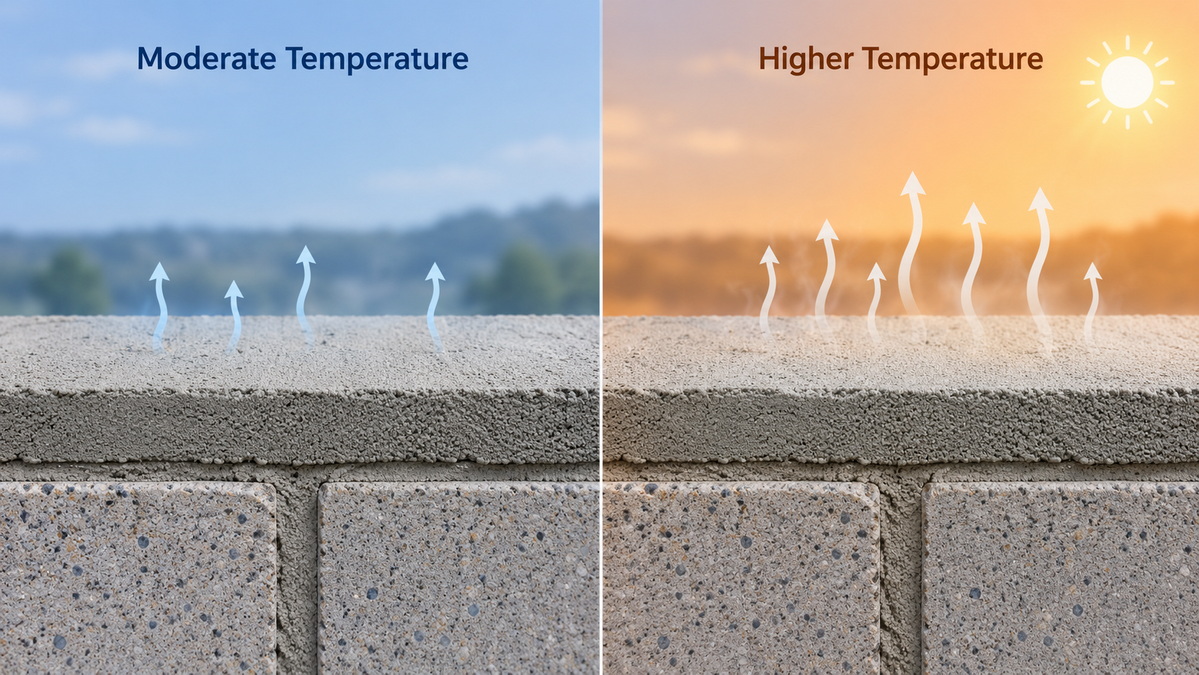
Controlled room-temperature studies can show lower retention at higher MS, while industry guidance associates hydroxyalkyl substitution with improved temperature tolerance.
These observations are not necessarily contradictory. They concern different aspects of performance.
A structural change may slightly reduce retention at one temperature while changing thermal behavior elsewhere. Only a temperature-dependent test series can establish the resulting curve for a particular grade.
This is why warm-weather selection should compare complete performance profiles rather than isolated MS values.
The following workflow is a proposed development procedure, not a report of Shengda laboratory results.
Identify the actual product and its main failure risk.
For tile adhesive, investigate skin formation, tile wetting, and bond development. For render, examine substrate suction, workability, and finishing behavior.
Do not transfer cement-mortar findings directly to gypsum products or household formulations without separate validation.
Request available information on:
- Viscosity and its measurement conditions.
- Substitution characteristics.
- Moisture content and particle size.
- Dissolution behavior.
- Thermal behavior and test method.
Matching nominal viscosity alone does not fully match two polymers. Concentration, temperature, instrument settings, and substitution all affect the reported value.
Keep binder, sand, filler, mixing sequence, mixing energy, and cellulose ether dosage unchanged.
Begin with a fixed-water comparison to investigate polymer effects. Then run a separate, clearly labeled comparison at matched application consistency.
Adjusting water silently during testing can conceal the reason one grade appears better.
An illustrative screening matrix could include:
| Variable | Suggested development levels |
|---|---|
| Cellulose ether family | Selected HPMC and HEMC grades |
| Temperature | 20°C, 30°C, and 40°C |
| Dosage | Below, at, and above the current baseline |
| Measurement age | Defined intervals after mixing |
| Replication | At least three independent measurements per condition |
These are proposed screening conditions, not universal acceptance limits or a replacement for a prescribed standard.
Control sample temperature, humidity, and exposure consistently.
Alongside retention, assess the properties relevant to the finished product:
- Workability and spread.
- Slip or sag resistance.
- Open time where applicable.
- Setting behavior.
- Required hardened strength or adhesion.
Choose the grade that satisfies the complete specification, not merely the highest retention number.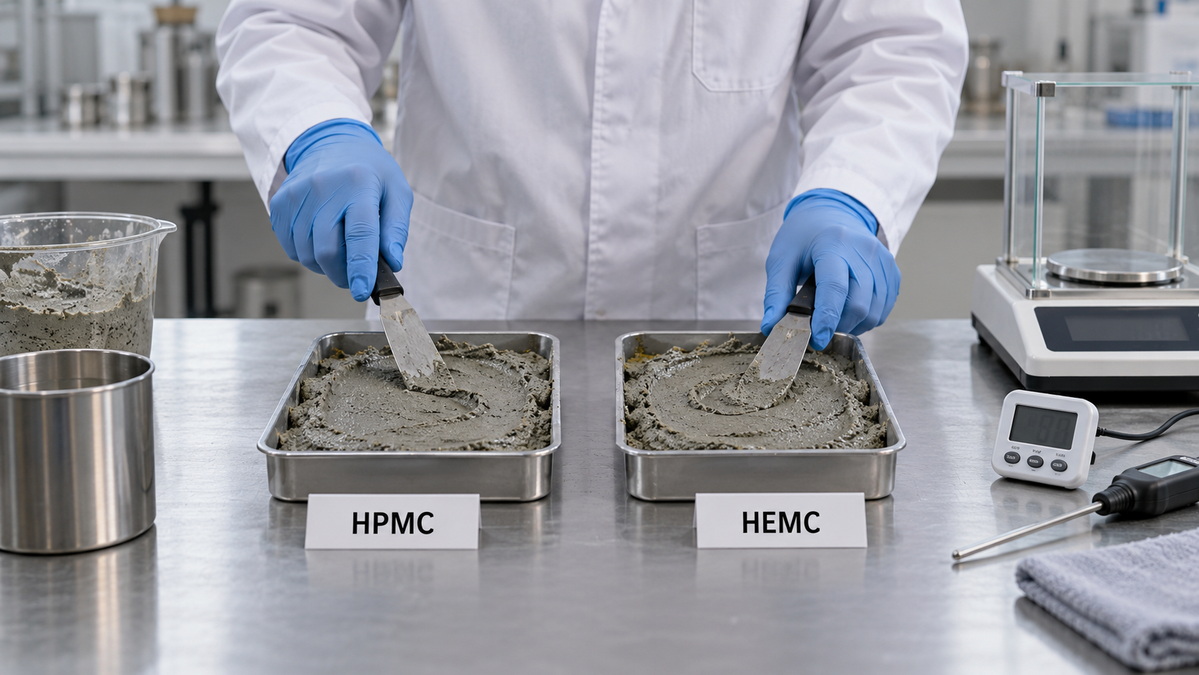
When retention values approach their upper range, small differences can be difficult to interpret.
Before accepting a one-percentage-point advantage, ask:
1. Was the same method used?
2. Were dosage and water content identical?
3. Were results replicated?
4. Is the difference larger than experimental variability?
5. Does it improve actual application performance?
Different suction and filter-paper procedures can produce different results. Published research comparing methods found that they were broadly comparable, but not identical for every polymer system.
A supplier statement such as "98% water retention" is therefore incomplete without formulation, temperature, dosage, and method details.
For purchasing decisions, request a documented comparison rather than an unsupported ranking.
Shandong Shengda New Material Co., Ltd. develops, produces, and supplies HPMC, HEMC, and related cellulose ether solutions for global customers.
For construction applications, the most useful starting point is your formulation and performance target—not a request for the "highest MS" or "highest viscosity."
Send our team your binder system, current dosage, water addition, application temperature, substrate type, and main performance challenge. Request suitable HPMC and HEMC samples for controlled, side-by-side evaluation.
For sustainability-focused procurement, also request supporting documentation for any environmental claim. A cellulose-derived raw material alone does not establish the finished product's lifecycle impact.
No. Controlled mortar research found slightly lower retention as MS increased in the investigated HPMC and HEMC groups. The result depends on polymer structure and test conditions.
No. Some HEMC grades offer favorable thermal behavior, but the finished formulation must be tested. Family names do not replace grade-specific temperature data.
Yes. Substitution, dissolution behavior, and polymer structure can differ. Viscosity values are also comparable only when measured under equivalent conditions.
MS describes average hydroxyalkyl incorporation per cellulose repeat unit. DS describes substitution at original hydroxyl positions. They measure different structural characteristics.
No. Retention helps maintain available water, but open time also depends on surface drying, formulation, substrate conditions, and bond development. Test it separately.
They can provide background on polymer behavior, but they do not establish household-product performance. Surfactants, salts, pH, and product-specific requirements need separate evaluation.
1. Patural, L., Marchal, P., Govin, A., Grosseau, P., Ruot, B., and Devès, O. "Cellulose ethers influence on water retention and consistency in cement-based mortars." *Cement and Concrete Research*, 41(1), 46–55, 2011. DOI: 10.1016/j.cemconres.2010.09.004. Primary basis for the MS comparisons, molecular-weight results, and test-method limitations. Full manuscript available through HAL. [hal]
2. Chen, N., Wang, P., Zhao, L., and Zhang, G. "Water Retention Mechanism of HPMC in Cement Mortar." *Materials*, 13(13), 2918, 2020. DOI: 10.3390/ma13132918. Supports the discussion of water migration, colloidal structures, cohesion, and formulation-dependent retention. Open-access full text available through PubMed Central. [pmc.ncbi.nlm.nih]
3. Pourchez, J., Peschard, A., Grosseau, P., Guyonnet, R., Guilhot, B., and Vallée, F. "HPMC and HEMC influence on cement hydration." *Cement and Concrete Research*, 36(2), 288–294, 2006. DOI: 10.1016/j.cemconres.2005.08.003. Background on cellulose ether chemistry and cement hydration. [sciencedirect]
4. Gantrade Corporation. "Applications in Cementitious Products." Industry technical guidance on substitution terminology, cellulose ether functions, and grade-dependent thermal behavior. Commercial guidance is distinguished here from controlled experimental evidence. [gantrade]


