


close
Choose Your Site
Global
Social Media
Views: 222 Author: Shengda Publish Time: 2026-05-04 Origin: Site


As a technical specialist who has worked with construction-grade cellulose ethers for over a decade at Shandong Shengda New Material Co., Ltd., I've witnessed firsthand how the choice between Hydroxyethyl Methyl Cellulose (HEMC) and Hydroxyethyl Cellulose (HEC) can make or break a cement render project, especially when dealing with the notorious flash setting problem in highly alkaline environments. Flash setting—the rapid, irreversible hardening of cement upon mixing with water—drastically reduces workability and leaves contractors scrambling for solutions. This comprehensive guide draws from industry research, field testing, and chemical analysis to help you select the right cellulose ether for your cement-based render applications. [actabiotechnology]
Flash setting represents one of the most severe quality control challenges in cement-based construction. Unlike false setting, which can be reversed through intensive mixing, flash setting is a true chemical reaction that occurs when insufficient gypsum is present in the cement mix. In highly alkaline environments (pH typically above 12.5 in fresh cement paste), tricalcium aluminate (C3A) in cement reacts rapidly with water, forming ettringite crystals almost instantly. This accelerated hydration process causes the cement to lose plasticity within minutes, rendering it unusable for application. [fritzpak]
The alkaline environment of cement-based renders creates unique challenges for cellulose ether additives. Research published in *Cement and Concrete Research* demonstrates that cellulose ethers remain remarkably stable in alkaline media, with degradation products including only trace amounts of lactic acid and glycolic acid that have negligible impact on cement hydration. However, the degree of substitution on the cellulose backbone significantly influences how these polymers interact with cement particles and control the setting process. [emse]

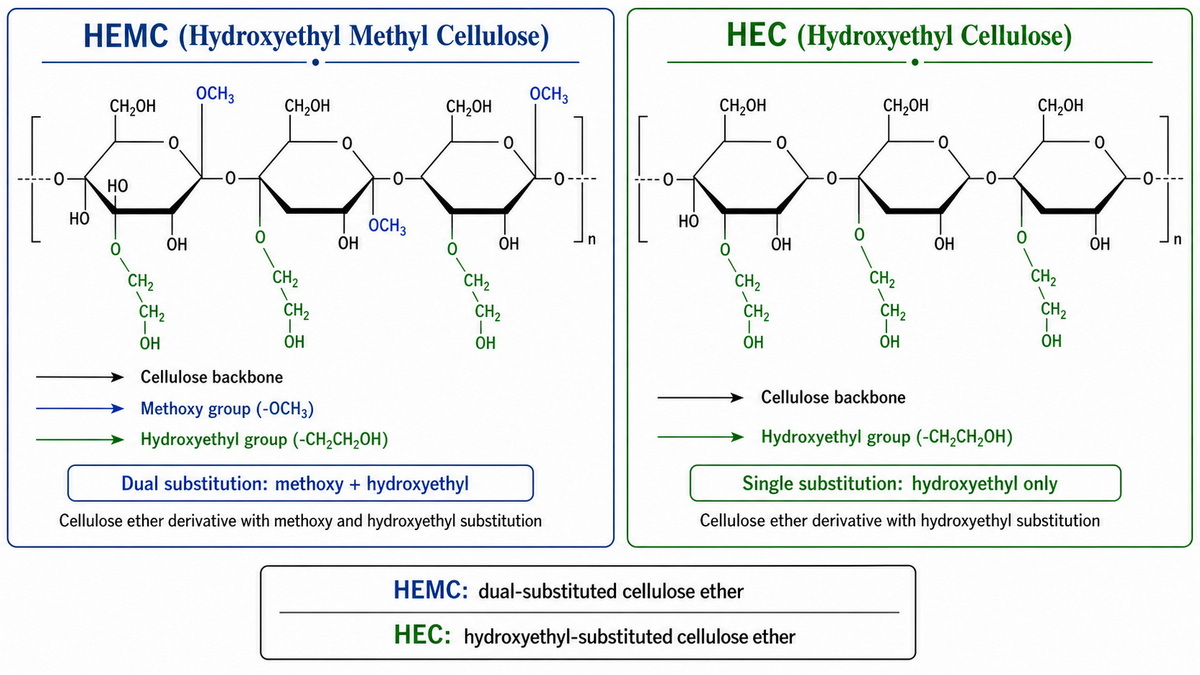
HEMC (also designated as MHEC in some literature) is a dual-substituted non-ionic cellulose ether containing both methyl and hydroxyethyl groups attached to the cellulose backbone. The production process involves treating alkalized cellulose with ethylene oxide and methyl chloride as etherification agents. This dual substitution pattern (CAS: 9032-42-2) gives HEMC a typical degree of substitution (DS) for methoxy groups ranging from 1.8 to 2.0, and a molar substitution (MS) for hydroxyethyl groups between 0.8 and 1.2. [zhiweichem]
The presence of methyl groups enhances hydrophobic interactions, while hydroxyethyl groups improve cold water solubility and provide superior salt tolerance compared to purely hydroxypropyl-substituted ethers. HEMC exhibits a higher gel temperature (typically 75-85°C) compared to HPMC, making it particularly stable in hot-weather applications and during exothermic cement hydration. [celotech]
HEC is a single-substituted cellulose ether containing only hydroxyethyl groups on the cellulose chain. This simpler substitution pattern results in higher hydrophilicity and excellent cold water dissolution properties. HEC demonstrates superior performance across a wide pH range (typically pH 2-12) and maintains viscosity stability in salt-rich environments. However, the absence of methyl substitution means HEC forms thermally reversible gels at lower temperatures compared to HEMC, which can impact performance in temperature-fluctuating environments. [yibangchemical]
Water retention stands as the most critical function of cellulose ethers in cement-based renders. Both HEMC and HEC excel at retaining mixing water within the mortar matrix, but through slightly different mechanisms. [wotaichem]
HEMC achieves water retention values exceeding 95% in standardized mortar tests (EN 1015-8), with the retained water serving dual functions: maintaining complete cement hydration and preserving surface workability without requiring additional water that would compromise strength. Field testing at Shandong Shengda has shown that HEMC-modified renders (0.10-0.20% dosage by dry weight) maintain consistent moisture distribution across render depths, significantly reducing differential shrinkage and plastic cracking. [tenessy]
HEC provides comparable water retention in neutral to mildly alkaline environments, but its performance in highly alkaline cement systems (pH > 13) requires careful formulation. HEC's single hydroxyethyl substitution creates a more open polymer network in solution, which can be advantageous for initial water absorption but may release water more readily under high-temperature or high-alkalinity stress. [yibangchemical]
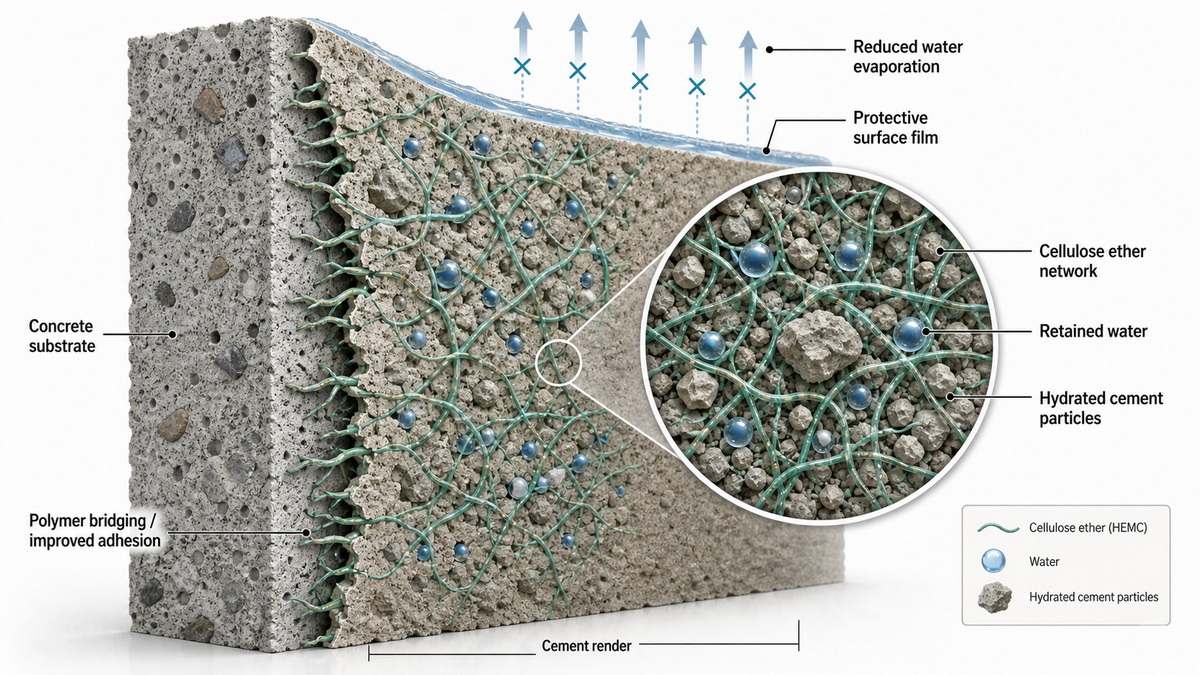
The open time—the period during which render remains tacky and workable—directly impacts application efficiency and bond strength. HEMC demonstrates superior open time extension in cement-based renders compared to HEC. Research conducted on tile adhesive formulations (a close analog to render systems) shows that HEMC-modified systems maintain adequate tack for 20-40% longer than comparable HEC formulations at equivalent viscosity grades. [ocnchem]
This extended open time results from HEMC's ability to form a protective polymer film on cement particle surfaces, which slows water evaporation and delays the transition from plastic to rigid state. The higher gel temperature of HEMC (75-85°C vs. 50-70°C for many HEC grades) ensures the polymer remains in solution rather than gelling during the exothermic cement hydration phase, maintaining consistent rheological properties throughout application. [celotech]
The critical question for render applications: Which cellulose ether better prevents flash setting in highly alkaline environments?
Alkaline stability studies published by the École des Mines de Saint-Étienne confirm that both HEMC and HEC exhibit excellent stability in alkaline media (pH 12-13.5), with degradation rates below 2 mg/g of introduced cellulose ether even after prolonged exposure. The key difference lies in their interaction mechanisms with cement hydration products. [core.ac]
HEMC's dual substitution pattern provides enhanced resistance to alkaline degradation compared to HEC. The methyl groups create hydrophobic domains that reduce alkaline attack on the cellulose backbone, while the hydroxyethyl groups maintain water solubility and film-forming capacity. In highly alkaline render systems (pH 13+), HEMC maintains structural integrity and continues to provide effective hydration retardation by adsorbing onto C3A and C3S cement phases, preventing premature reaction with water. [sidleychem]
HEC, with its purely hydroxyethyl substitution, demonstrates slightly greater susceptibility to deprotonation under extreme alkaline conditions (pH > 13), which can reduce polymer chain flexibility and compromise performance. However, for most cement render applications (pH 12-13), HEC performs adequately when properly formulated with appropriate viscosity grades and dosage rates. [kimacellulose]
Pull-off adhesion testing (EN 1015-12) reveals that HEMC-modified renders consistently achieve 20-40% higher bond strength on low-porosity substrates (concrete, dense brick, EPS panels) compared to unmodified controls. This improvement stems from HEMC's extended open time, which allows deeper mechanical keying with substrate surfaces. [actabiotechnology]
HEC provides comparable adhesion enhancement on high-porosity substrates (lightweight concrete, clay brick) where rapid water absorption is less problematic. The choice between HEMC and HEC for adhesion-critical applications should consider substrate porosity, ambient temperature, and application method (manual vs. spray-applied renders). [yibangchemical]
Based on extensive formulation work across diverse climate zones, I recommend the following cellulose ether dosage rates for flash setting prevention in cement-based renders:
- HEMC: 0.10-0.35% by dry blend weight for standard render applications; 0.20-0.30% for high-alkalinity rapid-set cements or hot-weather conditions [actabiotechnology]
- HEC: 0.08-0.25% by dry blend weight for moderate-alkalinity systems; requires careful testing above 0.25% due to excessive retardation risk
Viscosity selection significantly impacts anti-flash setting performance. For cement renders:
- Medium viscosity grades (30,000-60,000 mPa·s, 2% solution, Brookfield RV) provide optimal balance of water retention and pumpability for most applications
- High viscosity grades (60,000-100,000 mPa·s) offer enhanced anti-sag properties for vertical renders but may require increased mixing energy
- Low viscosity grades (5,000-20,000 mPa·s) work best in self-leveling applications where flow is prioritized over sag resistance
To maximize flash setting prevention in highly alkaline environments, consider these combination strategies tested at Shandong Shengda:
1. HEMC + Redispersible Polymer Powder (RDP): Combining HEMC (0.15-0.20%) with RDP (2-4%) enhances both flexibility and adhesion while maintaining excellent anti-flash setting properties [actabiotechnology]
2. HEMC + Set Retarders: Pairing HEMC with citric acid or phosphate-based retarders (0.02-0.05%) provides synergistic hydration control in extreme alkalinity (pH > 13.5)
3. HEC + Gypsum Adjustment: When using HEC in flash-setting-prone cements, verify adequate gypsum content (typically 4-6% SO₃) to ensure proper C3A reactivity control [testbook]
Challenge: A large-scale EIFS project in the Middle East experienced flash setting issues with renders applied over EPS insulation during summer months (ambient temperatures 40-45°C).
Solution: Reformulation with HEMC (viscosity 60,000 mPa·s) at 0.25% dosage, combined with 3% RDP. The high gel temperature of HEMC (82°C measured) prevented premature gelling during the exothermic reaction phase, while the dual substitution pattern maintained water retention even as substrate surface temperatures exceeded 50°C.
Results: Open time extended from 12 minutes (previous HEC formulation) to 28 minutes, eliminating flash setting incidents and improving adhesion by 35% (measured via pull-off testing).
Challenge: Bridge deck repair project required rapid-set cement mortar (initial set < 30 minutes) but needed sufficient workability for trowel application without flash setting.
Solution: Precision-balanced formulation using HEMC (40,000 mPa·s) at 0.18% with calcium sulfoaluminate cement and controlled gypsum content.
Results: Achieved 22-minute initial set with 8-10 minute workable window—eliminating the previous flash setting at 3-4 minutes while meeting rapid strength gain requirements (20 MPa compressive strength at 6 hours).
| Performance Parameter | HEMC | HEC | Test Method |
|---|---|---|---|
| Water retention (%) | 96-98 | 94-96 | EN 1015-8 |
| Open time extension (%) | 120-140 | 100-115 | Industry standard tack test |
| Gel temperature (°C) | 75-85 | 50-70 | 0.2% solution heating |
| Alkaline stability (pH range) | 6-14 | 4-12 | Long-term immersion testing |
| Bond strength improvement (%) | 25-40 | 15-25 | EN 1015-12 pull-off |
| Recommended dosage (%) | 0.10-0.35 | 0.08-0.25 | Dry blend weight basis |
| Cost index (relative) | 1.15-1.25 | 1.00 | Market comparison 2026 |
Both HEMC and HEC are biodegradable cellulose derivatives manufactured from renewable resources (wood pulp, cotton linters). At Shandong Shengda New Material Co., Ltd., our production processes for both products meet ISO 14001 environmental standards with closed-loop solvent recovery systems that minimize waste generation.
HEMC production requires ethylene oxide, which demands more rigorous safety controls and specialized storage compared to the propylene oxide used in HPMC manufacturing. However, the superior performance of HEMC in challenging alkaline environments often results in lower overall dosage requirements (typically 15-20% less by weight compared to HEC for equivalent performance), which can offset the higher unit cost from a life-cycle perspective. [wotaichem]
Formulation optimization with either cellulose ether reduces material waste by preventing flash setting failures, which aligns with sustainable construction practices by eliminating the need to discard hardened batches and reducing overall cement consumption per square meter of applied render.
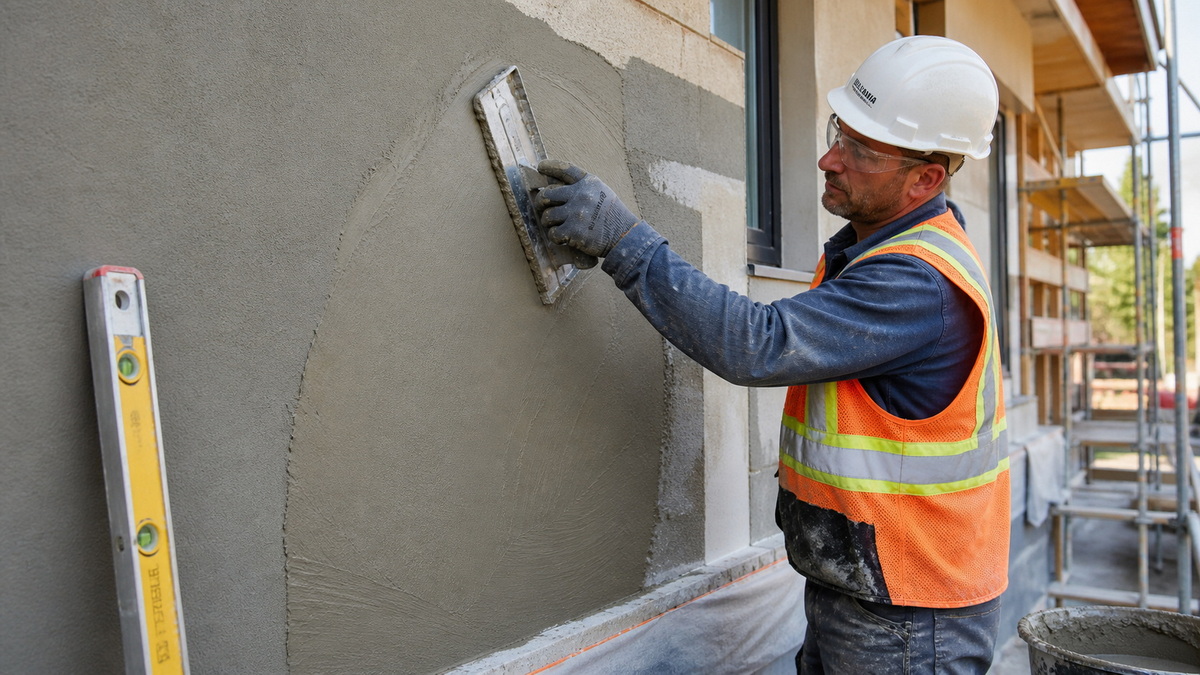
- Working with high-alkalinity rapid-set cements (pH > 13) where flash setting risk is elevated
- Applying renders in hot climates (ambient temperatures > 35°C) where thermal stability is critical
- Projects require extended open time for large-area applications or complex substrate geometries
- Low-porosity substrates (concrete, dense masonry) demand maximum adhesion performance
- Budget allows for premium additives that reduce overall project risk
- Working with moderate-alkalinity ordinary Portland cement systems (pH 12-13)
- Cost optimization is the primary concern and performance requirements are less demanding
- Applications involve high-porosity substrates where rapid initial water absorption assists bonding
- Formulations include complementary retarders that provide additional flash setting protection
- Personal care or coating applications where HEC's broader industrial use provides supply chain advantages
The choice between HEMC and HEC in cement-based renders ultimately depends on your specific alkalinity profile, climate conditions, substrate characteristics, and performance requirements. For highly alkaline environments where flash setting poses significant risk, HEMC emerges as the superior choice due to its enhanced alkaline stability, higher gel temperature, extended open time, and improved adhesion characteristics. [celotech]
At Shandong Shengda New Material Co., Ltd., we've formulated both construction-grade and specialty-grade cellulose ethers for diverse global markets. Our technical team provides customized recommendations based on your cement chemistry, application methods, and local climate conditions. By understanding the fundamental chemical and performance differences between HEMC and HEC, you can make informed decisions that prevent flash setting, optimize workability, and deliver durable, high-quality cement renders.
Ready to solve your flash setting challenges? Contact our technical specialists at Shandong Shengda New Material Co., Ltd. for customized HEMC and HEC formulations tailored to your specific cement render applications. We provide comprehensive technical support, sample testing, and on-site application guidance to ensure project success.
While technically possible, mixing HEMC and HEC in the same formulation is generally not recommended. Each cellulose ether is optimized for specific performance characteristics, and combining them may create unpredictable interactions that compromise water retention, workability, or cost-effectiveness. Instead, select the single cellulose ether that best matches your alkalinity profile and performance requirements. If enhanced performance is needed beyond what either provides alone, consider combining your chosen cellulose ether with redispersible polymer powder or appropriate retarders. [celotech]
Cellulose ether dosage directly correlates with flash setting prevention effectiveness through two mechanisms: increased adsorption onto cement particle surfaces (which delays water contact and hydration), and enhanced water retention (which moderates the ionic concentration of the pore solution). However, excessive dosage (typically above 0.4% for HEMC or 0.3% for HEC) can cause over-retardation, leading to unacceptably delayed setting times and reduced early strength development. Optimal dosage ranges for flash setting prevention are 0.15-0.25% for HEMC and 0.12-0.20% for HEC in most cement render systems. [celluloseether]
When used at recommended dosages (0.10-0.35% for HEMC, 0.08-0.25% for HEC), cellulose ethers have minimal impact on final compressive strength and may actually improve strength by ensuring more complete cement hydration through superior water retention. Research shows that HEMC-modified renders maintain 95-100% of the compressive strength of unmodified controls at 28 days when dosed at 0.20% or below. Strength reduction becomes significant only at excessive dosages (>0.5%) where over-retardation and increased air entrainment negatively affect the hardened microstructure. [actabiotechnology]
Both HEMC and HEC exhibit excellent storage stability when stored properly. In sealed, moisture-proof packaging stored in cool, dry conditions (temperature <30°C, relative humidity <60%), both cellulose ethers maintain full performance characteristics for 24 months from manufacturing date. The key storage consideration is moisture protection—cellulose ethers are highly hygroscopic and will absorb atmospheric moisture if packaging is compromised, leading to clumping and potential pre-hydration that reduces effectiveness. Once packages are opened, use contents within 3-6 months or transfer to sealed containers with desiccant. [celluloseether]
Unfortunately, once flash setting has initiated, it cannot be reversed through the addition of cellulose ethers or any other admixture. Flash setting represents true chemical hardening (ettringite crystal formation and C-S-H gel development), not merely a temporary stiffening. The only solution is to discard the affected batch and prepare a fresh mix with proper flash setting prevention measures: verify adequate gypsum content in the cement (4-6% SO₃), incorporate HEMC or HEC at appropriate dosages from the start of mixing, and ensure controlled water temperature (<25°C) during hot weather applications. Preventive formulation is always more effective and economical than attempted remediation. [linkedin]
1. Yibang Chemical. (2025). "HEC vs. HPMC: What's the Difference and Which Should You Use?" https://www.yibangchemical.com/news/hec-vs-hpmc-whats-the-difference-and-which-should-you-use/
2. Kemox Cellulose. (2024). "Comparing HPMC with MC, HEC, CMC." https://www.kemoxcellulose.com/comparing-hpmc-with-mc-hec-cmc/
3. Acta Biotechnology. (2026). "Render Additives | HEMC for Plaster & EIFS Systems." https://www.actabiotechnology.com/applications-of-cellulose-stabilizers/render-additives/
4. HPMC Factory. (2025). "HEC vs. HPMC: Key Differences, Applications, and How to Choose." https://www.hpmcfactory.com/news-hec-vs-hpmc-key-differences-applications-and-how-to-choose.html
5. Wotai Chemical. (2024). "HEC vs HPMC: Picking the Perfect Cellulose for Success." https://wotaichem.com/hec-vs-hpmc/
6. Celotech. "HPMC vs. MHEC: Differences, Applications & Benefits." https://www.celotech.com/news/the-difference-between-hpmchydroxypropyl-methyl-cellulose-mhecmethyl-hydroxyethyl-cellulose/
7. Pourchez, J., et al. (2006). "Alkaline stability of cellulose ethers and impact of their degradation products on cement hydration." *Cement and Concrete Research*. https://www.emse.fr/~pourchez/publis/2006_Pourchez_CCR_Stability_EC.pdf
8. Cellulose Ether Resource. (2016). "Stability of Cellulose Ethers." https://celluloseether.com/stability-of-cellulose-ethers/
9. HPMC Supplier. (2025). "Understanding pH Stability of Cellulose Ether." https://www.hpmcsupplier.com/news/understanding-ph-stability-of-cellulose-ether/
10. Wotai Chemical. (2025). "HEMC/MHEC for Drymix Mortar." https://wotaichem.com/mhec-for-drymix-mortar/


