


close
Choose Your Site
Global
Social Media
Views: 265 Author: Shengda Publish Time: 2026-11-17 Origin: Site


Content Menu
● What Are Cellulose Ether Derivatives?
● Main Types of Cellulose Ether Derivatives
>> Hydroxypropyl Methylcellulose: HPMC
>> Hydroxyethyl Cellulose: HEC
>> Hydroxyethyl Methylcellulose: HEMC or MHEC
>> Hydroxypropyl Cellulose: HPC
>> Carboxymethyl Cellulose: CMC
● HPMC vs. HEC vs. HEMC: Which Should You Evaluate?
>> For Tile Adhesives and Dry-Mix Mortars
>> For Liquid Cleansers and Personal Care
● Why Viscosity Numbers Alone Can Mislead Buyers
● A Practical Five-Step Cellulose Ether Selection Process
>> 1. Define the Finished Product
>> 2. Describe the Actual Problem
>> 3. Standardize the Comparison
>> 4. Test Relevant Performance
● Troubleshooting Common Formulation Problems
● How to Evaluate Sustainability Claims
● Discuss Your Application with Shandong Shengda New Material
>> What are the main derivatives of cellulose ethers?
>> Are all cellulose ethers water-soluble?
>> What is the difference between HPMC and HEMC?
>> Does higher HPMC viscosity mean better quality?
>> Can construction-grade HPMC be used in personal care products?
>> How can buyers compare cellulose ether suppliers fairly?
Cellulose ether derivatives include hydroxypropyl methylcellulose (HPMC), methylcellulose (MC), hydroxyethyl cellulose (HEC), hydroxyethyl methylcellulose (HEMC), hydroxypropyl cellulose (HPC), ethylcellulose (EC), and carboxymethyl cellulose (CMC). These modified cellulose polymers help manufacturers control water retention, viscosity, film formation, and application performance.
However, they are not interchangeable. A polymer that improves tile adhesive workability may not deliver the clarity, compatibility, or texture required in a liquid cleanser.
At Shandong Shengda New Material Co., Ltd., our focus is on construction-grade and daily chemical-grade cellulose products. From a formulation perspective, the most useful question is not simply which derivatives exist, but which chemistry and grade match your product, production process, and performance requirements.
Cellulose ethers are produced by chemically modifying cellulose, a structural polymer found in plants. Etherification replaces hydrogen atoms in some cellulose hydroxyl groups with different substituent groups.
These substitutions change how the polymer interacts with water, solvents, minerals, and other formulation ingredients.
Three characteristics help explain the resulting performance:
- Substituent chemistry influences solubility, ionic character, and temperature response.
- Degree of substitution describes the average number of substituted hydroxyl groups per cellulose repeating unit.
- Molecular size influences solution viscosity and other formulation properties.
For hydroxyalkyl derivatives, molar substitution also helps describe the introduced side chains.
This chemistry explains why two products labeled "cellulose ether" can behave differently—and why even two HPMC grades may require separate application testing.
The following comparison provides a starting point. Actual performance depends on substitution, molecular weight, modification, and the complete formulation.
| Derivative | Ionic character | Typical solubility behavior | Common application focus |
|---|---|---|---|
| HPMC | Nonionic | Generally soluble in cold water; temperature-sensitive | Mortars, tile adhesives, selected personal care systems |
| MC | Nonionic | Cold-water soluble; thermally gelling | Water retention, thickening, binding |
| HEC | Nonionic | Soluble in cold and hot water | Coatings, cleansers, personal care |
| HEMC/MHEC | Nonionic | Water-soluble; thermal behavior varies by grade | Tile adhesives, renders, construction mortars |
| HPC | Nonionic | Cold-water and selected organic-solvent soluble | Binders, films, specialty formulations |
| EC | Nonionic | Generally water-insoluble; soluble in suitable organic solvents | Films, coatings, specialty binders |
| CMC | Anionic | Sodium grades are generally water-soluble | Detergents, textiles, paper, rheology control |

HPMC contains methyl and hydroxypropyl substituents. It combines thickening, water retention, film formation, and binding functions.
In construction formulations, HPMC can help:
- Retain mixing water.
- Improve spreading and troweling.
- Adjust consistency and cohesion.
- Support workable open time.
- Contribute to slip resistance in appropriately designed systems.
Water retention matters because premature water loss can interfere with application and cement hydration. Nevertheless, final adhesion depends on the entire formulation, substrate, curing conditions, and application method—not HPMC alone.
Selected HPMC grades also serve as rheology modifiers and film formers in personal care products. Construction-grade material should not automatically be substituted into those applications.
MC contains methyl substituents and provides thickening, water retention, and film-forming functions.
A defining feature is thermal gelation: suitable aqueous solutions form gels when heated and return toward solution on cooling. The exact behavior depends on grade and formulation.
MC remains an important reference chemistry, but mixed ethers such as HPMC and HEMC provide additional options for tailoring application performance.
HEC is a nonionic, water-soluble polymer widely used for thickening and rheology control.
Its solutions commonly exhibit shear-thinning behavior: viscosity decreases during stirring, pumping, or spreading, making the product easier to process and apply.
Unlike several other cellulose ethers, conventional HEC does not exhibit the same heat-induced clouding or gelation behavior.
HEC is therefore worth evaluating for water-based coatings, liquid cleansers, and personal care formulations. Compatibility and final texture must still be confirmed in the actual system.
HEMC and MHEC are alternative naming conventions for the same mixed cellulose ether chemistry, containing methyl and hydroxyethyl substituents.
This derivative deserves particular attention in construction-grade cellulose ether selection.
Commercial grades are used in cement-based tile adhesives, renders, and related mortars to control water retention, consistency, and application properties.
Choosing between HPMC and HEMC requires more than comparing abbreviations. Evaluate specific grades under the temperatures, substrates, and working conditions expected in service.
HPC contains hydroxypropyl substituents. It combines cold-water solubility with solubility in selected polar organic solvents.
Its film-forming and thermoplastic properties make it useful in specialty binders, coatings, and pharmaceutical applications.
Temperature is an important processing variable because HPC water solubility decreases at elevated temperatures. Solvent composition also affects behavior.
EC differs from the water-soluble derivatives discussed above: commercial ethylcellulose is generally water-insoluble.
Its value lies in film formation, binding, and compatibility with suitable organic-solvent systems.
EC is used in specialty coatings, adhesives, and controlled-release applications. It is not a direct substitute for HPMC or HEC when the objective is thickening a conventional water-based formulation.
CMC contains carboxymethyl groups and is commonly supplied as sodium carboxymethyl cellulose.
Unlike the other derivatives listed here, sodium CMC is anionic. This distinction matters when assessing interactions with salts, charged ingredients, and formulation pH.
CMC provides thickening, water binding, and stabilization in suitable systems. Industrial applications include detergents, paper, textiles, and drilling fluids.
Its suitability should be established through compatibility testing rather than assumed from water solubility alone.
For construction and daily chemical manufacturers, these three derivatives often deserve the closest comparison.
HPMC and HEMC are practical starting points for evaluating water retention, workability, and consistency.
Define the application before requesting samples:
- Tile adhesives require balanced open time, slip resistance, and adhesion.
- Renders need manageable spreading, water retention, and application consistency.
- Grouts require appropriate flow, water retention, and resistance to bleeding.
- Repair mortars need properties matched to placement and substrate conditions.
A high-viscosity grade is not automatically the best choice for every product.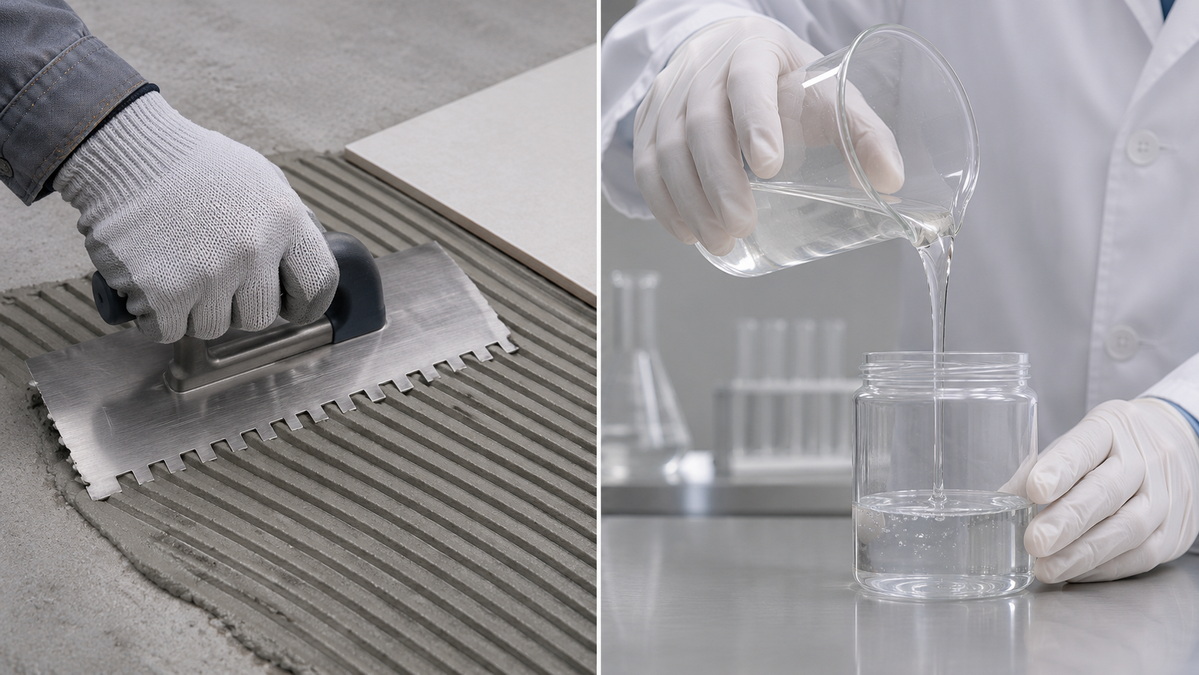
HEC is a useful candidate for water-based thickening. Selected HPMC grades can also provide thickening, foam-related benefits, and film formation.
Evaluate the finished formulation for:
- Surfactant compatibility.
- Clarity or intended appearance.
- Pouring and dispensing behavior.
- Foam characteristics.
- Viscosity development during production.
- Storage stability.
The best-performing polymer in water may behave differently after fragrance, electrolytes, preservatives, and surfactants are introduced.
Viscosity is meaningful only when the measurement conditions are known.
A supplier's reported value may depend on:
- Polymer concentration.
- Solution temperature.
- Instrument and measurement geometry.
- Spindle speed or shear rate.
- Hydration time and sample preparation.
For example, a value measured in a 1% solution cannot be directly compared with another measured at 2%. Different methods can also produce different readings for the same shear-thinning material.
Request the complete test method alongside the specification.
More importantly, solution viscosity does not independently establish mortar open time, slip resistance, cleanser clarity, or storage stability. Treat it as one selection parameter—not a complete performance prediction.
The following workflow turns a broad product inquiry into a more useful technical discussion.
Specify whether you are developing tile adhesive, render, grout, wall putty, liquid detergent, or another product.
Include the binder or surfactant system and intended application conditions.
Replace "we need better quality" with an observable target.
Examples include premature mortar drying, excessive trowel drag, poor vertical hold, cleanser stringiness, or delayed viscosity development.
Clear problem definitions make sample selection more efficient.
Compare candidate grades under consistent conditions.
For dry-mix products, control water addition, mixing procedure, rest time, substrate, and temperature. For liquid formulations, control addition order, agitation, hydration time, and pH.
Document any adjustment rather than making unrecorded changes between trials.
Evaluate properties that matter to the application, not just the easiest measurement.
For tile adhesives, this may include open time, slip, and adhesion under the applicable product requirements.
For cleansers, assess appearance, viscosity, dispensing, and stability.
Use recognized test methods where applicable and record deviations.
A successful laboratory sample is the beginning, not the end.
Repeat the formulation, assess additional batches, and verify performance under realistic production and storage conditions before changing supply.
The examples below are diagnostic starting points, not reports of specific customer projects.
| Observed problem | Questions to investigate | Practical next step |
|---|---|---|
| Lumps during liquid mixing | Was powder added too quickly? Was the correct dispersion procedure followed? | Review the grade-specific addition and hydration instructions |
| Mortar dries too quickly | Are temperature, substrate absorption, and water retention contributing? | Compare grades under representative site conditions |
| Mortar feels excessively sticky | Is polymer choice or dosage unbalanced with the formulation? | Evaluate troweling alongside retention and consistency |
| Cleanser viscosity changes | Did pH, salt, surfactants, or hydration conditions change? | Investigate the complete formulation and production history |
| Similar grades perform differently | Were viscosity methods and modifications actually equivalent? | Compare documentation and run controlled application trials |
Avoid correcting every problem by increasing dosage. First identify whether the cause is polymer selection, dispersion, formulation balance, or processing.
Cellulose ethers originate from plant-derived cellulose, but renewable feedstock does not establish every aspect of environmental performance.
A responsible purchasing assessment considers:
- Feedstock sourcing.
- Manufacturing energy and resource use.
- Packaging and transport.
- Product-specific environmental documentation.
- Performance at the required dosage.
Claims about biodegradability, carbon footprint, or environmental superiority should be supported for the specific product and assessment conditions.
For construction and daily chemical applications alike, compare options at equivalent functional performance rather than relying on a general "natural" description.
Shandong Shengda New Material Co., Ltd. focuses on the research, development, production, and sales of HPMC and related cellulose ether products for construction and daily chemical applications.
To begin a targeted product discussion, share:
- Your finished product and formulation type.
- Current cellulose ether specification and test method.
- Main performance problem.
- Processing and application conditions.
- Target market requirements.
Contact our team to discuss suitable grades and request samples for comparative evaluation. A clearly defined test plan provides a stronger basis for selection than choosing by product name or viscosity alone.
Common derivatives include HPMC, MC, HEC, HEMC/MHEC, HPC, EC, and CMC. They differ in substituent chemistry, ionic character, solubility, and application behavior.
No. Many commercial grades are water-soluble under suitable conditions, but ethylcellulose is generally water-insoluble. Temperature and solvent composition also affect certain derivatives.
HPMC contains methyl and hydroxypropyl groups; HEMC contains methyl and hydroxyethyl groups. Both are used in construction, but selection should be based on grade-specific application testing.
No. Higher viscosity describes behavior under specified measurement conditions. It does not independently establish water retention, workability, open time, or finished-product performance.
Not automatically. Personal care applications require appropriate specifications, documentation, impurity controls, and regulatory suitability. Confirm the intended use before evaluating a grade.
Compare equivalent specifications and test methods, then evaluate samples in the same formulation. Include batch consistency, documentation, technical communication, and application performance in the decision.
1. Original article supplied for restructuring: "What Are the Derivatives of Cellulose Ethers?" Published January 23, 2025. Used as the starting framework for the derivative overview, not as evidence of Shandong Shengda's capabilities. [Original webpage]. [hpmc]
2. Ashland. *Performance Specialties Reference Guide, EMEA.* Technical background on ionic and nonionic cellulose ethers, derivative families, solubility, and typical functions. [Technical reference guide].pdf). [ashland].pdf)
3. Ashland. *Agricultural Chemicals Reference Guide.* Background on cellulose ether chemistry, degree of substitution, molar substitution, and simple versus mixed ethers. [Technical reference guide]. [ashland]
4. Dow. *WALOCEL™ M 120-01 Cellulose Ether.* Commercial HEMC example supporting discussion of tile adhesive applications, workability, open time, and water retention. [Product information]. [dow]
5. Dow. *Cement Modifier and Repair Mortar.* Application-property comparisons and viscosity measurement conditions supporting the distinction between solution viscosity and mortar performance. [Application information]. [dow]
6. Ashland. *Adhesives Additives.* Technical descriptions of HEC shear thinning, HPC solvent compatibility, CMC ionic character, and EC water insolubility. [Technical overview]. [ashland]
7. Ashland. *Natrosol™ 250 HEC: Formulating Elegant Liquid and Semisolid Drug Products.* Technical background on HEC solubility and thermal behavior. [Technical publication]. [ashland]
8. Dow. *CELLOSIZE™ Texture 40-0101 Hydroxypropyl Methylcellulose.* Example of an HPMC grade intended for cleansing and personal care applications. [Product information]. [dow]


