


close
Choose Your Site
Global
Social Media
Views: 210 Author: Shengda Publish Time: 2026-07-25 Origin: Site


Content Menu
● HEMC vs HEC in Dishwashing Liquid
● Formulation Strategy for Better Results
● FAQ
>> 1. Which is better for salt tolerance, HEMC or HEC?
>> 2. Can HEMC be used in clear dishwashing liquid?
>> 3. Why is salt used in dishwashing liquid?
>> 5. Can HEMC and HEC be blended?
>> 6. What should be tested before mass production?
Dishwashing liquid looks simple on the shelf, but its performance depends on a careful balance of surfactants, thickener, salt, fragrance, and stability. Among the most important raw material decisions is whether to use HEMC or HEC as the primary cellulose ether thickener.
For formulators, the question is not only which material thickens better. The real issue is which one keeps the product stable, clear, and consistent when salt is added during production and during storage.
Salt tolerance is a critical property in dishwashing liquid because salt is often used to adjust viscosity. If the thickener cannot tolerate electrolyte changes, the formula may become too thin, cloudy, unstable, or even separate over time.
In practical production, the formula is rarely perfect on the first trial. Salt levels, water hardness, surfactant ratio, fragrance load, and temperature can all affect the final texture. A good thickener must therefore work not just in the lab, but also in real manufacturing conditions.
HEC, or Hydroxyethyl Cellulose, is a non-ionic cellulose ether widely used in liquid detergents and personal care systems. It is valued for its thickening ability, surfactant compatibility, and good performance in clear formulas.
Because HEC does not carry ionic charge, it is generally more stable in systems with added salt. This makes it a popular choice for dishwashing liquid, hand wash, and other transparent cleaning products where clarity and predictable rheology matter.
HEMC, or Hydroxyethyl Methyl Cellulose, is another cellulose ether used in liquid formulations. Compared with HEC, it has a different substitution pattern, which can give it a different hydration behavior, texture profile, and film-forming tendency.
In detergent applications, HEMC can support viscosity build and may create a more structured feel. In some formulas, that can be an advantage. However, for clear dishwashing liquids, it often requires more careful optimization than HEC.
If the goal is better salt tolerance, HEC is usually the stronger choice in dishwashing liquid. It is commonly preferred in high-electrolyte systems because it delivers steadier viscosity and better clarity under salt stress.
HEMC can still perform well, but its main value often lies in producing a richer or more structured rheology profile. In a transparent dishwashing liquid, that extra structure is not always necessary, and it can sometimes make formulation work more demanding.
| Property | HEMC | HEC |
|---|---|---|
| Salt tolerance | Good, but often needs more optimization | Strong and usually more predictable |
| Clarity in liquid detergent | Good, depending on formula design | Very good in clear systems |
| Texture | More structured | Smoother and cleaner flow |
| Formulation ease | Moderate | Easier in many clear systems |
| Best fit | Premium or structured products | Clear dishwashing liquid and salt-adjusted systems |
Salt does not simply "thicken" a detergent in a straight line. In surfactant systems, viscosity often rises first and then falls if too much salt is added. This is why formulators often talk about a salt curve.
That curve matters because the thickener must remain stable as the formula moves toward the viscosity peak. A material with better salt tolerance gives the formulator more room to adjust the texture without losing clarity or stability.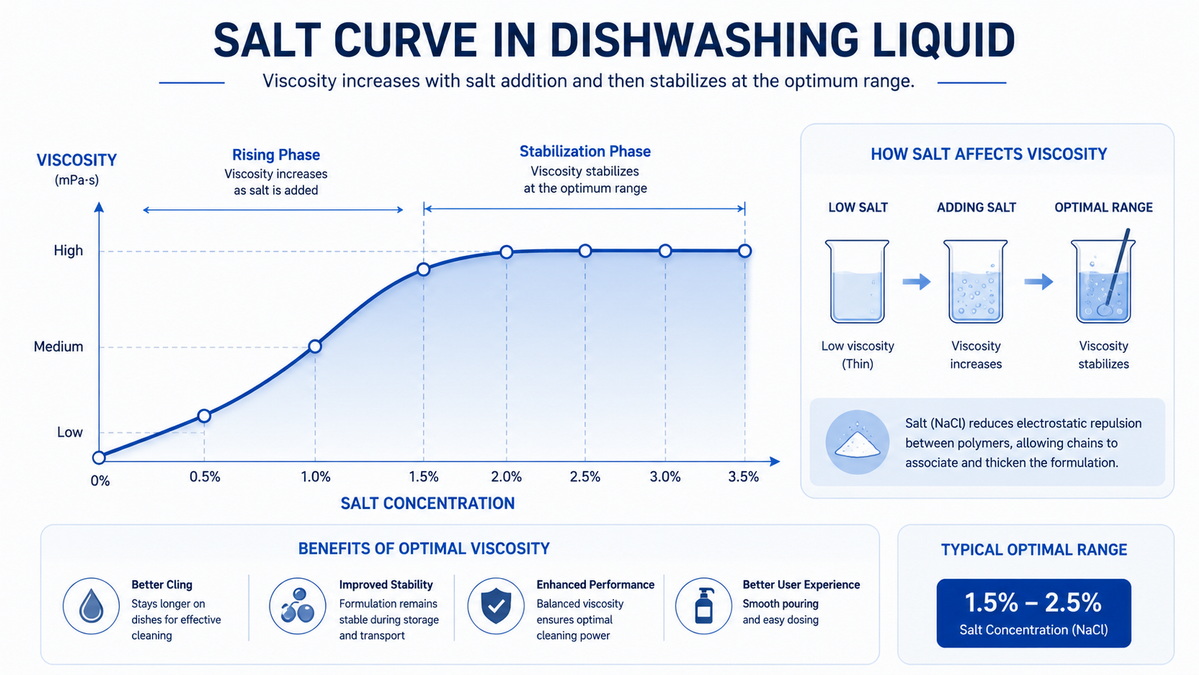
HEC is usually preferred in clear dishwashing liquid for three main reasons.
- It is non-ionic, so it is less sensitive to electrolyte changes.
- It is easier to control during salt addition.
- It tends to support transparent and stable liquid systems.
For brands that want a clean appearance and repeatable production results, these advantages are very important. HEC often gives a more forgiving formulation window, especially in export-oriented products where consistency across batches is essential.
HEMC is not the wrong choice. It can be useful when the product needs a slightly denser, more premium body or when the same raw material strategy is being used across multiple home care products.
It may also be worth considering in formulas where visual clarity is not the only priority. If the brand wants a richer flow, stronger suspension behavior, or a more distinctive sensory profile, HEMC can have a place in development.
The best results usually come from a step-by-step formulation process rather than a one-shot salt adjustment.
1. Fully hydrate the cellulose ether before final viscosity correction.
2. Build the surfactant base first.
3. Add salt gradually in small steps.
4. Check clarity after each adjustment.
5. Re-test after 24 hours, 72 hours, and cold storage.
This process helps identify the real salt tolerance limit of the system and reduces the risk of over-thickening or sudden thinning.
Use the following logic when choosing between the two materials:
- Choose HEC if your top priority is salt tolerance and clarity.
- Choose HEMC if you want a more structured or premium texture.
- Test both when the formula contains higher fragrance, mixed surfactants, or challenging water conditions.
- Do not rely on salt alone to create viscosity; use the thickener as the base control tool.
For most transparent dishwashing liquids, HEC is the safer starting point. HEMC becomes more interesting when the formula needs a different sensory profile or a broader product strategy.
In real production, the best thickener is the one that performs reliably under your exact conditions. That means the choice should be based on surfactant type, salt target, pH, water quality, and packaging format.
This is especially important for manufacturers serving international markets. A formula that works well in one region may behave differently in another because of temperature, storage, or raw material variation. That is why pilot testing remains essential before mass production.
For most dishwashing liquid formulas, HEC offers better salt tolerance and easier clarity control than HEMC. HEMC remains useful in more structured or premium-feel products, but HEC is usually the more practical starting point for stable, clear, salt-adjusted liquid detergents.
HEC is usually better for salt tolerance in dishwashing liquid because it is more predictable in electrolyte-rich systems.
Yes, but it often needs more careful optimization than HEC to maintain clarity and stable viscosity.
Salt is commonly used to fine-tune viscosity and help the product reach the desired thickness.
HEC mainly affects viscosity and rheology. It is not primarily a foam-building ingredient.
Yes. Some formulators blend them to balance clarity, thickness, and sensory feel.
Viscosity, clarity, pH, cold stability, and shelf stability should all be tested before scale-up.
1. [Shandong Shengda New Material Co., Ltd.]
2. [InnoNew Material — Hydroxyethyl Cellulose HEC for Detergent]
3. [Wiley Online Library — A look behind the salt curve]


