


close
Choose Your Site
Global
Social Media
Views: 257 Author: Shengda Publish Time: 2026-08-11 Origin: Site


Content Menu
>> Main characteristics that affect solubility
● How to Dissolve HPMC Properly
● Why HPMC Behaves Differently from Other Polymers
● HPMC in Construction Materials
>> Key functions in construction
>> Typical construction applications
● HPMC in Daily Chemical Products
● How to Choose the Right HPMC Grade
● Practical Troubleshooting Guide
>> If the formula performs poorly in use
>> Simple troubleshooting checklist
● Why Temperature Matters So Much
● FAQ
>> 1. What is the main solvent of HPMC?
>> 2. Does HPMC dissolve in hot water?
>> 3. Why does HPMC form lumps?
>> 4. Can HPMC be used in daily chemical products?
>> 5. Is HPMC suitable for construction materials?
>> 6. How do I choose the right HPMC grade?
HPMC is a non-ionic polymer derived from cellulose. It has excellent water compatibility and is designed to function in aqueous systems. However, it does not behave like ordinary powders that dissolve instantly in any liquid.
Its key characteristic is that it dissolves better in cold water. When the water temperature rises, HPMC may swell first and form a gel-like state before fully hydrating. That is why direct addition to hot water often creates poor dispersion instead of a smooth solution.
This temperature-sensitive behavior is one reason HPMC is widely used in construction and daily chemical products. It helps control thickening, water retention, suspension, and film formation, while still allowing stable processing in large-scale production.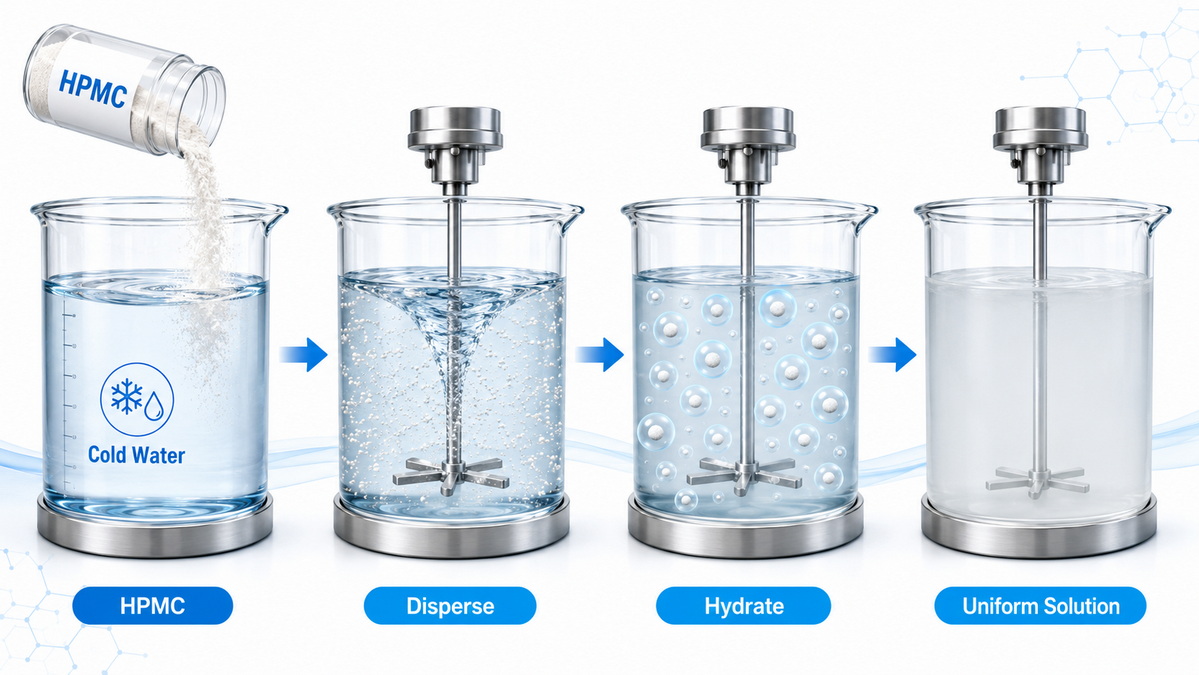
- It is soluble in cold water.
- It shows thermal gelation behavior.
- It remains stable across a wide pH range.
- It performs well in non-ionic water-based systems.
For most industrial formulas, the best solvent for HPMC is water. In standard production, there is no need for a special solvent system unless the application is highly specialized.
In construction materials, water is the main medium for hydration. In daily chemical products, water is also the main solvent, although some formulas may include humectants, surfactants, or co-solvents to improve texture or processing behavior.
| Solvent system | Typical use | Notes |
|---|---|---|
| Cold water | Construction, daily chemicals, general industrial use | The most common and practical choice |
| Water + co-solvent | Specialty films, coatings, selected formulations | Used only when process design requires it |
| Hot water | Not recommended for direct dissolution | May cause swelling or gelation |
For most users, the real focus is not only the solvent itself, but also the hydration process. Even when using water, poor processing can lead to clumping or uneven viscosity.
The correct mixing method is essential for stable results. HPMC does not always dissolve instantly. It needs time to hydrate fully, especially in higher-viscosity grades.
A good process usually starts with clean water at a suitable temperature. The powder should then be added slowly and evenly under continuous agitation. If the powder is poured too quickly, it can form lumps on the surface and prevent full hydration.
1. Prepare clean cold or room-temperature water.
2. Start agitation before adding HPMC.
3. Add the powder slowly and evenly.
4. Maintain mixing until the powder is fully dispersed.
5. Allow enough time for complete hydration.
6. Check final viscosity after full stabilization.
- Adding powder too quickly.
- Using water that is too hot.
- Mixing with insufficient agitation.
- Measuring viscosity too early.
- Ignoring compatibility with other ingredients.
These mistakes often lead to poor performance in mortar, putty, tile adhesive, or personal care products. Stable hydration is especially important when the product must deliver consistent thickening or water retention.
The solubility behavior of HPMC comes from its chemical structure. It is a modified cellulose material with hydroxypropyl and methyl groups attached to the cellulose backbone. These groups change how the polymer interacts with water.
Compared with unmodified cellulose, HPMC is much more suitable for water-based systems. Its non-ionic nature also gives it good compatibility with many ingredients, which is why it is widely used in both construction and daily chemical industries.
Another important advantage is its balance of solubility and thermal response. This allows formulators to control the way the product thickens, spreads, and sets during use.
HPMC is especially important in building materials. It is widely used in tile adhesives, wall putty, dry-mix mortar, gypsum products, and self-leveling systems.
In these applications, HPMC helps improve water retention, open time, workability, and adhesion. It also helps reduce sagging and supports smoother application.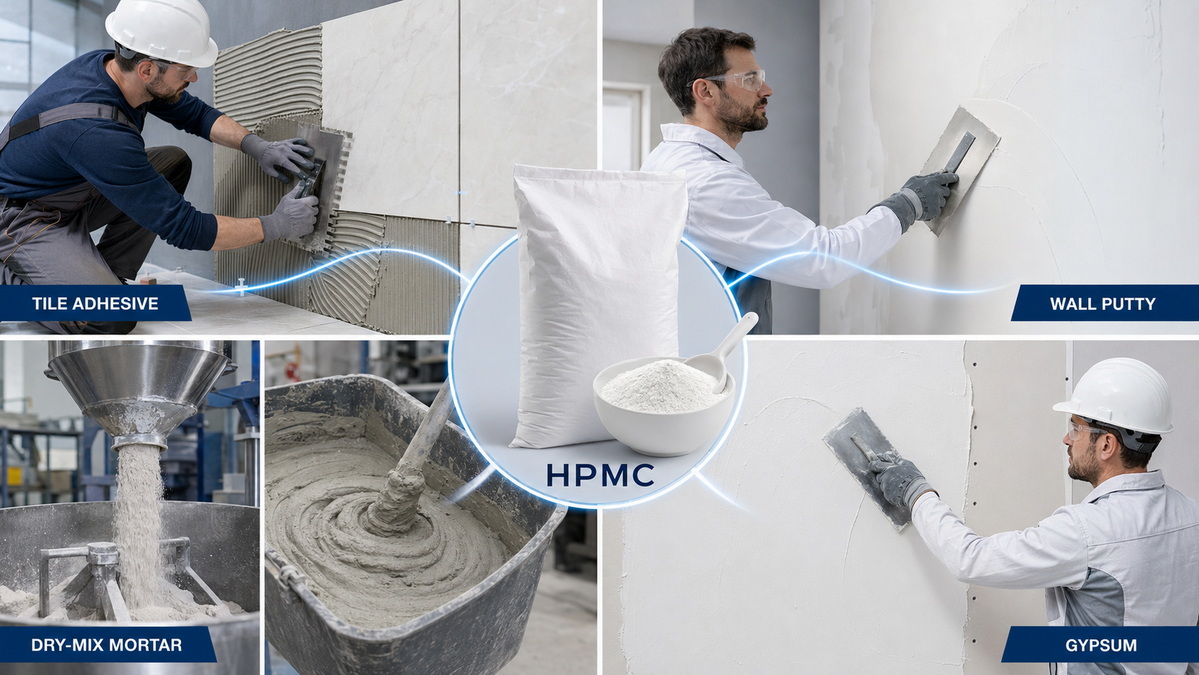
- Improves water retention.
- Enhances workability.
- Extends open time.
- Supports adhesion.
- Improves anti-sag performance.
- Helps reduce cracking caused by rapid water loss.
Because construction systems often use dry powders that are mixed with water on site, HPMC must hydrate in a predictable way. The mixing sequence and water temperature can strongly affect the final result.
| Application | Main benefit |
|---|---|
| Tile adhesive | Better bonding and workability |
| Wall putty | Improved smoothness and water retention |
| Dry-mix mortar | Stable performance and easier application |
| Gypsum plaster | Better consistency and longer working time |
| Self-leveling compound | Improved flow control |
HPMC is also widely used in daily chemical formulations. It can thicken water-based systems, stabilize suspensions, and improve texture and feel. Because it is non-ionic, it is often suitable for formulas that need good stability and smooth processing.
Common daily chemical uses include shampoos, body washes, facial cleansers, and other personal care systems where texture and consistency matter. In these products, HPMC supports a pleasant product appearance and better user experience.
Its role is not limited to thickening. It can also help improve suspension stability, reduce phase separation, and enhance the overall structure of the formula.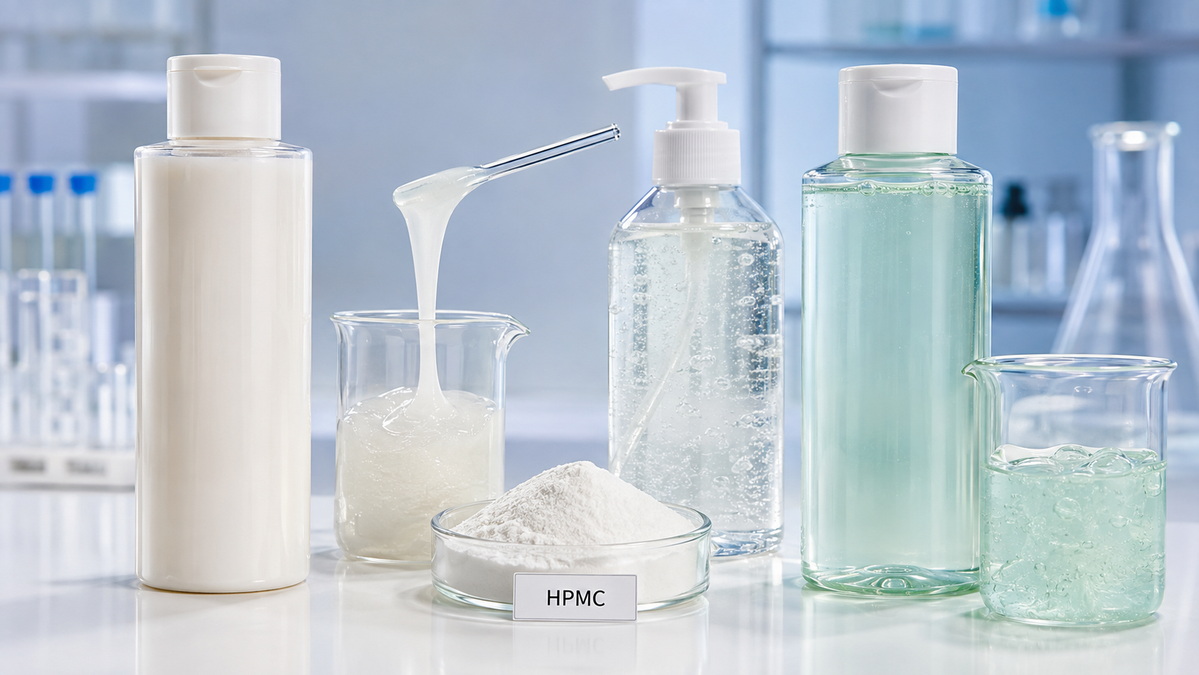
Not every HPMC grade behaves the same way. Different grades vary in viscosity, particle size, substitution pattern, hydration speed, and final application performance.
When selecting a product, buyers should consider the actual end use first. A grade that works well in mortar may not be ideal for personal care or specialty coatings.
| Factor | Why it matters |
|---|---|
| Viscosity grade | Affects thickening and flow behavior |
| Hydration speed | Influences processing efficiency |
| Particle size | Affects dispersion and lump formation |
| Application type | Construction, daily chemicals, or specialty systems |
| Batch consistency | Important for stable production |
For industrial users, the safest approach is to test the grade in the real formula before full-scale production. Small changes in grade can produce noticeable differences in performance.
Many HPMC processing problems come from hydration errors rather than the product itself. If the solution is too thick, too thin, or uneven, the first place to check is the mixing process.
This usually means the powder was added too fast or the water was not moving enough. Slower feeding and stronger agitation often solve the problem.
The problem may be incomplete hydration, temperature variation, or incompatibility with other ingredients. Allow more time for full dispersion before testing.
The issue may be the wrong grade, not just the wrong process. Viscosity level, application type, and final performance requirements should all be reviewed together.
- Check water temperature.
- Review the powder addition rate.
- Increase agitation if needed.
- Allow more hydration time.
- Confirm the selected grade matches the application.
Temperature is one of the most important factors in HPMC solubility. Cold water supports smooth hydration, while hot water may trigger swelling or gel formation before the polymer is fully dispersed.
This is why some users mistakenly think HPMC is hard to dissolve. In reality, the issue is often the wrong water temperature or a poor mixing method.
When temperature is controlled properly, HPMC can perform very consistently. That consistency is one of the reasons it remains such an important material in industrial formulation work.
The solvent of Hydroxypropyl Methylcellulose is usually water, especially cold or room-temperature water. The key to good performance is not simply choosing the right solvent, but using the right hydration method and product grade.
For construction and daily chemical applications, proper dispersion, temperature control, and application matching are essential for achieving stable results. When these factors are managed well, HPMC can deliver reliable thickening, water retention, and overall product performance.
The main solvent of HPMC is water, especially cold or room-temperature water.
HPMC does not dissolve well in hot water at the start. It may swell or gel instead of hydrating smoothly.
Lumps usually form when the powder is added too quickly or the mixing is not strong enough.
Yes. It is widely used in shampoos, body washes, cleansers, and other water-based personal care products.
Yes. It is widely used in tile adhesives, wall putty, mortar, gypsum, and self-leveling systems.
Choose based on viscosity, hydration behavior, particle size, and the final application.
1. [Dofinechem Technical Document]
2. [Cinda Securities Research Report]
3. [LANDU HPMC Manufacturer Page]


