


close
Choose Your Site
Global
Social Media
Views: 247 Author: Shengda Publish Time: 2026-09-29 Origin: Site


Content Menu
● What Is Hydroxypropyl Methylcellulose?
>> Key Properties of Construction-Grade HPMC
● Why Is HPMC Important in Construction Materials?
● How Does HPMC Improve Cement Mortar Performance?
>> Water Retention for Better Hydration
>> Improved Workability and Troweling
>> Better Cohesion and Stability
● Main Applications of HPMC in Construction
>> HPMC for Wall Putty and Skim Coat
>> HPMC for Cement Render and Plaster
>> HPMC for Self-Leveling Mortar
● How to Choose the Right HPMC Grade
>> Practical HPMC Grade Selection Process
● Common Mistakes When Using HPMC in Mortar
>> Choosing HPMC Only by Viscosity
>> Ignoring Raw Material Variation
>> Skipping Field Application Trials
>> Treating HPMC as a Commodity
● Quality Control for Construction-Grade HPMC
>> What is HPMC used for in construction?
>> How does HPMC improve tile adhesive?
>> Is higher-viscosity HPMC always better for mortar?
>> Can HPMC improve cement mortar adhesion?
>> What is the difference between HPMC and other cellulose ethers?
>> Can HPMC be used in gypsum plaster?
Hydroxypropyl Methylcellulose (HPMC) is a high-performance cellulose ether widely used in dry-mix construction materials. This guide explains how construction-grade HPMC improves water retention, workability, open time, cohesion, anti-sag properties, and application consistency in tile adhesive, wall putty, cement mortar, gypsum plaster, EIFS systems, and self-leveling compounds.
Hydroxypropyl Methylcellulose, commonly known as HPMC, is one of the most important functional additives in modern construction mortar. It is widely used in dry-mix products because it helps manufacturers, contractors, and installers achieve better workability, more stable application performance, and more reliable curing conditions.
In tile adhesive, wall putty, cement render, gypsum plaster, self-leveling mortar, and external insulation systems, HPMC does much more than thicken the mixture. It helps retain water, improve consistency, support cement hydration, extend workable time, reduce vertical sag, and create a smoother application experience.
For dry-mix mortar producers, selecting the right construction-grade HPMC can make a visible difference in product quality. A properly selected grade helps mortar spread more smoothly, remain workable for longer, form stable ridges after combing, and maintain better contact with substrates and tiles.
At Shandong Shengda New Material Co., Ltd., we focus on the research, development, production, and supply of cellulose ether products for construction and daily chemical applications. Our goal is to help customers develop stable, high-quality, and sustainable material solutions for different market needs.
Hydroxypropyl Methylcellulose is a non-ionic cellulose ether made by chemically modifying cellulose. Cellulose is a naturally occurring polymer associated with plant-based raw materials. Through controlled modification, cellulose gains useful properties such as water solubility, thickening ability, water retention, and rheology control.
Construction-grade HPMC is usually supplied as a white or off-white powder. It is added to dry-mix mortar during production. When the dry mixture is combined with water, the HPMC hydrates and becomes active in the mortar system.
This hydration process helps regulate the movement of water inside the mixture. It also improves cohesion between cement, sand, fillers, polymer powders, and other additives. As a result, the mortar becomes easier to mix, apply, spread, comb, and finish.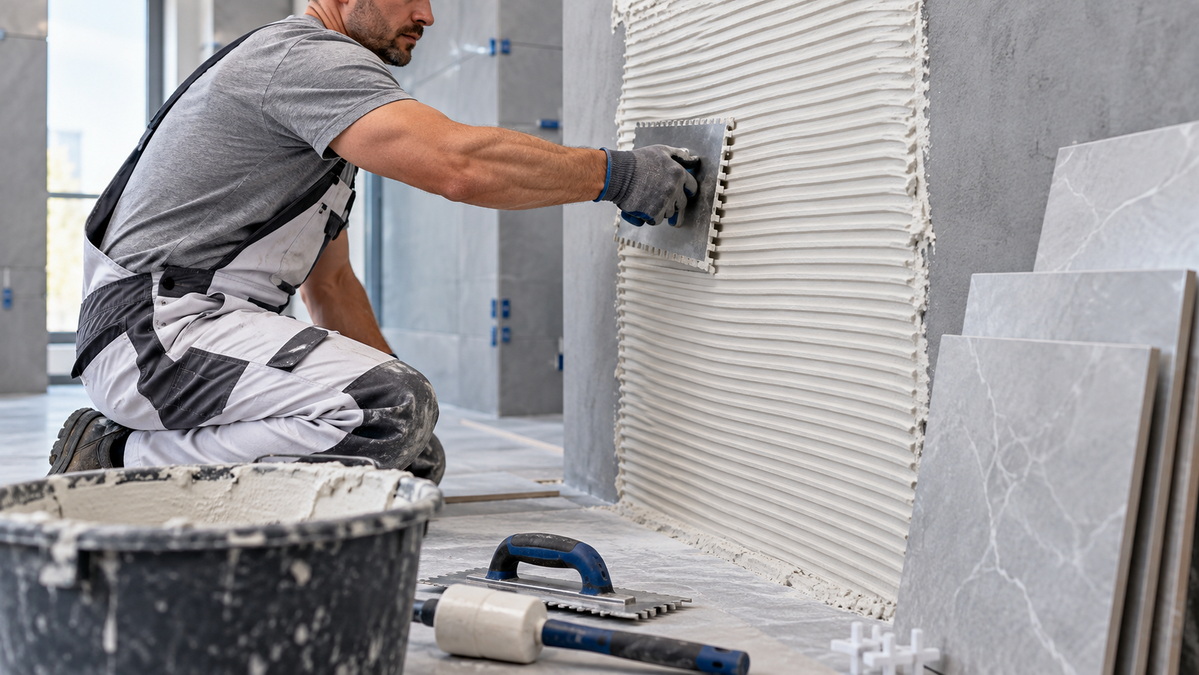
| Property | Role in Construction Mortar | Practical Benefit |
|---|---|---|
| Water retention | Helps reduce rapid water loss | Supports cement hydration and longer workability |
| Thickening | Increases mortar consistency | Helps prevent separation and excessive flow |
| Rheology control | Adjusts the way mortar flows and responds to force | Improves spreading and troweling behavior |
| Cohesion | Helps hold ingredients together in a stable system | Reduces segregation and improves handling |
| Open-time support | Keeps the surface workable for longer | Gives installers more time to place and adjust tiles |
| Anti-sag performance | Helps mortar remain in place on vertical surfaces | Supports wall-tile installation and vertical plastering |
| Application consistency | Helps create a smoother, more uniform mortar texture | Improves jobsite efficiency and finish quality |
Construction materials must perform well not only after curing, but also during mixing and application. Fresh mortar must be easy to prepare, spread, comb, level, and adjust. It must also retain enough water to allow cement hydration to continue properly.
Without effective water retention, cement mortar can lose water too quickly. This often happens when the substrate is highly absorbent, when the weather is hot and dry, or when wind increases surface evaporation.
When a mortar loses water too rapidly, it may become difficult to apply and may not achieve the intended bonding or finishing performance.
Common problems include:
- Short working time
- Difficult spreading
- Poor combing behavior
- Surface skinning
- Reduced tile adjustment time
- Fast drying on absorbent substrates
- Poor contact between adhesive and tile
- Inconsistent final appearance
- Reduced curing efficiency
HPMC helps address these issues by managing water movement inside the material. The polymer creates a more stable mortar structure and slows rapid water migration into the substrate or surrounding environment.
The result is a more controlled application process and a more dependable finished product.
Water retention is one of the most valuable properties of HPMC in cement-based systems. Cement requires sufficient water to hydrate and develop its strength. If water disappears too quickly, the hydration process can be interrupted.
Highly absorbent substrates such as concrete blocks, cement boards, aerated concrete blocks, and masonry walls can draw water out of fresh mortar. Hot temperatures, low humidity, and strong airflow can create similar problems.
HPMC helps the mortar retain water for a longer period. This gives cement more time to hydrate and improves the working conditions for installers.
Better water retention can support:
- Longer open time
- Improved adhesion development
- Better workability
- More consistent curing
- Reduced premature drying
- Better contact between mortar and substrate
- More stable tile installation conditions
However, higher water retention should not be the only goal. A mortar must maintain a balanced performance profile. Excessive HPMC dosage can make mortar too thick, too sticky, difficult to mix, or less suitable for applications that require higher flow.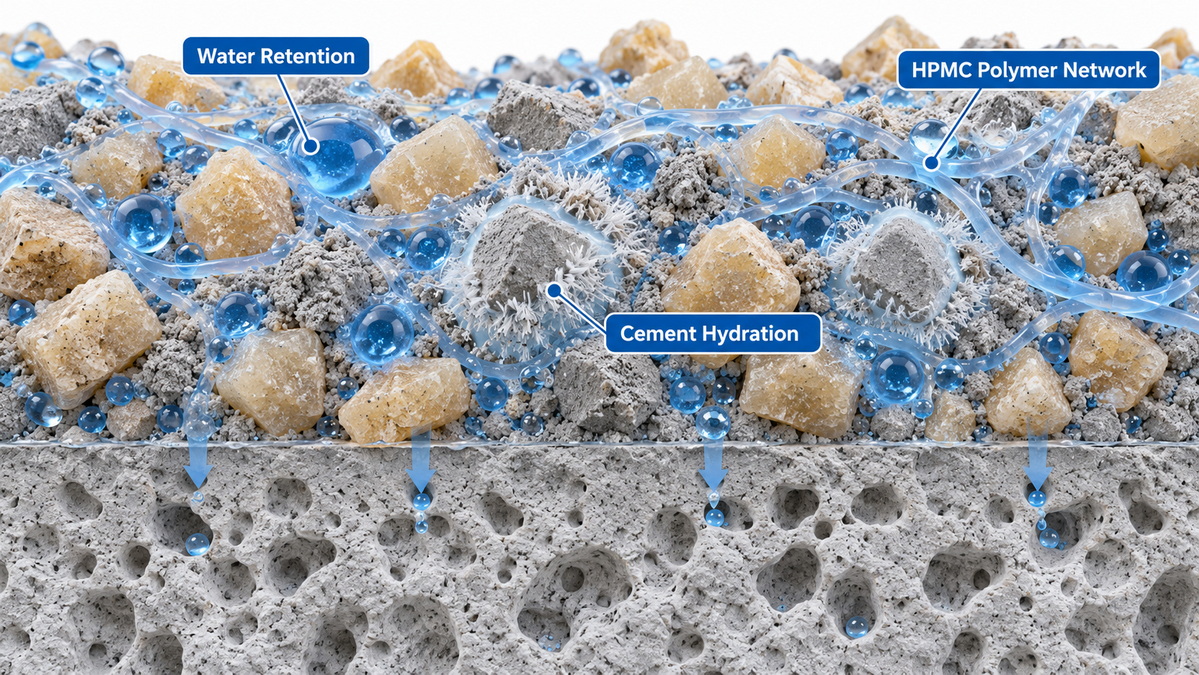
Workability describes how easily a mortar can be mixed, spread, pumped, troweled, combed, leveled, or finished. It is one of the most important qualities noticed by contractors and installers.
A well-formulated HPMC-modified mortar should feel smooth and controlled during application. It should not become excessively dry, grainy, sticky, runny, or difficult to spread.
In tile adhesive, the ideal mortar should form clear and stable trowel ridges. In wall putty, it should spread smoothly and scrape evenly. In cement render, it should remain cohesive without dropping excessively from the wall. In self-leveling products, it should flow evenly without separating.
HPMC helps manufacturers fine-tune these characteristics.
Cement mortar contains several components, including cement, sand, calcium carbonate, mineral fillers, polymer powders, pigments, and other additives. These materials must work together as a stable system.
HPMC helps increase cohesion between solid particles and water. This reduces the risk of segregation, where heavier particles settle or water separates from the mixture.
Better cohesion can support:
- More uniform mixing
- Stable mortar texture
- Reduced material separation
- Better trowel control
- Improved handling during application
- More consistent product quality
Open time is the period during which a freshly applied mortar remains capable of forming a proper bond. This is especially important for tile adhesive.
After tile adhesive is spread and combed onto a wall or floor, the installer needs time to position and press the tile into place. If the adhesive surface dries too quickly, it may form a skin that reduces contact and bonding quality.
HPMC helps extend open time by slowing water loss. This is particularly useful in warm climates, dry indoor environments, large-area installation projects, and applications involving large-format tiles.
Tile adhesive is one of the most common uses of construction-grade HPMC. Cement-based tile adhesives require a balance of water retention, trowelability, anti-slip performance, open time, and bonding conditions.
HPMC helps tile adhesive remain workable after it has been mixed with water. It also supports the formation of stable trowel ridges and can help reduce tile movement on vertical surfaces.
Key benefits of HPMC in tile adhesive include:
- Improved water retention
- Better trowelability
- Longer open time
- Stronger mortar cohesion
- Improved anti-sag behavior
- Better tile adjustment time
- More consistent application feel
- Improved contact between tile and adhesive
For high-performance tile adhesive formulations, HPMC is often used together with redispersible polymer powder. HPMC mainly supports water retention and rheology control, while polymer powder can enhance flexibility, adhesion, and resistance to movement.
Wall putty and skim coat products require a smooth texture, good blade feel, sufficient working time, and easy finishing.
HPMC helps improve the consistency of wall putty and supports smoother application. It can reduce the risk of rapid drying, especially on absorbent surfaces. It also helps the material remain stable during spreading and scraping.
In a well-balanced wall putty formulation, HPMC can contribute to:
- Smoother spreading
- Improved scraping performance
- Better moisture control
- More uniform surface finishing
- Reduced dry feeling during application
- Improved handling on different substrates
- Better product consistency from batch to batch
The correct HPMC grade should provide a smooth application feel without excessive stickiness. If the viscosity or dosage is too high, the putty may feel heavy, stringy, or difficult to finish.
Cement render and plaster must remain workable long enough for proper application and finishing. These products also require good cohesion so that the mortar can stay on vertical surfaces without excessive drop or sag.
HPMC supports water retention and helps improve mortar handling during wall application. It can make the mixture easier to spread and finish while supporting more stable curing conditions.
For cement render and plaster, important performance goals may include:
- Easy mixing
- Smooth application
- Reduced material drop
- Controlled setting behavior
- Strong cohesion
- Suitable working time
- Improved water retention
- Uniform finished appearance
Gypsum plaster has different setting behavior from cement mortar. Therefore, HPMC selection must be based on the specific gypsum formulation rather than cement-based results alone.
In gypsum plaster and gypsum joint compounds, HPMC can help improve consistency, water retention, spreading behavior, and application comfort. It can also support a more uniform texture during manual or machine application.
Important factors for gypsum plaster include:
- Setting-time compatibility
- Smooth application
- Good pumping behavior
- Controlled water demand
- Stable consistency
- Surface finishing quality
- Compatibility with retarders and other gypsum additives
External Insulation and Finish Systems require carefully controlled adhesive and basecoat materials. These formulations need strong workability, reliable bonding, stable consistency, and resistance to demanding outdoor installation conditions.
HPMC can support the application performance of EIFS adhesive mortars and basecoat systems. It helps improve water retention and cohesion while supporting smoother installation.
For EIFS products, manufacturers should evaluate the full formula under real conditions, including substrate type, weather exposure, insulation board type, polymer content, and required mechanical performance.
Self-leveling mortar requires a very different balance from tile adhesive or wall putty. The material must flow easily and level itself, but it must remain stable without separation or excessive bleeding.
HPMC can help manage water distribution and improve system stability. However, the grade and dosage must be carefully selected. Too much thickening can reduce flow and prevent proper leveling.
A successful self-leveling formulation requires balance between:
- Flowability
- Stability
- Water retention
- Setting behavior
- Surface smoothness
- Reduced segregation
- Reduced bleeding
- Compatibility with superplasticizers and other additives
Selecting the right HPMC grade requires more than reviewing viscosity. Viscosity is important, but it is only one part of the overall performance profile.
Two HPMC products with similar viscosity values may behave differently in mortar because of differences in particle size, hydration speed, substitution level, purity, moisture content, ash level, bulk density, and manufacturing consistency.
The best choice depends on the specific formulation and target application.
| Selection Factor | Why It Matters |
|---|---|
| Application type | Tile adhesive, skim coat, plaster, EIFS, and self-leveling mortar need different rheological behavior |
| Water retention requirement | Absorbent substrates and hot climates may require stronger water-retention performance |
| Viscosity range | Affects thickness, cohesion, application feel, and flow behavior |
| Hydration speed | Influences mixing time and the risk of lump formation |
| Cement and filler type | Different raw materials can change the performance of HPMC |
| Other additives | HPMC must be compatible with polymer powder, starch ether, retarders, accelerators, and defoamers |
| Climate conditions | Heat, wind, humidity, and substrate absorbency affect application performance |
| Product standard | The final formulation may need to meet local or project-specific performance requirements |
1. Define the target product and intended application.
2. Identify the most important performance requirements, such as water retention, open time, anti-sag behavior, flow, or surface smoothness.
3. Prepare a control formulation using the current raw materials.
4. Test several HPMC grades at suitable dosage ranges.
5. Measure fresh-mortar properties, including mixing behavior, consistency, water retention, density, flow, and trowelability.
6. Evaluate cured properties, including bond strength, compressive strength, flexural strength, shrinkage, and cracking behavior where relevant.
7. Confirm the formula through practical application trials under realistic site conditions.
This process helps manufacturers avoid choosing HPMC based on price or viscosity alone.
Viscosity provides useful information, but it does not fully predict application performance. A suitable HPMC grade must also provide the right water retention, hydration behavior, rheology, and compatibility with the complete formulation.
More HPMC does not always create better mortar. Excessive dosage can increase water demand, reduce flow, create stickiness, affect air content, and make application more difficult.
Changes in cement, sand, calcium carbonate, fillers, polymer powders, and other materials can affect mortar performance. An HPMC grade that works well in one formula may require adjustment when raw materials change.
Laboratory testing is essential, but field trials provide equally important information. Contractors may notice details that are difficult to measure in the laboratory, such as trowel feel, combing quality, tile adjustment time, pumping behavior, and surface finishing comfort.
HPMC is a functional additive with a direct influence on product quality. Stable manufacturing, consistent quality control, technical support, and formulation knowledge are important for long-term production reliability.
A dependable HPMC supplier should provide stable material quality and support customers in selecting suitable grades for specific applications.
Important quality-control indicators may include:
- Viscosity
- Moisture content
- Ash content
- pH value
- Bulk density
- Particle-size distribution
- Purity
- Dissolution behavior
- Water-retention performance
- Batch-to-batch consistency
For dry-mix mortar manufacturers, it is also important to test how HPMC performs in the complete formula. Material specifications are useful, but application testing is the most reliable way to confirm whether a grade is suitable for the final product.
Shandong Shengda New Material Co., Ltd. provides cellulose ether solutions for construction-material manufacturers seeking stable performance in tile adhesive, wall putty, cement render, gypsum plaster, EIFS systems, and other dry-mix mortar applications.
HPMC is a highly valuable additive in the construction industry because it improves the performance of dry-mix mortar at every stage of use. It helps manufacturers produce more stable formulations and helps installers achieve smoother, more reliable application results.
From tile adhesive and wall putty to cement plaster, gypsum-based products, EIFS mortars, and self-leveling compounds, the right construction-grade HPMC can improve water retention, workability, open time, cohesion, anti-sag behavior, and overall product consistency.
The best results come from selecting HPMC according to the complete formula, local application conditions, target performance, and real-world testing. Instead of focusing only on viscosity, manufacturers should consider the total performance balance needed for their specific market and product category.
For manufacturers seeking consistent cellulose ether solutions for construction materials, Shandong Shengda New Material Co., Ltd. offers professional HPMC products and formulation-oriented support for global dry-mix mortar applications.
HPMC is used in construction materials such as tile adhesive, wall putty, skim coat, cement render, gypsum plaster, EIFS mortar, and self-leveling compounds. It helps improve water retention, workability, cohesion, open time, and application performance.
HPMC helps tile adhesive retain water, remain workable for longer, form stable trowel ridges, reduce vertical sag, and support better contact between tiles and the adhesive layer.
No. Higher viscosity may improve certain properties, but it can also reduce flow, increase stickiness, and make mortar harder to apply. The right viscosity depends on the formulation and application.
HPMC can support adhesion by improving water retention, cohesion, workability, and cement hydration conditions. Final adhesion also depends on cement type, polymer powder content, fillers, substrate preparation, curing conditions, and the overall formula.
HPMC is one type of cellulose ether. Other types include methyl cellulose, hydroxyethyl methyl cellulose, methyl hydroxyethyl cellulose, and hydroxyethyl cellulose. Different cellulose ethers provide different performance characteristics and may be selected for different construction applications.
HPMC should be stored in a cool, dry, clean, and well-ventilated location. Keep bags or containers sealed to protect the powder from moisture and contamination.
Yes. HPMC is commonly used in gypsum plaster and gypsum joint compounds to improve consistency, water retention, spreading behavior, and surface finishing performance. The selected grade should be tested in the specific gypsum formulation.
1. Kima Chemical. [What Is HPMC in the Construction Industry?]
2. Ma, B. et al. [Water Retention Mechanism of Hydroxypropyl Methyl Cellulose in Cement Mortar]. *Materials*, 2020.
3. National Center for Biotechnology Information, PubChem. [Hydroxypropylmethylcellulose].
4. ScienceDirect. [Cellulose Ethers Influence on Water Retention and Consistency in Cement-Based Mortars].
5. ACTA Biotechnology. [Tile Adhesive Additives: HPMC & HEMC for High-Performance Mortar].


