


close
Choose Your Site
Global
Social Media
Views: 259 Author: Shengda Publish Time: 2026-09-01 Origin: Site


Content Menu
● What Is HPMC and Why Does Supplier Selection Matter?
● Leading Global HPMC and Cellulose Ether Manufacturers
>> 1. Ashland
>> 2. Dow
>> 4. SE Tylose
>> 6. Nouryon
>> 7. Shandong Shengda New Material Co., Ltd.
>> 8. China-Based Cellulose Ether Manufacturers
>> 9. Pharmaceutical Solution Providers
>> 10. Regional and Application-Focused Suppliers
● HPMC vs. HEMC vs. HEC: Key Differences for Buyers
● How to Qualify an HPMC Supplier
>> Step 1: Define the Required Performance
>> Step 2: Compare Equivalent Grades
>> Step 3: Test Samples in the Complete Formula
>> Step 4: Assess Supply Reliability
>> Step 5: Approve Commercial Batches Carefully
● Why the Lowest HPMC Price May Not Be the Lowest Cost
● Choosing the Right Cellulose Ether Partner
>> Is HPMC the same as hypromellose?
>> What is the best HPMC for tile adhesive?
>> Can HEC replace HPMC in cement mortar?
>> What documents should an HPMC supplier provide?
>> How can I compare HPMC viscosity from different suppliers?
>> Is China a reliable source for HPMC, HEMC, and HEC?
>> What is the difference between construction-grade and daily-chemical-grade cellulose ether?
Selecting an HPMC manufacturer is a strategic decision for formulators, distributors, and construction-material producers. Hydroxypropyl methylcellulose (HPMC) affects water retention, viscosity, workability, open time, stability, adhesion development, and final-product consistency across many formulations.
For tile adhesives, wall putty, skim coats, gypsum products, detergents, water-based coatings, shampoos, and personal-care products, the right cellulose ether grade can improve manufacturing efficiency and end-user performance. The wrong grade, even at a lower purchase price, can lead to higher dosage, inconsistent mixing, weak workability, product complaints, or expensive reformulation.
This guide introduces leading global companies associated with HPMC and related cellulose ethers, including hydroxyethyl methylcellulose (HEMC), methyl hydroxyethyl cellulose (MHEC), and hydroxyethyl cellulose (HEC). It also provides a practical framework for comparing suppliers based on technical suitability, quality consistency, supply reliability, and application support.
Hydroxypropyl methylcellulose, also known as hypromellose in pharmaceutical applications, is a non-ionic and water-soluble cellulose ether. It is produced by modifying purified cellulose to provide controlled properties such as thickening, water retention, film formation, suspension, binding, and rheology modification.
However, HPMC is not a single interchangeable material.
Two products with similar nominal viscosity may perform differently in the same formula. This is because performance is influenced by factors including substitution level, particle size, surface treatment, dissolution speed, moisture content, gel temperature, bulk density, and batch-to-batch manufacturing consistency.
For example, a cellulose ether used in cement-based tile adhesive may need to provide several functions at once:
- Strong water retention to support cement hydration
- Good workability for easier spreading and troweling
- Suitable open time for practical tile installation
- Anti-sag performance for vertical applications
- Stable viscosity during mixing and storage
- Consistent adhesion performance after curing
A supplier should therefore offer more than a basic product specification. A reliable supplier should understand the end-use application, provide appropriate documentation, support sample testing, and maintain consistent quality from one shipment to the next.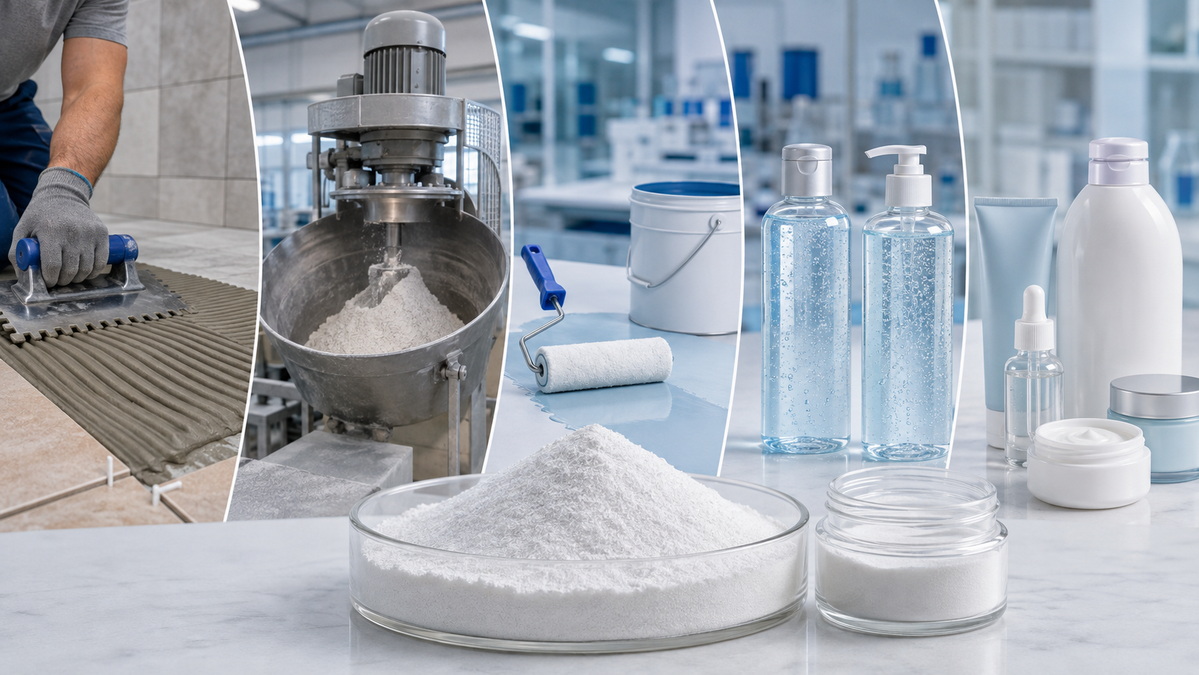
Ashland is a specialty-additives company known for its Benecel™ cellulose ether portfolio. The company is particularly active in pharmaceutical, nutrition, personal-care, and specialty industrial applications.
Benecel™ hypromellose products are used in applications requiring high purity, controlled functionality, and reliable performance. In pharmaceutical formulations, HPMC can serve as a tablet binder, film-forming polymer, viscosity modifier, and hydrophilic matrix material for controlled-release dosage forms.
Typical application areas include:
- Pharmaceutical tablets and capsules
- Controlled-release formulations
- Nutritional products
- Personal-care formulations
- Specialty industrial products
Ashland may be a strong fit for buyers that require sophisticated technical documentation, high-purity materials, and application-specific support for regulated or high-performance product categories.
Dow is widely recognized in the global construction-chemicals market for its WALOCEL™ cellulose ether portfolio. Its products are commonly used in cement-based dry-mix mortar systems, including tile adhesives, grouts, self-leveling compounds, and spray plasters.
Dow's cellulose ether grades are designed to improve critical construction-material properties such as water retention, workability, adhesion, consistency, sag resistance, and processing behavior.
Typical application areas include:
- Cement-based tile adhesives
- Wall putty and skim coat
- Cement render and plaster
- EIFS and external insulation systems
- Grouts and self-leveling compounds
- Dry-mix mortar systems
For construction-material manufacturers, Dow is often considered when formulation performance, technical support, and global market availability are important purchasing factors.
Shin-Etsu Chemical is a major Japanese producer of functional materials. Its METOLOSE® brand includes methylcellulose and hypromellose products for pharmaceutical, food, personal-care, and industrial applications.
METOLOSE® cellulose ethers are used for thickening, water retention, film formation, protective-colloid performance, binding, and sustained-release functions. The product range is particularly relevant to formulators that require controlled quality and detailed technical support.
Typical application areas include:
- Pharmaceutical excipients
- Tablet binders
- Controlled-release matrix systems
- Food applications
- Personal-care products
- Specialty industrial formulations
Shin-Etsu may be particularly relevant for buyers that need premium-grade cellulose ethers for technically demanding formulations.
SE Tylose is part of the Shin-Etsu Group and supplies a wide range of cellulose ether products under the Tylose® brand. It serves construction, coatings, personal-care, and industrial markets.
Tylose® products are used to control viscosity, improve water retention, modify rheology, support film formation, and improve formulation stability. The company has a strong presence in European and international cellulose ether markets.
Typical application areas include:
- Construction mortar
- Tile adhesives
- Cement render
- Water-based paints
- Coatings
- Cosmetics and personal-care products
For buyers comparing global suppliers, SE Tylose should be viewed as a specialist cellulose ether producer with strong application relevance in construction and coatings.
Lotte Fine Chemical is a South Korean supplier with cellulose ether brands including MECELLOSE™ and AnyCoat™. Its product portfolio serves construction materials and pharmaceutical-related applications.
The company is relevant to customers seeking an Asia-based multinational supplier with established capabilities in cellulose ether production and specialty chemical manufacturing.
Typical application areas include:
- Construction-grade HPMC
- HEMC and MHEC applications
- Pharmaceutical-grade hypromellose
- Film-coating systems
- Industrial formulations
When evaluating Lotte Fine Chemical or similar suppliers, buyers should clearly define whether they need construction-grade, personal-care-grade, or pharmaceutical-grade materials. These categories require different levels of purity, documentation, testing, and regulatory support.
Nouryon is an important supplier in the broader cellulose ether industry through its Bermocoll® product range. Its portfolio is particularly relevant to paints, coatings, water-based systems, and dry-mix applications.
It is important to distinguish Bermocoll® products from conventional HPMC. Many Bermocoll® grades are based on ethyl hydroxyethyl cellulose (EHEC) and methyl ethyl hydroxyethyl cellulose (MEHEC), rather than standard hydroxypropyl methylcellulose.
These products can provide rheology control, water retention, stability, consistency, and improved application properties in water-based formulations.
Typical application areas include:
- Water-based paints
- Architectural coatings
- Latex paints
- Dry-mix mortar
- Industrial coatings
- Specialty water-based formulations
Nouryon may be especially relevant when a formulation requires optimized flow, anti-sag behavior, storage stability, or viscosity control in water-based paint systems.
Shandong Shengda New Material Co., Ltd. is a Chinese manufacturer focused on the research, development, production, and supply of HPMC, HEMC, and HEC cellulose ethers.
The company provides cellulose ether solutions for construction materials and daily-chemical applications. Its product range is relevant to global buyers seeking an experienced manufacturing partner with flexible service, application-oriented support, and direct communication throughout the sourcing process.
Key product categories include:
- Hydroxypropyl methylcellulose (HPMC)
- Hydroxyethyl methylcellulose (HEMC)
- Hydroxyethyl cellulose (HEC)
Typical application areas include:
- Tile adhesive
- Cement-based mortar
- Wall putty
- Skim coat
- Gypsum plaster
- EIFS systems
- Water-based paint
- Detergents
- Shampoos
- Body wash
- Facial cleansers
- Personal-care products
For buyers sourcing from China, Shandong Shengda New Material Co., Ltd. can offer a practical balance of manufacturing capability, product customization, competitive sourcing, and export-oriented service.
The company is particularly relevant for customers looking for:
- Construction-grade cellulose ethers
- Daily-chemical-grade cellulose ethers
- Viscosity and dissolution customization
- Technical documentation and sample support
- Stable long-term supply relationships
- OEM, ODM, wholesale, and international distribution opportunities
China is one of the world's major production centers for construction-grade cellulose ethers. Many Chinese producers supply HPMC, HEMC, MHEC, and HEC for dry-mix mortar, coatings, detergents, and personal-care formulations.
However, a buyer should never select a supplier based only on the lowest price or the listed viscosity range.
A reliable manufacturer should be evaluated according to product consistency, technical knowledge, documentation quality, supply capacity, export experience, and willingness to support formulation testing.
Key points to evaluate include:
- Technical Data Sheet availability
- Safety Data Sheet availability
- Certificate of Analysis for each batch
- Viscosity test method and conditions
- Moisture and ash control
- pH specifications
- Particle-size consistency
- Raw-material traceability
- Packaging quality
- Shipment lead time
- Sample consistency
- Application support
- Complaint-handling process
The most reliable sourcing approach is to request samples, test them in the actual formulation, validate a commercial production batch, and establish an internal quality-comparison procedure before approving a supplier for large-scale orders.
Some companies play an important role in the pharmaceutical cellulose ether market without being commodity HPMC manufacturers. These businesses may provide complete coating systems, formulation expertise, specialty polymers, and processing support.
For example, pharmaceutical coating suppliers can offer ready-to-use systems that combine polymers, plasticizers, and pigments. Such solutions may reduce processing complexity for tablet and capsule manufacturers.
Typical application areas include:
- Tablet film coating
- Capsule coating
- Enteric coating
- Moisture-barrier coating
- Immediate-release coating
- Modified-release formulation support
This category is most relevant for pharmaceutical companies that need a finished functional system rather than bulk HPMC powder alone.
The final category includes regional specialists and application-focused cellulose ether suppliers. These companies may be particularly competitive in one market segment, one geography, or one technical function.
For example, a supplier that performs well in pharmaceutical controlled-release formulations may not be the most suitable option for cement mortar. Likewise, a premium-grade rheology modifier for decorative paint may not be economically suitable for large-volume wall putty production.
The best supplier is therefore not always the largest or most internationally recognized company. The best supplier is the one that delivers consistent performance in the customer's specific formulation.
| Cellulose Ether | Main Functions | Common Applications | Key Selection Factors |
|---|---|---|---|
| HPMC | Water retention, thickening, film formation, binding | Tile adhesive, wall putty, pharmaceuticals, detergents | Water retention, viscosity stability, open time, gel behavior |
| HEMC / MHEC | Rheology modification, water retention, workability | Cement mortar, gypsum plaster, tile adhesive | Cement compatibility, anti-sag performance, temperature tolerance |
| HEC | Thickening, suspension, rheology control | Water-based paint, shampoo, body wash, cosmetics | Clarity, surfactant compatibility, thickening efficiency |
| EHEC / MEHEC | Rheology control, stability, water retention | Paints, coatings, dry-mix mortar | Flow behavior, storage stability, enzyme resistance |
The ideal cellulose ether should be selected according to the complete formulation and the desired final performance. A product with a higher viscosity is not automatically better. A lower-viscosity grade may provide better processability, while a modified grade may deliver stronger water retention or improved anti-sag behavior.
Start with the end-use target rather than a product name.
For example, a tile adhesive producer may need longer open time, stronger anti-sag behavior, improved water retention, and reliable troweling performance. A shampoo manufacturer may need good clarity, fast hydration, smooth sensory feel, and stable viscosity in the presence of surfactants and salts.
Define the most important performance requirements before requesting samples.
Do not compare products only by a nominal viscosity number.
Ask each supplier to confirm:
- Solution concentration
- Test temperature
- Test instrument
- Spindle type
- Rotational speed
- Test method
- Surface-treatment status
- Moisture content
- Particle-size range
A grade described as "100,000 mPa·s" can perform differently depending on how the viscosity was measured.
Basic laboratory data is useful, but it cannot replace formulation testing.
Use the supplier sample in the full product formula and evaluate:
- Mixing time
- Lump formation
- Dissolution behavior
- Viscosity development
- Water retention
- Open time
- Sag resistance
- Adhesion performance
- Storage stability
- Appearance
- Odor
- Sensory characteristics where relevant
For construction materials, testing should include practical application evaluation rather than laboratory viscosity alone. For personal-care products, appearance, clarity, foam, skin feel, and long-term stability should also be evaluated.
A technically suitable product is not enough if deliveries are inconsistent or documentation is incomplete.
Evaluate the supplier's:
- Production capacity
- Batch traceability
- Quality-control procedures
- Packaging standards
- Lead time
- Export experience
- Communication speed
- Sample-to-production consistency
- Corrective-action process
- Ability to provide ongoing technical support
Before moving to full-scale procurement, test a production-grade commercial batch.
Retain a sample from the approved batch as an internal reference. Compare future shipments against this approved standard using the same test method and formula.
This process helps identify quality variation before it affects commercial production.
Many buyers focus first on price per kilogram. However, the true cost of cellulose ether should be calculated at the finished-product level.
A low-priced HPMC grade may require a higher dosage to achieve the same water-retention performance. It may also create problems such as inconsistent open time, poor workability, variable hydration, reduced stability, or customer complaints.
These problems can increase total operating cost through:
- Higher additive dosage
- More cement or polymer consumption
- Longer mixing time
- Reformulation work
- Production downtime
- Product returns
- Field complaints
- Lost customer confidence
The more useful purchasing question is:
The global cellulose ether market includes multinational chemical companies, specialized formulation providers, regional producers, and experienced China-based manufacturers.
The right HPMC, HEMC, or HEC supplier depends on the target application, required performance, quality expectations, production scale, technical documentation needs, and supply-chain priorities.
For construction materials and daily-chemical formulations, buyers should work with suppliers that can provide consistent grades, practical formulation support, dependable documentation, and stable commercial supply.
Shandong Shengda New Material Co., Ltd. provides HPMC, HEMC, and HEC cellulose ether solutions for global customers in construction and daily-chemical industries. The company supports customers with product selection, technical documentation, sample evaluation, customized requirements, and long-term supply cooperation.
This guide reviews leading global HPMC and cellulose ether suppliers while explaining how buyers can select suitable HPMC, HEMC, HEC, and related products for construction materials, coatings, detergents, personal care, and pharmaceutical applications. It highlights supplier-comparison criteria, formula-testing methods, quality-control priorities, and the importance of evaluating total formulation cost rather than product price alone.
Yes. Hypromellose is the name commonly used for hydroxypropyl methylcellulose in pharmaceutical and regulatory contexts. The chemistry is the same, but product grades can differ significantly depending on purity, viscosity, particle size, substitution level, and intended application.
The best HPMC for tile adhesive depends on cement type, filler content, polymer powder dosage, target open time, anti-sag requirements, climate conditions, and mixing process. Buyers should select a grade through real formulation testing rather than by viscosity alone.
HEC is generally not a direct replacement for HPMC or HEMC in cement mortar. HPMC and HEMC are commonly used when water retention, workability, and mortar performance are critical. HEC is more frequently selected for water-based paints, detergents, shampoos, and personal-care products.
A reliable supplier should provide a Technical Data Sheet, Safety Data Sheet, Certificate of Analysis, product specification, packaging information, batch traceability details, and relevant compliance declarations for the target market.
Confirm the exact viscosity test conditions, including solution concentration, temperature, instrument, spindle, rotational speed, and method. Without these details, two viscosity values cannot be considered directly comparable.
China has a large cellulose ether manufacturing industry and can be a reliable source for HPMC, HEMC, and HEC. Buyers should assess individual suppliers based on manufacturing control, testing capability, batch consistency, technical support, export experience, and commercial reliability.
Construction-grade cellulose ether is designed for applications such as tile adhesive, wall putty, cement mortar, and gypsum products. Daily-chemical-grade cellulose ether is intended for products such as detergents, shampoos, body wash, and facial cleansers, where clarity, sensory properties, surfactant compatibility, and stable thickening behavior are often more important.
1. Kima Chemical. [Top 10 Hydroxypropyl Methyl Cellulose Manufacturers in the World]
2. Ashland. [Benecel™ Methylcellulose and Hypromellose]
3. Ashland. [Benecel™ K1500 PH PRM Hypromellose]
4. Ashland. [Ashland Expands Benecel™ Cellulose Ether Production Capacity]
5. Dow. [MC 65 Methyl Hydroxyethyl Cellulose]
6. Dow. [WALOCEL™ X-LIS E 40-01 HEMC]
7. Shin-Etsu Chemical. [METOLOSE® for Pharmaceutical Application]
8. Shin-Etsu Chemical. [METOLOSE® and Tylose® for Personal Care]
9. Nouryon. [Cellulose Ethers]
10. Nouryon. [Bermocoll® EBM 10 000]
11. Colorcon. [Opadry® Complete Film Coating System]


