


close
Choose Your Site
Global
Social Media
Views: 286 Author: Shengda Publish Time: 2026-10-30 Origin: Site


Content Menu
● Brazil's Position in the Cellulose HEC Supply Chain
>> A substantial downstream market—not a verified domestic HEC production ranking
>> Why buyers consider Brazilian supply channels
● How These Cellulose HEC Suppliers Were Selected
● Supplier Comparison: Capacity, MOQ, and Certification Transparency
● Five Cellulose HEC Manufacturers and Suppliers to Evaluate for Brazil
>> 1. Shandong Shengda New Material Co., Ltd.
>>> Company profile
>>> Core strengths and market relevance
>>> OEM/ODM and customization scope
>>> Best-fit procurement scenario
>> 2. Ashland — Natrosol Hydroxyethylcellulose
>>> Company profile
>>> Core strengths and principal markets
>>> OEM/ODM and customization scope
>>> Best-fit procurement scenario
>> 3. Dow — CELLOSIZE Hydroxyethyl Cellulose
>>> Company profile
>>> Core strengths and principal markets
>>> OEM/ODM and customization scope
>>> Best-fit procurement scenario
>> 4. LOTTE Fine Chemical — HECELLOSE
>>> Company profile
>>> Core strengths and principal markets
>>> OEM/ODM and customization scope
>>> Best-fit procurement scenario
>> 5. MCassab — Brazilian HEC Distribution and Technical Support
>>> Company profile
>>> Core strengths and principal markets
>>> OEM/ODM and customization scope
>>> Best-fit procurement scenario
● Technical Buyer's Guide: Specify Performance Before Requesting Prices
>> Confirm that the material is actually HEC
>> Make viscosity measurements comparable
>> Separate construction, coatings, and personal-care requirements
● The Insider Pitfall: A Passing Viscosity Result Can Hide a Processing Mismatch
● Compliance and Sustainability: Request Evidence That Matches the Product
● Sampling, Factory Verification, and Import Logistics
>> A staged qualification process
>> Verify the factory behind the quotation
>> Compare landed cost, not only the price per tonne
>> Put supply promises into the contract
● Conclusion: Match the Supplier Route to the Procurement Risk
● FAQ
>> 1. How can I check whether a supplier's ISO certificate has expired or been suspended?
>> 2. Can two HEC grades with the same stated viscosity be used interchangeably?
>> 3. How do I confirm that a Brazilian supplier is selling the original manufacturer's product?
>> 4. Is a manufacturer's published total capacity enough to guarantee my HEC supply?
Brazil offers professional buyers several routes to sourcing hydroxyethyl cellulose: purchasing from a Brazilian distributor, working with an international producer's regional organization, or importing directly from an overseas manufacturer. These routes should not be confused. A supplier selling HEC in Brazil is not necessarily manufacturing it there.
For procurement managers, the central question is therefore not simply which company offers the lowest quotation. It is which supplier can deliver the correct grade, reproducible formulation performance, traceable quality documentation, and commercially reliable replenishment.
A practical supplier evaluation should begin with factory identity, certification scope, research and application capabilities, quality-control procedures, and delivery consistency. For cellulose HEC, an impressive viscosity number or a familiar brand name cannot replace a documented application trial.
This guide examines five relevant manufacturers and supply channels, starting with Shandong Shengda New Material Co., Ltd. as a direct-import option. It distinguishes documented company information from commercial terms that buyers must confirm individually.

Brazil's coatings industry provides an important commercial context for HEC procurement. According to ABRAFATI's latest published sector data, Brazilian paint production reached 2.005 billion liters in 2025, compared with 1.983 billion liters in 2024, representing growth of 1.2%. The association identifies Brazil as the world's fourth-largest paint producer. These figures describe the coatings industry; they are not measurements of Brazil's HEC production or consumption.
The distinction matters. Water-based coatings represent a relevant application for cellulosic rheology modifiers, but coatings output cannot be converted directly into an HEC market size without reliable information about formulation composition, dosage, and competing thickener technologies.
ABRAFATI's February 2026 update initially anticipated approximately 2.0% growth in paint sales for 2026. That figure is a forecast, not a completed full-year result.
Brazil's supplier ecosystem connects chemical distribution, formulation support, and major downstream manufacturers. São Paulo is a particularly relevant commercial hub: Dow's Brazil and Latin America headquarters are located there, MCassab's history and operations are closely connected with the state, and the city hosts the ABRAFATI coatings exhibition. These connections support supplier access and technical networking, but do not establish a concentrated Brazilian HEC manufacturing cluster.
For procurement purposes, local and direct-import channels solve different problems:
- Local distribution can be evaluated for domestic invoicing, available inventory, and smaller replenishment orders.
- International producers can be evaluated for established grade portfolios and technical documentation.
- Direct-import manufacturers can be evaluated for customization, purchasing flexibility, and landed-cost competitiveness.
None of these advantages should be assumed from the company category alone. They belong in the quotation and qualification process.
The shortlist uses five transparent screening criteria.
| Evaluation area | Evidence buyers should request | Procurement relevance |
|---|---|---|
| Product identity | Current technical data sheet identifying HEC and the exact grade | Prevents substitution with another cellulose ether |
| Manufacturing and supply traceability | Producer name, manufacturing location, lot identification, and distributor authorization where applicable | Establishes who makes and releases the material |
| Quality management | Current certificates, scope, site details, and representative certificates of analysis | Helps assess whether quality controls cover the supplied product |
| Application support | Sample plan, test-method alignment, formulation guidance, and complaint procedures | Reduces the risk of selecting a grade by viscosity alone |
| Commercial reliability | Written MOQ, lead time, stock location, packaging, and change-notification terms | Makes supply commitments measurable |
The list includes companies with documented cellulose-ether manufacturing portfolios or a publicly identified HEC supply offering relevant to Brazilian buyers.
No numerical score is assigned because comparable audited data on HEC-specific capacity, current Brazilian inventory, delivery performance, and customer acceptance rates are not publicly available across the shortlist.
The following table separates disclosed information from information requiring confirmation. "Not verified" does not mean a supplier lacks the capability or certificate; it means the reviewed evidence does not establish it.
| Company | Supply role and geographical position | Relevant product or offering | Public capacity information | MOQ | Certification position |
|---|---|---|---|---|---|
| Shandong Shengda New Material Co., Ltd. | Chinese manufacturer; direct-import option for Brazilian buyers | HEC, HPMC, and HEMC | Company states 60,000 tonnes/year across two factories and its cellulose-ether portfolio; HEC-only capacity is not disclosed | Confirm by grade, packaging, and customization scope | Obtain current certificates and verify site, scope, and validity |
| Ashland | International manufacturer; confirm Brazilian commercial channel | Natrosol HEC | Current comparable HEC tonnage not established in reviewed sources | Confirm with regional sales or authorized supplier | Request documents for the actual producing site and grade |
| Dow | International manufacturer with a Brazilian organization | CELLOSIZE HEC | Current HEC-specific capacity not established in reviewed sources | Confirm for the selected grade and local/import route | Grade-specific technical and sustainability information is available; factory certificate scope requires verification |
| LOTTE Fine Chemical | South Korean manufacturer; Brazilian buyers should verify the supply channel | HECELLOSE | Current comparable HEC-specific tonnage not established in reviewed sources | Confirm with manufacturer or supplying distributor | Verify documents for HECELLOSE rather than transferring claims from other product families |
| MCassab | Brazilian distribution and technical-service route | Publicly lists Hecellose HEC 100K | Manufacturing capacity is not an appropriate measure of distributor stock availability | Confirm local stock, pack size, and replenishment MOQ | Request original producer documentation and applicable distributor certificates |
Sources: company information and product pages. Shengda's capacity is a company-reported total, not independently verified HEC capacity.
Shandong Shengda New Material Co., Ltd. states that it was founded in 2006 and specializes in the research, development, production, and sale of cellulose ethers. Its portfolio includes hydroxyethyl cellulose, hydroxypropyl methylcellulose, and hydroxyethyl methylcellulose. The company describes a dual-factory model with combined annual production capacity of 60,000 tonnes across its cellulose-ether business.
That figure needs careful interpretation: it is not a published statement of 60,000 tonnes of HEC capacity alone.
Shengda is worth evaluating as a value-oriented direct-manufacturer option for buyers who want to discuss product selection and application requirements with the producer rather than purchasing solely through an intermediary.
Its published company information emphasizes customized solutions, customer support, and technical services. These are relevant starting points for smaller and medium-sized brands seeking closer communication about samples, specifications, and application requirements. However, response speed, low-volume flexibility, and price competitiveness should be tested during the enquiry process rather than presented as independently proven advantages.
The company describes a global customer focus, but the reviewed page does not provide a country-by-country sales breakdown or independently verified Brazilian delivery history.
For a raw-material manufacturer, OEM/ODM support should be defined precisely. Buyers can ask Shengda to confirm:
- Grade selection against a target formulation.
- Agreed viscosity ranges and test methods.
- Hydration and dispersion requirements.
- Customized specifications, where technically feasible.
- Private-label packaging and labeling availability.
- Technical support during sample evaluation and scale-up.
These are proposed qualification topics, not confirmed inclusions in every order. The company's published customization and technical-support statements support opening this discussion, but each deliverable should be written into the commercial agreement.
Shengda is a candidate for buyers seeking a potentially cost-effective, development-oriented manufacturing relationship, especially when communication and specification flexibility matter alongside price.
Before approval, request HEC-specific capacity allocation, representative batch records, current certificates, export documentation, and references relevant to the intended supply route.
Ashland traces its history to 1924. Its Natrosol portfolio includes hydroxyethylcellulose used in applications such as water-based paints, coatings, and personal-care products. Ashland describes Natrosol products as thickeners offering performance across a broad pH range, with salt tolerance and surfactant compatibility relevant to formulation development.
Ashland is a relevant benchmark for procurement teams evaluating established branded HEC grades for coatings, construction-related formulations, and personal care.
Its historical production disclosures describe an international HEC manufacturing network. Those disclosures demonstrate manufacturing experience, but a 2017 capacity-expansion announcement should not be treated as a current plant-capacity statement.
Brazilian buyers should also avoid inferring that every Ashland facility in Brazil produces Natrosol. Ashland's public reference to a pharmaceutical facility expansion in Cabreúva does not establish HEC manufacture at that location.
The appropriate starting point is grade selection and application support within the Natrosol portfolio. Private labeling, custom polymer manufacture, or customer-exclusive specifications should not be assumed without a specific agreement.
Consider Ashland when an established formulation already specifies Natrosol, when technical documentation is a priority, or when a branded reference material is needed for comparison with alternative HEC suppliers.
Confirm the producing plant, Brazilian sales channel, lead time, and change-control procedure for the exact grade.
The original Dow Chemical Company was founded in 1897. Dow maintains a Brazilian organization, including its Brazil and Latin America headquarters in São Paulo, and offers HEC under the CELLOSIZE brand.
Dow's CELLOSIZE personal-care portfolio includes products intended for shampoos, conditioners, body washes, creams, lotions, and related formulations. Its published grade table specifies viscosity ranges together with solution concentration, spindle, and speed—details that make comparisons more technically meaningful.
For example, the published table gives CELLOSIZE QP-300 a viscosity range of 300–400 mPa·s at 2% concentration, while QP-15000H is listed at 1,100–1,500 mPa·s at 1%, with different stated measurement settings. The values cannot be compared fairly as though they came from one identical test.
Procurement discussions should focus on selecting an appropriate commercial grade and obtaining formulation guidance. A branded HEC portfolio is not evidence of routine private-label supply or unrestricted custom synthesis.
Dow also publishes biobased-carbon and biodegradability information for named grades. Buyers should retain the stated test basis and grade identity instead of extending these claims to every HEC product.
Dow is relevant for personal-care and home-care buyers who require detailed grade differentiation, documented formulation properties, and access to an established multinational supplier organization.
Brazilian presence does not by itself confirm that the requested grade is manufactured or stocked locally.
LOTTE Fine Chemical traces its origins to Korea Fertilizer Inc., founded on August 27, 1964. Its cellulose-related product portfolio includes HECELLOSE, MECELLOSE, AnyCoat, and AnyAddy.
The company describes HECELLOSE as a nonionic, water-soluble cellulose-derived polymer used in paints, personal and home care, construction, oilfields, and polymerization applications. This breadth makes it a relevant producer for buyers comparing HEC options across several formulation categories.
Brazilian market relevance is supported by MCassab's public listing of Hecellose HEC 100K. Nevertheless, buyers should verify the exact grade designation, original manufacturer, and current commercial relationship before treating any distributor as an authorized channel for a particular product.
The documented offering is a branded cellulose-product portfolio. Buyers should ask about grade matching, application support, and approved specifications; private-label packaging and custom polymer development require separate confirmation.
An important documentation boundary applies here: certifications published for AnyAddy or another product family should not automatically be attributed to HECELLOSE. LOTTE's product page identifies different families and associated applications separately.
Evaluate LOTTE when seeking an additional international manufacturer for paints or personal/home-care applications, particularly where an existing HECELLOSE grade can serve as a defined technical reference.
MCassab's history began in 1928 in São Paulo state. It operates as a diversified Brazilian group with distribution and industrial activities. Its industrial-chemicals website publicly lists Hecellose HEC 100K as a thickening and stabilizing product for coatings, cosmetics, and industrial applications.
MCassab is a different type of candidate from the manufacturers above. Its relevance lies in the Brazilian supply channel, not in an assumed HEC polymerization plant.
Its personal-care catalogue describes laboratory infrastructure, formulation-development support, and tailored technical training. Buyers should confirm whether those resources are available for the exact industrial or personal-care HEC project under discussion.
For a distributor, useful customization may mean selecting a suitable supplied grade, supporting formulation development, or coordinating manufacturer documentation. It does not necessarily mean modifying the polymer itself.
Repacking, private labeling, formulation development, and contract manufacturing are separate services. Each requires confirmation rather than being bundled under a general OEM/ODM claim.
MCassab is worth evaluating when Brazilian commercial support and a domestic supply arrangement matter more than dealing directly with the overseas producer.
Ask for stock location, available quantity, original packaging status, manufacturer traceability, and the replenishment timetable.
HEC, HPMC, HEMC, and other cellulose ethers are related materials, but their commercial names do not make them interchangeable.
Nouryon's Bermocoll range illustrates this distinction. Its official information identifies the principal chemistries as ethyl hydroxyethyl cellulose and methyl ethyl hydroxyethyl cellulose. A Bermocoll product may be relevant to a coatings formulation, but it should not be described automatically as conventional HEC.
Place the exact material identity and grade on the purchase specification. When a supplier proposes an alternative chemistry, treat it as a formulation change requiring evaluation.
"100,000 viscosity" is not a complete specification.
Dow's published CELLOSIZE data demonstrates why: viscosity values are linked to concentration, spindle, and rotational speed. Without those conditions, apparently similar figures may describe materially different test results.
Require the supplier and your laboratory to agree on:
1. Solution concentration and calculation basis.
2. Water quality.
3. Hydration procedure and endpoint.
4. Measurement temperature.
5. Instrument, spindle, and speed.
6. Timing between preparation and measurement.
If two suppliers use different methods, test both samples under the same agreed protocol before comparing them.
A grade that meets a paint-thickening target has not automatically passed a personal-care qualification.
Dow's product information differentiates grades using properties such as solution clarity and viscosity, while Ashland identifies compatibility characteristics relevant to formulation selection. These differences show why application-specific evaluation matters.
A practical evaluation matrix should include the properties relevant to the finished product:
| Application | Suggested qualification priorities |
|---|---|
| Architectural coatings | Dispersion, viscosity development, application feel, storage stability, and compatibility with the complete formulation |
| Construction-related products | Application-specific water management, workability, and interaction with other ingredients |
| Personal care | Clarity, texture, surfactant compatibility, odor, microbiological specifications, and finished-product stability |
| Household products | Compatibility with the full detergent system, viscosity retention, and performance over the intended storage conditions |
These are proposed testing priorities, not universal acceptance limits. Set numerical requirements against the intended formulation and market.
A frequently overlooked qualification risk is approving an HEC alternative solely because its fully hydrated solution matches the incumbent's viscosity.
Some HEC grades are surface-treated. Brenntag's technical description, for example, identifies Natrosol 250 HR as hydroxyethyl cellulose surface-treated with glyoxal. That treatment is a product characteristic buyers should consider when comparing dispersion and hydration behavior.
The practical implication is that a final viscosity reading alone does not demonstrate that two grades will behave identically during addition and mixing.
To reduce this risk, qualify hydration as a separate purchasing parameter:
- Run the comparison using the actual plant addition sequence.
- Record viscosity development at agreed intervals.
- Check for undispersed material and lumps.
- Repeat under the intended water and formulation conditions.
- Compare the laboratory sample with the first production shipment.
- Require notification of changes affecting the agreed product specification or processing behavior.
These checks are especially important when replacing a grade that operators have used for years. A cheaper material can remain commercially attractive, but only after the production process—not just the final laboratory number—has been validated.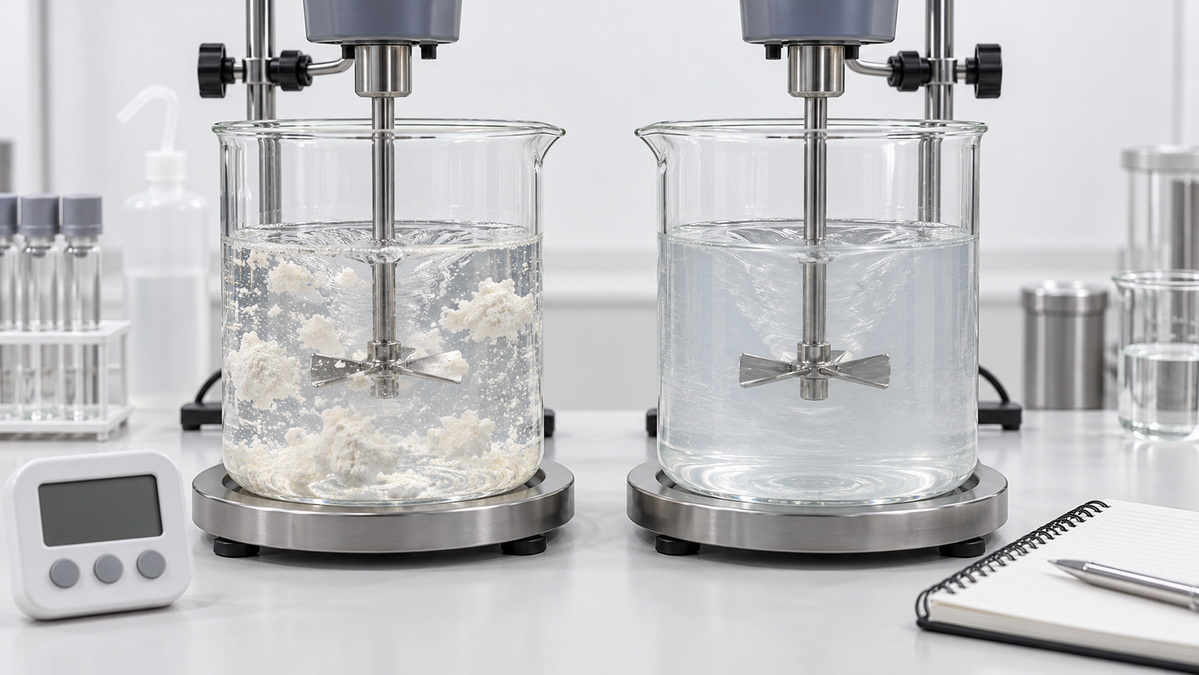
Avoid treating a page of certification logos as a complete qualification package.
For each shortlisted supplier, request:
- A current safety data sheet and technical data sheet.
- A lot-specific certificate of analysis.
- The actual manufacturer and producing-site identity.
- Applicable quality-management certificates.
- Grade-specific declarations needed for the intended application.
- Evidence supporting any environmental or sourcing claim.
Where ISO certification is claimed, verify the legal entity, site, standard, status, and scope. IAF CertSearch provides a mechanism for checking accredited management-system certificates and reviewing their current status.
Environmental claims also need boundaries. Dow publishes biobased-carbon and biodegradability information for particular CELLOSIZE grades; that is more useful than a broad "eco-friendly" statement because the claim is connected to an identified product.
Do not infer that "cellulose-derived" proves identical environmental performance across every grade, formulation, manufacturing process, and disposal condition.
If a purchasing checklist asks for CE or RoHS documentation, first establish why it applies to the supplied material and end use. Do not use either label as a substitute for HEC identity, batch quality, or application-specific compliance review.
A disciplined approval sequence can be organized as follows:
1. Documentation review: confirm identity, grade, specification, manufacturer, and test methods.
2. Laboratory screening: compare the candidate with an approved reference under identical conditions.
3. Batch comparison: where practical, examine samples from multiple production lots.
4. Pilot production: use the intended mixing equipment and addition sequence.
5. Commercial-lot approval: confirm that delivered material matches the approved specification.
6. Ongoing monitoring: retain samples and track complaints, delivery performance, and batch variation.
This is a recommended qualification framework rather than a claim that every supplier already follows it.
Ask the seller to explain which entity manufactures the HEC, which entity exports it, and which entity issues the certificate of analysis.
During a remote or on-site audit, request a traceable walkthrough covering raw-material receipt, production identification, testing, packing, and lot release. The purpose is not simply to view equipment; it is to establish whether the material you will receive can be traced through a controlled process.
A useful purchasing comparison includes:
- Product price.
- Freight and insurance.
- Customs and brokerage charges.
- Applicable taxes and recovery treatment.
- Inland delivery and warehousing.
- Financing and inventory costs.
- Expected usable output in the approved formulation.
Have a Brazilian customs specialist confirm the applicable classification and import requirements for the exact product. Do not adopt a tariff code solely because another supplier uses it.
For trade-market research, Brazil's official Comex Stat system provides detailed import and export information with customizable filters. Its data can support sourcing analysis, but a broad customs category must not be presented as pure HEC trade unless the classification and underlying coverage justify that interpretation.
The purchase agreement should identify the approved grade, specification revision, packaging, delivery term, lead-time basis, documentation, and complaint process.
Also define whether a change of producing plant, product specification, or supply source requires prior written approval. A sales promise is easier to manage when its measurable elements appear in the contract.
The strongest HEC sourcing decision is not necessarily a choice between a Brazilian supplier and an overseas factory. It is a choice between different combinations of product assurance, technical access, working capital, and supply responsibility.
Shandong Shengda offers a direct-manufacturer discussion around its cellulose-ether portfolio and customization-oriented services. Ashland, Dow, and LOTTE provide established branded product families. MCassab offers a Brazilian distribution route with a publicly identified HEC product offering. Their roles differ, so they should not be compared as though all five operate equivalent Brazilian factories.
For a quotation from Shandong Shengda, submit your application, current reference grade, viscosity test method, estimated annual demand, packaging requirements, and Brazilian delivery destination. Request a proposed grade, supporting documentation, sample plan, and written commercial terms before progressing to plant trials.
Obtain the complete certificate rather than a cropped logo. Check the legal entity, factory address, standard, certificate number, scope, and dates.
Use IAF CertSearch where applicable, then compare the returned details with the supplier's documents. Its status categories include Active, Suspended, Withdrawn, and Expired. If you cannot resolve the record, contact the issuing certification body directly rather than assuming the certificate is valid or fraudulent.
Not on that information alone. Published CELLOSIZE specifications show that viscosity depends on stated concentration and measurement settings. Surface treatment can also differ between HEC products, as illustrated by the Natrosol 250 HR description.
Run both products under one method and then compare them in the complete formulation and production sequence.
Request the manufacturer's exact grade name, original packaging details, lot identification, and lot-specific certificate of analysis. Where brand authorization matters, ask the manufacturer to confirm the supplying channel.
For the first shipment, reconcile the purchase order, bag labels, delivery documents, and certificate of analysis before releasing the material to production.
No. A multi-product capacity figure does not establish the output of one HEC grade or the volume available for your order.
For example, Shengda's published 60,000-tonne annual figure covers its cellulose-ether operation; the reviewed page does not disclose HEC-only capacity. Ask for the capacity and scheduling information relevant to the requested grade, plus a written supply commitment.
Define the service instead of relying on the label.
Distinguish standard-grade supply, grade selection, custom specifications, formulation assistance, repacking, and private labeling. Then specify ownership of specifications, packaging approval, testing, change control, minimum order quantities, and responsibility for regulatory documentation.
A supplier offering technical support or customized solutions has not necessarily agreed to custom polymer manufacture or finished-product development.
Source documents used for the market context and supplier assessment include:
- ABRAFATI, "Dados do Setor": 2025 and 2024 Brazilian paint-production figures. [abrafati.com]
- ABRAFATI, "Vendas de tintas superaram 2 bilhões de litros em 2025": industry performance and the association's initial 2026 outlook. [abrafati.com]
- Brazil's federal government, official Comex Stat service description and foreign-trade data documentation. [gov]
- Shandong Shengda New Material Co., Ltd., company introduction and stated production model. [shengdahpmc]
- Ashland, corporate history, Natrosol product information, and historical production-network announcement. [ashland]
- Dow, corporate timeline, Brazil locations, and CELLOSIZE product data. [corporate.dow]
- LOTTE Fine Chemical, corporate history and cellulose-product portfolio. [lotte-cellulose]
- MCassab, corporate history, Hecellose listing, and personal-care catalogue. [mcassab.com]
- IAF CertSearch, certificate-verification guidance. [prerender.iafcertsearch]


