


close
Choose Your Site
Global
Social Media
Views: 222 Author: Shengda Publish Time: 2026-05-12 Origin: Site


From a formulator's perspective, tile grout is one of the most sensitive cement-based materials: small changes in water retention, setting profile, and pore structure immediately show up as color variation or white efflorescence. Efflorescence is the visible, whitish salt deposit that migrates with moisture through porous grout and crystallizes on the surface, often making dark or colored grout look faded or "dusty." At the same time, color inconsistency is usually a combination of uneven water content, mixing differences between batches, and local variations in curing and porosity. [images.thdstatic]
In this context, switching from Hydroxyethyl Cellulose (HEC) to Hydroxyethyl Methyl Cellulose (HEMC) gives manufacturers and private-label brands an extra lever to stabilize water retention, refine the microstructure of the hardened grout, and thus narrow the variation window of both color and efflorescence. As Shandong Shengda New Material Co., Ltd., we supply construction-grade HEMC and HEC and see, in practice, where each grade performs best in cementitious systems. [hpmcproducer]

Hydroxyethyl Cellulose (HEC) is a non-ionic cellulose ether modified only with hydroxyethyl groups. It is widely used as a thickener and water-retaining agent in coatings and some cement-based systems. HEC offers good thickening efficiency, stable pH behavior, and easy handling, which is why it is common in paints and certain putties. In cement grout, HEC can increase viscosity and help prevent segregation, but its water-retention and thermal stability characteristics are not optimized specifically for high-performance grouts in hot or highly variable job-site conditions. [ar.hpmctop]
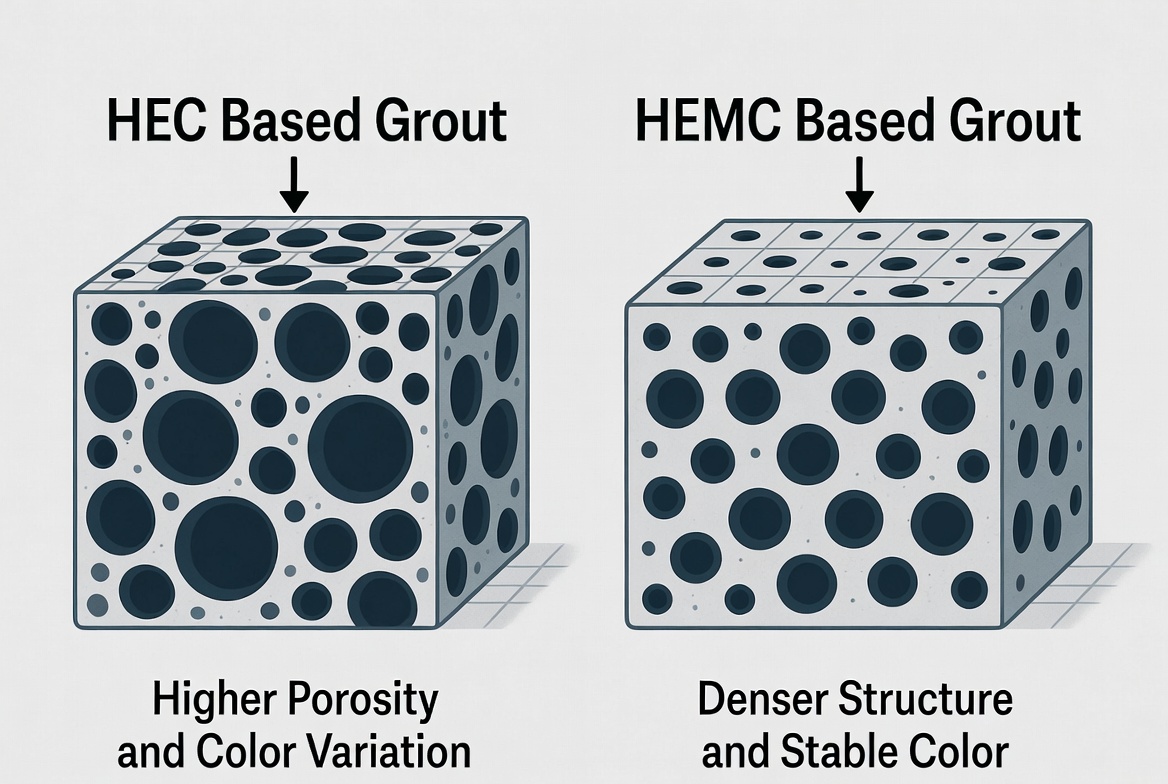
Hydroxyethyl Methyl Cellulose (HEMC) is also a non-ionic cellulose ether, but it combines hydroxyethyl and methyl substituents, which gives it different solubility and gelation behavior versus HEC. In construction mortars and tile grouts, HEMC is valued for higher water retention, better rheology control, longer open time, and improved workability, especially in high-temperature or fast-drying environments. It also shows good film-forming, emulsifying, and thickening properties, helping to achieve a denser and more homogeneous matrix in the hardened grout. [dysdxcl]
| Property / Aspect | HEC in Tile Grout | HEMC in Tile Grout |
|---|---|---|
| Chemical substitution | Hydroxyethyl only qianhaochem | Hydroxyethyl + methyl dysdxcl |
| Water retention | Good, but more sensitive in hot/dry jobsites ar.hpmctop | Higher water retention, more robust at high temperaturear.hpmctop |
| Rheology & sag resistance | Good thickening; can be less optimized for vertical grout joints shuangniujc | Fine rheology control; better anti-sag and creamy feelzhiweichem |
| Gel temperature | Moderate ar.hpmctop | Higher gel temperature; more stable in hot climatesar.hpmctop |
| Porosity impact | Can leave a more open pore structure if water retention is sub‑optimal | Helps form denser microstructure and lower capillary porosityzhiweichem |
| Typical use focus | Paints, putties, some cementitious systems shuangniujc | Tile grouts, tile adhesives, high-performance mortars zhiweichem |
From a grout designer's point of view, these differences translate directly into how easily you can control color uniformity and how much "space" you leave for salts to migrate and cause efflorescence.
Field investigations and technical bulletins from grout and epoxy manufacturers point to several recurring factors that drive color inconsistency: [thegritandpolish]
- Uneven water content (too much water in mixing or cleanup).
- Different mixing ratios between batches or not dry-blending powders together.
- Variable substrate moisture and curing conditions.
- Overly porous grout matrix, which alters the final shade and lightness.
- Contamination from previous washes, dirty sponges, or cleaning chemicals.
Even with the right cellulose ether, poor job-site practice can destroy color consistency. However, a well-optimized HEMC system makes the grout less sensitive to small variations, because it holds water more uniformly in the joint, slows down water loss, and promotes a more even hydration of cement and pigments. [zhiweichem]
- With HEC, water retention is acceptable, but in hot or windy conditions the mortar can lose water too quickly in surface layers, making those areas lighter and more porous. [ar.hpmctop]
- With HEMC, higher water retention and better rheology keep pigment distribution more uniform, while slowing the surface drying so that hydration proceeds more evenly through the grout joint. [hpmcproducer]
In practice, contractors often report that HEMC-based grouts "match the color on the box" more reliably when job conditions change from one day to another. This stability is one of the core reasons many premium grout brands have switched or are switching from traditional HEC/HPMC systems to HEMC-focused formulations for colored grouts. [zhiweichem]
Efflorescence is a salt crystallization phenomenon. Water dissolves soluble salts (often calcium compounds) in cementitious materials, migrates toward the surface, and evaporates, leaving a visible white deposit. Technical documents from grout and tile system manufacturers highlight three key elements: [cdnmedia.mapei]
- Source of salts (Portland cement, aggregates, admixtures, substrate).
- Pathways for water (pores and microcracks).
- Continuous moisture movement (liquid water or vapor).
If you cannot fully remove salts or moisture, you must control the pathways and reduce the driving force for migration. This is where the choice between HEC and HEMC materially influences performance.
By improving water retention and controlling rheology, HEMC supports a denser, more cohesive matrix in cement-based tile grout. This has several technical implications: [ar.hpmctop]
- Lower capillary porosity, so there are fewer continuous channels for moisture and salts.
- More controlled hydration, leading to fewer microcracks and weak zones.
- More consistent setting behavior, reducing local variations that can trap water.
Industry guidance on efflorescence prevention also stresses using materials that minimize porosity and moisture ingress, alongside membranes and topical moisture mitigation. HEMC-based grouts align with this strategy by complementing good design (vapor retarders, waterproofing, and sealers) with intrinsic microstructural resistance to salt migration. [uk]
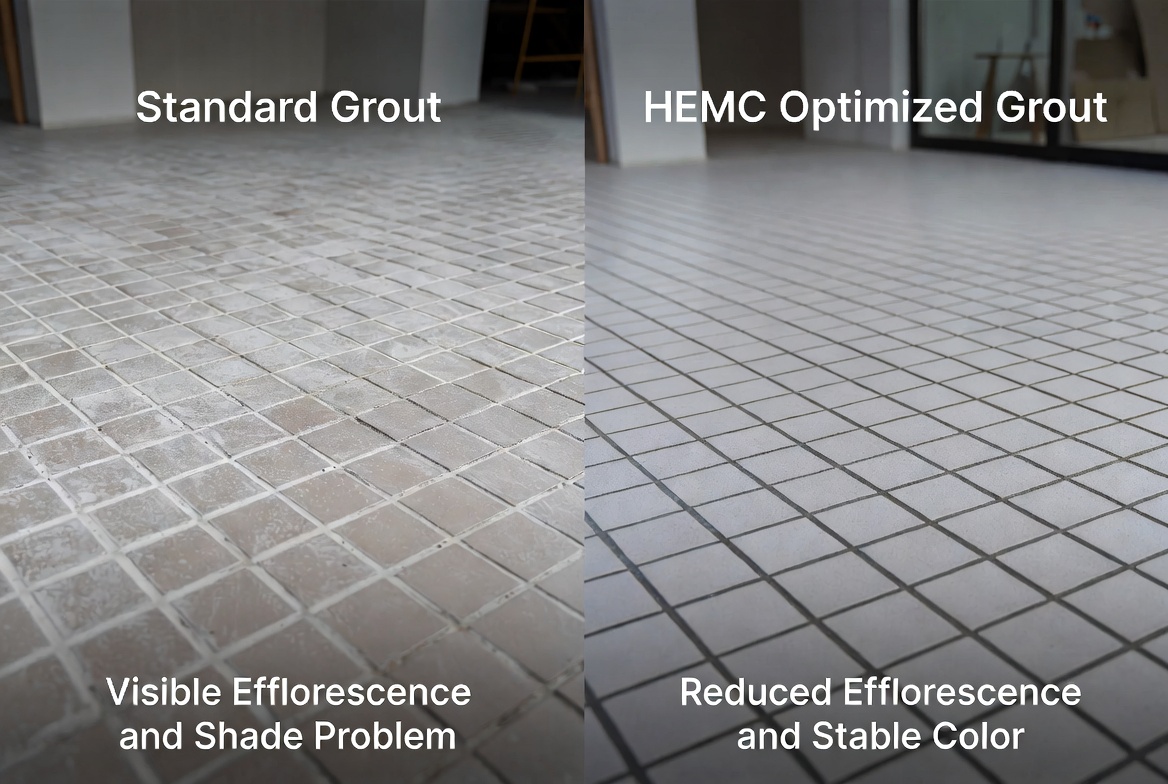
From an R&D and QC viewpoint, moving from HEC to HEMC in tile grout brings several measurable advantages when formulations are adjusted correctly:
- Narrower water demand window: HEMC's stronger water retention makes the mix less sensitive to slight water dosing variations; operators experience a more stable "feel." [hpmcproducer]
- Improved slump and sag resistance: Vertical joint filling becomes easier and cleaner; the material stays in the joint rather than flowing or shrinking back. [dysdxcl]
- More uniform shade panels in lab tests: Color cards produced under controlled conditions typically show tighter shade tolerance with HEMC systems due to more consistent curing and pore structure. [zhiweichem]
- Better hot-climate robustness: High gel temperature and thermal stability make HEMC-based formulations less prone to early water loss and performance drop in hot environments. [dysdxcl]
Experienced installers often describe the user experience of HEMC-based grout in simple, practical terms:
- Creamier and smoother during application; joints are easier to fill fully in one pass.
- Longer open time, so there is less rush and fewer "cold joints" between batches. [hpmcproducer]
- Easier cleanup window: controlled water retention means grout is firm enough when cleaning starts, reducing the risk of washing out pigment or creating weak, porous surfaces that later effloresce. [custombuildingproducts]
- Fewer callbacks related to "wrong color" or "white haze" complaints when combined with correct mixing and moisture control. [images.thdstatic]
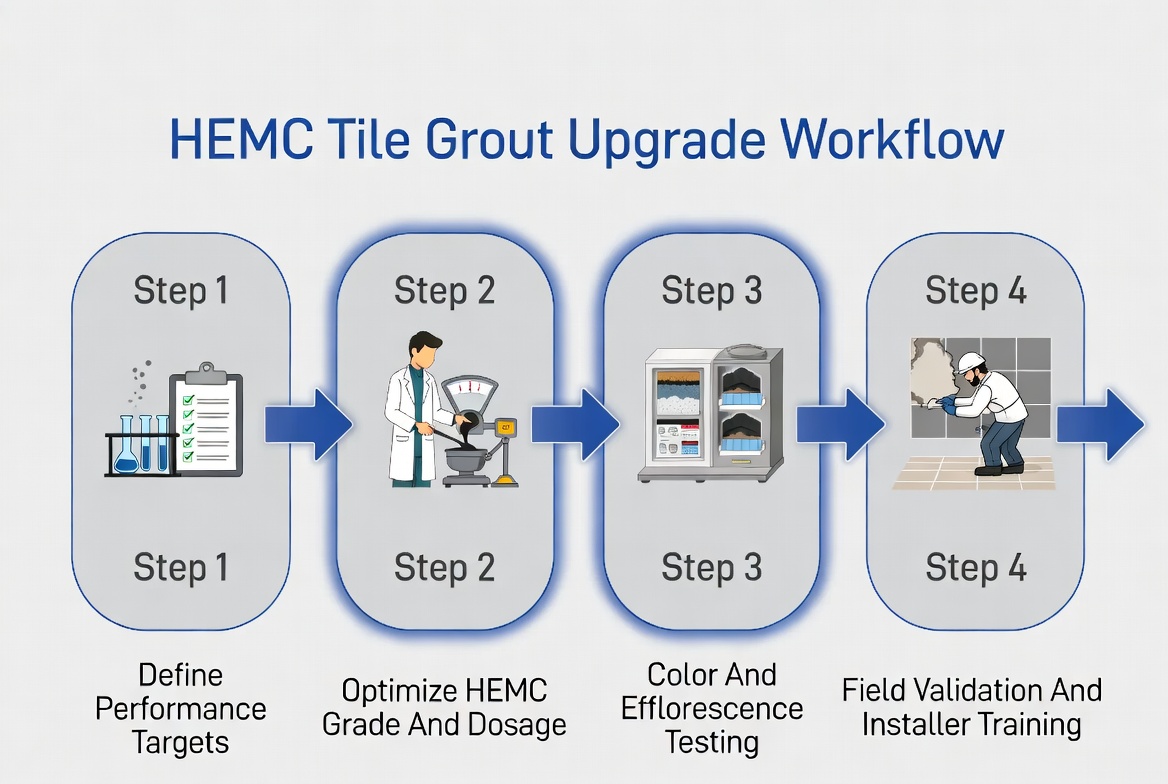
Here is a practical formulation roadmap we use when supporting clients who upgrade their grout recipes from HEC to HEMC.
1. Color tolerance: Specify acceptable ΔE or visual shade variation across standard panels.
2. Efflorescence rating: Use internal or third-party tests to rate efflorescence after accelerated exposure.
3. Workability KPIs: Pot life, open time, joint fill, and sag resistance.
4. Curing and strength: Check early and final compressive/flexural strength, shrinkage, and bond.
1. Start with a HEMC grade recommended for tile grout (construction-grade, appropriate viscosity, and substitution level). [dysdxcl]
2. Replace HEC on an equal dosage basis, then gradually reduce or increase HEMC until you recover target viscosity and flow.
3. Monitor thixotropy and anti-sag behavior in vertical joint tests; adjust dosage for balance between filling and smooth tooling.
- Adjust water-to-binder ratio to reflect improved water retention and avoid overly "tight" mixes.
- Check aggregate grading and pigment loading; denser packing supports HEMC's microstructural benefits.
- Consider co-admixtures (redispersible polymer powders, defoamers, hydrophobic agents) to support stain resistance and reduced water absorption.
1. Produce shade panels under hot, cold, and humid conditions.
2. Simulate over‑watering and under‑watering scenarios to test robustness.
3. Use accelerated efflorescence protocols following moisture cycling recommendations from technical bulletins. [cdnmedia.mapei]
4. Confirm that the HEMC grout maintains color consistency and shows lower or slower efflorescence formation than the HEC-based control.
From an industry expert's point of view, HEC is not "wrong", it is simply less specialized for challenging grout applications. HEC remains a practical choice when:
- You produce economy-grade, neutral-colored grout where minor shade variation is acceptable.
- Projects are mostly in moderate climates and stable indoor environments, with minimal thermal or humidity extremes.
- You want to prioritize cost efficiency and already have well-established QC and installer training for HEC-based systems.
However, when your brand promise includes premium color accuracy, dark or intense colors, and minimized efflorescence, HEMC becomes the more strategic choice in your portfolio. The competitive advantage comes not only from fewer complaints, but also from a stronger, more credible technical story you can tell specifiers, distributors, and contractors.
Even the best HEMC formulation needs correct site practice to unlock its full benefits. Industry documents on color variation and efflorescence highlight several non‑negotiable field habits: [tcnatile]
- Use consistent water dosage and avoid over‑watering during mixing.
- Dry-mix or box all powder units together before adding water to ensure shade uniformity. [thegritandpolish]
- Respect minimum curing times for substrates and setting materials before grouting. [custombuildingproducts]
- Avoid early or aggressive cleanup with excess water, which can dilute pigments and create porous surfaces. [images.thdstatic]
- Implement moisture control strategies: vapor retarders, membranes, and proper drainage to minimize continuous water movement through grout. [uk]
- Apply or recommend penetrating grout sealers where appropriate to reduce water ingress and staining. [tcnatile]
When we support customers switching to HEMC, we often supply a one-page installer guide summarizing these practices. This aligns your lab improvements with real-world user behavior, reducing the performance gap between "datasheet results" and what owners actually see on their floors.
As Shandong Shengda New Material Co., Ltd., we focus on construction- and personal-care-grade cellulose ethers, including both HEMC and HEC, and support customers in more than one role: manufacturer, formulation advisor, and long-term technical partner. Our HEMC products offer: [dysdxcl]
- Tailored viscosity ranges suitable for tile grouts and tile adhesives.
- High water retention and stable rheology, validated in cement-based systems across climate zones. [ar.hpmctop]
- Support for lab reformulation, from initial benchmarking to pilot industrial trials.
- Consistent quality control and supply capability for international OEM and private-label brands. [dysdxcl]
If you are evaluating a switch from HEC to HEMC to improve color consistency and reduce efflorescence, partnering directly with a producer that understands both the chemistry and the field constraints will shorten your development cycle and reduce risk.
If your grout line is facing color complaints, whitening, or efflorescence issues, now is the right time to benchmark a HEMC-based formulation against your current HEC system. Our technical team at Shandong Shengda New Material Co., Ltd. can help you:
- Analyze your current grout formula and performance.
- Select the right HEMC grade and dosage for your market segment.
- Design and evaluate test panels in line with your branding and color palette.
Contact us with your current technical datasheets and target markets, and we will propose a step‑by‑step upgrade plan to enhance your grout's color stability and efflorescence resistance.
No. Efflorescence also depends on salts in cement, substrate moisture, design details, and site practice. HEMC helps by reducing porosity and stabilizing the matrix but must be combined with good moisture management and correct installation. [cdnmedia.mapei]
You can start with a 1:1 replacement for screening, but final dosage must be optimized to match rheology, water demand, and open time. Lab trials are essential before full-scale production. [zhiweichem]
Yes. HEMC works in both sanded and unsanded cement grouts and is particularly beneficial for dark, highly pigmented formulations where color uniformity is critical. [hpmcproducer]
HEMC typically provides a more controllable cleaning window: grout firms up uniformly, allowing cleanup without washing out pigment or leaving soft, porous surfaces that are prone to efflorescence. [custombuildingproducts]
In hot or highly variable climates, HEMC's higher gel temperature and stronger water retention give it a clear advantage. In mild indoor conditions with basic color requirements, some manufacturers still use HEC for cost-driven products. [ar.hpmctop]
1. MAPEI – *Causes and cures of efflorescence* (technical bulletin). [Link] [cdnmedia.mapei]
2. Custom Building Products – *Removing Efflorescence* (technical bulletin). [Link] [custombuildingproducts]
3. Aqua Mix / The Home Depot – *Efflorescence on Grout* (guideline). [Link] [images.thdstatic]
4. Weber – *Preventing and removing efflorescence from tile grout* (blog). [Link] [uk]
5. TCA / industry sources – *Color variation and grout colorants guidance*. [Link] [tcnatile]
6. Zhiwei Chem – *HEMC for Tile Grout* (product application note). [Link] [zhiweichem]
7. HPMC Top – *HPMC vs HEC: 6 Differences You Need to Know* (article, including construction notes). [Link] [ar.hpmctop]
8. HPMC Producer – *HEMC vs. HPMC for Construction Applications: Which One Is Better?* (technical blog). [Link] [hpmcproducer]
9. Qianhao Chem – *HEMC vs. HEC: Structural and Functional Comparison* (overview article). [Link] [qianhaochem]
10. Shandong Dongyuan Shengda New Material – *Hydroxyethyl Methyl Cellulose – HEMC* (product page). [Link] [dysdxcl]
11. Shuangniu – *Hydroxyethyl Cellulose (HEC)* (product overview, construction notes). [Link] [shuangniujc]
12. Funahai – *HEMC Hydroxyethyl Methyl Cellulose* (coatings performance notes). [Link] [funahai]
13. The Grit and Polish – *Epoxy Grout Color Variation: What Went Wrong + How to Fix It* (practical tips). [Link] [thegritandpolish]


