


close
Choose Your Site
Global
Social Media
Views: 249 Author: Shengda Publish Time: 2026-09-22 Origin: Site


Content Menu
● What Is Hydroxypropyl Methylcellulose?
>> Why HPMC Is Used in So Many Industries
● Key HPMC Properties That Influence Performance
>> Viscosity Is Important, but Not the Only Factor
● HPMC for Construction Mortar Applications
>> Common Construction Applications
>> HPMC in Wall Putty and Skim Coat
● How to Select HPMC for Dry-Mix Mortar
>> Step 1: Identify the Main Formulation Challenge
>> Step 2: Review the Complete Formula
>> Step 3: Conduct Controlled Testing
>> Step 4: Confirm Results in Production
● HPMC for Daily Chemical Products
>> Common Daily Chemical Applications
>> What HPMC Can Improve in Liquid Systems
>> Compatibility Testing Is Essential
● How to Dissolve HPMC Correctly
>> Hot-Cold Dissolution Method
>> Cold-Water Dispersion for Surface-Treated HPMC
>> Common Causes of HPMC Lumps
● Quality Control Requirements for HPMC Buyers
>> Questions to Ask Before Purchasing HPMC
● Common HPMC Selection Mistakes
>> Example: Solving a Tile Adhesive Workability Problem
>> What is the difference between HPMC and HEMC?
>> What HPMC viscosity is suitable for tile adhesive?
>> Why does HPMC create lumps in water?
>> Can HPMC be used in liquid detergent?
>> Does higher HPMC viscosity always provide better water retention?
>> What information should I provide when requesting an HPMC sample?
Hydroxypropyl methylcellulose (HPMC), also known as hypromellose or hydroxypropyl methyl ether, is one of the most widely used cellulose ethers in modern formulation systems. It plays an important role in dry-mix construction materials, liquid detergents, cleaning products, coatings, and selected personal-care applications.
For manufacturers, distributors, and formulators, HPMC is not simply a white powder added to increase thickness. The correct HPMC grade can influence water retention, mixing behavior, workability, open time, sag resistance, viscosity development, suspension stability, and final product consistency.
Shandong Shengda New Material Co., Ltd. focuses on the research, development, production, and supply of cellulose ether products, including construction-grade and daily-chemical-grade HPMC. By matching product properties with application requirements, manufacturers can improve formulation reliability, reduce production variation, and create products that perform more consistently in real working conditions.
Hydroxypropyl methylcellulose is a chemically modified cellulose polymer. It is produced from refined cellulose through a controlled etherification process. During this process, some hydroxyl groups on the cellulose molecular chain are replaced with methoxy and hydroxypropoxy groups.
This modification gives HPMC a valuable combination of water-related and rheology-related properties. Depending on the grade, HPMC can dissolve, disperse, thicken, retain water, stabilize suspensions, improve workability, and form protective films.
HPMC is usually supplied as a white or slightly off-white powder. It is odorless and can form clear or slightly hazy solutions in water, depending on the grade, concentration, processing conditions, and the ingredients used in the final formulation.
HPMC is valued because it can perform several functions at the same time. This reduces the need for multiple additives in many formulation systems.
Key functional benefits include:
- Water retention for cement-, gypsum-, and lime-based materials
- Viscosity control in water-based liquid formulations
- Improved workability during mixing, spreading, troweling, and pumping
- Suspension stability for pigments, fillers, and insoluble ingredients
- Better open time for construction mortars and tile adhesives
- Film-forming ability in coatings and selected personal-care applications
- Improved consistency during storage and application
- Reduced segregation in dry-mix and liquid products
- Non-ionic behavior that can support compatibility in many complex systems
The performance of HPMC depends on much more than its viscosity. A grade with a certain viscosity may perform very differently when its substitution level, particle size, surface treatment, or dissolution speed changes.
Selecting HPMC based on a single technical parameter can lead to inconsistent formulation results. Professional buyers should assess several properties together.
| HPMC Property | Why It Matters | Typical Impact on Formulation |
|---|---|---|
| Viscosity | Determines thickening and rheology behavior | Influences flow, workability, water retention, and body |
| Methoxy content | Affects thermal behavior and solubility | Influences gel temperature and solution characteristics |
| Hydroxypropoxy content | Supports hydration and application performance | Can affect flexibility, solubility, and thermal response |
| Particle size | Controls dispersion and mixing behavior | Fine particles may hydrate faster but require controlled mixing |
| Surface treatment | Determines cold-water dispersion behavior | Helps reduce lump formation during addition |
| Water retention | Critical in mortar applications | Supports cement hydration and open time |
| Moisture content | Influences storage stability and product consistency | High moisture can affect powder flow and handling |
| Ash content | Reflects purity and production control | Important for repeatable formulation results |
| Gel temperature | Relevant in temperature-sensitive processes | Influences behavior during heating and cooling |
| pH compatibility | Important in detergent and cleaning systems | Affects viscosity stability in the finished formulation |
Viscosity is often the first property customers ask about. It is important because it influences thickening, water retention, application feel, and system stability.
However, viscosity results must be compared carefully. Different suppliers may test viscosity at different solution concentrations, temperatures, spindle types, rotation speeds, or hydration times.
For example, two HPMC grades may both be described as "high viscosity," but they may show different performance in tile adhesive because of differences in water retention, surface treatment, particle size, or chemical substitution.
For this reason, formulators should compare products using the same test method and conduct application-level trials before making a final selection.
Construction-grade HPMC is widely used in dry-mix mortar because it can improve water retention, workability, consistency, and application efficiency.
When mortar is applied to porous concrete blocks, cement boards, walls, floors, or tiles, water can be absorbed rapidly by the substrate or lost through evaporation. If the mortar loses water too quickly, cement hydration may be incomplete. This can reduce workability and may affect final bonding performance.
HPMC helps retain water inside the mortar for a longer period. This supports the hydration process and provides a more practical working window for installers.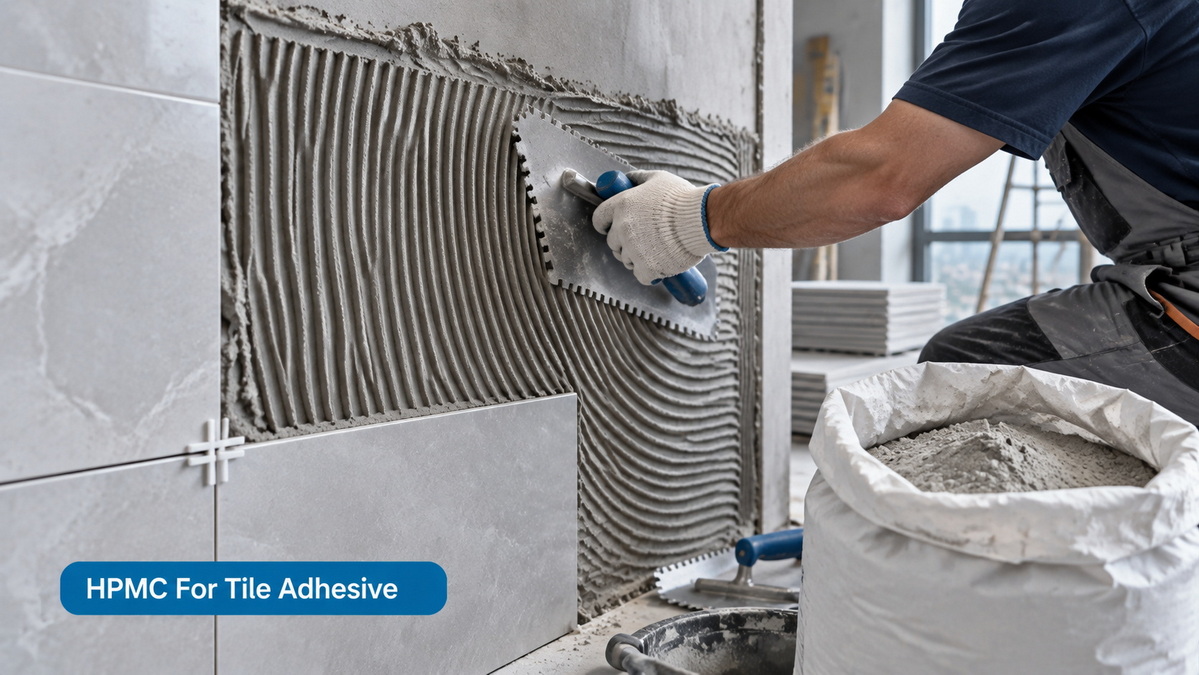
HPMC can be used in many dry-mix building material systems, including:
- Tile adhesive
- Cement-based render
- Gypsum plaster
- Wall putty
- Skim coat
- Masonry mortar
- Repair mortar
- Crack filler
- Joint filler
- External insulation system mortar
- Decorative mortar
- Self-leveling compound
- Cement-based waterproofing mortar
Tile adhesive requires a careful balance of water retention, open time, slip resistance, spreadability, and bonding performance.
When HPMC is properly selected, it can help tile adhesive remain workable after application. It can also improve the adhesive's ability to retain moisture while the tile is positioned and adjusted.
Important benefits in tile adhesive may include:
- Improved open time
- Better trowelability
- More stable combing performance
- Reduced rapid drying
- Enhanced water retention
- Improved application feel
- Lower risk of premature surface skinning
- Better support for cement hydration
A grade that is too low in viscosity may not provide enough water retention or workability. A grade that is too high in viscosity may make the adhesive overly sticky, difficult to spread, or harder to pump.
Wall putty and skim coat products need a smooth, creamy texture. They must spread easily and create an even finish without excessive dragging, powdering, or cracking.
HPMC can help improve:
- Spreading performance
- Trowel feel
- Water retention
- Surface smoothness
- Application consistency
- Resistance to rapid drying
- Stability during mixing
- Workability over time
In hot, dry, or windy environments, water retention becomes even more important. Rapid moisture loss can reduce the working time available to installers and may lead to uneven surface results.
Gypsum plaster has different formulation requirements from cement mortar. The setting behavior, filler system, retarders, and other additives can affect how HPMC performs.
In gypsum-based systems, HPMC can help improve workability, water retention, consistency, and application time. It can also help control the interaction between water and powder ingredients during mixing.
A suitable HPMC grade should be selected according to the desired setting profile, application thickness, machine or hand application method, ambient temperature, and final surface requirement.
Selecting the right HPMC grade should be based on real application needs rather than nominal viscosity alone.
Start by defining the issue that needs to be improved.
Common challenges include:
- Mortar dries too quickly
- Tile adhesive has insufficient open time
- Wall putty feels too rough or difficult to spread
- Mortar has poor water retention
- The product is too sticky during application
- Pumping performance is inconsistent
- The formulation separates during mixing
- The finished surface has poor smoothness
- The mortar loses workability too quickly
A clear problem definition makes grade selection faster and more accurate.
HPMC interacts with many other raw materials. Its performance can change when any major ingredient changes.
Important formulation variables include:
- Cement type and cement dosage
- Gypsum type and purity
- Sand gradation
- Calcium carbonate fineness
- Redispersible polymer powder dosage
- Starch ether selection
- Air-entraining agent level
- Hydrophobic additive content
- Retarder or accelerator dosage
- Mixing time and mixing equipment
- Water-to-powder ratio
A change in filler fineness or polymer powder dosage can alter water demand and rheology. Therefore, HPMC should be evaluated within the full formulation system.
A reliable evaluation program should include both fresh mortar testing and cured mortar testing.
Fresh mortar testing may include:
- Water retention
- Consistency
- Open time
- Slip resistance
- Density
- Workability
- Application feel
- Trowelability
- Pumpability
- Air content
Cured mortar testing may include:
- Bond strength
- Surface quality
- Crack resistance
- Drying behavior
- Shrinkage tendency
- Adhesive performance
- Mechanical strength
Laboratory results are important, but production-scale testing is equally necessary.
Large-scale mixers generate different shear forces. Raw materials may also vary between batches. Temperature, humidity, storage conditions, and packaging methods can influence finished-product behavior.
A pilot production test helps confirm that the selected HPMC grade provides stable performance under real manufacturing conditions.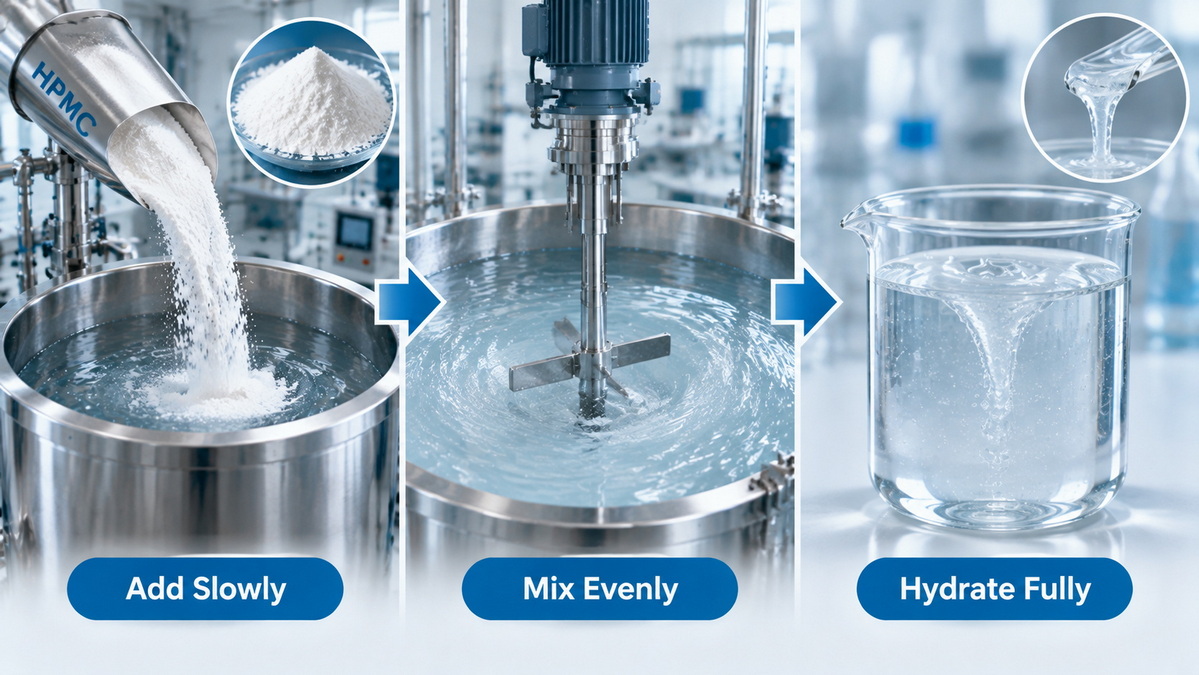
Daily chemical formulations require a different HPMC selection strategy from construction mortar. In liquid detergent, cleaning products, and selected personal-care formulations, HPMC can function as a thickener, stabilizer, suspension aid, and rheology modifier.
The final product must usually remain visually stable, easy to pour, easy to pump, and consistent during storage.
Suitable HPMC grades may be used in:
- Liquid laundry detergent
- Dishwashing liquid
- Hand wash
- Surface cleaner
- Toilet cleaner
- Bathroom cleaner
- Glass cleaner
- Shampoo
- Body wash
- Hair-care gel
- Lotion and cream systems
- Household cleaning gel
- Selected personal-care products
In daily chemical products, HPMC may help improve:
- Product thickness
- Flow control
- Suspension of insoluble particles
- Appearance stability
- Storage consistency
- Product texture
- Pouring performance
- Resistance to separation
- Film-forming behavior
- Consumer sensory experience
The final performance depends on the whole formula. Surfactants, salts, fragrances, solvents, preservatives, colors, pH regulators, and active ingredients may all influence the viscosity and stability of an HPMC-containing system.
A daily chemical HPMC grade should always be tested with the actual surfactant package.
For example, a formula containing high salt levels may behave differently from a low-salt formula. A system with anionic surfactants may respond differently from one containing mainly nonionic or amphoteric surfactants.
Before production, formulators should test:
- Initial viscosity
- Viscosity after 24 hours
- Viscosity after one week
- Stability at high and low temperatures
- pH variation
- Appearance changes
- Fragrance compatibility
- Foam behavior
- Pourability
- Long-term storage performance
Correct dispersion is critical for achieving stable viscosity and avoiding lumps.
When conventional HPMC powder is added too quickly into cold water, the outer surface of the particle may hydrate immediately. This can form a gel layer around the dry powder core, creating visible lumps or "fish eyes."
The hot-cold method is suitable for many standard HPMC grades.
1. Add part of the required water into a clean mixing tank.
2. Heat the water to a suitable temperature.
3. Add HPMC powder slowly under continuous agitation.
4. Mix until the powder is evenly dispersed.
5. Add the remaining cold water.
6. Continue mixing while the solution cools.
7. Allow enough time for complete hydration and viscosity development.
8. Adjust the final formulation after the HPMC has fully hydrated.
This method helps reduce lump formation and supports more uniform viscosity development.
Some HPMC grades are designed for cold-water dispersion. These products typically disperse first before they begin to hydrate fully.
Even with surface-treated HPMC, good mixing practice remains essential:
- Add powder gradually
- Maintain sufficient agitation
- Avoid dumping large quantities into the tank
- Prevent powder accumulation at the liquid surface
- Allow time for complete hydration
- Test final viscosity only after the required holding time
HPMC lumping is usually caused by poor addition or mixing conditions rather than poor raw-material quality alone.
Common causes include:
- Adding powder too quickly
- Using insufficient agitation
- Adding HPMC directly into cold water without a suitable method
- Using a low-shear mixing system
- Introducing powder into a poorly formed vortex
- Evaluating viscosity before full hydration
- Using an unsuitable HPMC grade for the process
A dependable HPMC supply program requires consistent testing and clear documentation. Construction and daily chemical manufacturers should not rely only on appearance or a general viscosity description.
Important quality-control documents and indicators include:
- Product technical data sheet
- Certificate of analysis
- Safety data sheet
- Batch number and production traceability
- Viscosity specification
- Test method details
- Moisture specification
- Ash content specification
- Particle size information
- Packaging details
- Storage recommendations
- Shelf-life information
- Application guidance
- Sample evaluation support
Before selecting a supplier or grade, buyers should ask practical questions:
1. What is the recommended application range for this HPMC grade?
2. Which viscosity test method is used?
3. At what solution concentration is viscosity measured?
4. Is the product surface-treated for cold-water dispersion?
5. What water-retention performance can be expected in mortar?
6. What is the recommended dosage range?
7. Can the supplier provide batch-specific test documentation?
8. Is technical support available during laboratory testing?
9. What storage conditions are recommended?
10. Can the product be customized for a specific formulation challenge?
A professional supplier should be able to explain not only the product specification but also the formulation logic behind the recommended grade.
Many formulation problems occur because HPMC is selected using incomplete information.
Avoid the following mistakes:
- Choosing HPMC only by price per kilogram
- Comparing viscosity values measured using different methods
- Assuming that identical viscosity means identical performance
- Ignoring particle size and dissolution behavior
- Using too much HPMC to solve a formulation problem
- Changing multiple raw materials during one test
- Skipping production-scale validation
- Selecting a construction grade for a daily chemical system without compatibility tests
- Ignoring climate conditions in mortar applications
- Evaluating a solution before full hydration is complete
A tile adhesive manufacturer may report that its product has acceptable water retention but feels too sticky during troweling.
A simple solution might be to reduce HPMC dosage. However, this can also reduce water retention and open time.
A better approach is to review the entire system:
- Check whether the HPMC viscosity is too high
- Review redispersible polymer powder dosage
- Evaluate starch ether level
- Check filler particle-size distribution
- Review air entrainment
- Compare water demand
- Test alternative HPMC grades under controlled conditions
In many cases, the best result comes from improving the balance between water retention, flow, stickiness, and application feel rather than reducing one ingredient alone.
Hydroxypropyl methylcellulose is a high-value functional additive for construction mortar and daily chemical formulations. Its ability to retain water, control viscosity, improve workability, stabilize systems, and support consistent application makes it essential in many modern industrial products.
However, successful HPMC selection requires more than choosing a viscosity grade. Formulators should evaluate chemical substitution, particle size, surface treatment, water retention, dissolution behavior, compatibility, and the complete formulation system.
For construction materials, the right HPMC can improve open time, spreading performance, mortar stability, and water retention. For daily chemical products, it can improve viscosity, product appearance, suspension stability, and user experience.
Shandong Shengda New Material Co., Ltd. provides construction-grade and daily-chemical-grade cellulose ether solutions designed to support practical formulation development. By combining stable material quality with application-focused technical communication, manufacturers can build more reliable products for demanding markets.
For a suitable HPMC grade recommendation, share your application type, current formulation challenge, target viscosity, processing method, and required performance results with the technical team.
HPMC and HEMC are both non-ionic cellulose ethers used in construction materials, coatings, and other formulation systems. Their chemical structures differ, which can affect water retention, workability, gel behavior, solubility, and rheology. The most suitable option depends on the application and complete formulation.
There is no single viscosity that fits every tile adhesive formula. The suitable grade depends on cement type, filler system, redispersible polymer powder level, sand grading, climate conditions, water demand, and target properties such as open time and slip resistance. Application testing is necessary before final selection.
Lumps often form when HPMC powder is added too quickly into cold water. The outer layer hydrates first and traps dry powder inside. Gradual addition, proper agitation, sufficient hydration time, and the correct dissolution method can reduce this problem.
Yes. Suitable daily-chemical-grade HPMC can be used as a thickener, rheology modifier, stabilizer, or suspension aid in selected liquid detergent and cleaning-product formulations. Compatibility testing with surfactants, salts, fragrance, pH regulators, and preservatives is necessary.
No. Higher viscosity can support water retention, but it may also increase stickiness, reduce flow, make mixing more difficult, or affect pumping performance. The best grade is the one that provides a balanced combination of water retention, workability, open time, and processability.
HPMC should be stored in its original sealed packaging in a cool, dry, and well-ventilated location. It should be protected from moisture, damaged bags, direct exposure to water, and excessive dust generation. Always follow the storage guidance provided for the specific grade.
Provide the application type, current formula category, target viscosity, main performance issue, mixing method, dosage range, climate conditions, and expected end-use requirements. This information helps identify a more suitable HPMC grade for testing.
1. KIMA Chemical Co., Ltd. "Hydroxypropyl Methylcellulose HPMC."
[https://www.kimacellulose.com/blog/hydroxypropyl-methylcellulose-hpmc.html]
2. U.S. Food and Drug Administration. "Inactive Ingredient Database."
[https://www.accessdata.fda.gov/scripts/cder/iig/index.cfm]
3. BSI. "BS EN 998-1:2016 Specification for Mortar for Masonry — Rendering and Plastering Mortar."
[https://webstore.ansi.org/preview-pages/BSI/preview_30291085.pdf]
4. iTeh Standards. "EN 998-1:2017 Mortar Specification for Rendering and Plastering."
5. Redox. "Safety Data Sheet: Hydroxypropyl Methyl Cellulose."
[https://redox.com/wp-content/sds/1677.pdf]
6. Carl ROTH. "Safety Data Sheet: Methyl Hydroxypropyl Cellulose."


