


close
Choose Your Site
Global
Social Media
Views: 259 Author: Shengda Publish Time: 2026-09-03 Origin: Site


Content Menu
● What Is Hydroxyethyl Methyl Cellulose?
>> Main Functions of HEMC/MHEC
● HEMC, HPMC and HEC: Key Differences
● Why HEMC Is Important in Cement-Based Mortar
>> Better Anti-Slip and Anti-Sag Performance
>> More Consistent Application
>> Support for Crack-Resistance Strategies
>> Cement Render and Gypsum Plaster
>> Joint Compound and Repair Mortar
● HEMC in Waterborne Coatings and Daily Chemical Products
>> Waterborne Paints and Coatings
>> Detergents and Household Cleaning Products
● How to Select the Right HEMC Grade
>> Step 1: Define the End-Use Requirement
>> Step 2: Review the Complete Formulation
>> Step 3: Use Viscosity as a Starting Point
>> Step 4: Test Under Real Conditions
>> Step 5: Confirm Performance at Pilot Scale
● Special Considerations for Hot and Dry Conditions
● Quality Information Buyers Should Review
>> Recommended Documents and Data
● Storage, Handling and Production Tips
>> Recommended Storage Practices
>> Dry-Mix Mortar Production Tips
● Working With Shandong Shengda New Material
>> What is the difference between HEMC and MHEC?
>> What is HEMC used for in tile adhesive?
>> Can HEMC be used in wall putty?
>> Can HEMC be used in waterborne paint?
>> Does higher viscosity mean better HEMC performance?
>> How should HEMC powder be stored?
Hydroxyethyl Methyl Cellulose (HEMC), also known as Methyl Hydroxyethyl Cellulose (MHEC), is a non-ionic, water-soluble cellulose ether used to improve water retention, viscosity, workability, adhesion and rheology. For dry-mix mortar manufacturers, paint producers and daily chemical formulators, selecting the right HEMC grade can improve product consistency, processing efficiency and finished-product performance.
Shandong Shengda New Material Co., Ltd. develops and manufactures construction-grade and daily-chemical-grade cellulose ethers, including HPMC, HEMC/MHEC and HEC. We provide application-focused material solutions for customers seeking dependable performance in mortar, coatings, household products and other water-based formulations.
Hydroxyethyl Methyl Cellulose is commonly referred to as HEMC or MHEC. Both names describe the same category of modified cellulose ether.
HEMC/MHEC is generally supplied as a white or off-white free-flowing powder. When added and properly hydrated in water-based systems, it can provide thickening, water retention, suspension support and rheology control.
This multifunctional behavior makes HEMC valuable across a broad range of construction and industrial formulations.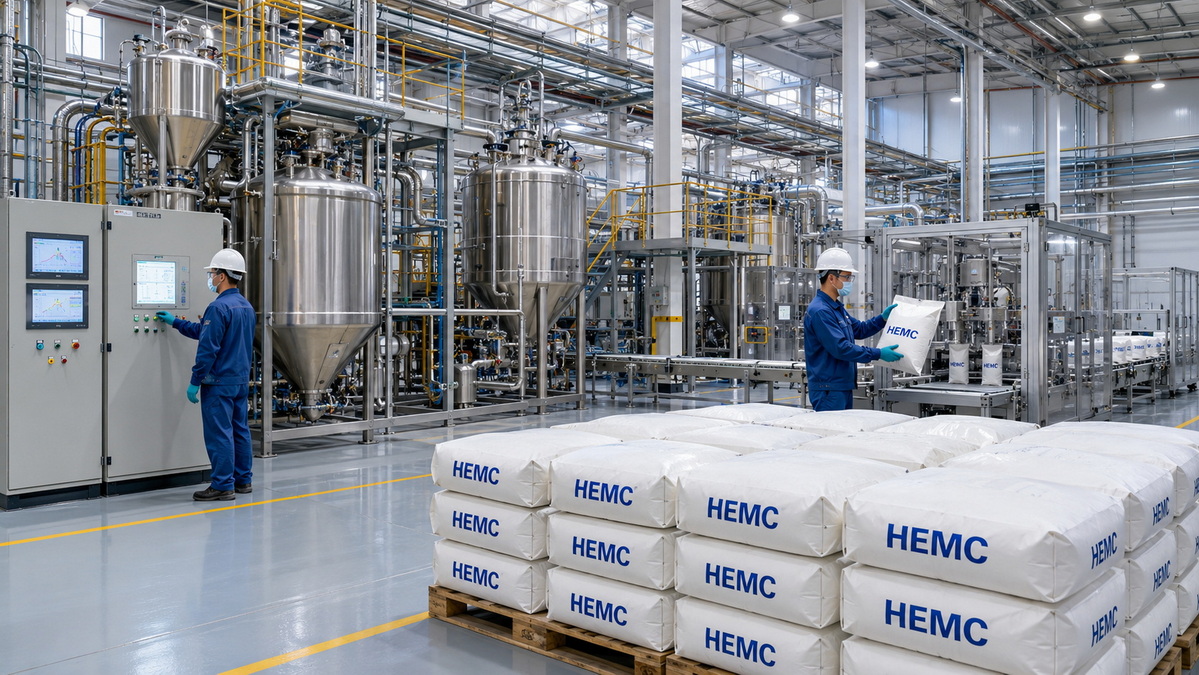
HEMC is commonly used to:
- Retain water in cement-, gypsum- and lime-based materials
- Increase viscosity and create a more stable consistency
- Improve workability during mixing, pumping, troweling or spreading
- Support adhesion and cohesion in mortars and adhesive systems
- Extend open time for easier construction application
- Improve anti-sag and anti-slip performance on vertical surfaces
- Stabilize particles in selected water-based coatings and liquids
- Improve product texture in suitable detergent and daily chemical formulations
The final effect depends on the grade, dosage, formulation design, raw materials, production process and application environment.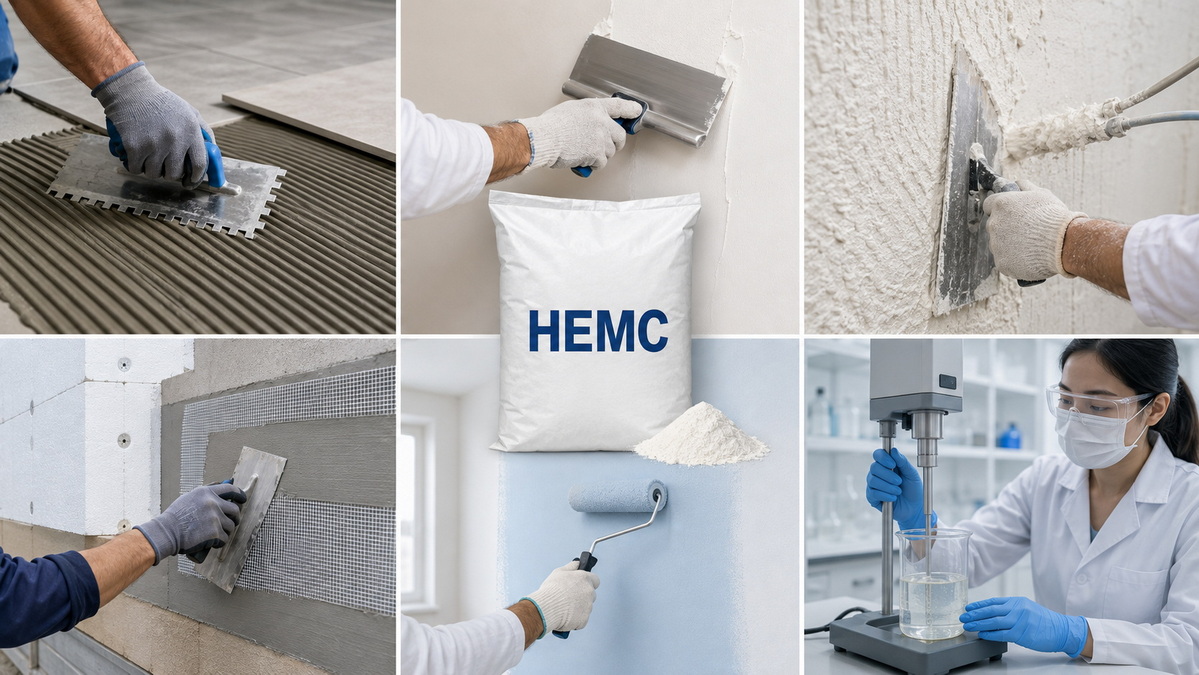
HPMC, HEMC/MHEC and HEC are all cellulose ethers, but they are not identical materials. Their chemical structure, dissolution characteristics, viscosity development, thermal behavior and compatibility with other ingredients may differ.
| Cellulose Ether | Main Performance Characteristics | Typical Applications | Selection Focus |
|---|---|---|---|
| HEMC / MHEC | Water retention, workability, open time, anti-sag properties and stable rheology | Tile adhesive, wall putty, cement render, gypsum plaster, EIFS/ETICS, joint compound | Suitable for demanding dry-mix mortar systems and extended workability requirements |
| HPMC | Versatile water retention, thickening, bonding and workability improvement | Tile adhesive, skim coat, cement mortar, gypsum products and general dry-mix mortar | Often selected for broad construction-material applications |
| HEC | Efficient thickening, suspension support and rheology modification in water-based systems | Waterborne paints, coatings, detergents, shampoos and personal care products | Often preferred for aqueous liquid formulations |
For formulators, the most suitable cellulose ether is not necessarily the product with the highest listed viscosity. The right grade must achieve a balanced combination of water retention, consistency, open time, anti-slip performance, mixing behavior and final cost efficiency.
Cement-based mortar requires sufficient water to support hydration and maintain workable application properties. However, fresh mortar may lose water quickly when applied to a dry or porous substrate. High temperature, wind and low humidity can further increase evaporation.
HEMC helps manage water within the mortar system. It can slow excessive water loss, improve fresh-mortar consistency and provide a more stable application window.
Water retention is one of the most important functions of HEMC in dry-mix mortar. When mortar loses water too rapidly, it may become difficult to spread, comb or finish. Insufficient water availability can also negatively affect the hydration process.
A properly selected HEMC grade helps hold water inside the fresh mortar for longer. This can support more uniform curing conditions and improve construction handling.
Open time refers to the period during which an applied adhesive or mortar remains workable and capable of forming an effective bond.
For tile adhesive, longer open time can give installers more flexibility after combing the material onto the substrate. This is especially useful when working on large wall areas, in warm climates or on highly absorbent surfaces.
Vertical applications require mortar or adhesive to stay in place after installation. Tile adhesive should hold the tile without excessive movement, while wall putty and render should resist sagging before setting.
HEMC can help build a stable and cohesive structure, contributing to better anti-slip and anti-sag performance when combined with appropriate formulation design.
A balanced HEMC grade can improve trowel feel, spreadability and surface smoothness. For contractors and applicators, this may mean easier installation, improved coverage and fewer interruptions during the work process.
Cracking can result from many factors, including substrate movement, excessive shrinkage, incorrect water ratio, poor curing, unsuitable filler design and inadequate binder content.
HEMC is not a complete solution to every cracking problem. However, its ability to improve water retention can support a more controlled drying process and help create better curing conditions.
HEMC is widely used in cement-based tile adhesive formulations. It can improve water retention, workability, trowelability, open time and anti-slip performance.
A suitable grade helps tile adhesive maintain stable combed ridges after application. It can also support better contact between tile, adhesive and substrate.
Important formulation factors include:
- Cement type and cement dosage
- Filler gradation and particle-size distribution
- Redispersible polymer powder content
- Starch ether and other rheology modifiers
- Water-to-powder ratio
- Target tile size and installation method
- Wall or floor application conditions
- Ambient temperature and substrate absorption
Wall putty and skim coat require smooth spreading, good leveling, suitable working time and a refined surface finish.
HEMC can help improve:
- Water retention
- Trowel feel
- Cohesion
- Surface smoothness
- Working time
- Reworkability
When selecting HEMC for wall putty, evaluate both the initial application behavior and the later-stage feel. A formulation may feel smooth immediately after mixing but become too sticky, dry or difficult to finish after extended standing time.
Cement render, gypsum plaster and machine-applied plaster require a stable balance between water demand, workability, sag resistance and setting behavior.
HEMC can support:
- Better mixing stability
- Improved hand or machine application
- More uniform spreading
- Increased water retention
- Reduced premature drying
- Better cohesion on vertical surfaces
For machine-applied systems, formulators should also test pumping, spraying, hose transport, spray pattern and surface finish.
External thermal insulation systems require consistent adhesion, good workability and reliable crack-resistance performance across the full system.
HEMC can contribute to cohesive, workable base-coat mortar when formulated with cement, mineral fillers, polymer modifiers, fibers and other performance additives. The best grade should be selected through testing with the complete system rather than as an isolated ingredient.
Joint compounds and repair materials often require smooth application, good substrate contact and stable consistency. HEMC can help control water retention and rheology, allowing operators to achieve better workability and easier finishing.
Although HEMC is strongly associated with dry-mix mortar applications, cellulose ethers also play useful roles in selected water-based liquid formulations.
In waterborne paint systems, cellulose ethers can act as rheology modifiers, thickening agents and suspension-support materials. They can contribute to viscosity control, brushability, roll application behavior and pigment stability.
For coatings, HEC is often a preferred option. However, HEMC may also be considered depending on the desired rheology profile, formulation compatibility and final coating performance.
Key factors to evaluate include:
- Viscosity development
- Pigment suspension
- Flow and leveling
- Brush drag or roller feel
- Spatter resistance
- Storage stability
- Compatibility with dispersants, defoamers and binders
In detergent and household-cleaning formulations, suitable cellulose ether grades may improve viscosity, texture, suspension and product appearance.
The material should be evaluated carefully with the full system, particularly when the formulation contains surfactants, salts, fragrances, preservatives, solvents or active ingredients.
Selected cellulose ethers can be used in personal care products such as shampoos, body washes, liquid soaps, toothpaste and other water-based products.
Performance requirements may include:
- Smooth texture
- Controlled viscosity
- Stable appearance
- Good suspension behavior
- Compatibility with surfactants
- Consistent product feel over shelf life
The selected grade must meet the relevant product, safety and regulatory requirements for the intended market.
Choosing a HEMC grade should be based on the full formulation and its end-use requirements. A structured evaluation process can reduce trial-and-error work and help avoid costly production adjustments.
Start by identifying the product category and target performance.
For example, a tile adhesive may require strong water retention, anti-slip behavior and open time. A wall putty may prioritize smooth troweling and surface finish. A waterborne coating may focus on viscosity, flow and pigment suspension.
Set measurable targets before beginning laboratory trials.
Cellulose ether performance changes when other raw materials change. Consider:
- Binder type and dosage
- Cement or gypsum type
- Calcium carbonate or silica filler grade
- Redispersible polymer powder
- Starch ether
- Retarder or accelerator
- Defoamer
- Surfactant
- Pigment
- Water ratio
- Mixing equipment
A grade that performs well in one formula may require adjustment in another formula.
Viscosity is important, but it should not be the only selection criterion. Two materials with similar viscosity values may perform differently because of variation in chemical substitution, particle characteristics, surface treatment and hydration behavior.
Use viscosity to identify initial testing options, then confirm the final selection through application performance.
Laboratory testing should reflect actual use conditions whenever possible.
Evaluate the material under expected:
- Water ratios
- Mixing times
- Ambient temperatures
- Humidity levels
- Substrate absorption conditions
- Application thicknesses
- Production equipment settings
For export-oriented products, testing should also consider the climate conditions of the destination market.
After laboratory approval, validate the formulation at pilot or production scale. This stage should include mixing consistency, feeding behavior, powder distribution, packaging stability and real application feedback.
A successful product should perform consistently from sample preparation to industrial production and final field use.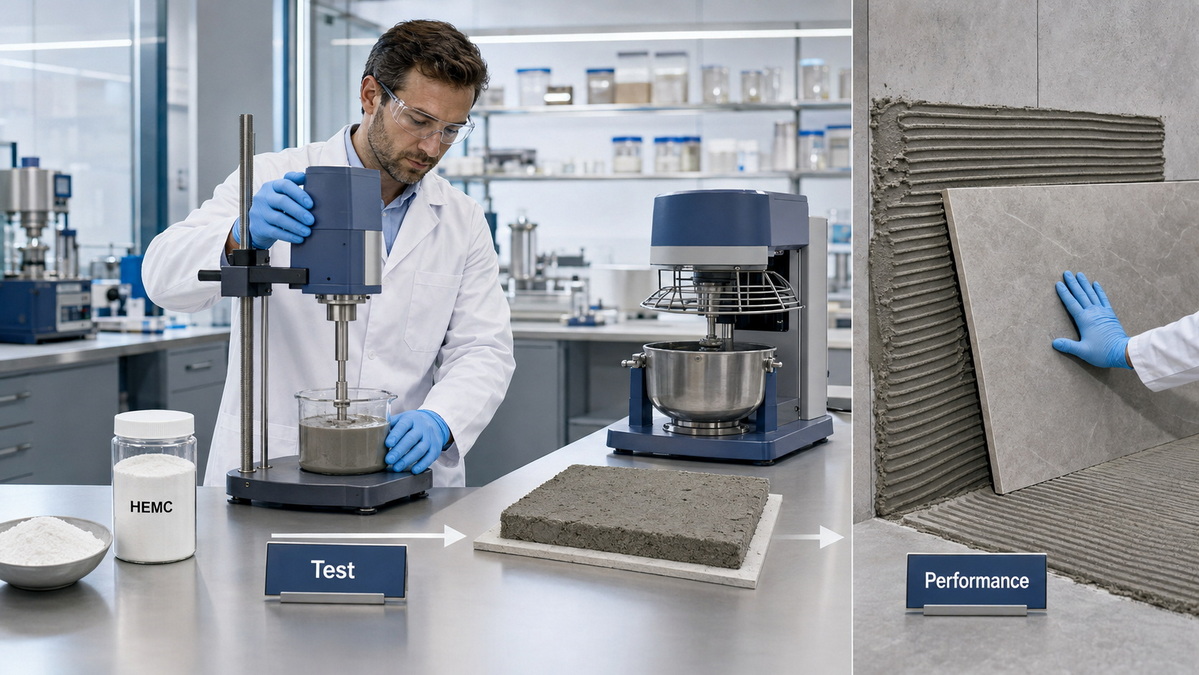
High temperatures, dry air and wind can shorten mortar working time and accelerate moisture loss. These conditions may affect open time, spreadability and adhesion development.
For projects in hot or dry climates, formulators should evaluate:
- Water retention under elevated temperature
- Open time on absorbent substrates
- Mortar consistency after standing
- Anti-slip performance on vertical surfaces
- Workability during extended application
- Curing behavior after application
Climate is important, but it is only one part of the formulation decision. Substrate absorption, cement chemistry, filler blend, polymer content and water ratio can be equally important.
Always validate HEMC performance in the complete mortar formulation and under representative site conditions.
For dry-mix mortar producers, importers, distributors and private-label brands, product evaluation should include more than product name and price.
A dependable supplier should be able to provide clear technical documentation and batch-level quality information.
- Technical Data Sheet
- Safety Data Sheet
- Certificate of Analysis
- Product specification
- Viscosity test method and conditions
- Moisture specification
- Ash content specification
- pH range where relevant
- Particle-size information where applicable
- Storage guidance
- Shelf-life recommendation
- Batch traceability information
- Sample-testing support
When reviewing viscosity data, confirm the test method. Results can vary depending on solution concentration, water temperature, instrument type, spindle, rotational speed and measurement procedure.
Comparable data requires comparable test conditions.
HEMC powder should be stored in sealed packaging in a cool, dry and well-ventilated area. Moisture exposure may affect powder flow, handling consistency and product performance.
- Keep bags sealed before use
- Protect material from humidity and water exposure
- Store away from direct sunlight
- Follow the specified shelf-life period
- Reseal partially used bags promptly
- Use a first-in, first-out inventory system
For dry-mix mortar production, ensure consistent feeding and sufficient blending time. Good powder distribution is essential for stable mortar performance.
- Verify raw-material identity before charging
- Follow the approved addition sequence
- Use controlled feeding equipment where appropriate
- Maintain consistent mixing time
- Monitor powder segregation risk
- Retain samples for batch traceability
For liquid systems, use an appropriate addition process to avoid lump formation and incomplete hydration.
Depending on the cellulose ether grade and formula, the process may require controlled dispersion, pre-mixing, specific agitation speed or a defined addition sequence.
Check the final viscosity only after complete hydration.
Shandong Shengda New Material Co., Ltd. provides HPMC, HEMC/MHEC and HEC cellulose ether products for construction materials and daily chemical applications.
Our product development focuses on practical formulation needs, including water retention, viscosity control, workability, open time, anti-sag performance and liquid-system rheology.
Whether you are developing tile adhesive, wall putty, EIFS base coat, gypsum plaster, waterborne paint, detergent or another water-based formulation, selecting the right cellulose ether grade can improve product consistency and reduce unnecessary formulation adjustments.
Share your application type, binder system, performance requirements and production conditions to identify a suitable material starting point.
HEMC/MHEC is a versatile cellulose ether with important functions in construction materials, coatings and selected daily chemical products. Its value comes from its ability to improve water retention, viscosity, workability, cohesion, open time and rheology.
For dry-mix mortar formulations, HEMC can support more stable application behavior in tile adhesive, wall putty, cement render, gypsum plaster and EIFS base coat. In water-based liquid systems, cellulose ethers can contribute to viscosity control, product texture and suspension stability.
The best HEMC grade is determined by the complete formulation—not by viscosity alone. Careful laboratory testing, pilot validation and real-condition evaluation are essential for consistent product performance.
HEMC means Hydroxyethyl Methyl Cellulose, while MHEC means Methyl Hydroxyethyl Cellulose. Both names are commonly used for the same category of non-ionic cellulose ether.
HEMC is used in tile adhesive to improve water retention, workability, trowelability, open time, cohesion and anti-slip performance. The most suitable grade depends on the cement, fillers, polymer powder, water ratio and target application conditions.
Neither material is universally better. HEMC and HPMC have different chemical structures and performance profiles. The best choice depends on the specific mortar, coating or liquid formulation, as well as the desired water retention, workability, rheology and processing behavior.
Yes. HEMC is commonly used in wall putty and skim coat to improve water retention, smooth spreading, cohesion, working time and finishing performance.
HEMC may be used in selected waterborne coatings depending on the required rheology and formulation compatibility. HEC is also widely used for water-based paint thickening and rheology control.
No. Higher viscosity may improve body, water retention or anti-sag behavior in some systems, but it may also affect flow, mixing, air entrainment and application feel. Grade selection should be confirmed through full-formulation testing.
Store HEMC in sealed bags in a cool, dry environment. Protect it from moisture, reseal opened packages promptly and follow the stated shelf-life recommendations..
1. Chen, N. et al. "Water Retention Mechanism of HPMC in Cement Mortar." *Polymers*, 2020.
[https://pmc.ncbi.nlm.nih.gov/articles/PMC7372461/]
2. Bülichen, D. et al. "Working Mechanism of Methyl Hydroxyethyl Cellulose (MHEC) as Water Retention Agent." *Cement and Concrete Research*, 2012.
[https://www.sciencedirect.com/science/article/abs/pii/S0008884612000695]
3. Ashland. "Natrosol™ Hydroxyethylcellulose."
[https://www.ashland.com/industries/personal-and-home-care/oral-care/natrosol-hydroxyethylcellulose]
4. Ashland. "Ashland Expands Global Natrosol™ Hydroxyethylcellulose Capacity."
5. Industrial Cellulosics. "METHOCEL™ Cellulose Ethers in Building and Construction."
[https://www.industrialcellulosics.com/insights/methocel-cellulose-ethers-in-building-and-construc]
6. LANDU. "MHEC | HEMC Manufacturer | Hydroxyethyl Methyl Cellulose."
[https://landu-china.com/en/hydroxyethyl-methyl-cellulose-hemc-mhec/]


