


close
Choose Your Site
Global
Social Media
Views: 222 Author: Shengda Publish Time: 2026-05-28 Origin: Site


HPMC and HEMC are both effective cellulose ethers for skim coats in humid climates, but they behave differently when it comes to water retention, open time, and sensitivity to "bubbling" defects. Choosing the right grade and formulation strategy is the key to solving bubbling issues rather than relying on a single "universal" product. [chinacoatonline]
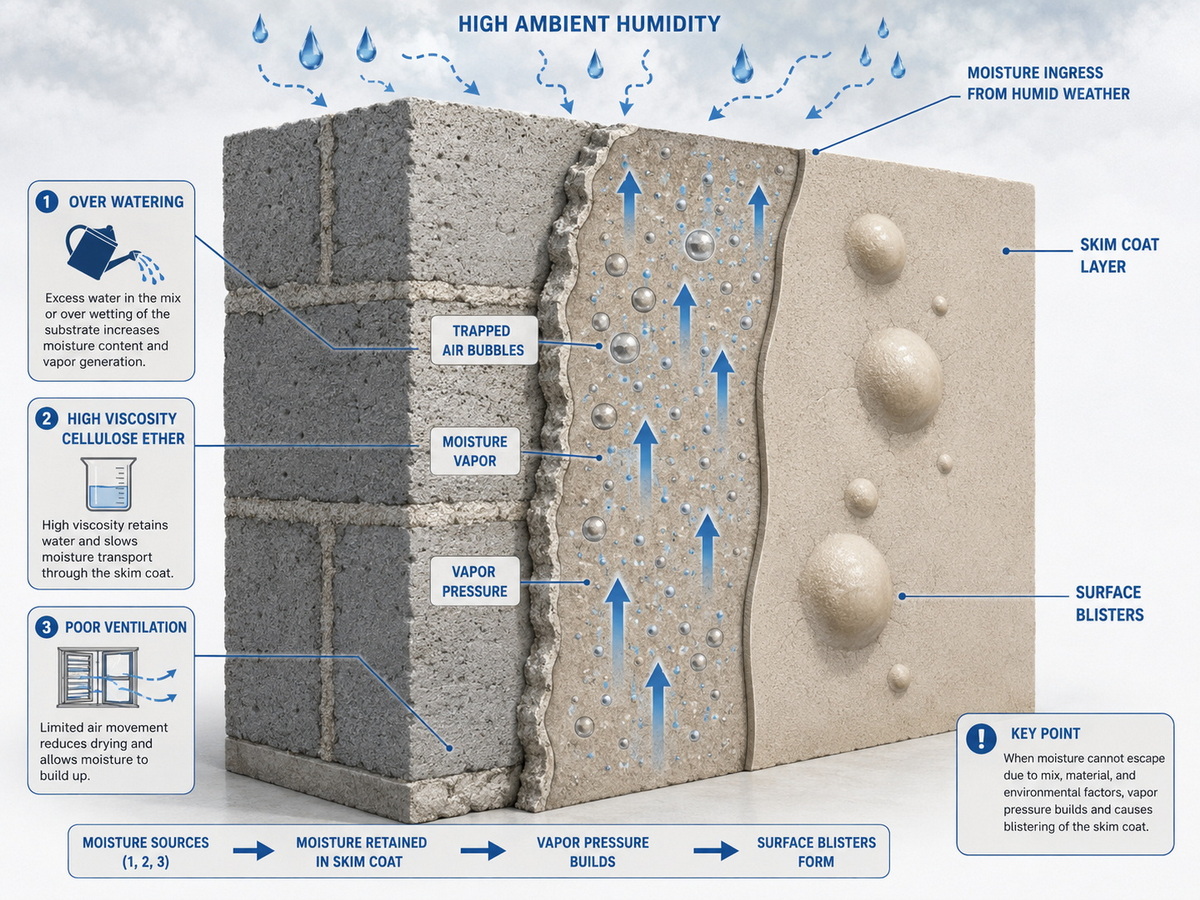
Skim coat formulations for interior and exterior walls rely on water‑soluble cellulose ethers such as Hydroxypropyl Methyl Cellulose (HPMC) and Hydroxyethyl Methyl Cellulose (HEMC) to control water retention, workability, and adhesion. In humid regions, prolonged surface wetting, slower drying and trapped moisture under the skim layer are the primary triggers for bubbling, pinholes and blisters. [tshuaxue]
From a practical field perspective, contractors often complain that a skim coat looks perfect at application but shows micro‑bubbles or soft spots after 12–24 hours, especially during the rainy season. As a cellulose ether manufacturer focused on construction‑grade and daily‑chemical‑grade products, Shandong Shengda New Material Co., Ltd. regularly supports customers in Southeast Asia, the Middle East, and coastal China to fine‑tune HPMC/HEMC grades to these conditions. [linkedin]
Hydroxypropyl Methyl Cellulose (HPMC) is a non‑ionic cellulose ether derived from natural cellulose and modified with methyl and hydroxypropyl groups. In skim coat and wall putty, typical roles of HPMC include: [flbook.com]
- Water retention for proper hydration of cement and gypsum
- Rheology and sag resistance to keep the paste on the wall
- Workability and smooth troweling feel
- Open time extension so applicators can rework the surface
HPMC is widely used in tile adhesives, putties, self‑leveling, gypsum plasters and other dry‑mix mortars because of its strong water‑retention capability and consistent performance across a wide temperature range. [efful]
Hydroxyethyl Methyl Cellulose (HEMC), sometimes referred to as MHEC, is also a non‑ionic cellulose ether derived from cellulose but modified with hydroxyethyl and methyl groups. In skim coat systems, HEMC provides: [sdlandu]
- Good water retention with slightly different hydration behavior vs. HPMC
- Stable viscosity and creamy mortar consistency
- Improved workability and slip resistance in some formulations
In many markets, HEMC is used in cement‑based putty, plaster and ETICS/EIFS systems as an alternative or complement to HPMC, especially when formulators want a different balance between water retention and open time. [sdlandu]
From an R&D and field‑support perspective, the following differences are the most relevant when you try to solve bubbling in humid weather: [tshuaxue]
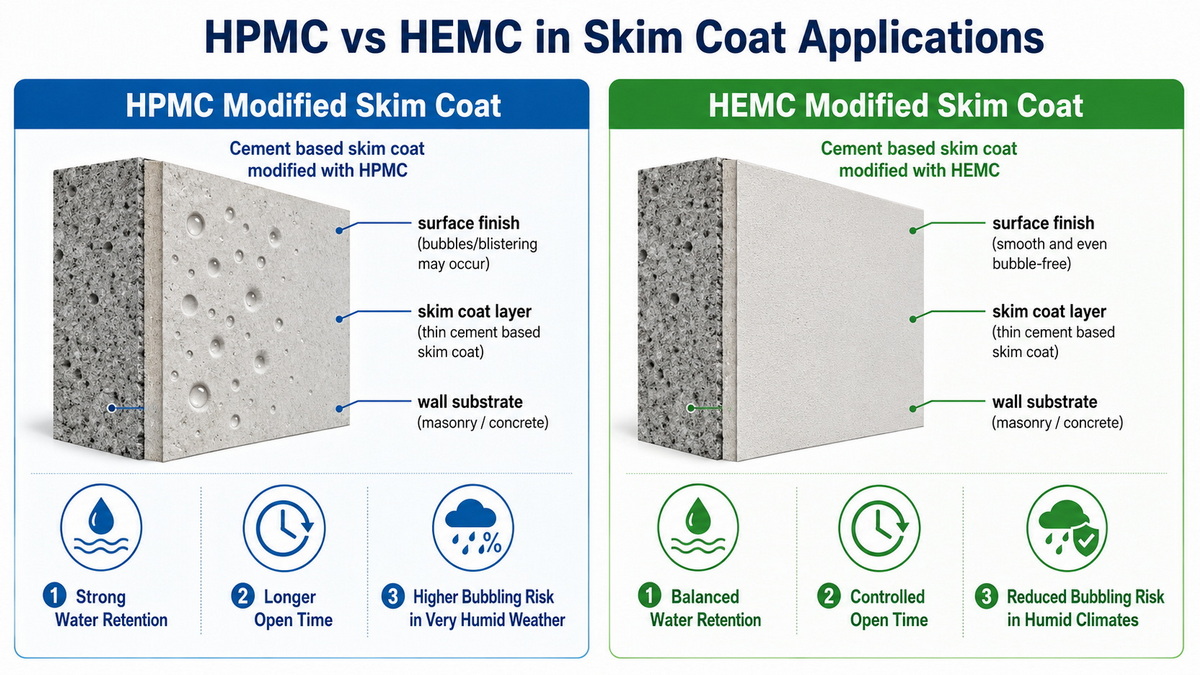
- HPMC usually provides very strong water retention, which is beneficial in hot, dry climates but can slow down drying too much when relative humidity is high. [flbook.com]
- HEMC tends to have a slightly different water‑retention curve, which can allow somewhat faster surface drying while still keeping enough water inside for cement hydration in certain formulations. [sdlandu]
In extremely humid conditions (e.g., tropical rainy season), too strong water retention near the surface may trap moisture and air, increasing the tendency for blisters. Using a lower viscosity HPMC or partially replacing HPMC with HEMC can balance this effect. [efful]
- Construction‑grade HPMC for skim coat is commonly used in viscosity ranges like 40,000–100,000 cps (Brookfield, 2% solution), which yields creamy, highly pseudoplastic mortars. [flbook.com]
- HEMC products for putty often target similar nominal viscosities but may show slightly different flow and leveling behavior, which can reduce entrapped air during mixing and application if the grade is selected correctly. [sdlandu]
From field feedback, applicators often describe HEMC‑modified putty as "a bit easier to de‑bubble" under the trowel in humid conditions, while HPMC gives a stronger "body" but sometimes more micro‑bubble marks if mixing is aggressive. [efful]
- Strong open time is an advantage of quality HPMC, but in high humidity it can mean longer tacky periods, during which surface defects (bubbles, dust pick‑up, trowel marks) can appear. [flbook.com]
- HEMC can enable a slightly quicker surface set in some formulations, shortening the window in which bubbling can develop at the surface while still ensuring full hydration inside the layer. [sdlandu]
For coastal and monsoon‑region projects, our technical team often recommends "tuned" open time rather than "maximum" open time to minimize humidity‑driven bubbling. [chinacoatonline]
From site audits and technical service visits, bubbling issues rarely come from a single factor. They usually combine: [efful]
- High ambient humidity and low air movement
- Over‑watered mix to chase workability
- Over‑thick application in one pass
- Aggressive mechanical mixing that introduces excessive air
- Incompatible cellulose ether grade (too high viscosity or water retention) for the local climate
In such scenarios, air entrapped inside the mortar and moisture trapped near the surface cannot escape quickly. As partial setting occurs, localized vapor pressure pushes against the soft skim coat layer, forming bubbles and micro‑blisters. Cellulose ether choice (HPMC vs. HEMC) directly influences how fast water migrates, how air escapes and how quickly a stable film forms. [tshuaxue]
From a neutral industry perspective, neither HPMC nor HEMC is "absolutely better"; performance depends on grade selection, dosage, and the rest of the formulation. However, when bubbling in humid weather is the specific pain point, certain trends emerge from our lab tests and customer projects. [chinacoatonline]
- HPMC‑dominant systems
- Best for dry or moderately humid climates requiring long open time
- Very robust water retention; may need adjustment in tropical zones
- HEMC‑dominant or blended systems
- Often more forgiving in high‑humidity environments
- Can provide smoother de‑aeration and slightly quicker surface set
As a manufacturer, we often recommend HPMC/HEMC blends, fine‑tuned viscosity and particle size, and pairing the cellulose ether with suitable defoamers to minimize air entrainment and bubbling. [chinacoatonline]
| Aspect | HPMC in skim coat | HEMC in skim coat |
|---|---|---|
| Chemical structure | Methyl + hydroxypropyl cellulose ether (tshuaxue) | Methyl + hydroxyethyl cellulose ether (sdlandu) |
| Water retention strength | Very high, especially at higher viscosities (flbook.com) | High, but profile can allow faster surface dry (sdlandu) |
| Typical open time effect | Longer open time, slower surface set (flbook.com) | Balanced open time, can be slightly shorter (sdlandu) |
| Sensitivity to very humid climate | May increase bubbling if grade/dosage too high (flbook.com) | Often more tolerant when properly selected (sdlandu) |
| Workability / troweling feel | Strong body, high pseudoplasticity (flbook.com) | Creamy, sometimes easier de‑aeration (sdlandu) |
| Main construction applications | Tile adhesive, putty, plaster, self‑leveling (flbook.com) | Putty, plaster, ETICS, cement mortars (sdlandu) |
This comparison should guide technical and purchasing teams when choosing or adjusting cellulose ether grades for humid‑season skim coat production.
As a cellulose ether supplier, we regularly support skim‑coat manufacturers in coastal and tropical regions who struggle with seasonal bubbling. A typical case pattern looks like this (generalized from multiple projects): [chinacoatonline]
- Original formula used high‑viscosity HPMC designed for drier climates. [flbook.com]
- During the rainy season, defect rates (bubbles, pinholes) rose significantly on site.
- Lab simulation at higher humidity showed slow surface drying and visible micro‑blisters. [efful]
Optimization steps often included:
1. Switching to a lower‑viscosity HPMC grade or partially replacing with HEMC to adjust water retention and flow. [flbook.com]
2. Adding a compatible defoamer suitable for cementitious systems to reduce entrapped air. [efful]
3. Adjusting recommended water dosage and application thickness in technical datasheets. [flbook.com]
In multiple projects, this combined approach reduced visible bubbling and improved surface density, while maintaining workability and open time requested by contractors. [chinacoatonline]
From an industry‑expert and UX‑oriented standpoint, clear, actionable steps help both R&D teams and site engineers. [efful]
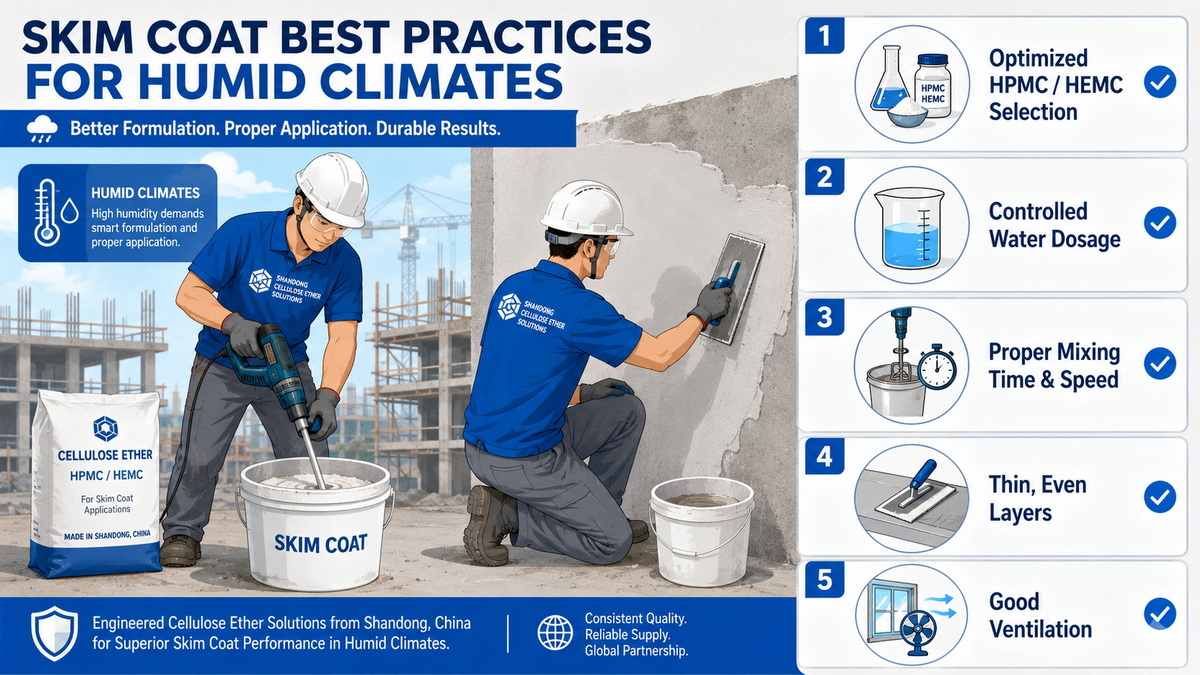
- Choose construction‑grade HPMC or HEMC specifically tested for skim coats in your climate zone. [flbook.com]
- For very humid climates, consider HEMC‑rich or blended systems to balance water retention and drying. [sdlandu]
- Avoid "blindly" increasing viscosity or dosage to boost workability; this can raise bubbling risk. [efful]
- Use consistent mixing time and speed to avoid excessive air entrainment. [efful]
- Respect recommended water‑to‑powder ratios and avoid over‑watering. [flbook.com]
- Apply skim coats in thin, even layers, especially in humid conditions. [efful]
- Improve ventilation and air movement where possible to support drying. [efful]
- Avoid application on heavily saturated substrates or during direct water exposure (e.g., heavy rain on exterior walls). [efful]
When the key requirement is to minimize bubbling under high humidity, HEMC often offers several advantages if properly specified: [sdlandu]
- More controlled surface drying, reducing the time window for bubble formation
- Good leveling and flow, which helps air escape under the trowel
- Stable performance in cement‑based and gypsum‑based skim coats
By pairing HEMC with optimized fillers, polymer powders and defoamers, formulators can create skim coats that remain smooth and defect‑free even during long rainy seasons. [flbook.com]
Shandong Shengda New Material Co., Ltd. focuses on cellulose ether research, development, production and technical services for global construction and daily‑chemical customers. Our portfolio includes construction‑grade HPMC and HEMC tailored for: [sdshengda.en.made-in-china]
- Skim coat and wall putty
- Tile adhesive and grout
- Gypsum plaster and self‑leveling compounds
From an expert standpoint, the most efficient way to solve bubbling is not to "copy‑paste" a generic recipe, but to match cellulose ether grades to your local climate, raw materials and production process. We support partners with: [chinacoatonline]
- Lab screening of HPMC vs. HEMC grades for specific markets
- Technical guidance on dosage, mixing and additives
- Long‑term supply stability and quality control
For conversion and UX, the CTA should be specific and benefit‑oriented:
If you are experiencing bubbling or surface defects in humid‑season skim coats, contact our technical team to test customized HPMC and HEMC grades for your local conditions and production line. Our experts can help you benchmark different formulations and identify the optimal cellulose ether solution for your market.
You can place this CTA:
- After the "Practical formulation tips" section
- Once again in a short conclusion box near the end of the article
In many cases, partial or full replacement is technically possible, but the final decision should be based on lab testing of water retention, open time and surface quality under your specific climatic conditions. [sdlandu]
No. Very high viscosity can lead to excessive water retention and more bubbling risk in humid regions, so viscosity and dosage should be optimized rather than maximized. [flbook.com]
Typical dosages for construction‑grade HPMC/HEMC in skim coats are in the low percentage range, but the exact value depends on binder system, fillers, and desired properties and should be confirmed by testing. [flbook.com]
Defoamers help reduce air bubbles, but if the cellulose ether grade or site conditions are unsuitable, bubbling may persist, so a holistic optimization is recommended. [efful]
Higher ambient humidity slows drying, changes substrate moisture content and increases trapped air and vapor pressure, which together make bubbling more likely even if the formula is unchanged. [efful]
1. Shandong Shengda New Material Co., Ltd. – Company overview and product scope. [linkedin]
2. Shandong Shengda New Material Co., Ltd. – Product and business description for HPMC and related cellulose ethers. [sdshengda.en.made-in-china]
3. Industry listing describing production of HPMC and HEMC cellulose ethers for construction applications. [chinacoatonline]
4. Landu New Material – Product information on Hydroxyethyl Methyl Cellulose (HEMC) for construction use. [sdlandu]
5. Henan Tiansheng – Technical note on MC, HPMC, HEMC as non‑ionic cellulose ethers derived from natural cellulose. [tshuaxue]
6. Zhonghui Polymer Materials catalogue – Application fields of HPMC, HEMC and HEC in putty, tile adhesive and other mortars. [flbook.com]
7. Efful Technology – Discussion on selecting cellulose ether types and their impact on mortar performance. [efful]


