


close
Choose Your Site
Global
Social Media
Views: 279 Author: Shengda Publish Time: 2026-11-26 Origin: Site


Content Menu
● HEC vs HPMC for Latex Paint: The Essential Comparison
● How HEC and HPMC Modify Latex Paint Rheology
>> HEC: An Established Water-Phase Thickener
>> HPMC: Useful Functionality With Additional Thermal Considerations
● Improving Storage Stability: Diagnose the Failure First
>> Viscosity Drift: Separate Hydration From Degradation
>> Settling and Syneresis: Look Beyond a Single Viscosity Reading
>> Enzyme Resistance Is Not Preservation
● Improving Application Consistency Across Different Shear Conditions
>> Measure More Than Container Viscosity
>> Balance Sag Resistance Against Leveling
>> Verify Water Retention Under Relevant Conditions
● A Practical Six-Step HEC vs HPMC Screening Protocol
>> 1. Define the Paint and Its Failure Criteria
>> 2. Establish a Reliable Reference
>> 3. Hydrate Each Grade Correctly
>> 4. Compare at Matched Performance
>> 5. Conduct Controlled Storage Trials
>> 6. Recheck Application After Aging
● Troubleshooting Guide: Match the Symptom to the Investigation
● The Procurement Detail That Often Gets Missed
>> Compare Viscosity Methods Before Comparing Numbers
>> Evaluate Cost per Accepted Batch
● Choosing a Cellulose Ether With Shandong Shengda
>> Is HEC better than HPMC for latex paint?
>> Can HPMC replace HEC at the same dosage?
>> Does enzyme-resistant HEC eliminate preservatives?
>> Why does paint viscosity change overnight?
>> Can HEC and HPMC be blended?
>> Does better water retention guarantee better paint?
Choosing between HEC and HPMC for latex paint formulations involves more than comparing viscosity specifications. Hydroxyethyl cellulose (HEC) and hydroxypropyl methylcellulose (HPMC) both modify water-phase rheology, but their hydration behavior, temperature response, and grade-specific characteristics can produce different results during manufacturing, storage, and application.
For paint formulators, the practical question is: which cellulose ether delivers reliable suspension, manageable processing, and consistent application in the complete formulation?
HEC is generally the more established starting point for conventional waterborne architectural paints. HPMC deserves consideration when its particular rheological and water-retention characteristics fit the formulation. Neither should be selected by polymer name alone.
This guide presents a formulation-focused comparison for Shandong Shengda New Material Co., Ltd., a Chinese manufacturer specializing in cellulose ether research, development, production, and sales. Recommendations are screening guidance, not claims of company-specific test results.
Both materials are nonionic cellulose ethers. Their chemical substitutions influence water interaction, dissolution, and thermal behavior. However, molecular weight, substitution pattern, surface treatment, and formulation composition can matter as much as the polymer family.
| Selection factor | HEC | HPMC |
|---|---|---|
| Established application | Widely used in waterborne architectural coatings | Widely used in construction and other formulations; paint suitability requires grade-specific validation |
| Main contribution | Water-phase thickening and shear-thinning flow | Thickening, water retention, and rheology modification |
| Hydration | Available in surface-treated grades designed for controlled incorporation | Requires a grade-appropriate dispersion and hydration method |
| Temperature response | Conventional aqueous HEC solutions do not exhibit HPMC-type thermal gelation | Aqueous solutions can reversibly gel or precipitate upon heating |
| Biological considerations | Enzyme-resistant grades are available | Resistance cannot be inferred from the polymer name |
| Application performance | Grade selection affects sag, flow, and roller behavior | Grade and formulation determine application balance |
| Replacement strategy | Establish a validated reference formulation | Compare at matched paint performance, not equal dosage |
The central lesson is simple: equal solution viscosity does not establish equal performance in paint.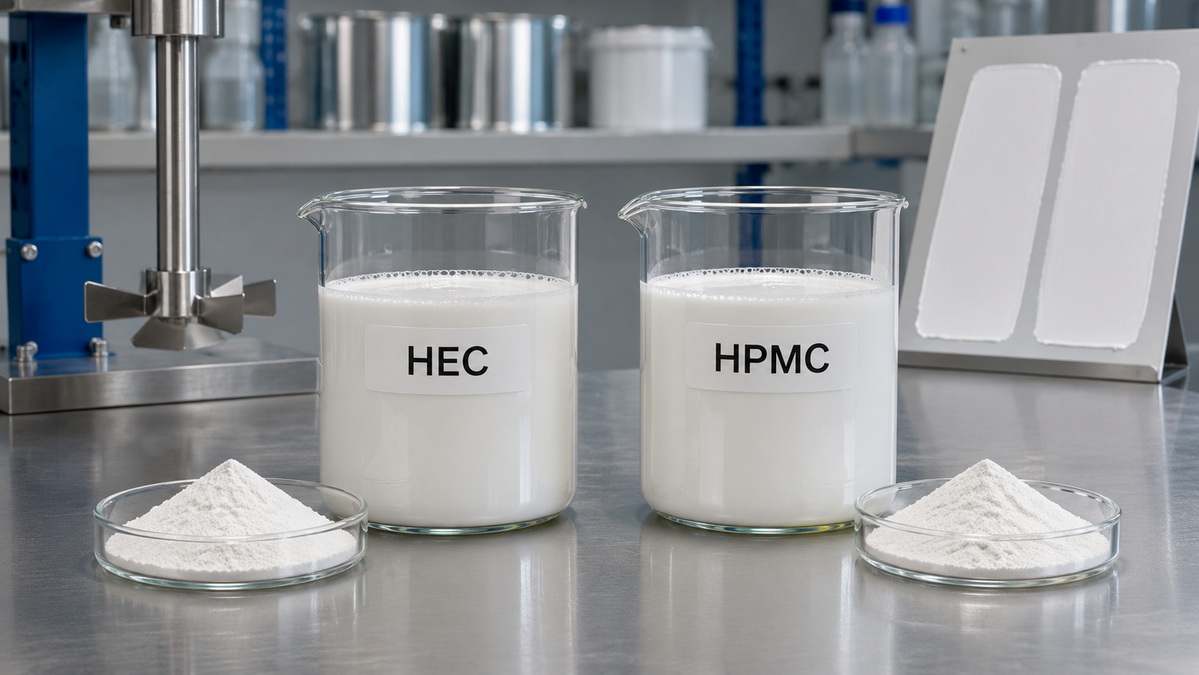
HEC dissolves in water and increases the viscosity of the continuous phase surrounding latex particles, pigments, and extenders.
Its solutions are typically shear-thinning: viscosity decreases as shear increases. This helps reconcile two competing requirements—maintaining structure in the container while allowing paint to move during stirring and application.
However, shear-thinning alone does not prove adequate pigment suspension or sag resistance. Those properties depend on the complete formulation and its behavior across relevant shear conditions.
Standard HEC should also be distinguished from hydrophobically modified HEC. Modified grades can introduce associative thickening and different high-shear or spatter performance.
HPMC contains methoxy and hydroxypropyl substituents. It can provide thickening and water retention, but its aqueous behavior differs from HEC.
A particularly important distinction is thermally induced gelation or precipitation. The transition depends on the grade and surrounding formulation.
This does not mean HPMC-based paint inevitably gels during transport. It means formulators should investigate temperature sensitivity rather than assume that room-temperature results predict warm-storage performance.
Likewise, strong performance in cementitious mortar does not automatically demonstrate suitability for latex paint. The binder chemistry, particle interactions, and application requirements are different.
"Poor storage stability" can describe several unrelated problems. Selecting the correct cellulose ether starts with identifying what actually changed.
A paint that thickens after filling may contain incompletely hydrated cellulose ether. Other formulation interactions can also contribute.
Conversely, viscosity loss may involve microbial activity, enzymatic polymer degradation, changes in dispersion stability, or other chemical and physical effects.
A useful investigation records:
- Viscosity immediately after manufacture and after equilibration.
- Measurement temperature, spindle, speed, and conditioning procedure.
- pH before and after storage.
- Odor, gas formation, discoloration, and visible contamination.
- Changes in sediment, separation, and redispersibility.
Do not respond to every viscosity loss by increasing thickener dosage. Additional polymer will not correct contamination or a destabilized pigment dispersion.
Pigment settling, hard sediment, and liquid separation require separate observations.
A paint can meet its routine viscosity target yet develop unacceptable sediment because that reading does not adequately characterize its low-shear structure. Conversely, increasing viscosity can make application unnecessarily heavy without eliminating the underlying instability.
Record both the amount of separation and the effort needed to redisperse sediment. Easily redispersible settling and a compact hard cake are not equivalent failures.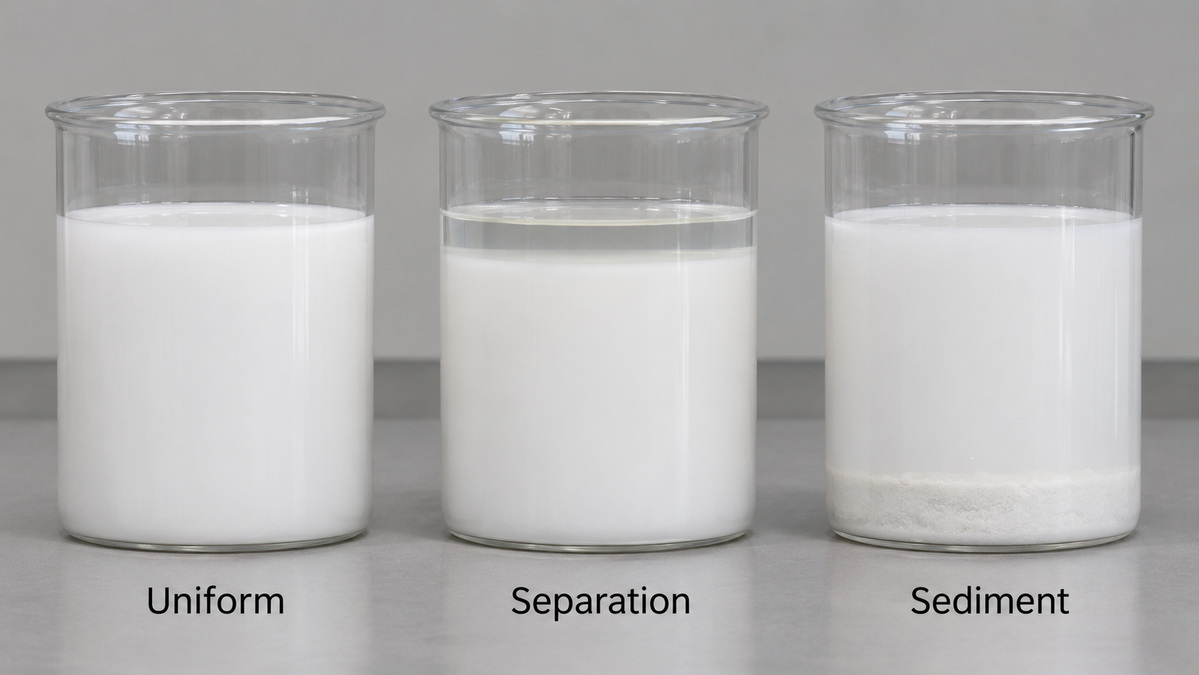
Certain commercial HEC grades are designed to resist enzymatic degradation better than conventional grades.
However, enzyme resistance is not the same as antimicrobial preservation. A resistant thickener does not sterilize process water, clean equipment, or establish finished-paint shelf life.
Use an appropriately validated preservation system, hygienic manufacturing practices, and microbiological testing suited to the intended market. Neither HEC nor HPMC should be described as "preservative-free" solely because a grade offers improved biological resistance.
A stable container is only half the requirement. The paint must also deliver predictable behavior under a brush or roller.
Paint experiences different deformation conditions during storage, mixing, loading, and application.
A useful assessment combines:
- Low-shear measurements for structure and suspension-related behavior.
- Routine consistency measurements, such as a suitable KU method.
- High-shear measurements for application-related behavior.
- Practical roller, brush, sag, and leveling evaluations.
Two paints with similar KU values may still differ in roller loading, brush drag, leveling, or film build. Matching one number is therefore insufficient for an HEC-to-HPMC substitution.
More structure is not always better.
Insufficient resistance to flow can produce sagging. Excessive structure can retain roller texture or brush marks and make the paint feel difficult to spread.
Evaluate both properties at a controlled wet-film thickness. Otherwise, differences in applied film build can obscure the real effect of the thickener.
Water retention can influence application on absorbent substrates. However, longer workable time is not determined by cellulose ether alone.
Substrate suction, temperature, humidity, airflow, binder properties, and the rest of the formulation also contribute.
Test on representative surfaces rather than relying exclusively on nonabsorbent laboratory panels. A smooth drawdown on a sealed chart does not demonstrate consistent application on porous plaster.
The following protocol is a proposed development framework, not a published universal specification.
Record binder type, pigment volume concentration, solids, pH, application method, and intended storage environment.
Set acceptance criteria before testing. Include application defects and redispersibility, not just viscosity.
Use the current acceptable formulation or a validated HEC-containing control.
Keep pigment, binder, dispersant, defoamer, and preservation conditions constant during the initial comparison. Record any unavoidable processing differences.
Compare fully developed systems, not partially dissolved powders.
Some surface-treated HEC grades permit controlled dispersion before hydration. HPMC may require cold-water processing or a hot/cold procedure, depending on the grade.
Follow the specific technical instructions. Do not transfer one grade's temperature or pH procedure to another without verification.
Run a small dosage ladder for each candidate.
Select samples with comparable routine consistency, then compare low-shear behavior, high-shear response, sag, leveling, and roller feel.
Equal powder addition is useful for examining thickening efficiency. It is not a sufficient basis for declaring two formulations equivalent.
An initial internal screen might include ambient storage and a justified elevated-temperature condition, with observations after one, two, and four weeks.
Choose temperatures with regard to polymer behavior, packaging, and expected distribution conditions.
Before viscosity measurement, return samples to the same specified temperature and use the same conditioning procedure.
Accelerated storage can identify weaknesses, but it does not establish a fixed number of months of real-time shelf life.
Repeat the practical application tests on stored samples.
A paint that retains its original consistency can still develop poorer leveling, increased spatter, or harder sediment. Storage stability should mean retained usability, not simply an unchanged instrument reading.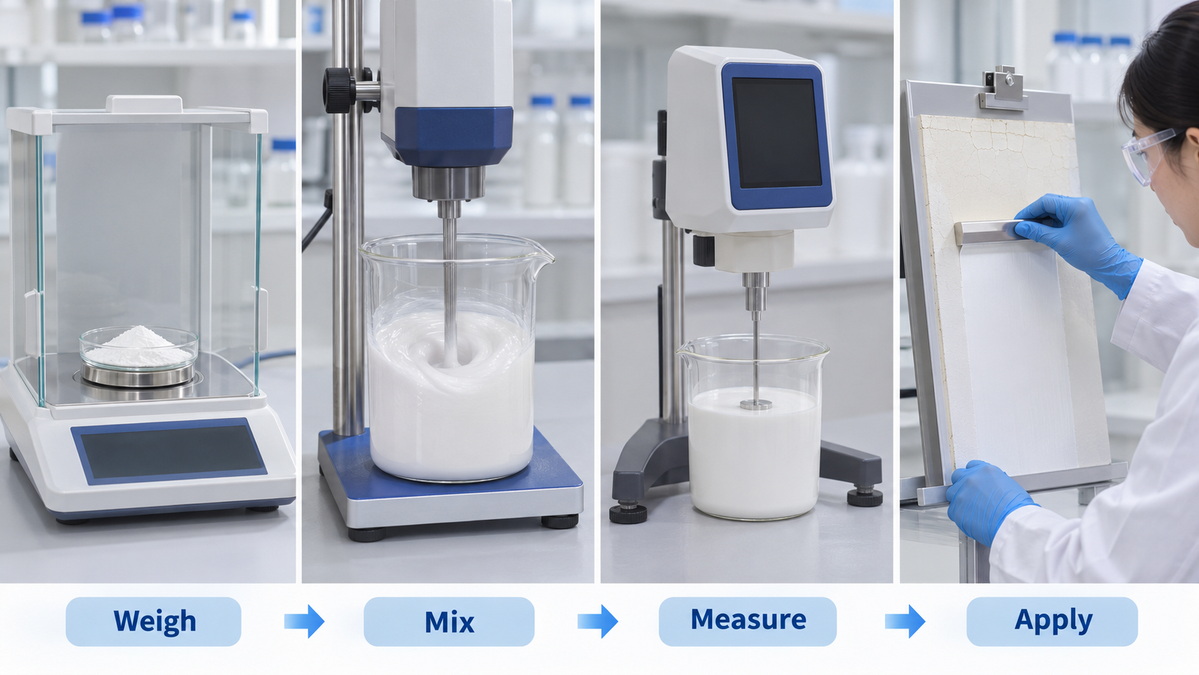
| Observed problem | Possible contributors | First investigation |
|---|---|---|
| Viscosity increases after filling | Incomplete hydration or formulation equilibration | Compare hydration endpoint and next-day viscosity |
| Viscosity decreases during storage | Microbial or enzymatic activity; formulation instability | Check microbiology, pH, temperature, and dispersion condition |
| Hard settling despite acceptable KU | Insufficient suspension structure or pigment instability | Examine low-shear behavior and pigment dispersion |
| Heavy roller drag | Excessive structure or unsuitable rheological balance | Compare flow behavior and controlled application |
| Poor leveling | Excessive structure recovery or rapid water loss | Evaluate film thickness, substrate, and drying conditions |
| Warm-storage inconsistency | Temperature-sensitive interactions or polymer behavior | Compare warm and cooled samples under controlled conditions |
These are diagnostic starting points, not definitive failure assignments.
A supplier's "high-viscosity HEC" and another supplier's "high-viscosity HPMC" may have been measured at different concentrations, temperatures, or instrument settings.
Request:
- Solution concentration and preparation procedure.
- Instrument, spindle, and rotational speed.
- Measurement temperature.
- Hydration and conditioning time.
- Whether the value is typical or a guaranteed specification.
Without this information, a numerical comparison can be misleading.
The cheapest price per kilogram may not deliver the lowest formulated cost.
Compare dosage, hydration time, energy demand, defoamer adjustment, rejected batches, and application performance.
A candidate that requires additional processing or compromises film appearance may be less economical despite a lower purchase price.
For a conventional waterborne architectural paint, HEC is a sensible initial reference because of its established coatings use and the availability of application-specific grades.
HPMC should be evaluated when a particular grade offers a relevant formulation advantage—not selected simply because it performs well in another construction application.
Shandong Shengda New Material Co., Ltd. focuses on HEC, HPMC, and related cellulose ether solutions for construction and daily chemical applications.
Contact Shandong Shengda with your binder type, target consistency, current dosage, manufacturing process, storage conditions, and observed defects. Request grade-specific technical information and samples for a controlled comparison.
For sustainability-related purchasing requirements, request supporting documentation rather than assuming that cellulose origin alone proves a lower-impact finished paint.
HEC is generally the more established starting point for conventional architectural latex paint. The better choice still depends on grade, formulation, processing, storage, and application results.
Not reliably. Compare dosage ladders and match finished-paint performance. Equal dosage or equal supplier-reported solution viscosity does not guarantee equivalent rheology.
No. Improved resistance to enzymatic degradation does not prevent all microbial contamination. Finished-paint preservation must be validated separately.
Incomplete cellulose ether hydration or other formulation equilibration may contribute. Check mixing, temperature, hydration time, and measurement conditions before adjusting dosage.
They can be considered in a screening program, but useful synergy should not be assumed. Verify hydration, temperature response, storage stability, and application behavior experimentally.
No. Water retention is only one performance variable. A successful paint must also balance leveling, sag resistance, drying, film appearance, and usability.
1. Ashland. *Architectural Paints.* Manufacturer overview of HEC, enzyme-resistant HEC, fluidized HEC suspensions, and hydrophobically modified HEC for architectural coatings. [ashland]
2. Ashland. *Natrosol™ B Hydroxyethylcellulose.* Product information covering enzyme resistance, incorporation treatment, and architectural-paint application properties. [ashland]
3. Ashland. *Natrosol Performax™ Hydroxyethylcellulose.* Manufacturer information on dispersion, process flexibility, thickening, stability, and distinctions among commercial HEC technologies. [ashland]
4. Ashland. *Natrosol™ 250 Hydroxyethylcellulose: Formulating Elegant Liquid and Semisolid Drug Products.* Technical discussion of aqueous HEC thermal behavior and enzymatic degradation. Used for polymer properties, not paint-performance claims. [ashland]
5. Dow. *CELLOSIZE™ Texture F4M Hydroxypropyl Methylcellulose—Technical Data Sheet.* Grade-specific guidance on dispersion, incomplete wetting, hot/cold preparation, and hydration. Used for processing principles, not as a latex-paint recommendation. [dow]
6. Dow. *Controlling the Application Performance of Cement Renders With Cellulose Ethers.* Technical explanation of substitution-dependent thermal gelation in HPMC and related ethers. Cement-render results are not presented here as latex-paint results. [dow]
7. Dow. *ACRYSOL™ Rheology Modifiers—Product Solutions Guide.* Coatings rheology guidance, including the role of low-shear viscosity measurements. [dow]
8. Dow. *WALOCEL™ XCS 41442.00 Cellulose Ether—Technical Data Sheet.* Example of explicitly defined solution concentration, instrument conditions, temperature, and the distinction between typical values and specifications. [dow]


