


close
Choose Your Site
Global
Social Media
Views: 222 Author: Shengda Publish Time: 2026-05-20 Origin: Site


As a manufacturer specializing in cellulose ether solutions for over two decades, I've witnessed firsthand how HPMC (Hydroxypropyl Methyl Cellulose) viscosity selection can make or break tile adhesive performance—particularly when it comes to achieving optimal open time in C1 and C2 formulations. The critical difference between these two classifications isn't just about bonding strength; it's fundamentally about how cellulose ether additives interact with cement matrices to deliver workability, adjustability, and long-term adhesion performance in vastly different application environments. [linkedin]
According to European Standard EN 12004 and its global equivalent ISO 13007-1, tile adhesives are classified primarily by their tensile adhesion strength. C1 adhesives represent the baseline category with a minimum tensile adhesion strength of ≥0.5 N/mm² (0.5 MPa), suitable for standard ceramic tiles on stable substrates in residential applications. These formulations work effectively for tiles up to 30×30 cm on interior walls and floors where structural movement and environmental stress remain minimal. [linkedin]
C2 adhesives, classified as "improved" or "high-performance" formulations, require double the bonding strength at ≥1.0 N/mm² (1.0 MPa). This enhanced performance makes C2 adhesives mandatory for porcelain tiles larger than 30×30 cm, exterior applications, high-traffic commercial areas, installations over underfloor heating systems, and challenging substrates including existing tiles. The performance gap extends beyond mere adhesion numbers—C2 formulations must maintain structural integrity under heat aging, water immersion, freeze-thaw cycling, and extended open time conditions. [youtube]

| Performance Parameter | C1 (Normal) | C2 (Improved) |
|---|---|---|
| Minimum Tensile Adhesion | ≥0.5 MPa | ≥1.0 MPa |
| Maximum Tile Size (Standard) | 30×30 cm | 60×60 cm |
| Polymer Modification Level | Standard | Enhanced |
| Typical Applications | Interior walls/floors, ceramic tiles | Large format tiles, porcelain, exteriors |
| Open Time Requirement | ≥20 minutes | ≥20 minutes (with higher demands) |
| Substrate Versatility | Limited to stable surfaces | Includes drywall, old tiles, waterproofing |
Both classifications must meet the minimum open time requirement of 20 minutes with maintained adhesion strength ≥0.5 MPa, though practical formulations—especially C2—often target 30-40 minutes to accommodate large-format tile installations and professional workflow demands. [celotech]
Hydroxypropyl Methyl Cellulose acts as a multifunctional modifier in tile adhesive formulations, creating a hydrogen bond network with cement particles through hydroxyl groups on its molecular chain. This three-dimensional gel structure fundamentally controls water retention, rheology, open time, and interfacial adhesion. When HPMC dissolves in the mixing water, it forms a protective film around cement particles that retards water evaporation while maintaining the wet state necessary for continued cement hydration and tile adjustability. [kimacellulose]
Research demonstrates that increasing HPMC content from 0.1% to 0.3% can increase the thixotropic index by 47% and extend open time by 300%. However, this relationship isn't linear—excessive dosing creates viscosity mutation, poor workability, and delayed setting that compromises early strength development. The optimal dosage window for tile adhesives typically ranges from 0.2% to 0.5% of the total dry mix, with C1 formulations generally using 0.25-0.35% and C2 formulations requiring 0.35-0.45% depending on environmental conditions and substrate characteristics. [celotech]
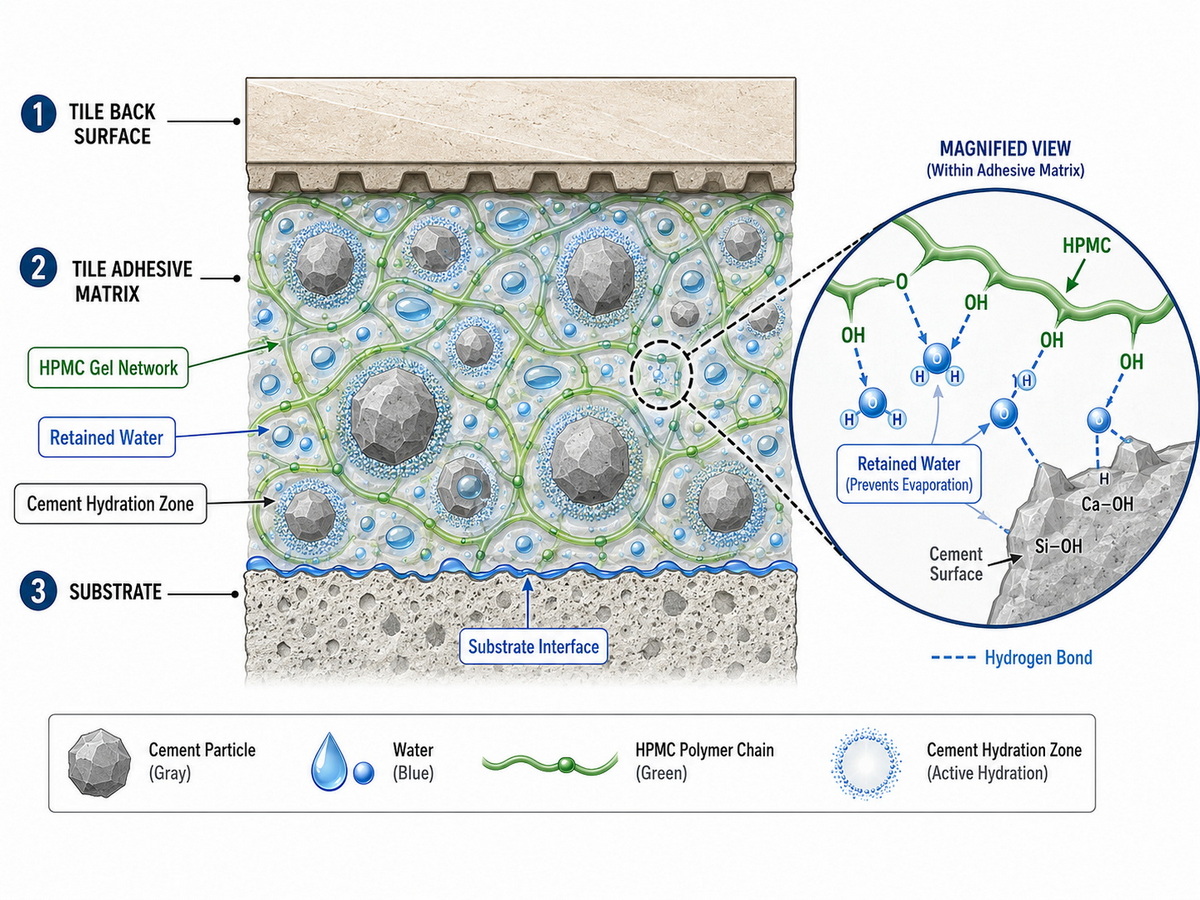
Open time—the critical window during which tiles can be placed with full adhesion after adhesive application—represents one of the most challenging parameters to optimize. HPMC extends open time by delaying surface skinning (the formation of a dry surface film that prevents tile bonding) through superior water retention that maintains the adhesive's wet state for 30-40 minutes after troweling. This extended workability proves essential for large-format tiles (≥60×60 cm) where precise placement and adjustment require additional time before achieving final positioning. [mapei]
In our formulation work at Shandong Shengda New Material, we've observed that water retention rates directly correlate with open time performance: at 0.2% HPMC dosage, water retention reaches only 65% in standard conditions (25℃/50% RH), whereas increasing to 0.4% dosage elevates water retention to 92% and cement hydration degree by 35%. This dramatic improvement translates to open times extending from as little as 3-5 minutes to 8-12 minutes—a 160% increase in working window. [linkedin]
HPMC viscosity, measured in mPa·s (milliPascal-seconds) using Brookfield or NDJ methods at 2% solution concentration at 20°C, serves as the primary specification parameter for cellulose ethers. Common viscosity ranges for tile adhesive applications include low (15,000-40,000 mPa·s), medium (40,000-80,000 mPa·s), and high (80,000-150,000 mPa·s) grades. Each viscosity range delivers distinct performance characteristics that must align with the adhesive classification and application requirements. [celixhpmc]
Higher viscosity HPMC provides enhanced sag resistance (critical for vertical wall applications), improved anti-slip properties, and stronger thickening effects that create a more robust body during troweling. However, excessive viscosity can compromise spreadability, mixing efficiency, and workability, creating a heavy, difficult-to-trowel paste that slows installation productivity. Conversely, lower viscosity grades deliver smoother application, better leveling, and easier mixing, but may lack the structural integrity needed for vertical installations or thick-bed applications. [sjzacchem]
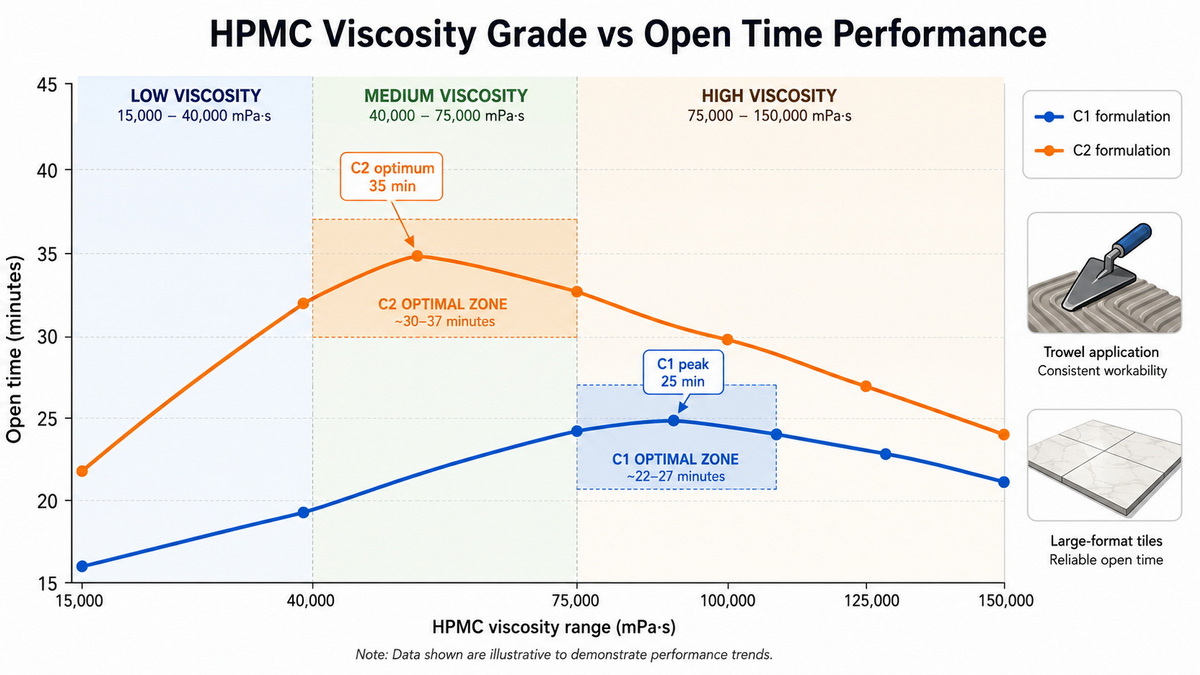
For C1 formulations targeting general-purpose residential applications, the viscosity strategy prioritizes balanced workability with cost-effective performance. Our recommended approach employs mid-to-high viscosity HPMC (60,000-100,000 mPa·s) at dosages between 0.25-0.35%. This combination delivers: [youtube]
- Reliable water retention (85-90%) preventing premature skinning
- Stable trowelability with moderate body and smooth spreading
- Standard open time (20-25 minutes) adequate for tiles up to 30×30 cm
- Adequate sag resistance for wall applications with standard ceramic tiles
The higher viscosity compensates for lower polymer modification levels in C1 formulations, providing structural support through cellulose networking rather than requiring expensive redispersible polymer powder (RDP) at elevated dosages. In our testing with Shandong Shengda's HPMC grades ranging from 400 to 200,000 CPS, we've found that C1 adhesives perform optimally with viscosities in the 75,000-100,000 mPa·s range. [linkedin]
C2 formulations demand a more sophisticated viscosity approach because they must deliver enhanced open time, superior bonding, and excellent anti-sag properties simultaneously. Contrary to intuition, many high-performance C2 adhesives utilize medium-to-low viscosity HPMC (40,000-75,000 mPa·s) combined with surface-modified cellulose ethers and higher RDP content. [youtube]
This strategy works because C2 formulations achieve structural integrity primarily through polymer modification (typically 2-3% RDP) rather than cellulose viscosity alone. The medium-viscosity HPMC serves distinct functions: [celotech]
- Enhanced open time extension (30-40 minutes) through optimized water retention without over-thickening
- Superior thixotropy (shear-thinning behavior) that provides smooth troweling yet excellent stand-up on vertical surfaces
- Improved polymer-cement compatibility allowing higher RDP dosages without viscosity mutation
- Better penetration and wetting of large-format tile backs and substrate surfaces
When formulating C2 adhesives for demanding applications—exterior facades, large porcelain slabs, installations over underfloor heating—we recommend anti-sagging modified HPMC grades (like surface-treated variants) at 0.35-0.45% dosage. These specialized grades deliver superior performance through structural modification rather than simple viscosity increase, preventing the workability issues that plague over-thickened formulations. [derekchem]
Climate conditions dramatically impact HPMC performance requirements. In high-temperature environments (>30°C), increase HPMC dosage by 0.05-0.1% to compensate for accelerated evaporation that shortens open time. Conversely, in low-temperature conditions (<15°C), reduce dosage by 0.03-0.05% to prevent excessive setting delay that compromises early strength development and installation productivity. [linkedin]
Substrate characteristics equally influence optimal HPMC selection: [sjzacchem]
- High water-absorption substrates (concrete blocks, aerated concrete): Use 0.35-0.45% HPMC with higher water retention to prevent adhesive dehydration
- Low-absorption surfaces (vitrified tiles, existing glazed ceramics): Optimize at 0.25-0.3% HPMC to maintain interface continuity without excessive film thickness
- Drywall and gypsum-based surfaces: Require C1 minimum with 0.3-0.35% HPMC for adequate bonding and moisture control [wacker]
HPMC never works in isolation—optimal tile adhesive performance requires carefully balanced interaction with redispersible polymer powder (RDP), cement type, aggregate gradation, and other additives. A critical formulation rule: reduce HPMC dosage by 0.02% for every 1% increase in RDP to prevent viscosity mutation and maintain workable consistency. This inverse relationship ensures that total polymer content (cellulose ether + latex polymer) remains within the processing window for good trowelability. [celotech]
For C2 formulations targeting EN 12004 compliance, a typical balanced approach includes: [celotech]
- RDP (Redispersible Polymer Powder): 1.5-3.0% for flexibility and enhanced bonding
- HPMC (Medium-viscosity modified grade): 0.25-0.45% for water retention and open time
- Portland Cement (42.5 or 52.5 grade): 20-30% as primary binder
- Graded silica sand/aggregates: 60-70% for structural matrix
- Additional modifiers: Defoamers, wetting agents, accelerators/retarders as needed
A documented 2024 metropolitan subway station project provides a cautionary tale about inadequate HPMC dosing. The contractor's formulation included 0.07% less HPMC than specification in their C2 tile adhesive, creating a cascade of failures: [linkedin]
- Open time collapsed to 9 minutes (standard requirement: ≥20 minutes)
- Tile hollowing (delamination) rate reached 18% (acceptable maximum: ≤5%)
- Project delays and costly remediation requiring tile removal and reinstallation
This real-world failure underscores a fundamental principle: open time isn't negotiable—it represents the minimum working window that installation professionals require to achieve proper tile placement, adjustment, and full back-coverage bonding. Cutting corners on cellulose ether dosage to reduce material costs creates exponentially higher expenses through installation failures and warranty claims. [celotech]
The remediation involved reformulating with properly dosed HPMC (0.4% of a 75,000 mPa·s grade) combined with quality-controlled RDP at 2.5%. Results demonstrated: [linkedin]
- Open time extended to 32 minutes providing adequate working window
- Hollowing rate reduced to <2% exceeding specification requirements
- Installation productivity improved by 40% due to extended adjustment time
- Long-term adhesion testing showed excellent performance under accelerated aging
This case validates our formulation philosophy at Shandong Shengda New Material: investing in premium-quality cellulose ethers with consistent viscosity, substitution degree, and water retention properties delivers far better value than attempting cost reduction through under-dosing or inferior materials. [linkedin]
The distinction between C1 and C2 tile adhesives extends far beyond simple adhesion strength specifications—it fundamentally reflects different performance philosophies, application demands, and formulation strategies. HPMC viscosity selection serves as the cornerstone of open time optimization, but success requires understanding that viscosity must be matched to the complete formulation system, including polymer modification level, environmental conditions, substrate characteristics, and tile specifications. [kimachemical]
For C1 formulations, mid-to-high viscosity HPMC (60,000-100,000 mPa·s) at 0.25-0.35% dosage delivers cost-effective performance for standard residential applications. For C2 high-performance adhesives, medium-viscosity modified grades (40,000-75,000 mPa·s) at 0.35-0.45% dosage, combined with elevated RDP content, achieve the extended open time (30-40 minutes) and superior bonding required for demanding commercial and exterior installations. [linkedin]
At Shandong Shengda New Material Co., Ltd., our two decades of cellulose ether research and manufacturing experience have proven that consistent quality—in viscosity stability, substitution degree, and water retention capacity—matters more than any single specification parameter. As global construction standards evolve toward larger tile formats, more challenging substrates, and stringent performance requirements, intelligent HPMC selection becomes not just a technical consideration but a competitive necessity for adhesive manufacturers seeking to deliver reliable, high-performing products. [linkedin]
Ready to optimize your tile adhesive formulations with precisely engineered HPMC solutions? Contact Shandong Shengda New Material's technical team for customized cellulose ether recommendations tailored to your specific C1 or C2 performance targets, substrate requirements, and regional climate conditions. Our comprehensive viscosity range (400-200,000 CPS) and applications support ensure you achieve optimal open time, workability, and long-term adhesion performance.
While technically possible, it's not recommended for optimal performance. C1 formulations typically benefit from higher viscosity HPMC (75,000-100,000 mPa·s) to provide structural support with lower polymer modification, whereas C2 formulations perform better with medium-viscosity modified grades (40,000-75,000 mPa·s) that complement higher RDP content. Using the same grade may require significant dosage adjustments and compromise either workability or performance characteristics. [youtube]
HPMC particle size distribution significantly impacts dissolution rate and water retention kinetics. Coarser particles (retained on 100-mesh screen) dissolve more slowly, creating a gradual release of thickening effect that extends open time by preventing rapid surface skinning. Finer particles provide immediate thickening but may create surface film formation that paradoxically shortens effective working time. Optimal formulations balance particle size distribution to achieve both rapid mixing and extended workability. [celotech]
EN 12004 mandates minimum 20 minutes open time with maintained tensile adhesion ≥0.5 MPa for both C1 and C2 classifications. However, practical large-format tile installation (60×60 cm or larger) often requires 30-40 minutes to allow for precise placement, leveling, and adjustment. Professional contractors typically specify formulations exceeding minimum standards by 50-100% to account for environmental variations and workflow requirements. [mapei]
Increasing HPMC dosage provides diminishing returns and can create performance problems beyond optimal ranges. Research shows that water retention increases from 65% to 92% when dosage rises from 0.2% to 0.4%, but further increases beyond 0.5% create excessive viscosity, poor workability, delayed setting, and reduced early strength. The relationship isn't linear—optimal dosage represents a balance between water retention benefits and processing limitations. [linkedin]
For high-temperature environments (>30°C), increase HPMC dosage by 0.05-0.1% and consider shifting to slightly higher viscosity grades (adding 10,000-20,000 mPa·s) to compensate for accelerated evaporation. For low-temperature conditions (<15°C), reduce dosage by 0.03-0.05% and potentially use lower viscosity grades to prevent excessive setting retardation that delays strength development. Additionally, surface-modified HPMC grades provide more stable performance across temperature ranges than standard grades through improved polymer-cement compatibility. [derekchem]
1. Shandong Shengda New Material Co., Ltd. Company Profile - LinkedIn. https://www.linkedin.com/company/shandongshengda
2. European Standard EN 12004: Adhesives for Ceramic Tiles - Wacker Chemical.
https://www.wacker.com/cms/en-us/products/insights/tile-adhesives-standards.html
3. Why Different Tile Adhesive Solutions Matter: C1, C2, S1, S2 - LinkedIn.
https://www.linkedin.com/pulse/why-different-tile-adhesive-solutions-matter-c1-c2-s1-dskxf
4. Understanding Tile Adhesives and Related Standards EN 12004 - Mapei.
5. European Standards for Tile Adhesives EN 12004 - Northern Builder.
https://northernbuilder.co.uk/a-masterclass-in-european-standards-for-tile-adhesives-en-12004/
6. How HPMC Enhances Tile Adhesive Bond Strength - Celotech Guide.
https://www.celotech.com/discussions/hpmc-tile-adhesive-bonding-performance/
7. The Role of HPMC in Tile Adhesives - KIMA Chemical.
https://www.kimacellulose.com/the-role-of-hpmc-in-tile-adhesives.html
8. RDP and HPMC for Tile Adhesives - Best Additives for C2 Mortars - Celotech. https://www.celotech.com/discussions/redispersible-polymer-powder-cellulose-ether-the-perfect-pair-for-tile-adhesives/


