


close
Choose Your Site
Global
Social Media
Views: 222 Author: Shengda Publish Time: 2026-05-21 Origin: Site


Autoclaved aerated concrete (AAC) is a highly absorbent substrate, which makes water management in mortars and plasters a central performance challenge. Cellulose ethers such as Hydroxyethyl Methyl Cellulose (HEMC) and Hydroxypropyl Methyl Cellulose (HPMC) are now standard additives in AAC block systems because they improve water retention, workability, and long‑term durability. [sa.hecmanufacturer]
From the perspective of Shandong Shengda New Material Co., Ltd. – a China‑based cellulose ether manufacturer with a full range of construction‑grade HEMC and HPMC – the key question is no longer "*whether* to use cellulose ether in AAC mix designs," but how to engineer the right HEMC/HPMC profile to control water absorption without sacrificing productivity on site. [sdshengda.en.made-in-china]
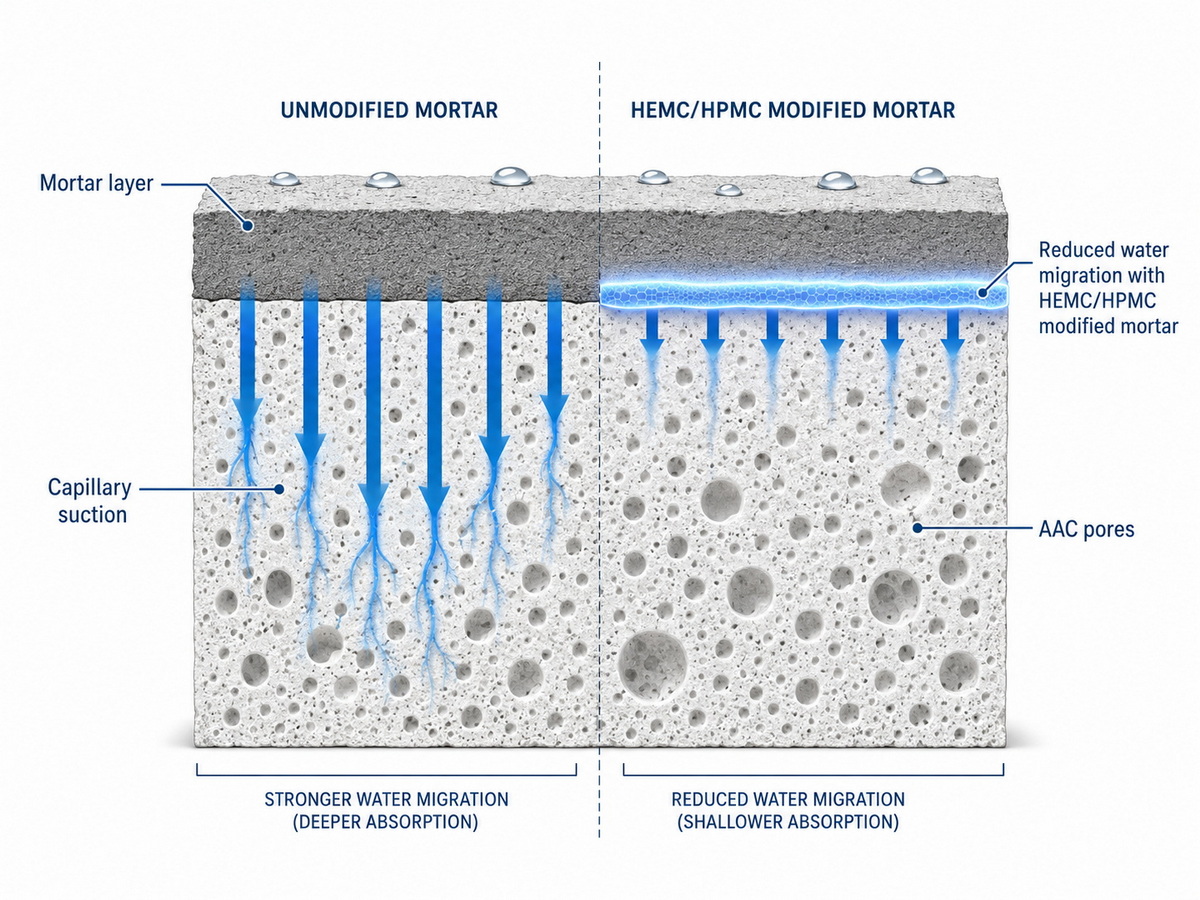
AAC is lightweight, porous, and capillary‑active, which brings both thermal benefits and moisture risks. Its micro‑cellular structure absorbs water quickly from fresh mortar, which can lead to poor hydration, weak bonding, and increased surface cracking if not controlled. [semanticscholar]
Key AAC substrate characteristics:
- High open porosity that drives rapid suction of mix water from mortars and adhesives. [semanticscholar]
- Large internal surface area, increasing capillary rise and potential water migration. [semanticscholar]
- High vapor permeability, which is beneficial for drying but risky if early‑age curing is poor. [semanticscholar]
In practice, this means that unmodified mortars on AAC blocks tend to lose water too fast, especially in hot or windy conditions, resulting in reduced strength and higher effective water absorption of the wall system. [sa.hecmanufacturer]
Both HEMC and HPMC are non‑ionic cellulose ethers that act as water‑retention agents, thickeners, and workability modifiers in cement‑based and gypsum‑based mixes. At the micro level, their hydrophilic groups form hydrogen bonds with water molecules and create a thin polymer film around cement particles, slowing down water loss and making hydration more uniform. [kimacellulose]
Core functions in AAC mortars and plasters:
- Water retention: Slows water migration into the AAC block and reduces evaporation, stabilizing the local water‑cement ratio. [kimacellulose]
- Rheology control: Provides lubricating film between particles, improving workability and sag resistance. [sciencedirect]
- Air entrainment (type & dosage dependent): Can introduce micro‑air, affecting pore size distribution, density, and thermal properties. [sciencedirect]
- Crack reduction: By keeping the surface moist longer, they reduce plastic shrinkage and early surface cracking. [celotech]
For AAC, the primary benefit is controlling water absorption at the interface so that the mortar neither dries out too quickly nor remains too wet, both of which can reduce bond strength and durability. [sa.hecmanufacturer]
- HPMC contains methoxy and hydroxypropyl groups, which provide excellent thickening, adhesion, and water retention. [celotech]
- HEMC contains methoxy and hydroxyethyl groups, making it more hydrophilic and typically more thermally stable than HPMC. [tenessy]
This structural difference is important in AAC systems because hydrophilicity and thermal stability directly influence water retention over time and at elevated temperatures. [celotech]
One of the most critical parameters in AAC block projects – especially in hot climates – is the gel temperature of the cellulose ether:
- HPMC: typical gel temperature around 60–75°C. [youtube]
- HEMC: typical gel temperature around 75–90°C, significantly higher. [youtube]
At high ambient temperatures, a lower gel temperature means the cellulose ether can partially lose its water‑retention function earlier, leading to faster loss of water retention and quicker curing of the mortar. This is why HEMC usually maintains better water retention in high‑temperature AAC applications, helping to reduce effective water absorption of the wall over time. [youtube]
Studies and industrial experience indicate that HEMC tends to be more water‑soluble and disperses more easily, while HPMC is strongly soluble in cold water and highly effective as a thickener. For dry‑mix AAC mortars, fast and uniform dispersion is critical to ensuring consistent water retention across the batch. [hpmc]
| Property / Criterion | HEMC in AAC Mortars | HPMC in AAC Mortars |
|---|---|---|
| Main functional groups | Methoxy + hydroxyethyl groups celotech | Methoxy + hydroxypropyl groups celotech |
| Gel temperature | Higher (approx. 75–90°C), better at high temperatures youtube | Lower (approx. 60–75°C), more sensitive to heat youtube |
| Water retention at high temperature | Very strong, maintains performance in hot climates youtube | Strong at moderate temperatures, may decline in heat youtube |
| Water retention at mild climate | Strong and stable kimacellulose | Excellent, widely used baseline choice kimacellulose |
| Solubility / dispersion | High water solubility, smooth consistency tenessy | Excellent cold‑water solubility, strong thickening tenessy |
| Effect on rheology | Smooth, creamy feel, good workability tenessy | Strong thickening, very good adhesion and body kimacellulose |
| Influence on pore structure | Can increase macro pores at high dosage if air not controlled sciencedirect | Also modifies pore structure but often with tighter control in standard ranges kimacellulose |
| AAC substrate suitability | Excellent for high‑temperature or highly absorbent AAC applications botaichem | Excellent for standard AAC applications with proper pre‑wetting and viscosity selection sa.hecmanufacturer |
In summary, HPMC remains a robust "default" choice for AAC block mortars, especially in moderate climates and when proper pre‑wetting of blocks is followed. HEMC becomes strategically advantageous where high temperatures or extended open times are expected, because it maintains water retention more reliably, which directly lowers the effective water uptake of AAC assemblies. [botaichem]
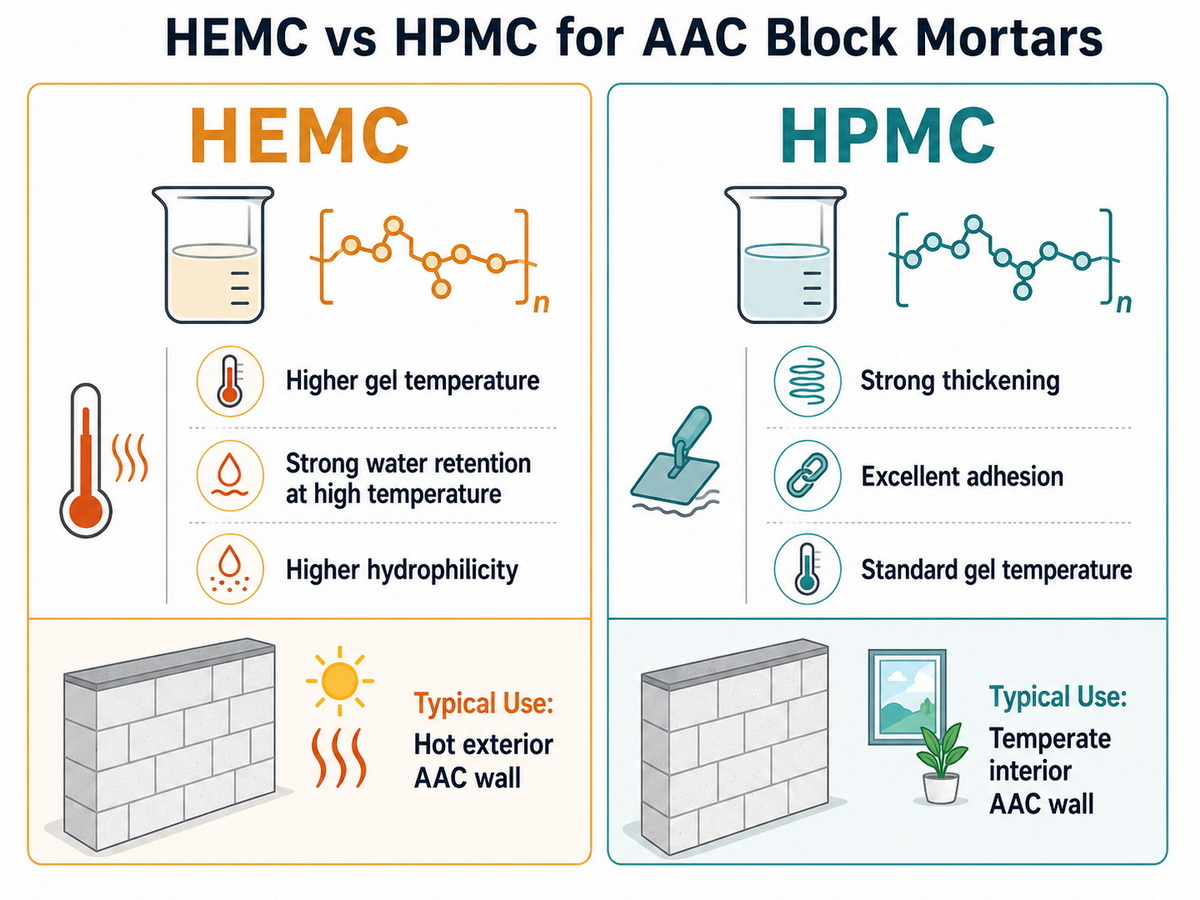
Beyond the chemistry of HEMC and HPMC, execution on site is crucial. Field trials and industry guidelines highlight several practical strategies. [botaichem]
1. Pre‑wet AAC blocks
Lightly pre‑wet highly absorbent AAC to reduce initial suction, especially when using HPMC‑based mortars. [sa.hecmanufacturer]
2. Use adequate viscosity grade
For AAC substrates, recommendations often start from ≥ 100,000 mPa·s HPMC to achieve strong water retention and cohesive mix behavior. [shandong.made-in-china]
3. Combine with optimized HEMC grades in hot climates
In high‑temperature regions or summer construction, shifting all or part of the cellulose ether package to HEMC can maintain water retention, reduce premature setting, and lower effective water absorption. [botaichem]
4. Control air content
Both HEMC and HPMC can increase macro‑pore content if dosed improperly, which affects density and moisture paths. Use lab testing to balance water retention with controlled air entrainment. [sciencedirect]
5. Tailor to the entire system
Consider compatibility with polymer powders, gypsum or cement binder type, and local sand grading rather than treating cellulose ether selection in isolation. [sciencedirect]
From an industry expert perspective, the real value is not in a single product, but in the ability to fine‑tune cellulose ether chemistry for specific AAC systems. Shandong Shengda New Material Co., Ltd., established in 2003, operates one of the more advanced cellulose ether product lines, covering a wide viscosity range for construction and daily‑chemical applications. [linkedin]
When supporting AAC block producers and dry‑mix mortar brands, a typical technical workflow includes:
- Substrate characterization: Measuring AAC density, open porosity, and suction rate to predict water absorption behavior.
- Binder system analysis: Cement vs. gypsum or hybrid systems, presence of redispersible polymer powder (RDP), and other additives. [linkedin]
- Climate mapping: Designing one cellulose ether profile for temperate regions and another for hot, dry or tropical zones, often increasing HEMC share in hotter markets. [linkedin]
- Lab screening: Testing several HEMC/HPMC viscosity grades and ratios to optimize water retention, slip resistance, and early‑age adhesion.
- Field validation: Monitoring crack development, bonding, and water absorption over time on real walls, then refining the formulation.
This data‑driven approach allows manufacturers to recommend, for example, HEMC‑rich formulations for high‑temperature AAC facades and HPMC‑dominant blends for interior AAC blockwork in temperate climates, all while maintaining compliance with local standards. [kimacellulose]
Drawing on published studies and industry practice, we can summarize scenario‑based guidance for AAC applications. [kimacellulose]
- High ambient temperature or strong solar radiation (summer projects, desert or tropical climates). [youtube]
- AAC facades where long open time and consistent water retention across the day are critical.
- Projects where repeated wetting and drying cycles demand more stable water retention behavior over a wide temperature range. [sciencedirect]
In these situations, HEMC's higher gel temperature and hydrophilicity help maintain water retention, slowing water migration into AAC and reducing long‑term water uptake of the wall system. [celotech]
- Moderate climates with controlled application conditions, such as interior AAC partitions or temperate regions. [sa.hecmanufacturer]
- Applications where maximum thickening and adhesion are primary goals – for example, AAC tile adhesives and basecoats requiring strong "body" and sag resistance. [tenessy]
- Formulations where cost and availability favor HPMC as a well‑understood, widely used standard. [kimacellulose]
Here, HPMC‑based systems, especially at higher viscosity grades and with proper pre‑wetting, can deliver excellent water retention and reduced water absorption at the AAC interface. [botaichem]
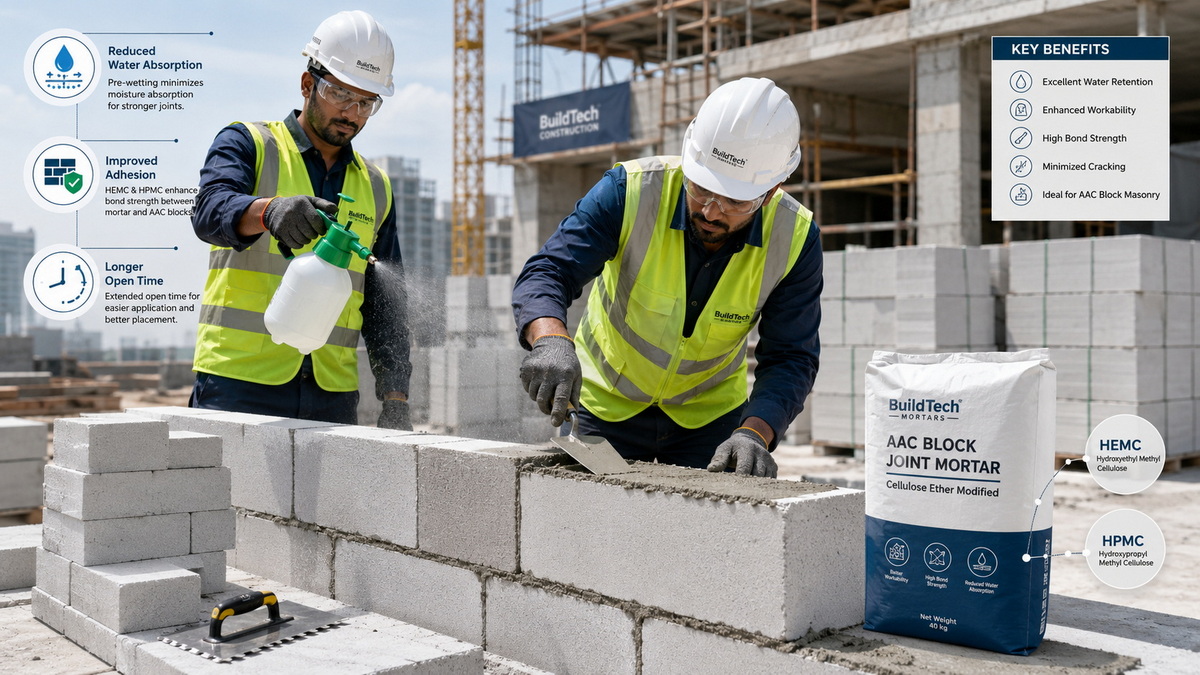
From a user‑experience standpoint, specifiers and formulation chemists need simple decision logic rather than purely chemical descriptions. Below is a concise framework you can apply when choosing between HEMC, HPMC, or a combination for AAC applications.
1. Define climate and exposure
- Hot, sunny, or windy exterior AAC: favor HEMC‑rich or high‑gel‑temperature cellulose ether package.
- Moderate, interior AAC: HPMC can be the main cellulose ether, possibly with minor HEMC adjustment.
2. Evaluate AAC absorption and pre‑wetting practice
- Very high suction AAC + limited pre‑wetting: prioritize strong water retention (high‑viscosity HPMC plus/or HEMC). [sa.hecmanufacturer]
- Well‑controlled pre‑wetting: more flexibility; can optimize for workability and finish.
3. Set performance priorities
- If reduced long‑term water absorption and durability are top priorities, consider higher HEMC content, especially on exterior walls. [youtube]
- If thick, highly adhesive mortar is the key, prioritize high‑viscosity HPMC and tune open time with co‑additives. [tenessy]
4. Verify with lab and field tests
- Measure water retention, open time, adhesive strength, and capillary water absorption according to relevant standards.
- Confirm that air content and pore structure remain in the desired range to avoid excessive macro‑porosity in the hardened mortar. [sciencedirect]
Shandong Shengda's technical service team typically supports this process by recommending specific product grades and blends mapped to local AAC characteristics and climate zones, helping you minimize water absorption while keeping application predictable on site. [sdshengda.en.made-in-china]
For AAC block systems, both HEMC and HPMC are powerful levers for reducing water absorption and improving durability, but they are not interchangeable. HPMC offers excellent water retention, adhesion, and thickening under standard conditions, while HEMC delivers superior stability and water retention in high‑temperature or highly demanding AAC environments. [tenessy]
If you are developing or optimizing AAC mortars, plasters, or adhesives, it is essential to align your cellulose ether choice with AAC substrate behavior, climate conditions, and performance targets rather than relying on generic formulations. [sciencedirect]
Call to action:
If you want to reduce water absorption in your AAC walls while keeping application simple for your crews, consider partnering with Shandong Shengda New Material Co., Ltd. to design a tailored HEMC/HPMC solution and arrange lab testing for your specific AAC products and climate conditions. [sdshengda.en.made-in-china]
AAC's high porosity causes it to absorb water rapidly from fresh mortars, which can weaken bonding and increase cracking; cellulose ethers slow this water loss and stabilize hydration. [semanticscholar]
No. HEMC generally performs better at high temperatures and in very demanding conditions, while HPMC is extremely effective in moderate climates and standard AAC applications with proper pre‑wetting. [celotech]
Yes. Many advanced formulations use a blend of HEMC and HPMC to balance water retention, workability, open time, and cost, especially when targeting multiple climate zones. [botaichem]
Higher cellulose ether content generally improves water retention and reduces early water loss into AAC, but excessive dosage can increase macro‑pores and air content, which must be controlled through testing. [sciencedirect]
A frequent issue is insufficient pre‑wetting of AAC blocks in hot, dry conditions, which can overpower even high‑viscosity HPMC and lead to excessive suction and poor adhesion. [sa.hecmanufacturer](https://sa.hecmanufacturer.com/news/industry-news/what-is-hydroxypropyl-methyl-cellulose-hpmc-in-construction.html)
1.Tenessy. "HPMC vs HEMC Which is Better for Your Project". Available at: https://tenessy.com/hpmc-vs-hemc-which-is-better-for-your-project.tenessy
2.Maha Asia. "Cellulose Ether A Key Ingredient for Construction". Available at: https://www.maha.asia/blog/surface-technology-5/quava-tm-one-stop-cellulose-ether-solution-for-construction-materials-222.maha
3.Kima Chemical. "Effect of HPMC and HEMC on Cement Hydration". Available at: https://www.kimacellulose.com/effect-of-hpmc-and-hemc-on-cement-hydration.html.kimacellulose
4.Celotech. "The Difference of Physical and Chemical Properties and Application of HPMC and HEMC in the Construction Industry". Available at: https://www.celotech.com/technology/the-difference-of-physical-and-chemical-properties-and-application-of-hpmc-and-hemc-in-the-construction-industry/.celotech
5.ScienceDirect. "Pore Structure of Mortars with Cellulose Ether Additions". Available at: https://www.sciencedirect.com/science/article/abs/pii/S0958946515000864.sciencedirect


