


close
Choose Your Site
Global
Social Media
Views: 222 Author: Shengda Publish Time: 2026-06-20 Origin: Site


Content Menu
● Understanding Efflorescence on Marble
● Why Cellulose Ethers Matter in Stone Adhesives
● Technical Overview: HPMC vs HEMC in Cement Systems
>> HPMC: Properties Relevant to Stone Adhesives
>> HEMC: Properties Relevant to Stone Adhesives
● Key Performance Comparison for Marble Stone Adhesives
>> HPMC vs HEMC: Practical Formulation Comparison
● How HPMC Helps Prevent Efflorescence on Marble
● Where HEMC Excels – And Its Role in Efflorescence Control
● Expert Formulation Strategies to Reduce Efflorescence
● Case‑Style Scenario: HPMC vs HEMC in a Marble Lobby Project
● Practical Selection Guide: When to Choose HPMC or HEMC
● How a Specialized Supplier Adds Value
● Call to Action: Optimize Your Marble Adhesive Formulations
● FAQ: HPMC vs HEMC in Stone Adhesives
In high‑end marble installation, the choice between HPMC and HEMC inside your stone adhesive can make the difference between a flawless, luxury surface and an efflorescence‑stained complaint job. As a cellulose ether manufacturer working directly with global tile adhesive and stone adhesive producers, we see every day how polymer design at the additive level translates into visible performance on the marble surface. [kemoxcellulose]
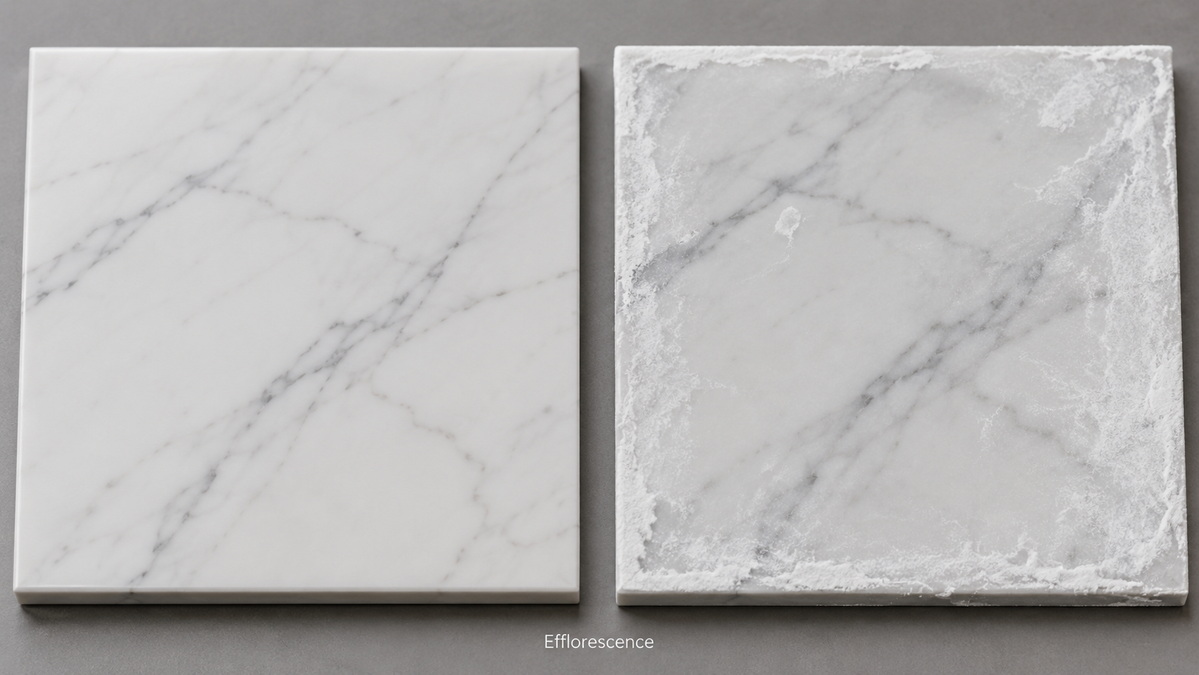
Efflorescence is the white, powdery or cloudy salt deposit that appears on marble or other natural stone surfaces when soluble salts migrate with water to the surface and crystallize as the water evaporates. [zh.wikipedia]
From a formulation and jobsite perspective, efflorescence is driven by three factors:
- Moisture movement through the adhesive or substrate
- Dissolved salts in cement, sand, water, or substrate
- Uncontrolled drying dynamics, especially on dense, moisture‑sensitive stones like marble
For premium projects—hotel lobbies, shopping malls, luxury residences—visible efflorescence on marble is not just an aesthetic issue; it directly affects owner satisfaction, maintenance cost, and installer liability.
Both Hydroxypropyl Methyl Cellulose (HPMC) and Hydroxyethyl Methyl Cellulose (HEMC) are non‑ionic cellulose ethers used in cementitious adhesives as:
- Water retention agents
- Rheology and workability modifiers
- Anti‑sag / anti‑slip agents
- Open time extenders and film stabilizers [kemoxcellulose]
In stone adhesives, their role in controlling water distribution, curing profile, and ion transport is critical to preventing efflorescence:
- Stronger water retention helps cement hydration, leaving less free water to carry salts.
- Well‑controlled viscosity reduces micro‑channels that facilitate water and salt migration.
- Optimized open time balances workability with early strength, reducing extended moisture exposure.
HPMC is produced by etherifying purified cellulose with methyl chloride and propylene oxide, creating a non‑ionic, water‑soluble polymer with well‑balanced hydrophilic and hydrophobic segments. [zh.wikipedia]
Key behaviors in cementitious stone adhesives:
- Excellent water retention, even at low dosages
- Good thickening efficiency, enabling stable, creamy mortar rheology
- Strong anti‑sag performance, especially on large‑format marble
- Widely tested and standardized in tile adhesives, grouts, and renders [kemoxcellulose]
These features support uniform hydration and reduced water migration, which indirectly mitigates efflorescence risk.
HEMC (Hydroxyethyl Methyl Cellulose) is modified with hydroxyethyl groups, making it slightly more hydrophilic compared to HPMC at equivalent substitution levels. [kmxhpmc]
In cement‑based stone adhesives, this translates into:
- Very strong water retention, particularly under hot‑climate conditions
- Different viscosity profile, often giving smoother, more "buttery" troweling
- Slightly different setting and open‑time behavior versus HPMC systems [celotech]
From an efflorescence standpoint, HEMC's hydrophilicity and water retention must be carefully balanced so that extra moisture retention does not prolong the time salts remain mobile.
| Performance Aspect | HPMC in Stone Adhesives | HEMC in Stone Adhesives |
|---|---|---|
| Water retention | High retention, well‑proven in tile/stone systems (kemoxcellulose) | Very high retention, especially in hot climates (kmxhpmc) |
| Rheology & troweling feel | Creamy, slightly more elastic feel (kemoxcellulose) | Very smooth, "buttery" feel, easier spreading on large surfaces (kmxhpmc) |
| Anti‑sag on large marble | Excellent with suitable viscosity grade (kemoxcellulose) | Very good, but depends strongly on grade selection (kmxhpmc) |
| Open time & adjustability | Balanced open time, widely documented standards (kemoxcellulose) | Often longer open time; needs tuning to avoid over‑wetting (kmxhpmc) |
| Efflorescence control contribution | Strong through controlled water release and microstructure (kemoxcellulose) | Strong, but must avoid excessive free water in dense stone systems (kmxhpmc) |
| Cost–performance (typical market) | Widely available, optimized cost–efficiency (kemoxcellulose) | Often slightly higher cost or more niche usage (kmxhpmc) |
| Climate suitability | All‑round, robust choice | Particularly useful in hot and dry climates |
*Note: Exact behavior depends on substitution degree, viscosity grade, formulation design, and local raw materials.*
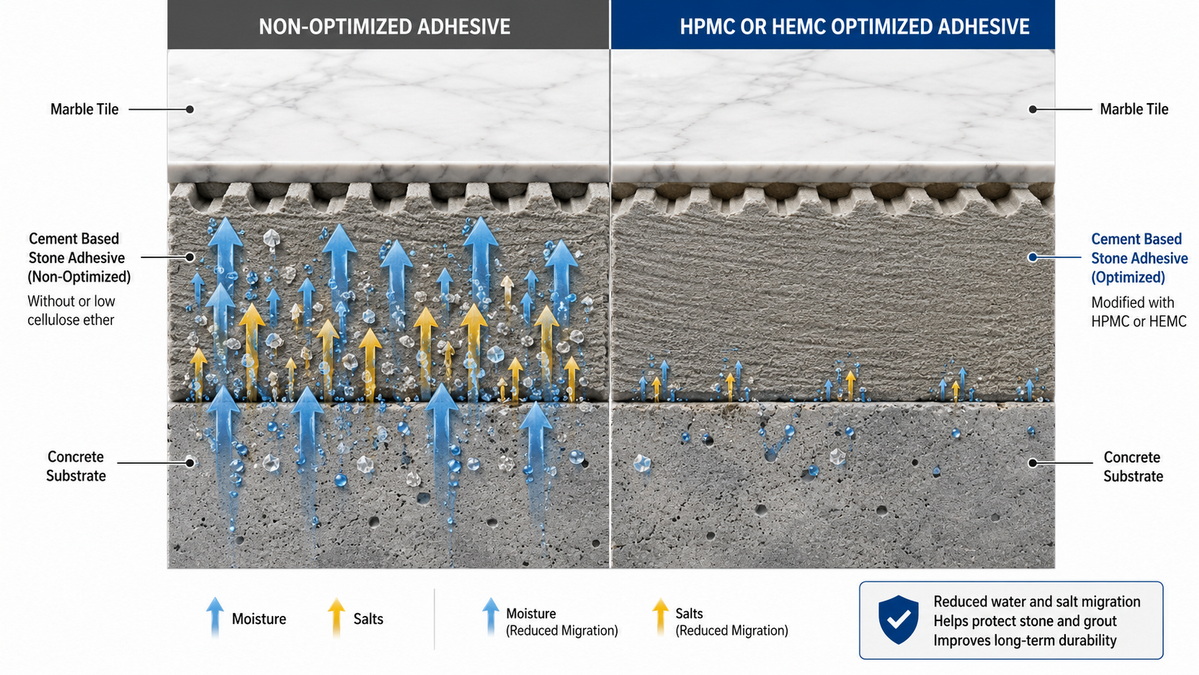
From an expert formulator's viewpoint, HPMC is often the first‑choice backbone polymer when the primary target is efflorescence control on moisture‑sensitive marble. Here is why:
1. Optimized water retention vs. release
- HPMC retains enough water to support cement hydration but does not excessively trap free water at the adhesive–stone interface when correctly dosed. [zh.wikipedia]
- This balanced behavior reduces the amount of water that can transport dissolved salts to the surface.
2. Micro‑pore structure and density
- HPMC helps create a denser, more cohesive cement matrix, especially when combined with optimized grading of sand and fillers. [kemoxcellulose]
- Fewer capillary channels mean lower capillary rise and reduced salt migration.
3. Early strength build‑up
- With the right HPMC grade, you can achieve faster early strength and lower water demand in the adhesive, shortening the time window in which moisture and salts can move. [cn.kdochem]
4. Compatibility with low‑alkali or white cements
- In premium marble projects, white cement or low‑alkali systems are common; HPMC systems are well documented and easier to fine‑tune to these binders. [zh.wikipedia]
As an industry supplier, we see HEMC used strategically in stone adhesive systems for specific conditions:
- Hot, dry climates where extreme evaporation can cause rapid surface drying and poor curing
- Formulations where extended open time is mandatory, for example with very large format marble slabs
- Systems that must maintain workability over longer mixing–application cycles
From an efflorescence perspective:
- HEMC's very strong water retention is valuable when high ambient temperature would otherwise cause premature drying and micro‑cracking, both of which can increase efflorescence risk. [kmxhpmc]
- However, the formulator must carefully control total water content, cement type, and salt sources to avoid leaving too much mobile water in the system.
In practice, many advanced stone adhesive formulations use:
- Pure HPMC systems for standard climates and general marble applications.
- Hybrid HPMC + HEMC systems to fine‑tune water retention and open time in demanding climates.
Drawing on typical practice among leading European and Asian tile adhesive producers, several best‑practice strategies have emerged:
1. Prefer low‑alkali binders and clean aggregates
- Use white or low‑alkali cement and washed sands to minimize soluble salt content. [zh.wikipedia]
2. Optimize cellulose ether selection
- Start with a well‑proven HPMC grade for stone adhesives, then adjust viscosity level to balance anti‑sag with water retention.
- In hot climates, consider adding a small proportion of HEMC to extend open time without pushing total dosage too high.
3. Control total water demand
- Use high‑quality cellulose ethers so you can achieve target workability at lower water‑cement ratios, leaving less free water to carry salts. [kemoxcellulose]
4. Integrate redispersible polymer powders and additives
- Combine HPMC/HEMC with RDP, defoamers, and hydrophobizing agents to tighten pore structure and reduce water pathways.
5. Jobsite application practices
- Avoid soaking substrates with water.
- Respect manufacturer's installation recommendations for back‑buttering and adhesive layer thickness, both of which influence moisture movement in marble.

Imagine a 1,000 m² polished marble lobby in a coastal city:
- The contractor initially uses a generic tile adhesive based on a standard cellulose ether with poorly controlled water retention.
- Within weeks, mild cloudy whitening and salt spots appear along edges of some marble tiles.
After a reformulation and product switch:
- The manufacturer introduces a specialized stone adhesive with a high‑purity HPMC optimized for stone, combined with low‑alkali white cement and selected aggregates.
- Water demand is reduced, and early strength improves.
- Over the next monitoring period, efflorescence complaints drop dramatically, while installers report easier troweling and better wetting of the marble back.
In hotter regions, we see manufacturers go a step further:
- A hybrid HPMC + HEMC system is used to maintain open time under high temperature without over‑wetting the marble, again with strong efflorescence control when total system design is optimized.
From both a manufacturer and applicator perspective, here is a practical decision logic:
- Choose primarily HPMC‑based stone adhesive when:
- You prioritize efflorescence control on high‑value marble.
- Your projects are in moderate climates.
- You want a well‑documented, robust solution with predictable rheology and anti‑sag. [kemoxcellulose]
- Consider HPMC + HEMC systems when:
- Projects are located in hot or very dry climates requiring extended open time.
- Marble tiles are very large format, and installers need longer adjustability.
- Your R&D team can fine‑tune dosages to ensure no excessive moisture retention in the stone adhesive layer. [celotech]
As a cellulose ether partner, we typically recommend starting from an HPMC stone‑grade benchmark, then building variant formulations with HEMC for specific climate or project conditions.
For global mortar producers and stone adhesive brands, partnering with a cellulose ether specialist focused on construction and daily chemical grades unlocks several advantages:
- Tailor‑made HPMC and HEMC grades designed specifically for stone adhesives, not just generic tile adhesives. [kmxhpmc]
- Application‑oriented technical support: lab testing on marble, granite, and other natural stones under different climate profiles.
- Consistent supply and quality control, ensuring stable viscosity and substitution degrees over multiple production lots. [kemoxcellulose]
This level of support helps manufacturers move beyond trial‑and‑error and build data‑driven, high‑margin stone adhesive product lines for premium marble applications.
If you are:
- A stone adhesive manufacturer refining your marble or natural stone product line, or
- A regional brand facing efflorescence complaints on marble projects, or
- An R&D engineer comparing HPMC and HEMC options for new formulations,
then now is the right time to benchmark a dedicated HPMC‑based stone adhesive system and, where needed, evaluate tailored HEMC or hybrid solutions.
Work with a cellulose ether partner that can:
- Provide construction‑grade HPMC and HEMC optimized for stone adhesives.
- Support you with lab‑scale and plant‑scale formulation trials.
- Help translate polymer choices into visible surface quality on marble for your end customers.
1. Does HPMC always prevent efflorescence on marble?
No single additive can "guarantee" zero efflorescence. HPMC significantly reduces risk by improving water retention, curing, and microstructure, but overall performance depends on cement, aggregates, water quality, and jobsite practices. [zh.wikipedia]
2. Can I just replace HPMC with HEMC at the same dosage?
Direct one‑to‑one replacement is not recommended. HEMC has different hydrophilicity and viscosity behavior, so you must adjust dosage, water content, and possibly other additives to maintain workability and minimize efflorescence. [celotech]
3. Which is better for large‑format marble tiles?
In many cases, a well‑designed HPMC‑based system already offers excellent anti‑sag and adhesion. In hot climates or when very long open time is needed, a hybrid HPMC + HEMC approach can provide better handling when properly optimized. [kmxhpmc]
4. Does using white cement eliminate efflorescence?
White cement can reduce visible staining and may have lower alkali, but it does not fully eliminate efflorescence. You still need optimized cellulose ethers, controlled water–cement ratio, and proper site practices. [zh.wikipedia]
5. How should I test my adhesive for efflorescence risk?
Run lab‑scale marble slab tests with controlled curing conditions, measure water absorption and surface appearance over time, and perform comparative trials using different HPMC/HEMC grades and dosages to quantify efflorescence tendency. [kemoxcellulose]
1. Kemox – Hydroxypropyl Methyl Cellulose (HPMC) properties and construction applications. Available at:
https://www.kemoxcellulose.com/zh/%E7%BE%9F%E4%B8%99%E5%9F%BA%E7%94%B2%E5%9F%BA%E7%BA%A4%E7%BB%B4%E7%B4%A0/ [kemoxcellulose]
2. Wikipedia – Hydroxypropyl Methylcellulose: general properties and uses as thickener, binder, stabilizer. Available at:
https://zh.wikipedia.org/zh-hans/%E7%BE%9F%E4%B8%99%E7%94%B2%E7%BA%A4%E7%BB%B4%E7%B4%A0 [zh.wikipedia]
3. Kaimoxing / construction cellulose ether supplier – Product portfolio including HPMC, HEMC, HEC for construction, coating and daily chemicals. Available at:
http://www.kmxhpmc.com/profile.html [kmxhpmc]
4. Celotech – Cellulose ether products for construction applications, including HPMC and HEMC. Available at:
https://www.celotech.cn/what-we-do.html [celotech]
5. Shandong‑based and other Chinese manufacturers' HPMC product pages for construction mortars, tile adhesives and stone adhesives, illustrating water retention and rheology roles. Available at:
https://cn.kdochem.com/products/hydroxypropyl-methyl-cellulose.html [cn.kdochem]


