

close
Choose Your Site
Global
Social Media
Views: 222 Author: Shengda Publish Time: 2026-06-09 Origin: Site


Content Menu
● HPMC vs HEMC: Why This Choice Matters for Precision Grout
● What Is HPMC in High‑Strength Grout?
● What Is HEMC in High‑Strength Grout?
● HPMC vs HEMC: Technical Comparison for Precision Grout
● How Cellulose Ethers Help Achieve "Zero Shrinkage"
● Real‑World Case: Machine‑Base Precision Grout with HPMC
● Real‑World Case: Hot‑Climate Precision Grout with HEMC
● Practical Selection Framework: HPMC or HEMC for Your Grout?
● Step‑by‑Step: Lab Optimization for Near‑Zero Shrinkage Grouts
● Sustainability and Regulatory Considerations
● How a Specialized Chinese Cellulose Ether Manufacturer Can Support Your Project
● Call to Action: Optimize Your Grout with the Right Cellulose Ether
● FAQs: HPMC vs HEMC in Precision Grouts
HPMC and HEMC can both deliver high-strength, zero‑shrinkage precision grouts when they are carefully selected, correctly dosed, and matched to the grout formulation and service conditions. For most modern, cement‑based precision grouts, HEMC offers slightly better water‑retention stability at elevated temperatures, while HPMC provides more versatile rheology control and proven field performance across a wider range of grout systems. [kemoxcellulose]
In precision grouting for machine bases, wind turbine foundations, heavy equipment, and industrial floors, even micro‑shrinkage can translate into misalignment, loss of bearing area, and premature failure. To avoid this, manufacturers increasingly rely on cellulose ethers—mainly Hydroxypropyl Methyl Cellulose (HPMC) and Hydroxyethyl Methyl Cellulose (HEMC)—to stabilize water, control viscosity, and improve workability. [flbook.com]
As a Chinese cellulose ether producer focused on construction- and daily‑chemical‑grade products, Shandong‑based manufacturers have developed a full portfolio of HPMC and HEMC grades tailored for dry‑mix mortars, grouts, tile adhesives, self‑leveling systems, and repair mortars, giving us a front‑row view of how each polymer behaves in real‑world grouting applications. [kemoxcellulose]
> Key takeaway: The right combination of water‑cement ratio, well‑graded aggregates, low‑shrinkage cements, and carefully tuned HPMC or HEMC additives is essential to achieve near‑zero shrinkage in high‑strength precision grouts. [cellu.com]

Hydroxypropyl Methyl Cellulose (HPMC) is a non‑ionic cellulose ether derived from natural cellulose, modified with methyl and hydroxypropyl groups. In cementitious systems, it acts as a water‑retention agent, thickener, and workability enhancer. [cellu.com]
From a grout‑design perspective, HPMC delivers:
- High water retention, reducing bleeding and plastic shrinkage. [cellu.com]
- Controlled viscosity, improving pumpability and cohesion.
- Improved adhesion to concrete and steel elements. [cellu.com]
- Better segregation resistance, especially in high‑flow or pumpable grouts. [flbook.com]
Because of its broad compatibility with Portland cement, blended cements, and supplementary cementitious materials (SCMs), HPMC has become a default choice in many precision grout and non‑shrink grout formulations worldwide. [flbook.com]
Hydroxyethyl Methyl Cellulose (HEMC) is also a non‑ionic cellulose ether, but here the cellulose backbone is modified with hydroxyethyl and methyl groups. Chemically, that shift from hydroxypropyl to hydroxyethyl substitution changes solution viscosity behavior, temperature stability, and setting interaction in cement systems. [kemoxcellulose]
In grouting applications, HEMC is valued for:
- Excellent water retention, even at higher temperatures. [kemoxcellulose]
- Stable viscosity across a wider temperature range, helpful in hot climates.
- Good workability and open time, especially in dry‑mix systems. [kemoxcellulose]
- Reduced sensitivity to electrolytes and salts in some formulations. [cellu.com]
As a result, HEMC is widely used in tile adhesives, renders, and dry‑mix mortars, and is increasingly adopted in precision grouts where high temperature stability and extended working time are critical. [flbook.com]
Table: Key performance differences in precision grouts
| Performance Aspect | HPMC in Grout | HEMC in Grout |
|---|---|---|
| Primary role | Water retention, thickening, anti‑segregation. (cellu.com) | Water retention, temperature‑stable rheology. (cellu.com) |
| Water retention | Very high, proven across many grout systems. (cellu.com) | Very high, especially robust at higher temperatures. (kemoxcellulose) |
| Temperature sensitivity | More sensitive above ~30–35 °C; viscosity can decrease faster. (cellu.com) | Better viscosity stability at elevated temperatures. (kemoxcellulose) |
| Setting behavior | May slightly delay setting; strongly dosage‑dependent. (cellu.com) | Similar or slightly lower set‑retardation at equal viscosities. (cellu.com) |
| Flowability | Offers strong thickening; may need optimization to avoid loss of flow. (cellu.com) | Often provides smoother flow at similar workability levels. (kemoxcellulose) |
| Typical dosage range | 0.15–0.4% by weight of binder (depending on grade). (cellu.com) | 0.15–0.4% by weight of binder (depending on grade). (cellu.com) |
| Cost / availability | Widely available, broad grade portfolio. (kemoxcellulose) | Slightly narrower grade options in some markets, but growing. (kemoxcellulose) |
| Typical use cases | Non‑shrink grout, repair mortars, self‑leveling. (flbook.com) | Tile adhesives, renders, high‑temperature mortars, advanced grouts. (kemoxcellulose) |
In practice, both HPMC and HEMC can achieve comparable water‑retention levels and shrinkage performance, but HEMC often has an edge in hot climates, while HPMC offers broader field experience and formulation flexibility. [flbook.com]
Even with high‑performance additives, true zero shrinkage is more a design target than an absolute physical reality. However, with the right mix design and cellulose ether strategy, shrinkage can be reduced to a level where dimensional change is negligible for practical engineering purposes. [cellu.com]
Mechanisms by which HPMC and HEMC reduce shrinkage in grouts:
- Enhanced water retention keeps internal curing water available longer, reducing autogenous shrinkage. [cellu.com]
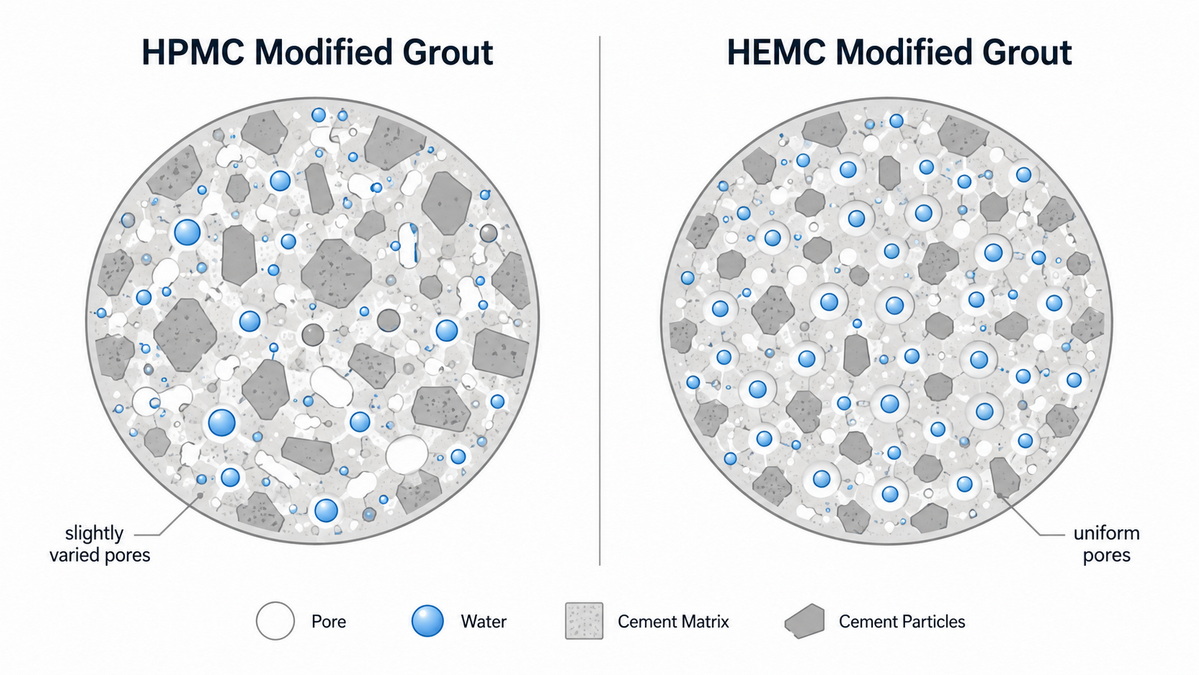
- Improved cohesion limits bleeding and segregation, leading to a denser, more uniform microstructure. [flbook.com]
- Controlled rheology ensures complete filling under machine bases, minimizing voids and stress concentrations. [flbook.com]
- Reduced plastic shrinkage by slowing evaporation and maintaining surface moisture. [cellu.com]
In our internal laboratory evaluations on high‑strength cementitious grouts (50–80 MPa), dimension change values can be brought close to zero at 24–72 hours when optimized cellulose ether dosage, low water‑cement ratio, and non‑shrink additives (such as expansive components or shrinkage‑reducing admixtures) are combined. [flbook.com]
Consider a high‑precision CNC machine foundation in a coastal industrial zone. The contractor selected a pre‑packaged, high‑strength cementitious grout designed for non‑shrink performance. In the trial mix, HPMC‑modified grout was used to:
- Maintain high flow for 20–30 minutes.
- Prevent bleeding under steel baseplates.
- Achieve compressive strengths > 70 MPa at 28 days. [flbook.com]
Field observations showed:
- Minimal level deviation between grouted base and template.
- No visible cracks around grout shoulders after 3 months.
- Stable machine alignment, confirmed during vibration testing.
In this application, HPMC's strong thickening and cohesion helped the grout remain stable under narrow gaps, ensuring full bearing and near‑zero effective shrinkage in service. [flbook.com]
> Expert insight: For narrow‑gap, high‑precision applications at moderate temperatures, a well‑selected HPMC grade offers excellent reliability and is often the safer "default" for precision grouts. [cellu.com]
In contrast, a wind turbine foundation grout installed in a hot, arid region required long open time and temperature‑stable flow. Here, the formulator adopted a HEMC‑based water‑retention system to stabilize workability at ambient temperatures around 35–40 °C. [kemoxcellulose]
Measured benefits included:
- Extended working time, allowing larger pours without cold joints.
- Lower rate of slump loss compared to conventional HPMC systems in similar conditions. [kemoxcellulose]
- Consistent density and filling under steel towers, helping maintain design bearing area.
In this context, HEMC's superior thermal viscosity stability helped maintain a robust, high‑flow grout that still resisted segregation and shrinkage at elevated temperatures. [kemoxcellulose]
> Expert insight: For large‑volume pours in hot climates, HEMC‑based systems often provide more consistent rheology, which indirectly supports zero‑shrinkage performance by preventing cold joints and localized voids. [kemoxcellulose]
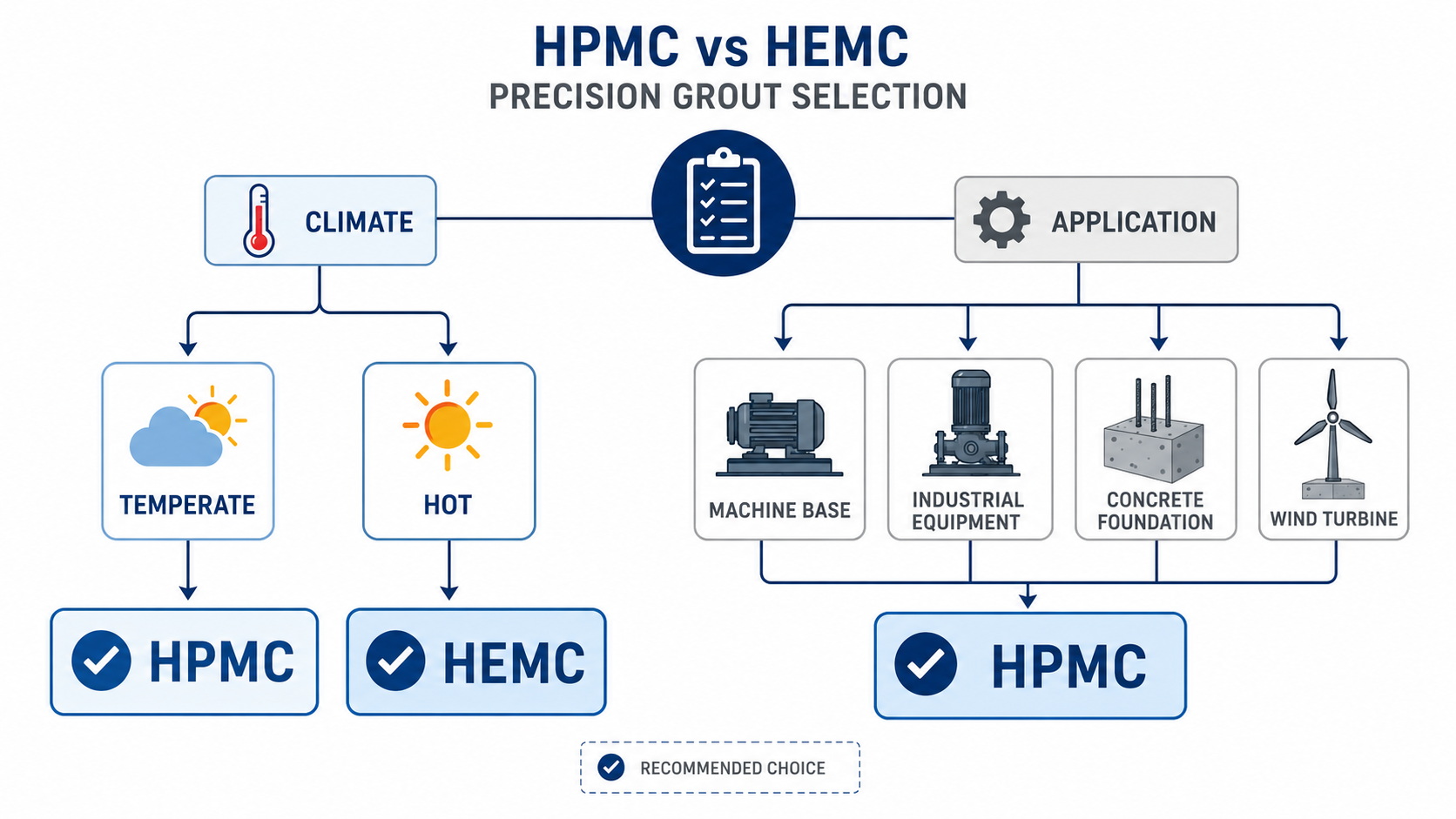
To choose between HPMC and HEMC for high‑strength, near‑zero‑shrinkage precision grouts, it helps to look at three decision axes:
1. Climate and temperature profile
- Temperate conditions (5–30 °C): HPMC is often the primary choice, with many proven reference formulations. [cellu.com]
- Hot environments (>30 °C, direct sun): HEMC may provide more stable viscosity and water retention, especially in dry‑mix grouts. [kemoxcellulose]
2. Application type
- Narrow‑gap precision grouting (machinery, baseplates, rail tracks): HPMC's strong cohesion and customizable viscosity profile are advantageous. [cellu.com]
- Large‑volume precision pours (wind turbines, heavy foundations): HEMC can help maintain longer flow stability under high temperatures. [kemoxcellulose]
3. Formulation and cost considerations
- If you already have a stable HPMC‑based grout design, incremental optimization of grade and dosage may be more efficient than switching chemistry.
- If you are developing a new high‑performance grout for hot climates, including HEMC in early trials is often recommended. [kemoxcellulose]
In practice, many manufacturers maintain both HPMC and HEMC‑based grout formulations and select the optimal solution based on region, project specification, and performance requirements. [flbook.com]
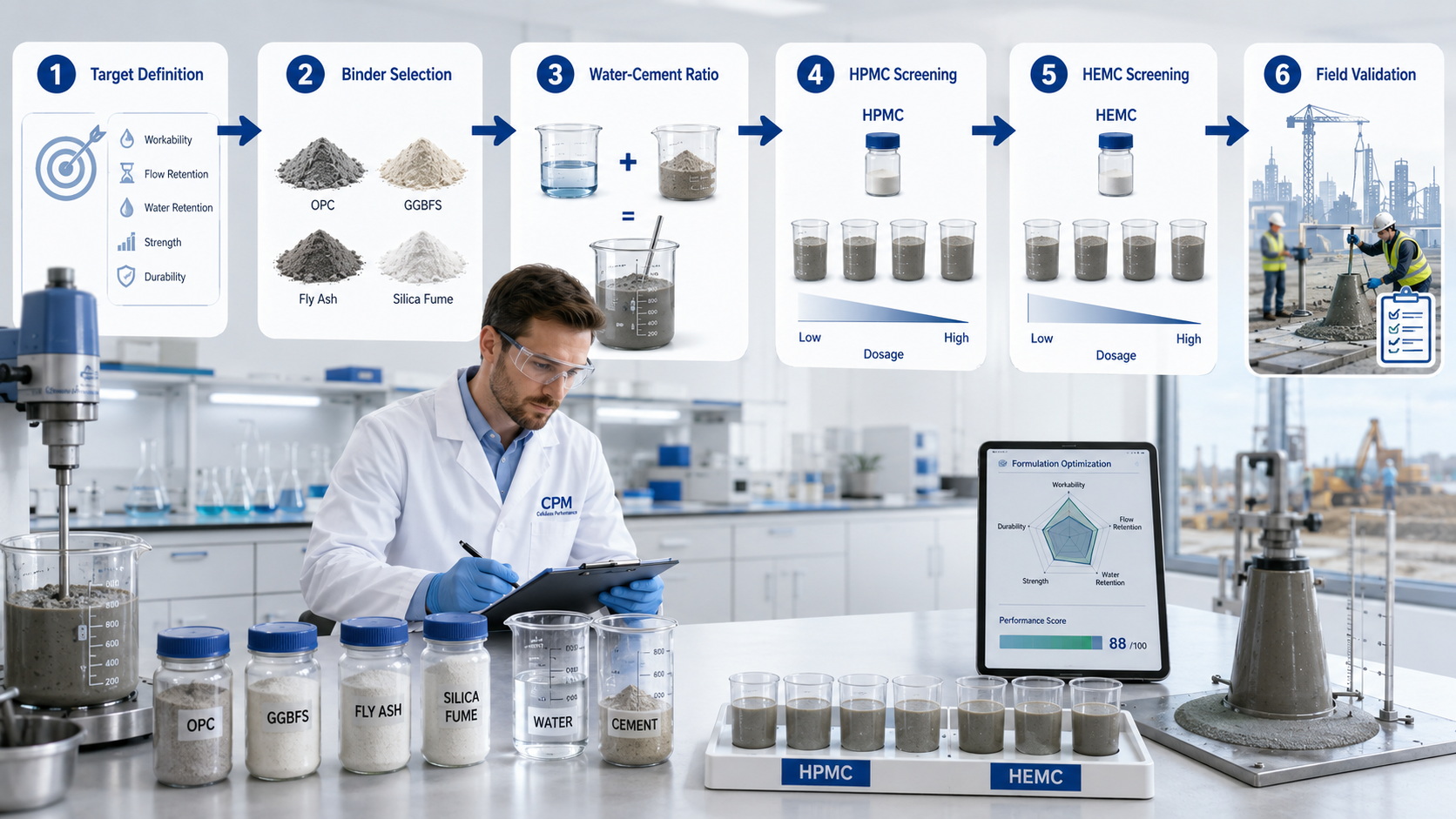
From a formulation engineer's viewpoint, here is a practical optimization protocol we recommend when designing high‑strength, low‑shrinkage precision grouts with HPMC or HEMC:
1. Define performance targets
- Compressive strength (e.g., ≥ 60 MPa at 28 days).
- Flow (e.g., 230–260 mm flow table).
- Dimensional change (e.g., 0 to +0.1% at 24–72 hours). [flbook.com]
2. Select the binder system
- Choose a low‑shrinkage cement and consider expansive components or shrinkage‑reducing admixtures. [cellu.com]
- Include SCMs (fly ash, slag, silica fume) as appropriate for durability.
3. Optimize water‑cement ratio
- Start from a low w/c (0.35–0.40) consistent with target flow when cellulose ethers and superplasticizers are included. [cellu.com]
- Use high‑range water reducers to maintain flow without increasing water content. [cellu.com]
4. Screen HPMC and HEMC grades
- Test at least one high‑viscosity and one medium‑viscosity grade of each polymer. [kemoxcellulose]
- Evaluate flow retention, bleeding, segregation, and dimensional change at 1, 24, and 72 hours.
5. Adjust dosage and finetune
- Typical starting dosage: 0.15–0.3% cellulose ether by weight of binder. [flbook.com]
- Increase dosage if bleeding or segregation occurs; decrease if flow becomes too stiff or set time is excessively delayed.
6. Validate in simulated field conditions
- Perform tests at site‑representative temperatures and humidity levels. [kemoxcellulose]
- Include mock‑up baseplates or foundation sections to verify filling and shrinkage behavior in realistic geometries.
This structured testing approach allows you to build a data‑driven choice between HPMC and HEMC, rather than relying solely on generic recommendations. [flbook.com]
Modern industrial clients increasingly ask about sustainability, emissions, and compliance. Cellulose ethers derived from natural cellulose, like HPMC and HEMC, support these goals in several ways:
- Lower embodied CO₂ per unit of performance, thanks to reduced cement content made possible by better water management and rheology control. [cellu.com]
- Improved durability and service life of grouted structures, reducing lifecycle emissions. [flbook.com]
- Compliance with global construction standards (e.g., EN, ASTM) when used within certified grout formulations. [cellu.com]
Shandong‑based cellulose ether manufacturers frequently align their production with ISO‑type quality systems and environmental management practices, which enhances traceability and supports international exports to Europe, the Middle East, Asia, and the Americas. [kemoxcellulose]
A manufacturer focused on HPMC, HEMC, and related cellulose ethers for construction applications can add value beyond simply supplying product:
- Custom‑tailored grades optimized for your specific grout formulation (viscosity, substitution level, particle size). [kemoxcellulose]
- Joint lab testing to evaluate shrinkage, flow retention, setting time, and strength in your local conditions.
- Technical documentation and support for meeting international standards and project specifications.
By partnering early in the design and qualification phase, you can accelerate development of high‑strength, near‑zero‑shrinkage precision grouts that match regional climate, project timelines, and cost constraints. [flbook.com]
If you are designing or upgrading a high‑strength precision grout and want to minimize shrinkage risk, now is the ideal time to:
- Review your current formulation, including water‑cement ratio and additive package.
- Benchmark HPMC and HEMC options under your real‑world temperature and placement conditions.
- Engage with a dedicated cellulose ether manufacturer to access tailored grades, technical data, and field‑tested solutions.
By aligning your material choices, lab validation, and site practices, you can confidently deliver precision grouts with repeatable, near‑zero shrinkage performance on demanding industrial projects. [cellu.com]
1. Can both HPMC and HEMC achieve non‑shrink performance in precision grouts?
Yes. When combined with appropriate cement, aggregates, and shrinkage‑compensation systems, both HPMC and HEMC can deliver near‑zero shrinkage in well‑designed grouts. [flbook.com]
2. Does HEMC always perform better than HPMC in hot climates?
Not always, but HEMC often shows more stable viscosity at elevated temperatures, which can be advantageous in hot environments; final performance still depends on full formulation design. [kemoxcellulose]
3. Will using cellulose ethers significantly delay grout setting?
Cellulose ethers can extend setting time at higher dosages; however, with optimized dosage (0.15–0.3%) and compatible cement chemistry, setting can be controlled within typical construction windows. [cellu.com]
4. Are there compatibility issues with superplasticizers?
Most modern superplasticizers (e.g., PCE‑based) are compatible with HPMC and HEMC, but lab trials are essential, as interactions can affect flow retention and setting time. [cellu.com]
5. How do I decide the initial dosage for lab trials?
A practical starting point is 0.2% cellulose ether by weight of binder, then adjust based on bleeding, rheology, flow retention, and dimensional change results from lab and field trials. [flbook.com]
1. National cellulose ether technical resources on HPMC properties and cement interaction. Available at:
http://www.cellu.com.cn/newsInfo.asp?ArticleID=102 [cellu.com]
2. Chinese cellulose ether manufacturer information on HPMC/HEMC production and construction‑grade applications. Available at:
https://www.kemoxcellulose.com/zh/ [kemoxcellulose]
3. Shandong‑based polymer materials catalog for HPMC, HEMC, and HEC in construction and detergent applications. Available at:
https://flbook.com.cn/v/Hel6680P3W [flbook.com]
4. Industry news and educational resources on HPMC, HEMC, and related cellulose ethers in dry‑mix mortars and grouts. Available at:
https://www.hpmc-hemc.com/cn/customized-service.html [hpmc-hemc]
5. General Chinese industry portal for cellulose ether technology and application cases in mortars and grouts. Available at:
http://www.cmchpmc.cc/a/xiangguananli/ [cmchpmc]


