


close
Choose Your Site
Global
Social Media
Views: 222 Author: Shengda Publish Time: 2026-09-06 Origin: Site


Content Menu
● Understanding HPMC E5 and HPMC E15
>> HPMC E5
>> HPMC E15
● HPMC E5 vs. E15: Key Differences
● How HPMC Viscosity Affects Formulation Performance
>> Mixing and Hydration Behavior
>> Film Formation and Coating Performance
>> Tablet Matrix and Release Behavior
● Choosing HPMC E5 or E15 for Pharmaceutical Applications
>> Immediate-Release Tablet Film Coating
>> Oral Suspensions and Liquid Dosage Forms
>> Matrix Tablets and Extended-Release Development
● Choosing HPMC E5 or E15 for Personal Care Products
>> When HPMC E5 May Be Preferred
>> When HPMC E15 May Be Preferred
>> Practical Personal Care Example
● Practical Tips for Working With HPMC
>> Use a Controlled Addition Method
>> Allow Enough Hydration Time
>> Control Temperature During Processing
>> Test at the Intended Concentration
>> Check Compatibility With Other Ingredients
>> Compare More Than One Batch
● Quality Factors to Review Before Purchasing HPMC
● Why Application Testing Matters
>> What is the main difference between HPMC E5 and HPMC E15?
>> Can HPMC E5 replace HPMC E15?
>> Is HPMC E5 suitable for tablet coating?
>> Is HPMC E15 suitable for sustained-release tablets?
>> Which HPMC grade is better for cosmetic creams?
>> How can I prevent HPMC from forming lumps?
>> What should I ask an HPMC manufacturer before purchasing?
Hydroxypropyl Methyl Cellulose is a non-ionic cellulose ether produced through the chemical modification of natural cellulose. The resulting polymer can dissolve or disperse in water under controlled conditions and can provide different functions depending on its substitution level, molecular weight, viscosity grade, concentration, and formulation environment.
HPMC is commonly used because it offers several useful characteristics:
- Good water solubility and hydration behavior
- Film-forming ability
- Thickening and rheology-control performance
- Compatibility with many formulation ingredients
- Stability across a broad range of applications
- Low odor and neutral taste in suitable grades
- Ability to support suspension stability
- Ability to form hydrated gel layers in aqueous environments
- Useful processing properties for coating, granulation, and liquid formulation
In pharmaceutical applications, HPMC is often called hypromellose. It may be used in tablet film coatings, capsule shells, oral suspensions, ophthalmic products, topical systems, controlled-release dosage forms, and other formulations requiring polymer functionality.
In personal care products, HPMC can help create a smooth, stable, consumer-friendly texture in lotions, creams, facial cleansers, shampoos, conditioners, gel products, and other daily chemical formulations.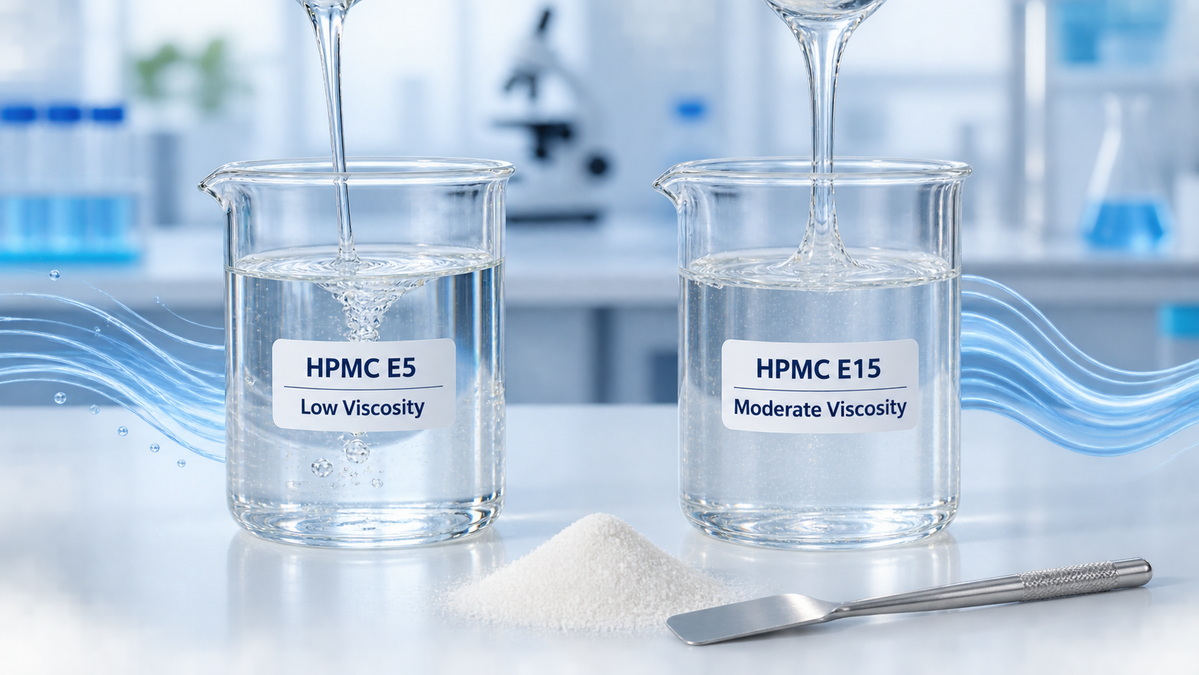
The designations E5 and E15 generally refer to HPMC grades with different nominal viscosity levels. The number is associated with a typical viscosity range measured under specified laboratory conditions.
However, viscosity values must always be interpreted carefully. The actual behavior of an HPMC solution can vary based on several factors:
- Polymer concentration
- Water quality
- Temperature
- Mixing speed
- Shear conditions
- Hydration time
- pH value
- Presence of salts or electrolytes
- Surfactants and emulsifiers
- Other polymers or active ingredients
- The supplier's specified testing method
Therefore, the grade name should be treated as a starting point for material selection rather than a complete guarantee of finished-product performance.
HPMC E5 is commonly regarded as a low-viscosity hypromellose grade. It is often selected when formulators require easy mixing, low solution resistance, good sprayability, and thin film formation.
Because E5 produces relatively low viscosity at comparable concentration levels, it can be suitable for applications where a highly fluid solution is needed.
Typical advantages of HPMC E5 include:
- Lower solution viscosity
- Easier pumping and transfer
- Good sprayability in coating processes
- Smooth and thin film formation
- Suitable processing behavior for low-viscosity systems
- Lower resistance during mixing
- Potentially faster handling in certain liquid applications
- Useful texture control for lightweight formulations
HPMC E5 is often evaluated for immediate-release tablet film coating, light personal care emulsions, fluid serums, low-viscosity topical products, and systems where excessive thickening is undesirable.
HPMC E15 is generally considered a moderate-viscosity grade. Compared with E5, E15 creates more solution body and can contribute to a more structured formulation.
This grade may be useful when a product requires greater viscosity, improved suspension support, enhanced texture, stronger film structure, or a more substantial hydrated polymer network.
Typical advantages of HPMC E15 include:
- Greater viscosity build
- More structured liquid formulations
- Improved body in creams and gels
- Potentially stronger film formation
- Better support for certain suspension systems
- More noticeable rheology modification
- Useful contribution to hydrated gel systems
- Increased formulation stability in some applications
HPMC E15 may be evaluated for tablet coating systems, topical creams, gel creams, personal care products, oral suspensions, and selected matrix tablet formulations.
The main difference between HPMC E5 and HPMC E15 is viscosity. However, viscosity affects much more than the thickness of a liquid. It can influence how the material hydrates, how easily it mixes, how a coating solution sprays, how a tablet film dries, how a cosmetic product feels on the skin, and how a polymer matrix behaves in contact with water.
| Property | HPMC E5 | HPMC E15 | Practical Effect |
|---|---|---|---|
| Nominal viscosity | Approximately 5 mPa·s | Approximately 15 mPa·s | E15 generally creates more viscosity than E5 under comparable test conditions |
| Solution flow | More fluid | More structured | E5 is often easier to pump, spray, and transfer |
| Mixing resistance | Lower | Higher | E15 may require more attention to mixing conditions |
| Film thickness potential | Lower | Higher | E15 may contribute to a more substantial film at the same concentration |
| Spray coating suitability | Often favorable for low-viscosity coating systems | May need viscosity optimization | E5 can offer easier atomization in some processes |
| Texture in personal care | Light and fluid | Richer and more structured | E15 may provide more body in creams and gels |
| Suspension support | Limited compared with E15 | Greater potential support | E15 may be preferred when more structure is needed |
| Matrix contribution | Lower | Higher | E15 may offer more polymer network development in hydrated systems |
| Best starting point | Thin coatings and fluid products | Structured coatings, creams, gels, and selected tablets | Final selection requires application testing |
HPMC requires proper dispersion and hydration to achieve a uniform solution. If HPMC powder is added too quickly to water, the outside of the powder particles may hydrate rapidly and form lumps. These lumps can trap dry powder inside and make full hydration more difficult.
Both E5 and E15 should be added gradually under controlled mixing conditions. The mixing procedure should be designed based on batch size, equipment type, water temperature, polymer concentration, and final application.
A typical hydration process may include the following steps:
1. Prepare the main water phase under controlled agitation.
2. Add HPMC slowly to prevent powder agglomeration.
3. Maintain appropriate stirring until the powder is uniformly dispersed.
4. Allow sufficient time for complete hydration.
5. Adjust the formulation with other ingredients after the HPMC solution is stable.
6. Remove air bubbles if the final product requires a smooth appearance.
E5 is often easier to handle in low-viscosity systems because it produces less resistance during mixing. E15 can require a more controlled process when used at higher concentrations because the solution becomes more structured as hydration proceeds.
HPMC is widely used as a film-forming polymer in tablet coating. The coating film can improve appearance, reduce dusting, support color identification, protect sensitive ingredients, improve swallowing, and contribute to a more professional finished-product presentation.
HPMC E5 is often suitable for thin-film coating systems because its lower viscosity can support convenient spraying and smooth surface coverage. It may help create a uniform coating without excessively increasing the viscosity of the coating suspension.
HPMC E15 can offer a different balance of film body and solution viscosity. It may be considered where the coating formulation needs more polymer structure or where the manufacturer wants to adjust coating solids, film thickness, or mechanical performance.
Film coating performance depends on more than the polymer grade. Important variables include:
- Tablet core hardness
- Tablet friability
- Coating solids content
- Spray rate
- Atomization pressure
- Nozzle design
- Pan speed
- Inlet-air temperature
- Exhaust-air conditions
- Bed temperature
- Plasticizer selection
- Pigment and opacifier loading
- Drying efficiency
- Coating weight gain
A coating system that is too thin may not provide sufficient coverage. A coating system that is too viscous may cause spray difficulties, poor atomization, uneven coverage, or longer drying times. The goal is to establish a stable processing window rather than simply using the highest possible viscosity grade.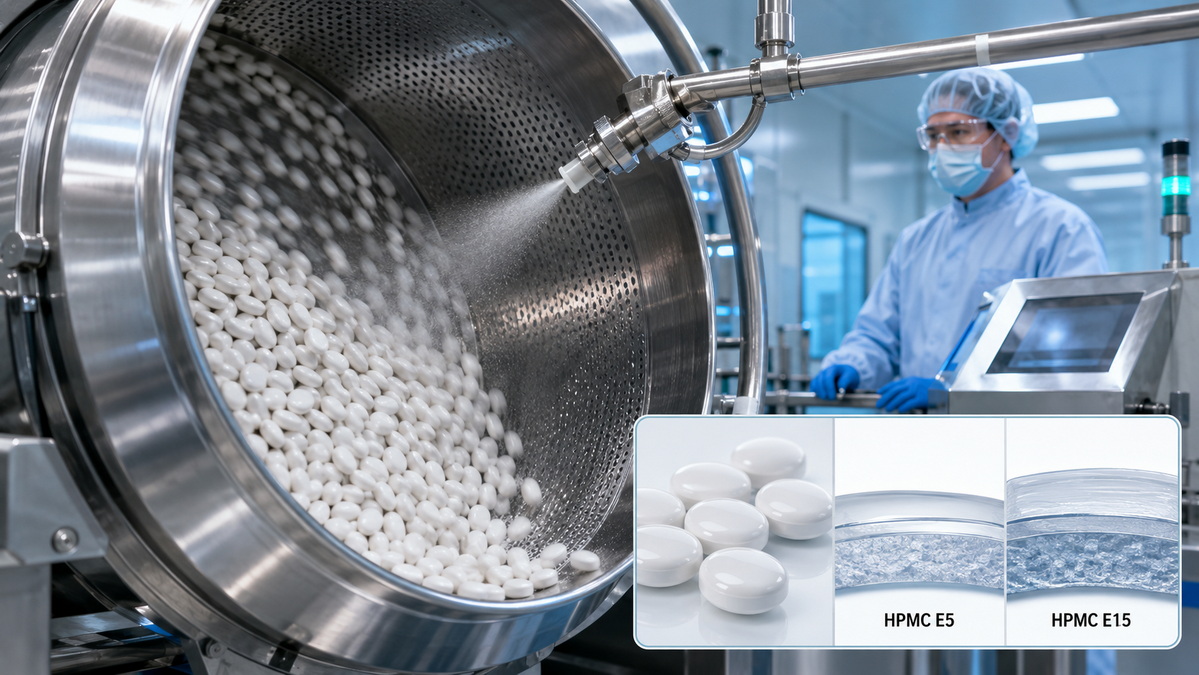
In oral dosage forms, HPMC can form a hydrated gel layer after contact with water. This gel layer may affect how water enters the tablet and how the active ingredient is released from the dosage form.
Compared with E5, HPMC E15 generally has greater potential to contribute to viscosity development and polymer network formation. For this reason, it may be considered in selected matrix tablet or modified-release development projects.
However, the release rate of a tablet cannot be predicted from the HPMC grade alone. It is influenced by:
- Drug solubility
- Drug loading
- Particle size
- Tablet shape
- Tablet surface area
- Compression force
- Tablet porosity
- Polymer concentration
- Additional excipients
- Dissolution medium
- pH conditions
- Agitation speed
- Storage conditions
For example, a highly soluble active ingredient may diffuse through a hydrated polymer matrix more quickly than a poorly soluble active ingredient. Two tablets using the same HPMC E15 grade may still show different release profiles if their active ingredients, tablet dimensions, and compression conditions are different.
For this reason, formulation development should include systematic dissolution testing rather than relying on theoretical assumptions.
HPMC E5 is often a practical starting point for immediate-release film coating applications. Its low viscosity can help formulators prepare coating liquids with good sprayability and manageable processing characteristics.
It may be especially useful when the primary purpose of the coating is:
- Color and visual identification
- Improved tablet appearance
- Reduced dusting
- Easier swallowing
- Surface protection
- Taste masking support
- Branding and product differentiation
E15 may also be evaluated in tablet coating when the formulation requires additional film body, different rheological behavior, or a modified balance between solution viscosity and coating solids.
The final coating grade should be selected after evaluating coating uniformity, adhesion, appearance, disintegration behavior, dissolution behavior, mechanical resistance, and stability.
For oral suspensions and liquid formulations, HPMC can help improve the distribution of insoluble particles and reduce visible settling. The correct viscosity level is important because a formulation that is too thin may allow particles to settle rapidly, while a formulation that is too thick may become difficult to pour, fill, or dose.
E5 may be used when a lower-viscosity system is desired. E15 may be more suitable when additional body and suspension support are needed.
The final decision should consider:
- Desired pourability
- Sedimentation behavior
- Redispersibility
- Mouthfeel
- Bottle filling performance
- Dosing accuracy
- Compatibility with sweeteners and flavors
- Stability during storage
E15 may provide more useful matrix contribution than E5 in some tablet systems. However, manufacturers should not assume that E15 will automatically produce an extended-release product.
A controlled-release formulation is created through the interaction of multiple variables. Depending on the target release time, formulators may need to evaluate higher-viscosity HPMC grades, polymer blends, hydrophobic excipients, pore-forming agents, or coating technologies.
A reliable development process should include:
1. Define the target release profile.
2. Screen several HPMC grades and polymer concentrations.
3. Prepare pilot-scale tablet batches.
4. Conduct dissolution testing under appropriate conditions.
5. Compare results against the target release profile.
6. Optimize tablet hardness, compression force, and excipient composition.
7. Conduct stability testing after the final formula is selected.
HPMC is used in many daily chemical and personal care formulations because it can influence texture, flow, stability, and consumer sensory experience.
HPMC E5 may be suitable for products that need a lighter, more fluid profile, including:
- Facial serums
- Light lotions
- Sprayable skin-care products
- Fluid emulsions
- Cleansing systems
- Shampoo formulations
- Lightweight hair-care products
- Low-viscosity gel products
A low-viscosity grade can help maintain a fresh, fast-spreading feel. It may also support processing where easy pumping and filling are important.
HPMC E15 may be more suitable for products requiring more texture, body, or stability, including:
- Body creams
- Gel creams
- Moisturizing lotions
- Hair masks
- Structured skin-care products
- Suspension-based cosmetic products
- Rich hand creams
- Products requiring a more substantial sensory profile
A higher-viscosity grade can help create a richer product feel. However, the final sensory result depends on the complete formula, including emulsifiers, oils, waxes, humectants, surfactants, salts, active ingredients, and fragrance components.
A lightweight facial lotion may begin development with HPMC E5 because the product requires good spreadability, low resistance during pumping, and a fluid consumer experience.
A moisturizing body cream may evaluate HPMC E15 when the goal is a more structured texture, reduced phase separation risk, and a fuller skin feel.
In both cases, developers should test the finished formula under different storage conditions. Viscosity, appearance, odor, color, pH, stability, and microbial protection should be evaluated before finalizing the grade selection.
Do not add a large quantity of HPMC powder into water all at once. Gradual addition under suitable agitation helps reduce clumping and improves hydration consistency.
HPMC does not always reach its final viscosity immediately after mixing. Give the polymer enough time to fully hydrate before making final viscosity adjustments or evaluating the formulation.
Temperature can affect HPMC dispersion, hydration, and viscosity measurement. Maintain consistent process conditions when comparing laboratory batches.
A viscosity value measured at one concentration may not predict finished-product performance at another concentration. Test HPMC at the concentration that reflects the actual formula whenever possible.
Salts, surfactants, solvents, acids, alkalis, pigments, preservatives, fragrance oils, and active ingredients may affect the behavior of HPMC. Compatibility testing is essential.
For commercial production, evaluate batch-to-batch consistency. A reliable supplier should provide clear specifications, traceability, and quality documentation.
When selecting an HPMC E5 or E15 supplier, purchasing teams should look beyond the stated viscosity grade. A comprehensive review can reduce formulation risk and improve long-term supply consistency.
Important documents and quality points include:
- Technical data sheet
- Certificate of analysis
- Safety data sheet
- Viscosity specification and test method
- Appearance and color requirements
- Moisture content
- pH range
- Ash content
- Particle size
- Bulk density
- Microbiological limits, where applicable
- Heavy-metal information, where applicable
- Storage instructions
- Packaging format
- Shelf-life statement
- Lot traceability
- Change-control process
- Regulatory and compliance declarations for the intended market
For pharmaceutical and high-value personal care products, consistent quality documentation is especially important. The supplier should be able to communicate clearly about product specifications, batch history, packaging protection, and material handling requirements.
The most suitable HPMC grade cannot be selected only from a catalogue. HPMC E5 and HPMC E15 may perform differently depending on the formula, equipment, manufacturing scale, and intended market.
A laboratory-grade evaluation should include practical tests that reflect production conditions.
For a tablet coating project, this may include:
- Coating solution preparation time
- Solution viscosity
- Spray performance
- Coating uniformity
- Surface appearance
- Film adhesion
- Tablet weight gain
- Disintegration time
- Dissolution profile
- Stability after storage
For a cosmetic product, evaluation may include:
- Viscosity development
- Texture and sensory profile
- Emulsion stability
- Centrifugal stability
- Freeze-thaw stability
- High-temperature stability
- pH stability
- Filling performance
- Consumer application feel
For industrial or daily chemical systems, factors such as water retention, workability, suspension behavior, compatibility, and storage stability should also be evaluated.
HPMC E5 and HPMC E15 are valuable hypromellose grades for pharmaceutical, personal care, and other formulation applications. HPMC E5 is generally better suited to low-viscosity systems, fluid products, thin coating films, and processes requiring easy pumping or spraying. HPMC E15 offers more viscosity build and may be more suitable for structured formulations, richer textures, stronger film development, suspension support, and selected tablet matrix systems.
The final choice should be based on formulation trials, processing conditions, target product performance, quality standards, and application-specific testing. A well-matched HPMC grade can improve manufacturing efficiency, support product stability, enhance appearance and texture, and help create a more consistent finished product.
Shandong Shengda New Material Co., Ltd. focuses on the research, development, production, and supply of HPMC and other cellulose ether products. The company provides building-grade and daily-chemical-grade cellulose solutions designed to support global customers with stable quality, practical technical communication, and dependable material selection for different formulation needs.
For product specifications, sample evaluation, technical documentation, and grade-selection support, Shandong Shengda New Material Co., Ltd. is prepared to assist customers in identifying an HPMC solution suited to their target application.
The main difference is nominal viscosity. HPMC E5 is generally a lower-viscosity grade, while HPMC E15 provides a higher level of viscosity build. This difference can affect mixing, coating performance, film formation, texture, suspension stability, and matrix behavior.
HPMC E5 should not automatically replace HPMC E15. E5 may produce a thinner and more fluid solution, while E15 may create more structure and viscosity. Any substitution should be confirmed through formulation trials and finished-product testing.
Yes. HPMC E5 is often used in low-viscosity film-coating systems because it can provide good sprayability and smooth film formation. The final coating result depends on the full coating formula, tablet core, equipment, and process conditions.
HPMC E15 may be evaluated for selected matrix tablet applications because it can provide more viscosity and gel formation than E5. However, sustained-release performance depends on polymer concentration, active ingredient properties, tablet design, excipients, and dissolution conditions.
HPMC E15 may be preferred when a cream requires more body, texture, or formulation structure. HPMC E5 may be better for lighter lotions, fluid emulsions, and products that require a less viscous feel.
Add HPMC gradually under controlled agitation, use an appropriate dispersion method, and allow enough time for complete hydration. Avoid adding large amounts of dry powder directly into water without sufficient mixing.
Request a technical data sheet, certificate of analysis, safety data sheet, viscosity specifications, testing method, particle-size information, packaging details, storage conditions, shelf life, traceability information, and relevant compliance documentation.
1. Kima Chemical. "[Understanding the Different Grades of HPMC: A Comparison of E5 and E15]."
2. United States Pharmacopeia. "[Hypromellose]."
3. United States Pharmacopeia. "[Hypromellose: Pharmacopeial Discussion Group Harmonization]."
4. U.S. Pharmacopeia–National Formulary Archive. "[Hypromellose Monograph and Viscosity Determination]."
5. Vlad, R. A., et al. "[Hydroxypropyl Methylcellulose—A Key Excipient in Pharmaceutical Formulations]."
6. U.S. Food and Drug Administration. "[Inactive Ingredient Database]."
7. European Commission. "[Hydroxypropyl Methyl Cellulose Food Additive Information]."


